NICOLA PISANO

NICHOLAS PISANO. – Sculptor, son of Pietro, born probably in Apulia around 1220, died between 1278 and 1284; in documents he is referred to as *Nicolao de Pisis, Nichole de Pisis, Nichola Petri de Apulia, Nicola de Apulia* and *Magister Nichola Pisanus filius quondam Petri*.

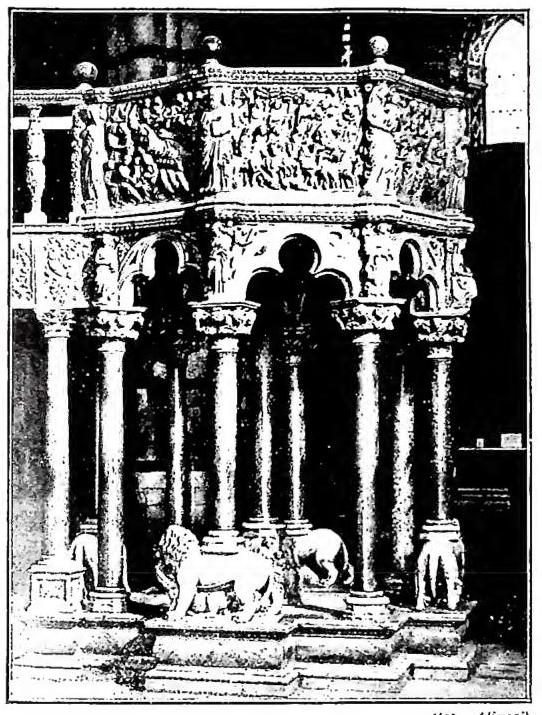
In 1260 he completed and signed the pulpit of the Pisa Baptistery; between 1264 and 1265 he was perhaps in Bologna, then between 1265 and 1269 he was in Siena in the company of numerous collaborators, including his son Giovanni and Arnolfo di Cambio, working on the pulpit of that cathedral; between 1272 and 1273 he was in Pistoia to remake the altar in the chapel of the Apostle in the church of S. Jacopo; around 1278 he was in Perugia for the work on the fountain with his son Giovanni, who signed the upper basin with his name alone. Of these documented works, only the Pistoia altar has been destroyed, while the Siena pulpit was altered in the 16th century when it was given a new staircase. It may also be supposed that for the Arca of S. Domenico in the church of the Santo in Bologna, N. provided a design or plan.

NICHOLAS PISANO – NICHOLAS I ROMANOV

were to swear loyalty to Nicholas I and, at the head of some military units, joined the insurrection decisively.

It was the first revolt that was not a mere palace conspiracy, but expressed clear discontent with autocracy and presented generic “socialist” demands. The revolt took place on 14 (26) December 1825 and, from the Russian word for December (*dekabr’*), it was called the Decembrist Revolt. This event, closely linked to his coronation, contributed to shaping in Nicholas I a rigidly absolutist attitude, which found practical expression in the struggle against revolution both domestically and internationally. He was a champion of protectionism. During his reign an important monetary reform was carried out. The question of abolishing serfdom long occupied him, though no real solution to the problem was ever reached. As a champion of an economy perhaps not inappropriately called by some historians “pre-capitalist,” he also greatly expanded the railways, thereby contributing to the development of modern capitalism. In foreign policy, Nicholas I was above all a staunch defender of legitimist politics in Europe, without neglecting the Eastern Question. Under his rule, Russian influence continued to push into the Balkans, along with the defense of Christian populations; though he did not ignore Russian interests in those lands or the situation created by the oppression of Christians under the Crescent, in the name of his absolutism he showed marked hesitation in supporting revolutions, even those inspired by Slavic and Christian ideals. In the war of 1853–55 against the Western powers, Russia under Nicholas I revealed its serious internal weaknesses. The Russian intervention of 1849 against the Hungarian Revolution did not suffice to win Austrian gratitude. Domestically, the economic and technical development of the country had not been such as to avoid unpleasant surprises of various kinds during the military campaign. Nicholas I had deluded himself into thinking he could stop revolutionary ideas at the borders of the Russian Empire: but rigid censorship and an intransigent police had not succeeded in preventing those ideas from penetrating the country; indeed, in the absence of a climate of legality, the young intellectual generation absorbed the most radical ideas of the West with fanaticism and extremism. At the dawn of his reign, Nicholas I had suppressed the first revolutionary attempt of modern Russia. By the end of his reign, Russia was defeated and isolated, agitated by unrest and intense fever for change across all social strata, while the first wave of “nihilism” began to sweep across the country. Nicholas I was not lacking in skill and cunning on certain occasions: during the Polish revolt of 1830–31, his policy sought to influence the Pope against the “rebels” in Poland, whom he presented as mere allies of all the other European revolutionaries.

He did everything possible to keep hidden from the Russian public the Pope’s remonstrances regarding the situation of Catholicism in Russian Poland. In other parts of the Empire, too, he opposed Catholicism and the return of schismatics to Catholicism.

BIBL.: M. O. Gersenzon, *Epocha Nikolaija*, I, Moscow 1910; Th. Schiemann, *Geschichte Russlands unter Kaiser N. I.*, 2 vols., Berlin 1908–19; A. Boudou, *Le St-Siège et la Russie, leurs relations diplomatiques au XIXe siècle*, 2 vols., Paris 1922.
Article illustration
NICHOLAS PISANO – Pulpit of the Cathedral – Siena.

general and was involved in the works between 1264 and early 1265. In that case, N. would also have carved some statues now lost that supported the ark itself.

Among other works variously attributed to N. are the two reliefs with the *Deposition* and the *Adoration of the Magi* in the lunette and the architrave of the left door of the Lucca Duomo; some heads and busts from the plastic decoration on the exterior of the Pisa Baptistery, the holy-water stoup of S. Giovanni Fuorcivitas in Pistoia, perhaps the work of Giovanni. To N., following Vasari’s lead, is attributed an architectural activity of which the church of S. Trinita in Florence would be the greatest testimony. Of Apulian origin, N., having arrived in Tuscany while still young around the mid-13th century, seems to revive the classical style with a somewhat archaeological flavor typical of Apulian Romanesque sculpture, in contact with the more lively accents of the distant or Tuscan Etruscan tradition proper to the Romanesque sculpture of Tuscany. However, it is not from his earliest work, the Pisa pulpit, that he shows knowledge of the achievements of Gothic culture, which become more pronounced in the Siena pulpit without this signifying any progress in his artistic development, which instead seems to manifest itself in the reliefs of the Perugia fountain, where there appears almost a rethinking of the tradition of which N. summarizes the language in order to shape it, bending and adapting it to new needs. – See pl. CXVIII.

BIBL.: W. Stechow, *S. V. P. N.*, in *Thieme-Becker, XXVIII*, pp. 101–103; P. Toesca, *S. v.* in *Enc. Ital.*, XXIV, pp. 784–86; G. Nicco Fasola, *N. P.*, Rome 1941, with extensive bibl. and documents.

Emilio Lavagnino