The Archdiocese of FIRENZE. - In Tuscany, Metropolitan (a. 1420). Suffragan dioceses: Borgo S. Sepolcro, Colle Val d'Elsa, Fiesole, Modigliana, Pistoia and Prato, S. Miniato. Seat of the regional Etruscan tribunal.
The diocese extends in the Arno valley from the confluence of the Sieve to near the confluence of the Elsa: it includes part of the Idice and Santerno valleys; the upper Sieve valley (Mugello) and part of its lower valley; part of the Chianti region, the Val di Pesa, part of the Elsa and Bisenzio valleys. It borders the dioceses of Fiesole, Colle Val d'Elsa, Volterra, S. Miniato, Pistoia, Prato, Bologna, Imola, and Modigliana. In 1592, it lost the piviere of Poggibonsi, transferred to Colle Val d'Elsa; in 1785, it acquired several parishes in the Apennines, three from Bologna and one from Imola; in 1795, it gained one through an exchange with Fiesole; in 1916, it ceded twelve to the diocese of Prato. The diocese covers an area of 2,075 square kilometers and has a population of 785,000 inhabitants, of whom 775,000 are Catholic. Urban vicariates: 5, comprising 83 parishes; rural vicariates: 39, comprising 394 parishes. Priests: 598. Male religious houses and convents: 58; female religious houses and convents: 219 (1948). Major seminary (theology), founded by Archbishop Della Gherardessa in 1712; minor seminary (high school and gymnasium), founded by Cardinal Archbishop Dalla Costa in 1938; Firenzuola seminary (gymnasium), founded by Archbishop Martini in 1801. Eugenian Schools, founded by Eugene IV in 1435. The archbishop holds the title of Prince of the Holy Roman Empire by diploma of Charles IV and of Grand Chancellor of the Florentine Theological University. Patron of the city and the ancient Florentine domain: St. John the Baptist. Patrons of the diocese: St. Zanobi, bishop, and St. Antonino, archbishop.
I. HISTORICAL NOTES.
SUMMARY:
I. Civil history
II. Religious history
III. Illustrious figures
IV. Cultural institutions, libraries, archives
V. Archaeology
VI. Art
VII. Abbey of S. Maria.I. CIVIL HISTORY
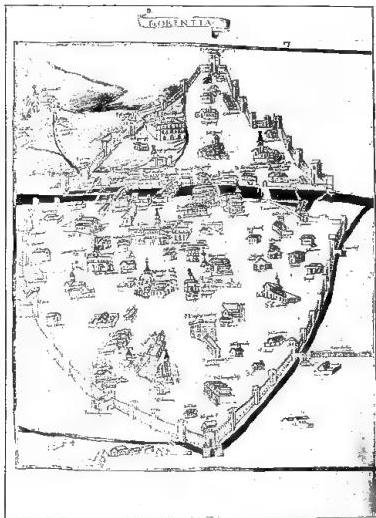
F., Fiorenza, Florentia: perhaps so named from the prosperity of the region or its inhabitants. It is highly uncertain whether a Etruscan city created on the plain by the Fiesolans for the needs of their trade preceded Roman F. Roman F. arose under Caesar as a guard on the Arno, where the Mugnone then flowed into it, near the present Ponte Vecchio; it arose astride the Via Cassia, later restored, which traversed the city from south to north, forming its cardo, traces of which are still recognizable in the streets of Por Santa Maria, Calimala, and Roma, while the decumanus is to be identified with the streets of Corso, degli Speziali, Piazza Vittorio Emanuele, and Via Strozzi. It was a modest fortress of 2000 meters in perimeter, destined to grow in importance, as it became an almost necessary station for officials, legates, and merchants traveling from Rome beyond the Apennines; and because the roads to Faenza, Lucca, and Pisa converged there.FIRENZE, ARCIDIOCESI di - Prospective plan of F. by Giacomo Angelo Fiorentino (1472) - Vatican Library, cod. Urb. lat. 277, f. 130v.
Under the Franks, the margrave of Tuscany also held the office of count of F. The ecclesiastical capitula of 825, issued by King Lothar and known as the Capitulary of Olona, established F. as a center of studies for the Tuscan district, as its location favored attendance at schools even by the poor. Its celebrated teachers later included a Guido, later bishop, a master Pietro, and a legisperitus Nordilone. During the transition from Frankish to Ottonian rule, among the most powerful margraves was Alberto of Tuscany; to diminish the margraves' power, the office of count of F. was separated from theirs. But the margrave who remained most popular among the Florentines was Ugo (the great baron of Dante), who enriched the Florentine territory with many foundations and whose name became surrounded by legend. The margraves Bonifazio and Beatrice followed, whose lordship was reasserted in F. after it had been an imperial city for some time. Meanwhile, the great struggle over investitures between the Pope and the Emperor took shape.
Matilda, the great marchioness of Tuscany, was a strong supporter of the reform and a faithful ally of Gregory VII in the difficult struggle for the freedom of the Church. F. remained ever faithful to Matilda; even when Henry IV entered Tuscany as a victor, touched the walls of F. without capturing it, and Matilda’s power seemed submerged. In 1076, when Gregory VII moved against the Emperor, who would later meet him at Canossa, the Pontiff had been a guest of F.
In the 14th century, internal disputes between the grandi and the popolo, between the popolo grasso and the popolo minuto, continued and intensified. The Duke of Athens took advantage of these divisions to establish a dictatorship but was driven out by popular force.
After the war of the "Eight Saints" fought against the legate of Gregory XI, who threatened F., the struggle between the city's factions flared up more fiercely: thus came the tumult of the Ciompi and the democratic experiment of Michele di Lando, who later ended in exile. But amid this turmoil of alternating events, in which peace seemed forever denied to the Florentine Republic, one family of popular origin, which had grown great and wealthy in trade, began to stand out among others. Hated and opposed by many, it was also struck by exile; but it was soon recalled to the homeland, and its head, Cosimo de' Medici, was proclaimed pater patriae after his death. Lorenzo the Magnificent was, in fact, lord of F. without the institutional forms of a principality. The Pazzi conspiracy did not succeed in overthrowing Medici supremacy. The religious and social movement of Savonarola, which ended with the condemnation of the Dominican, struck at Medici power, but it later revived with Leo X. Under Clement VII, the city was besieged by the imperial army of Charles V and forced to surrender (1530). The Florentine Republic ceased forever, and the principality arose. The first duke of F. was Alessandro de' Medici, assassinated by Lorenzino de' Medici.
Under Cosimo de' Medici, who with extreme rigor
annihilates his enemies and with astute politics consolidates
the power of his house; for him, Pius V elevates Tuscany to a grand duchy,
not without the protests of rival powers against Cosimo. The Medici dynasty, thus established, rules
in Tuscany for over two centuries, until with the death
of Gian Gastone in 1737, the sovereignty of the grand duchy
passes to the House of Lorraine with Francis II. To
him, after a brief period of government held by a
regency, succeeds Peter Leopold I, an absolutist prince,
author of beneficial reforms in the civil sphere,
while others he attempted were far less successful in the religious
field. The city suffered French occupation in 1801 and
in 1807-14. In 1801, by Napoleon's will, the
grand duchy was transformed into the Kingdom of Etruria for the
benefit of Louis of Bourbon, whom the infant
Charles Louis succeeded. It then passed again with the title of
grand duchy to Elisa Baciocchi. The restoration of the
Lorrainers with Ferdinand III was well received by the Florentines
and the Tuscans. But when popular consciousness seemed
ripe for national unity, the Lorrainer dynasty had to
yield, and Leopold II was expelled from Tuscany,
by a peaceful revolution, on 27 April 1859. Florence, together with Tuscany, then became part of the Kingdom of Italy, of which
it was the capital from 1865 to 1871.
II. RELIGIOUS HISTORY
In tracing reliable information about the spread of Christianity in Florence, it is not possible to go back further than the 3rd century. The first name encountered is that of a martyr; during the persecution of Decius, as tradition holds, on 25 October 250, at Minato he was beheaded on the hill overlooking the Arno, where the homonymous basilica later arose. At the beginning of the 4th century, the Christian community of Florence was gathered around its own bishop; indeed, in 313 Bishop Felice participated in Rome under Pope Miltiades in the Synod against the Donatists. However, the population was still largely pagan when, from Easter 393 to August 394, Ambrose of Milan sojourned in Florence and consecrated the basilica of San Lorenzo, then extra moenia, built by a pious woman named Giuliana. That was the first cathedral of Florence, later replaced by Santa Reparata.The oration delivered by St. Ambrose on that occasion is still preserved in his works. Nor is it improbable that it was precisely at Ambrose’s suggestion that the Florentines, bereft of their pastor, elected St. Zanobi to this office, who was present at the victory against the hordes of Radagaisus and is the most distinguished bishop of the Florentine community in the Roman period. According to Florentine annals, this victory should be linked to the introduction of the cult of St. Reparata in Florence, while recent historians consider it imported by the numerous Greek element present in the city in a slightly later period. Among the other earliest pastors, the names of Reparatus, who in 680 attended the Council of Pope Agatho against the Monothelites; Speciosus, bishop in 716; Thomas, who participated in another synod convened by Pope Zachary in 743; Bishop Andrew between 809 and 897; and Bishop Podo in 987 are known.
But religious life in its full fervor is revealed later, when the last remnants of paganism are extinguished, and as the centuries approach the millennium, monastic life also begins to assert and flourish here. Then, while Carolingian domination leaves its mark in the many churches dedicated to St. Martin of Tours, particularly dear to the Franks, monasteries arise everywhere: in the city and outside, on the mountains and in the plains. Moreover, female monasteries must have existed as early as the 6th century, if it is true that Pelagius I ordered the bishop of Florence to confine a sinful woman to a monastery. The monastery of San Miniato existed at least from 774, when Charlemagne donated it to the monastery of Nonantola. In the 9th century, the monasteries of San Donnino near Settimo, San Pietro a Lecore, and San Crisco at Campi already existed. The monastery of Sant’Andrea already existed in Florence, governed with an aristocratic imprint. The Badia is the oldest Benedictine monastery founded within the city walls, which the Margrave Ugo enriched with broad favors; while for him arose the other famous abbeys of Buonsollazzo, Marturi near Poggibonsi, and Verruca near Pisa. Nor was monastic life confined to the cloister; the action emanating from them continually interfered in the civil and political life of the region, which they sometimes even determined.
However, there is no doubt that monasticism assumed a new aspect and was kindled by a fervor of struggle previously unknown when the Apennine slopes closest to Florence knew the cenobitic communities created or reformed by St. Romuald and St. Giovanni Gualberto. The latter is the saint most relevant to the history of Florence, both because of his Florentine origin and because Florence was the center of the militia he created, which took its name from Vallombrosa. The reform sponsored in the Church by the purest and greatest figures, who emerged with it at the second millennium, found broad consensus in Florence, not without opposition. The voices of Peter Damian and Hildebrand resonated beneficially among a significant part of the clergy. Both maintained constant relations with them, aiming at the purification of the clergy from concubinage and simony. The Vallombrosans, from the monasteries of San Salvi and Settimo, waged war against the corrupt clergy with relentless vehemence; hence first the popular opposition against the monks, the nocturnal assault on the monastery of San Salvi, then the uprising against Bishop Pietro Mezzabarba, proclaimed simoniac, and the judicium Dei per ignem of Peter Igneus near the abbey of Settimo, an ordeal from which the monk emerged victorious. But already under Benedict IX, the Florentine Chapter had proceeded with its own reform, imposing common life on its members. Pope Victor II had convened a council in Florence in 1093, attended by the Emperor and many of the most distinguished prelates of Italy and Germany, in which severe sanctions were published against simony and concubinage. His successor was Gerard, bishop of Florence, who took the name of Nicholas II without resigning the spiritual government of the city, and Nicholas II also renewed the condemnation against the clergy infected with concubinage and simony. During his visits to Florence, he consecrated the new church of San Lorenzo, rebuilt on the ancient one.
But the crucial moment of the reformist movement against the clergy fallen from its dignity and forgetful of its ends had now passed. With new orientations in city life, new institutions emerged. In Florence, divided between Guelphs and Ghibellines, the Order of the Servants of Mary carried out its activity, fostering peace among the troubled spirits of their native city. From almost their origins, they were the trusted agents of Florentine Guelphism; when Cardinal Latino brokered peace between the opposing factions, the Servites were appointed custodians of the peace acts. They had their convent near Santa Maria di Cafaggio; later, that church would become the sanctuary of the Santissima Annunziata, a well-known center of Marian piety. Meanwhile, the new Orders of the Dominicans and Franciscans also opened their convents in Florence, and soon had flourishing Studia there. The activity of the Dominicans of Santa Maria (not yet Santa Maria Novella) is to be credited with the victory over the Patarines, who had achieved worrying diffusion in the city. Of all medieval heresies, that of the Patarines managed in particular to organize itself in the city and countryside and to establish a hierarchy presided over by their own bishop; at a certain point, they represented a serious danger not only to the orthodoxy of the city but, given the principles they professed, also to the stability of communal institutions themselves, until they were overcome and defeated, forced to flee, by the Dominican St. Peter Martyr. Against heretics, the communal statutes of 1325 contained condemnations, as they later did explicitly against the Fraticelli. Moreover, the Synod held by Bishop Francesco da Cingoli in 1327 threatened severe sanctions against the Patarines, ordering that the houses where they had conferred their consolamentum be demolished. This was the first diocesan Synod from which emerged a body of constitutions to be observed by clergy and people; however, there is no doubt that other synods had been celebrated before 1327, including one by Bishop Ranieri in 1073 in Santa Reparata, which at that time shared with San Giovanni the honors and prerogatives of the cathedral.
(Int. Alinati)
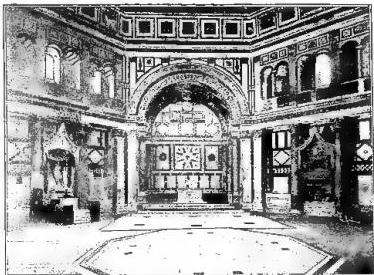
FLORENCE, ARCHDIOCESE of - Interior of the Baptistery (11th century).
Between the 13th and 14th centuries, Florence experienced the most glorious period of its communal fortunes. It was then that faith inspired and substantiated the greatest creations of Florentine genius: the Divine Comedy, a particular expression and vision of a believing citizen; Santa Maria del Fiore, a collective work of the believing populace. Meanwhile, popular piety was sublimated in humble saints from the countryside: Verdiana of Castelfiorentino, Giulia of Cortaldo, Giovanna of Signa, Giovanni of Vespignano. Later, during the rebirth of thought and the national spirit, the city’s convents became beacons of light for Christian Humanism; they provided the Commune with theologians and diplomats. Great was the influence exerted on the culture and political life of the city by Luigi Marsigli from the convent of Santo Spirito; Santo Spirito was frequented by humanists such as Coluccio Salutati, Niccoli, and Tommaso da Sarzana. In the monastery of Santa Maria degli Angeli, the Florentine youth gathered around Ambrogio Traversari: among them were Giannozzo Manetti and Matteo Palmieri. The blessed Giovanni Dominici alternated between his cell in Santa Maria Novella and the chair of the Studium, where he lectured on canon law. But already, Acciaiuoli had founded the Certosa at the gates of Florence, endowing it so that masters and students might reside there. Later arose the convent of San Marco, beloved for the sanctity of Antonino and the pure art of Fra Angelico. The 15th century was truly rich in notable events for the religious history of the city. Martin V received in Florence the obedience of Giovanni XXIII and elevated the city to a metropolitan see (1420). Eugene IV took refuge there in 1434 against the Roman insurrection that had forced him to flee. He carried out a great reform in the Florentine convents, suppressing some and assigning others to different religious orders. He consecrated Santa Maria del Fiore (1436), then completed with Brunelleschi’s dome, and established the Eugenian School for its service and for the Christian-humanistic culture of the clergy; he reformed the statutes of the theological University and even temporarily held the office of Florentine archbishop. But Eugene IV’s name is also linked to Florence because it was in Santa Maria del Fiore that, on 5 July 1439, the great Ecumenical Council of Ferrara-Florence concluded. The Florentine Chapter asked the Pontiff that the plenary indulgence granted by Eugene IV on 25 March, the anniversary of the Cathedral’s consecration, be transferred in memory of the achieved union to 5 July each year. Florence also owes to Eugene IV the appointment of St. Antonino as its archbishop (1446-1501 [V. ANTONINO]). The 15th century closed with the religious-social movement of Savonarola, which originated from the convent of San Marco, founded by St. Antonino.
Disturbances in the religious sphere arose later, under the reforming prince Pietro Leopoldo I. Jansenist tendencies were promoted by the bishop of Pistoia, Scipione de’ Ricci, formerly vicar of the Florentine archbishop Incontri. Disagreements and quite lively polemics arose among the clergy, but there was no deep or heartfelt adherence to Jansenism. The people remained hostile and indifferent to this movement. Regalist tendencies also emerged, which persisted among the clergy until Pietro Leopoldo was succeeded by Ferdinando III, under whom the government’s direction changed. Under Pietro Leopoldo, he had convened an assembly of Tuscan bishops at Palazzo Pitti to prepare for the National Council; however, it yielded no results, thanks in part to Archbishop Martini. Thus, the Council project foundered. During the Napoleonic occupation, there was the episode of Archbishop Eustachio d’Osmond (1810), bishop of Nancy, intruded into this see by Napoleon. He left Florence only with the retreat of French troops. Among the clergy who opposed him, some were deported: among them was Ferdinando Minucci, later archbishop of the city. Among the events of recent decades, the Diocesan Synod celebrated in 1905 by Archbishop Mistrangelo, after more than a century and a half, is worth recalling.
(photo: Aderino)
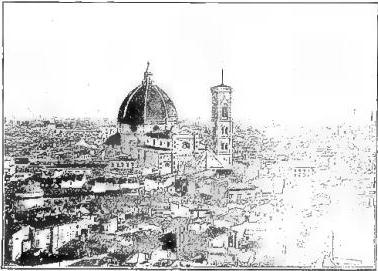
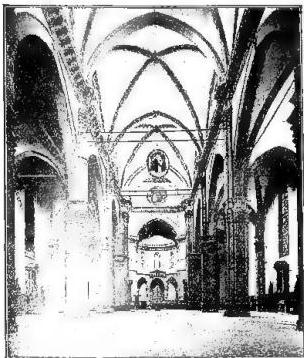
FLORENCE, ARCHDIOCESE of - Interior of Santa Maria del Fiore, by Arnolfo di Cambio and Francesco Talenti (1296-1351).
In 1934, the First Etruscan Council was held in Florence under the presidency of Cardinal Archbishop Elia dalla Costa as pontifical legate, and in 1935, the Diocesan Synod was celebrated, convened by the same archbishop. Another synod was called by Cardinal Archbishop E. dalla Costa for May 1946 and was, like the previous one, celebrated in Santa Maria del Fiore on the 8th and 9th of that month.
G. Villani, Cronica, Firenze 1823; D. Moreni, Continuazione delle memorie istoriche dell’Ambrosiana Imperial Basilica di S. Lorenzo, Firenze 1816-1823; L. Passerini, Genealogia e storia della famiglia Panciatichi, Firenze 1858; G. Richa, Notizie istoriche delle chiese fiorentine, Firenze 1754-1762; R. Davidsohn, Geschichte von Florenz, Berlin 1896-1927; G. degli Azzi, La vita religiosa in Firenze nel sec. XV, Firenze 1904; G. Soranzo, Il papato, l’Europa cristiana e i Tartari, Milano 1930; A. Panella, Storia di Firenze, Firenze 1949; G. Spini, Tra Rinascimento e Riforma, Firenze 1940; L. von Pastor, Storia dei Papi, Roma 1922-1934; F. Tocco, Le eresie del Medio Evo, Firenze 1884; G. Miccoli, Chiesa gregoriana, Firenze 1966; P. Paschini, Storia del Concilio di Firenze, Roma 1965; G. Mollat, Les papes d’Avignon, Paris 1912; A. Gherardi, Statuti della Università e Studio fiorentino, Firenze 1881; C. Guasti, La chiesa fiorentina, Firenze 1889; A. Messeri, L’arcidiocesi di Firenze, Firenze 1902; G. Richa, Notizie istoriche delle chiese fiorentine, Firenze 1754-1762; F. Palermo, I manoscritti palatini di Firenze, Firenze 1860; G. degli Azzi, La vita religiosa in Firenze nel sec. XV, Firenze 1904; G. Spini, Tra Rinascimento e Riforma, Firenze 1940; L. von Pastor, Storia dei Papi, Roma 1922-1934; F. Tocco, Le eresie del Medio Evo, Firenze 1884; G. Miccoli, Chiesa gregoriana, Firenze 1966; P. Paschini, Storia del Concilio di Firenze, Roma 1965.
A. Mercati
III. ILLUSTRIOUS FIGURES
Worthy of mention are: Bishop Gerardo, who became Nicholas II (1059-61); Cardinal Giovanni de' Medici, Leo X (1513-1521); Cardinal Archbishop Giulio de' Medici, Clement VII (1523-34); Cardinal Archbishop Alessandro de' Medici, Leo XI (1605); Cardinal Maffeo Barberini, Urban VIII (1623-44); Cardinal Lorenzo Corsini, Clement XII (1730-40). Equally deserving of remembrance are: Archbishop Francesco Gaetano Incontri, author of works on moral theology; Antonio Martini, translator of the Bible; Eugenio Cecconi, historian of the Councils of Ferrara-F. and the Vatican. During the 15th and 16th centuries, many humanists were canons of S. Reparata: Angelo Poliziano, the poet; Marsilio Ficino, founder of the Platonic Academy; Leonardo Bruni, secretary of the Republic; Gentile da Urbino, lecturer at the Studio; Scipione Ammirato, the historian; Francesco Berni, the poet. Other ecclesiastics who distinguished themselves in the literary republic: Benedetto Varchi, philologist and historian; Benedetto Duommattei, grammarian and Dante scholar; Monsignor Giovanni Della Casa, poet and essayist; Pier Francesco Giambullari, who wrote on history and language; Vincenzo Borghini, scholar of Tuscan and Florentine antiquities; Antonio Francesco Gori, archaeologist and epigraphist; Anton Maria Salvini and Salvino Salvini, of whom the former was most learned in classical languages, the latter wrote on academic subjects and Florentine matters; Giovanni Lami, most erudite, though around whose name many controversies arose in the 18th century. Nor should we forget Cardinal Agostino Bausa, a Dominican, formerly Master of the Sacred Palaces and later Archbishop of F. in the final years of the 19th century.IV. INSTITUTES OF CULTURE, LIBRARIES, ARCHIVES
From the time when the Studio generale was established in Florence by a bull of Clement VI, issued from Avignon on 31 May 1348, and its privileges were confirmed by an imperial diploma of Charles IV, the University of theologians formed the most distinguished part of the Studio itself. The first degree in theology was conferred in 1349 upon Friar Francesco di Biancozzo dei Nerli, amid the unanimous enthusiasm of the Florentines. While the other branches of the Studio, for various reasons—primarily the transfer of certain chairs to Pisa at a given time—ceased their activity and existence, the theological University is the sole academic college that represents the uninterrupted continuity of the Florentine Studio from its origins to the present day. It was granted notable privileges by the popes. It was reformed by Eugene IV; Leo XIII gave it new constitutions. Currently, the Florentine Theological College, following the publication of the apostolic constitution Deus scientiarum Dominus on 24 May 1931, has suspended the conferral of degrees. Of importance: the Chapter Archive of Santa Maria del Fiore for the ancient documents preserved there; the Archive of the Opera of Santa Maria del Fiore for matters concerning the construction of the Duomo; the Archive of the Archiepiscopal Curia; the Archive of the Laurentian Chapter. Notable for the number of its publications, especially from the 17th-18th centuries, is the Library of the Major Seminary, which also houses a section of manuscripts on Florentine subjects.V. ARCHAEOLOGY
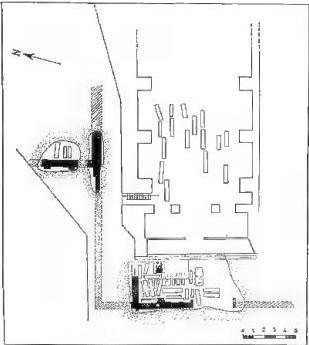
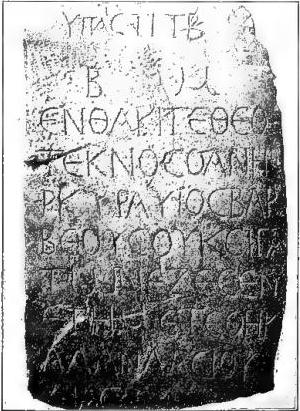
No precise information exists regarding the beginnings of Christianity in Florence; it is nonetheless highly probable, and certain elements seem to confirm it, that its first centre was the Jewish community of Greco-Oriental origin which, as was customary, had settled on the outskirts of the city, near the road that exited the southern gate: immediately south of the Arno, this road divided into two branches, one directed eastward toward Chiusi (the so-called Cassia Nova), the other descending directly southward toward Volterra and Siena. Remains of a cemetery basilica came to light in Florence in 1948 following excavations conducted by the Superintendency of Antiquities in the area of the ancient church of S. Felicita. This basilica had three naves: it measured approximately 26 metres in width and 40 in depth; the central nave was 10 metres wide, the lateral ones 6 and 10 metres. The numerous formae of common type yielded various funerary inscriptions—to which must be added those discovered in the past in this zone—for the earliest of which, dated 405, the construction of the building can be fixed at the end of the 4th century—beginning of the 5th. It is therefore the oldest Christian place of worship whose remains have been found in Florence; among the inscriptions discovered in the area are mentioned a deacon, some readers, and individuals invested with civil and military offices. The title of the church, that of another church located in the same area dedicated to S. Felice, and the cult of S. Lorenzo, to whom the first basilica inside the city was consecrated at the end of the 4th century, prove that the new faith came to Florence, in all likelihood, from Rome, or at least that the Florentine Church must have been in close relations with the Roman Church.A later tradition attributes to the time of the persecution of Decius the martyrdom of S. Miniato, who would then have been buried on the hill overlooking the city: but this is a late tradition and, it seems, of no reliability.
The first certain mention of a Florentine bishop is that left by Optatus of Milevis; among the participants at the Roman Synod of 313 against the Donatists, he names a Felix a Florentia Tuscorum: whether this was the first bishop of the city cannot be affirmed with certainty. In 393 Ambrose was in Florence, where he consecrated the church dedicated to S. Lorenzo, founded by a pious matron Giuliana: a fragment of an inscription found in the underground may perhaps belong to the generous donor. In this same period lived and governed the Florentine Church S. Zenobius, who died, it seems, in 417.
In addition to the materials found near the church of S. Felicita, some seals discovered in Borgo SS. Apostoli should be mentioned, as well as a sarcophagus, unearthed in the bed of the Arno near the Ponte della Vittoria in 1933: datable to the 4th century, it depicts scenes not among the most common: the farewell of the Apostles to Jesus, the resurrection of Jairus’ daughter, and the refusal by the three young men to worship the statue of Nebuchadnezzar.
a man collects the water in a bowl. The other is the celebrated lamp of the Valerii, found near the house of this noble family on the Caelian. It has the shape of a ship: one figure, in whom S. Peter or the Redeemer himself was recognised, holds the tiller, another in the attitude of the orans stands at the prow and is perhaps S. Paul: the interpretation, however, is much debated. Attached to the mast, which supports the sail, is a tablet with the inscription: « Dominus legem dat Valerio Severo. Eutropi vivas ». Its most probable date is the 4th century.
---
FIRENZE, ARCIDIOCESI di — Plan of the remains of the early Christian basilica in relation to the present church of S. Felicita.
VI. ART
From the late thirteenth century until the early sixteenth, Florence was the most vibrant center of artistic culture in all of Italy.In architecture, the Romanesque style did not bring the characteristic Lombard forms to Tuscany; only certain elements of them took root: Florentine Romanesque churches, in fact, continued the basilical forms, as seen in the church of the SS. Apostoli and in S. Jacopo Soprarno, while the Baptistery so closely repeats ancient forms that it was believed by fourteenth-century men to be a work of the classical period. Similar characteristics are found in S. Miniato al Monte and the Badia Fiesolana, in which churches dichromy is a peculiar feature.
(by courtesy of Dr. G. Maetzke)
FIRENZE, ARCIDIOCESI di - Inscription of Theotelinos dated 405 found in the basilica beneath S. Felicita.
The Gothic style, which created two masterpieces in S. Maria Novella and S. Croce, nevertheless seems to remain on the surface of elements without penetrating the organism of construction: the Loggia dei Lanzi, with its three round arches, already foreshadows the Renaissance; while the Cathedral, in whose interior the balcony in the central nave appears to restrain the ascensional thrust of Gothic lines, has a dome as its crowning feature; Giotto’s bell tower is Gothic only in its details.
At the beginning of the fifteenth century, the new architecture arose in Florence BRUNELLESCHI, FILIPPO (v.). To explain the reappearance of the classical spirit in it, there is no need to accept Vasari’s account of Brunelleschi’s journey to Rome with Donatello, for in Florence Brunelleschi could find classical inspiration in the Romanesque monuments, all imbued with the ancient spirit. Brunelleschi, who defined the laws of perspective, represents in this regard the mathematical conception of the Renaissance and provided painters with the most characteristic means of renewing their art, which in the fifteenth century was marked by the conquest of the third dimension.
Brunelleschi’s art spread throughout Tuscany; all Florentine architects, Alberti (v.), educated in the humanist school, proceeded from his premises up to Michelangelo; Michelozzo (v.) in the Convent of S. Marco, Giuliano da S. GALLIONE (v.) in the Madonna delle Carceri in Prato and in S. Maddalena dei Pazzi in Florence, and following the Benedetto da Maiano (v.), Giuliano da Maiano (v.), ROSSELLI, COSIMO (v.), and Il Cronaca.
Michelangelo himself (v.), in the New Sacristy of S. Lorenzo, maintained the scheme of the Old Sacristy, though interpreting it with his particular conception of architecture as masses in motion.
Michelangelo, though he worked almost always in Rome, dominated Florentine architecture of the sixteenth century. In his homeland, the most characteristic architect of the time was Vasari, a Mannerist, elaborator of forms already acquired.
The first sculptor in whom it is possible to recognize the characteristic sharp Arnolfo di Cambio (v.), also architect of S. Reparata, later of S. Maria del Fiore. His sculptural works, however, are found mostly outside Florence, especially in Rome, where they spread among marble workers the elegance and spirituality of Florence.
In the fourteenth century, the Sienese Tino da Camaino (v.) trained numerous pupils in Florence. Andrea da Pontedera (v.), known as Pisano, who came under Giotto’s influence, was commissioned in 1330 with the first door of the Baptistery and later worked on the reliefs of Giotto’s bell tower. From him derives Andrea di Cione, Orcagna (v.), who in 1359 completed the tabernacle of Or S. Michele, a work combining architecture and sculpture.
At the end of the fourteenth century, in the Porta della Mandorla of S. Maria del Fiore, the precursory signs of the Renaissance in sculpture began to appear: realism and the imitation of antiquity (images of pagan deities, sirens, singers, etc.).
The competition held in 1401 for another bronze door of the Baptistery saw Lorenzo Ghiberti emerge as the winner, who, while adhering to the still Gothic scheme of Andrea Pisano, created a personal work through the balance and synthesis of representation. The comparison between this door and the third, which occupied Ghiberti until 1452, shows the evolution accomplished by Florentine sculpture: the Gothic panels with mixed-line frames disappear, giving way to very broad fields; classical niches house statues; the bas-reliefs, competing with painting,
(fot. Alberi)
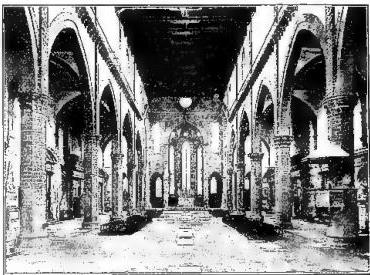
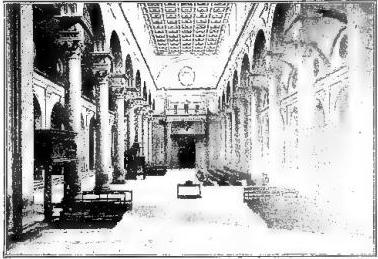
FIRENZE, ARCIDIOCESI di - Interior of the church of S. Croce. Rebuilt by Arnolfo di Cambio (1252).
are animated by numerous figures and present landscapes in the background; with great realism, portraits of various artists of the time are represented in the roundels, along with the sculptor’s self-portrait, and fruits and flowers are reproduced in the decorative festoon. Similarly, pictorial quality and broad perspective dominate in the urn of S. Zanobi and even influence Donatello.
every Gothic residue from sculptures and, without ever imitating it, appears as a continuator of antiquity; the pictorial bas-relief reaches in him, through stiacciato and the skillful gradation of planes, the resolution of the problem of form in motion, which, together with that of volume, Florentine artists continually set for themselves; volumes are attenuated in stiacciato to achieve movement.
Michelozzo (v.) BERTOLDO, SANTO (v.). Around them flourish, variously influenced by him and by Ghiberti, ROSSELLI, COSIMO (v.), Agostino di Duccio (v.), Desiderio da Settignano (v.), Mino da Fiesole (v.), Benedetto da Maiano (v.); the tendency toward the POLLAIOLO, PIERO (v.) Verrocchio (v.), master in painting to Leonardo da Vinci.
Della Robbia (v.) brought to sculpture the singular contribution of their glazed terracottas, a precious ornament of Florentine buildings.
In the sixteenth century, Florentine sculpture showed three tendencies. One, personified by Michelangelo, was followed by Raffaello da Montelupo (v.) Montorsoli (v.); another, which originated with Andrea Sansovino and was developed by Jacopo Sansovino (v.), proposed as its ideal the grace of the fifteenth century united with classical form; a BANDINELLI, BACCIO (v.) and Ammanati (v.), who ended by becoming blinded by Buonarroti.
Even more vigorously than in architecture and sculpture, the Florentine school asserted itself in painting. The Cimabue (v.), who undertook to free it from conventional Byzantine forms and gave it those characteristics that would always distinguish it from all others. According to the intellectualistic conception that Florentines have of reality, drawing dominates in it, which through a functional line suggests the volume of the represented object. Through chiaroscuro, this is then represented as detached from the background with a relief effect.
These characteristics decisively distinguish Florentine painting from the Sienese and Gothic, which instead consider
the line not as a functional element but as an ornamental and calligraphic one, that is, as a mere outline emptied of its content, and arrange the composition entirely on a single plane, without relief. In the Florentine plastic conception, color is subordinate, which for the most part merely fills in the drawing and is always subordinate to the opposition of light and dark necessary for relief: in the Sienese school, on the other hand, color, being limited to surface effects, is clear and brilliant.
All the characteristics of Florentine GIOTTINO (v.), who completely freed it from Byzantine formulas.
Giotto perceives objects as broad and compact masses, organizing the composition of his paintings with an architectural and spatial sense, in the same spirit as architecture, in which the aesthetic effect arises from the contrast between weight and support, and from the sense of volume.
In accordance with the Italian nature, Giotto, in narrating sacred stories, is logical, clear, measured, and convincing.
In the second half of the fourteenth century, an exchange of influences appears—one might almost say a compromise—between the Florentine and Sienese schools. After a brief late Gothic interlude, Lorenzo Monaco (v.), in which an exaggerated linear calligraphy combines with Sienese grace and Florentine vigor, the Renaissance begins.
Masolino (v.), though still tied to the Florentine Gothic current, applies perspective in his paintings, opening vistas of columns in the Banquet of Herod, yet his figures, though set against the backdrop opened by the third dimension, do not participate in the perspectival organism, as later, like true stage flats, they would in the paintings of Piero della Francesca.
Masaccio (v.), who is said to be a pupil of Masolino, renewed painting. From Brunelleschi he learned perspective, from Donatello he derived the sculptural plasticity of his figures. Thus, Masaccio continued Giotto’s work in spirit, renewing his solid plasticity and monumental aspect.
Masaccio’s art, like that of Giotto, had no true successors; his grand synthesis gave way to a realistic trend. ANGELICI (v.), a singular artist still dependent on the tradition of Florentine Gothic, the supreme and unsurpassed interpreter of religious idealism.
A pupil of Angelico but lacking his magical power of spiritualization, GOZZOLI, BENOZZO (v.) represented sacred scenes with great narrative skill, lively gusto, and popular simplicity.
Reality is strongly felt by Andrea del Castagno (v.), in whom the plastic tendency of Florentine painting becomes ever more pronounced, to the point of giving figures the character of wooden sculptures with violently marked and agitated contours to convey movement—another hallmark of Florentine art.
The rules of the rediscovered perspective are passionately followed by Paolo di Dono, Paolo Uccello (v.), who makes distant objects visible, softens the relief of bodies, and ultimately achieves effects of inlay through the juxtaposition of color zones. To avoid disturbing the perspectival vision, movement halts, and his static battles appear to us in an unreal stylization. Yet he also possesses tragic sentiment and heroic grandeur, as seen in the Universal Deluge in the cloister of Santa Maria Novella.
Piero della Francesca (v.) elevates perspective to the level of a true scientific discipline, successfully posing and resolving problems of linear and aerial perspective, managing to convey the sense of air and light vibrating around objects. His compositions are true architectures; his figures possess a vivid sense of volume achieved through a skillful gradation of color tones. Piero understood that perspective was the only means to unite drawing and color without falling into the pitfalls that ensnared the Florentines and Sienese.
Alongside the pursuit of form, the pursuit of movement develops in Florentine painting (as in sculpture), which, alongside Andrea del Castagno, finds its POLLAIOLO, PIERO (v.) BOTTICHER, PAUL (v.), who achieve it through the line that continuously animates form.
In the sixteenth century, Florentine painting is personified by Michelangelo, who, as architect, sculptor, and painter, pushes to their extreme limits all the characteristic elements of the school, especially form and movement. In him, form becomes more than volume—it becomes mass, and gigantic blocks opposed to one another in perpetual struggle and perpetual motion are all his works.
With him, Florentine art moves to Rome, so that Florence loses its primacy, and its school is no more than a provincial one.
Vincenzo Gobio
---
FIRENZE, ARCHBISHOPS of - Interior of the church of San Lorenzo seen from the high altar. Rebuilt in 1423, based on a design by Brunelleschi.
VII. - BADIA DI S. MARIA. - A celebrated monastery, commonly known as the Badia, founded by Willa, daughter of Marquis Boniface. After Willa’s death, her son Ugo confirmed and increased his mother’s donations to such an extent that he was considered the monastery’s founder. Following his death on 21 December 1001, the monks commemorated his anniversary each year, as Dante recalls in the Paradiso (XVI, 128-29), speaking of “the great baron, whose name and renown – the feast of Thomas still renews”; Dante’s own house stood near this monastery, to which he alludes again with the verses: “Florence, within the ancient circle – whence she still takes tierce and nones” (Par., XV, 97-98). In 1436, it was united with the Congregation of S. Giustina. Suppressed in 1810, it was reestablished in 1819 with only a minimal portion of its former possessions. After the new suppression of 1806, the monks remained in a few rooms, continuing to care for the parish until 1919. The premises had been converted into schools and judicial offices.
The monastery was rich in men distinguished for holiness and learning: among them were d. Borghini (v.), d. Agostino Rabatta, Bishop d. Galletti (v.), and Cardinal d. Angelo M. Querini; under the guidance of the Badia’s monks, G. B. Niccolini pursued his studies.
The present church was erected in 1625 by Segaloni on the foundations laid by Arnolfo di Lapo (13th century), to whom the fine bell tower is attributed. The portal, sculpted by Benedetto da Rovezzano, has recently been restored. Among the artworks it contains, two tombs sculpted by Mino da Fiesole are particularly notable—one from 1481 houses the remains of Count Ugo—and the celebrated painting by Filippo Lippi depicting the apparition of the Virgin to St. Bernard. The library and its splendid choir books have been partly dispersed; some are now in the Laurenziana and Magliabechiana libraries of Florence, while the documents are held in the State Archives of the same city. -Vedi tavv. XC-XCIII.
II. COUNCIL OF F.
Lasting from 1438 to 1445, the Ecumenical Council of F. is divided into three phases: 1) the conciliar sessions in Ferrara (from 1 January 1438 to 10 January 1439); 2) the conciliar sessions in F., which resulted in the decrees of union with the Greeks, Armenians, and Copts (1439-42); 3) the conciliar sessions in Rome (1443-45). The history of the Council of F. cannot be fully understood without considering the lengthy negotiations between the Holy See and the Greeks under Martin V and Eugene IV (v. the documents indicated in the bibliography).
SUMMARY:
I. Ferrara
II. F
III. Rome
IV. Effects of the Council of F.I. FERRARA (1438-39)
On 8 January 1438, the Blessed Niccolò Albergati solemnly opened the Council in the cathedral of S. Giorgio in Ferrara. Only 4 archbishops and 20 bishops were present, all from Italy, Spain, and France. The Council’s president declared his support for Pope Eugene IV and the legitimacy of transferring the Council from Basel to Ferrara. Seven further conciliar sessions followed, the third of which, on 10 January, promulgated a decree against the synodals of Basel, and the eighth, on 8 February, after the Pope’s arrival (27 January), issued another of the same tenor. The number of participants in the Synod of Ferrara grew; by the same session on 11 February, 5 cardinals, 4 archbishops, and 36 bishops were present. Moreover, on 8 February, the Byzantine Emperor John VIII Palaiologos, Patriarch Joseph II, and about 20 Byzantine bishops arrived in Venice and immediately sent a delegation to Ferrara. The Latin embassy—comprising the bishops Antonio of Porto, Pietro of Digne, Cristoforo of Coron, and Provost Nicholas of Cusa—was able to report to the Council on 1 March regarding the successful conclusion of negotiations in Constantinople, despite the strong opposition faced by the Pope’s envoys from representatives of the recalcitrant synodals of Basel. A pivotal moment came with the arrival in Ferrara (8 March) of Cardinal Cesarini, who no longer wished to serve the cause of the Council of Basel, which was in conflict with the supreme head of the Church. The Greek emperor made his solemn entry into Ferrara on 4 March; the Patriarch of Constantinople followed on the 8th of the same month.A fine representation of the Byzantine Churches accompanied them: the bishops of Heraclea, Ephesus, Sardis, Monemvasia, Trebizond, Cyzicus, Nicaea, Nicomedia, Lacedaemonia, Leabe (Mytilene), Stauropolis, Tirnovo (Bulgaria), Rhodes, Amasia, Silistra (Romania), Melenic (Bulgaria), and Maine (Peloponnese); additionally, a bishop and a protopapas from Moldo-Wallachia (Romania), 2 bishops from Georgia, and later, in mid-August 1438, the metropolitan of Kiev, Isidore, and the bishop of Suzdal. The patriarchs of Alexandria, Antioch, and Jerusalem, as well as the bishops of Caesarea, Side, and Sebaste, were represented by some of the aforementioned bishops and by Gregory Mammas, the emperor’s confessor and future patriarch. Six hegumens, as procurators of Greek monasteries (Arbea, etc.), 4 deacons of Hagia Sophia (sauroforoi), and distinguished laymen, including Demetrius, the emperor’s brother, and George Scholarius, later appointed patriarch, were part of the imperial court and patriarchal curia entourage.
The first solemn joint session of the Latins and Greeks took place in the cathedral of S. Giorgio on 9 April 1438 in the Pope’s presence. An important decree, drafted in Latin and Greek, was promulgated, affirming the ecumenicity of the Council of Ferrara. The second joint session of the Latins and Greeks was held only on 9 October 1438; the delay was due to the participants’ desire to satisfy the Byzantine emperor’s insistence that new invitations be sent to Western princes and the synodals of Basel to attend the Council of Ferrara. However, the interval between the first and second sessions of the Council was partly occupied by the “Conferences of Ferrara,” which discussed Purgatory and related questions.
These assemblies, however, did not have a public conciliar character but took place as private meetings between the two delegations. The Latin delegation included Cardinals Cesarini and Capranica, the Latin Archbishop of Rhodes Andrea Chrysoberges O.P., and Giovanni di Torquemada, the future cardinal. The Greek delegation, heavily influenced by the emperor, included the metropolitans Marco of Ephesus, Bessarione of Nicaea, Sefrosio of Anchialos, and Metodio of Lacedemonia. After several preliminary sessions (between April 24 and May 12, 1438), the most important discussions began on June 4. Archbishop L. Petit has the great merit of having discovered and published in 1920 the Greek text of the speeches delivered on this occasion by the Latins and the Greeks, and G. Hofmann was able to publish the Latin text of the orations delivered by the Latins. On June 4, Cardinal Cesarini expounded the Catholic doctrine on Purgatory, supporting his thesis with arguments drawn from Sacred Scripture and tradition. The Dominican Torquemada responded to Bessarione’s speech of June 14, providing theological explanations faithful to the thought of St. Thomas Aquinas on the debated question. Marco Eugenio and Andrea Chrysoberges also delivered speeches. A definitive result was not to be expected immediately, as these were not public conferences; however, in this way, favorable ground was prepared for an agreement, which was indeed achieved a year later in F., including on the dogmatic point of Purgatory. The public conciliar sessions of Ferrara (between October 9 and December 13, 1438) addressed the question of whether it was permissible to add a dogmatic formula to the so-called Nicene-Constantinopolitan Creed (Denz-U, 86) and whether the Council of Ephesus had expressed a prohibition in this regard (cf. Denz-U, 125). The Greek orators, to whom the Latins granted the advantage of beginning the public discussions, affirmed that it was not permitted to augment (or diminish) the Creed, and that the Council of Ephesus had prohibited any addition to the Creed, even if it were in conformity with the faith. Marco of Ephesus and Bessarione expressed themselves particularly in this sense. Cardinal Cesarini, Archbishop Andrea Chrysoberges, and the Franciscan Luigi, Bishop of Forlì, advocated a contrary opinion to that of the Greeks. Ambrogio Traversari, General of the Camaldolese and highly versed in Latin and Greek patristics, earned merit for having made patristic texts available to the synodals. Although sessions IX to XV (with session XII dedicated to receiving the embassy of the Duke of Burgundy, sent to pay homage to the Council) extensively addressed the aforementioned question of the Synod, the Greeks did not yield to the Latins. It was fortunate that the transfer of the Council from Ferrara to Florence and the days occupied by its preparation somewhat eased tensions. The bull sanctioning the change of venue was promulgated in the last Ferrarese session on January 10, 1439. The reason for the transfer is to be sought primarily in the financial straits of the pontifical Curia, which also bore the burden of maintaining the Greeks, a situation alleviated by the generous offer of Florence, which had already before the Council aspired to the glory of becoming its seat, as evidenced by the acts of the Florentine Signoria.
II. FLORENCE (1439-43)
Pope Eugene IV solemnly departed from Ferrara for F. (via Modena) on January 16, 1439. Patriarch Joseph followed on January 26 and arrived in Florence on February 15, welcomed by the Florentine clergy and people, who prepared lodgings for him in the Palazzo dei Fiorentini in Pitti. The Greek Emperor made his solemn entry into F. on February 14, 1439, and was hosted in the Palazzo de' Peruzzi. After a session (February 26) on the topics to be addressed and the dates of the public conciliar sessions, these were inaugurated at Santa Maria Novella on March 3, followed in the same month by seven others. The eight public sessions of March 1439 dealt with the Procession of the Holy Spirit.The two principal orators were Giovanni di Montenero (of Genoa), Provincial of the Dominicans, on behalf of the Latins, and Marco Eugenio on behalf of the Greeks. Particularly noteworthy were the expositions of the Dominican in the assemblies of March 21 and 24; in these two sessions, Giovanni di Montenero provided extensive arguments on the subject drawn from Sacred Scripture, the Latin and Greek Fathers, the ecumenical councils, and even the Synods of Toledo. In other sessions, lengthy discussions were held on the authenticity of a text in the third book Contra Eunomium of St. Basil (PG 29, 655, note 79). The concepts of nature, person, substance, principle, and cause also had to be explained to clarify Greek thought. In this regard, Giovanni di Montenero was able to contribute his thought, shaped by the theology of St. Thomas Aquinas, to the good cause. An immediate result in the form of agreement between the Latin and Greek synodals on the question of the Filioque (v.) was not, however, achieved in the first eight public sessions of Florence, but these certainly paved the way for union. It is to the credit of Pope Eugene IV, who never despaired even in critical situations, that he allowed a certain flexibility that enabled more concrete results. Thus, between March 30 and June 27, 1439, various forms of negotiations took place between Latins and Greeks in separate groups; personal interventions by the Pope; private sessions of the Greeks under the influence of the Emperor and some zealous proponents of union, such as Bessarione, Isidoro of Kiev, Giorgio Scholarios, etc.; and separate meetings of the Latins under the influential guidance of Cardinal Cesarini. The Greeks were given the opportunity to better understand the Catholic position on the primacy of the Pope in two speeches by Giovanni di Montenero on June 16 and 20, and the doctrine on the Eucharist in two other speeches by Giovanni di Torquemada (June 16 and 18, 1439). Through these means, a first agreement on the Procession of the Holy Spirit was now achieved, an agreement also accepted by the patriarch before his death (June 10). Cardinal Cesarini was able to inform the Latin synodals on June 27 that concord between Latins and Greeks on the Procession of the Holy Spirit, the question of the Creed, the Eucharist, the Last Things (Purgatory, etc.), and the primacy of the Pope was now
The union of the Armenians was promulgated with the bull Exultate Deo (v. DECRETUM AD ARMENOS) in the same cathedral on 22 November 1439 in the presence of the Pope, 8 cardinals, 43 Latin bishops, archbishops, and patriarchs, 25 Latin abbots, the Armenian doctors (vardapet) Serkis and Tommaso, and the Armenian monk Nerses. The Bishop of Padua, Pietro Donato, read the Latin text of the bull, the Armenian monk Nerses read a summary of the same bull in Armenian, and Francesco Basilio provided the Latin translation of this summary.
The preparation of this union had begun in 1433, followed by negotiations conducted by the Genoese colony of Caffa (Feodosia) in Crimea with the Armenian patriarch Constantine V, who, in his letters to Consul Imperiali and the Armenians of Caffa, granted, on 5 July 1438, full authority to his delegates Serkis, Marchos, Tommaso, and Joachim, Bishop of Pera (Constantinople), to conclude the union at the Pope’s Council. The Franciscan Giacomo de’ Primadizi accompanied the Armenian delegation to Genoa and to F. Discussions followed between a council delegation and the Armenian delegation on the controversial points, discussions happily crowned by the union. A delegation also came to the Council from the Armenian archbishop of Lviv (Poland), Gregory, which, after some discussions, accepted the bull of union of the Armenians on 15 December 1439.
Immediately after the union of the Greeks, the Holy See and the Council sent the Franciscan Alberto da Sarteano (Tuscany) as legate to the Copts and the Ethiopians. He had discussions with Nicodemus, abbot of the Ethiopian monastery of Jerusalem, who wrote a letter to the Pope on 9 November 1440, and with the Coptic patriarch John XI, who resided in Cairo and also sent a message to the Pontiff on 12 September 1440. The pontifical legate returned to Florence in the summer of 1441 with a delegation from the Coptic patriarch and another from the Ethiopian abbot of Jerusalem. The two Eastern delegations appeared before the Council on 31 August and 8 September 1441. Deliberations followed between a council delegation and 8 Coptic and Ethiopian monks on matters of faith and the Sacraments. On 4 February 1442, the bull of union of the Copts was promulgated in the church of Santa Maria Novella in the presence of the Pope, 20 cardinals, including Bessarion, 32 Latin bishops, archbishops, and patriarchs, and 11 Latin abbots, among whom (as already in the bull of union of the Greeks) was the abbot of the Greek monastery of Grottaferrata, and in the presence of the Orientals. The Arabic text of the bull and a brief Arabic declaration of fidelity to the Pope were read in the Council by the Coptic abbot Andrea, delegate of the Coptic patriarch. He also signed the Arabic text of the bull. It should be noted that the bull of union of the Copts contains an extensive exposition of the doctrine on the Most Holy Trinity and on the canon of Sacred Scripture and has incorporated the bull of union of the Greeks and that of the Armenians, with additions concerning the words of Consecration and the lawfulness of tetragamy.
In addition to the union of the Greeks, Armenians, and Copts, concluded in F., and their related decrees, other most important decrees were issued in this conciliar city. Special mention should be made of the bull Maisse vir Dei of 4 September 1439 against the illegitimate Council of Basel, the monitory against the antipope Felix V of 23 (?) March 1440, and the bull transferring the Council from Florence to Rome (approved also by the preceding Council) on 24 February 1443.
III. ROME (1443-45)
Pope Eugene IV left F. on 7 March 1443 with 15 cardinals. The pontifical curia stayed in Siena until 14 September; there the blessed Cardinal Niccolò Albergati died; there Isidore of Kiev, cardinal, received an embassy for the East. The first solemn conciliar session in Rome took place on 14 October 1443 in the Lateran. On 10 January, in a council session, a religious procession was decided in thanksgiving for a Christian victory over the Turks, announced by the apostolic legate in the East, Cesarini; this was held on 12 January 1444. On 30 September 1444, the union of the Syrians of Mesopotamia was concluded in the Council, preceded by deliberations between the Syrian archbishop of Edessa, Abdala, delegate of Patriarch Ignatius, and a council delegation on the Procession of the Holy Spirit, the two natures and the two wills of Christ. The union of the Chaldeans and Maronites of Cyprus was promulgated on 7 August 1445. It had been prepared by the legation of Andrew Chrysoberges, Archbishop of Rhodes, who had already obtained the adhesion of the Chaldeans and Maronites in the church of St. Sophia in Nicosia. Timothy, metropolitan of the Chaldeans, and Isaac, procurator of the Maronite bishop, were sent to Rome and both pronounced in the Council a profession of Catholic faith also in the name of their compatriots. On the occasion of the acceptance of their union, the Pope also promulgated a decree prohibiting the naming of Chaldeans and Maronites as heretics and establishing the rights of the Chaldean metropolitan, the Maronite bishop, and their Catholic successors.In the final part of the Council, the convention of the Patarene heretics of Bosnia was obtained, who had sent an embassy to Pope Eugene IV.
IV. EFFETTI DEL CONCILIO DI F
Non è da negarsi che dal Concilio di F. provenivano effetti dog-matici, teologici, storici, giuridici e culturali. Basta vedere i regesti delle bolle pontifice che si riferiscono alla preparazione, alla celebrazione e alle ripercussioni susseguenti il Concilio nella nuova edizione pubblicata da G. Hofmann per esserne convinti.
L'umanesimo trasse nutrimento dall'incontro degli Orientali con gli Occidentali, incontro che durò, in consuetudine continua di vita, parecchi anni. E già la causa dell'unità della Chiesa, considerata soltanto dal punto di vista storico, non era da sottovalutarsi benché gran parte dei vescovi bizantini non abbia mantenuto poi il solenne impegno di fedeltà dato al Papa, con la sottoscrizione della bolla d'unione. Il Concilio diede a futuri cardinali (Bessarione e Isidoro di Kiev) e 3 patriarchi di Costantinopoli di fede cattolica: Giuseppe II (morto durante il Concilio) e i suoi successori Metrofane e Gregorio Mammas; nelle Isole di Rodi, Creta, Cipro, nella città di Modon e altrove rimasero buoni gruppi di Greci fedeli all'unione sancita dal Concilio. L'unione degli Armeni in Caffa si sostenne fino alla strage fatta dai Turchi in questa città nel 1475. Sopra la fedeltà del patriarca copto si ha una testimonianza fino ai tempi di papa Niccolò V (1450). Ancora Callisto III (1455-58) e Pio II (1458-64) si mostravano fautori energici dell'unione conclusa in F., e trovavano almeno in una parte degli Orientali accoglienza favorevole. Il decreto dell'unione dei Greci rimase la norma dommatica delle unioni future dei Ruteni (1392-96), dai Romani (1697), dei Melkiti (inizio del sec. XVIII), ecc. Il Concilio Vaticano utilizzò questo decreto, ed il Concilio di Trento quello dell'Unione dei Copti nella questione del canone della S. Scrittura. Il decreto degli Armeni esercitò l'acume dei teologi cattolici che però non arrivarono nella interpretazione d'esso, e soprattutto della parte concernente i Sacramenti, ad un'unica opinione. E neppure, secondo Hürth, il papa Pio XII voleva, nella sua cost. apostolica Sacramentum Ordinis del 30 nov. 1947, mettere fine alla controversia teologica intorno al valore teologico di questo decreto. D'altra parte la costituzione mette in rilievo che nel Concilio di F. i Greci furono ammessi all'unità della Chiesa senza la condizione del cambiamento del loro rito dell'Ordinazione, che conosce soltanto l'imposizione delle mani senza la tradizione degli strumenti.
BIBLI: Dell'abbondantissima letteratura intorno al Concilio di F. si da qui soltanto una scelta; del resto elenchi dettagliati si trovano negli articoli bibliografici su questo Concilio nella rivista Irénikon, 16 (1939), pp. 305-30, 301, 22 (1949), 196-201, e nella letteratura che si citerà. - Edizioni delle fonti: Manzi, 31 A, 31 B; L. Petit, Documents relatifs au Concile de Florence, 4 fasc., Parigi 1920-21, in PO 16, 1; 17, 2; G. Hofmann, Concilium Florentinum, 3 fasc., Roma 1920-31 (in Orientalia Christiana XVI, 3; XVII, 2; XXII, 1) e finalmente la nuova collezione del Pont. Istituto degli Studi Orientali, Concilium Florentinum, Documenta et Scriptores dei quali il I vol. (in tre fasc.) contiene le bolle pontifice, ed. da G. Hofmann, il II vol., fasc. 1, il trattato teologico dei card. Giovanni de Torquemada, Apparatus super decretum Florentinum unionis Graecorum, ed. da E. Candal, ed. il vol. II, fasc. 2 il trattato storico-teologico dell'arcivescovo di Creta Fanfino Vallaresto, Libellus de ordine generatum conciliorum et unione Florentina, ed. da B. Schultze. - Studi sulle fonti: G. Hofmann, Papata, conciliarismo, patriarcato, in Miticelana historiae pontificiae, II, 2, Roma 1940; J. Gill, The Sources of the Acta of the Council of Florence, in Orientalia Christiana Periodica, 14 (1948), pp. 43-70; J. Gill, The Acta and the Memoirs of Synopsal as History, ibid., pp. 305-55. - Esposizioni storiche: Hefde-Leclercq, VII, pp. 951-1951, 1079-80, 1081-88, 1104-1106; G. Hofmann, Die Konzilsarbeit in Ferrara, in Orientalia Christiana Periodica, 3 (1937), pp. 110-40, 405-55; id., Formulae praeviae ad definitionem Concilii Florentini de processione Spiritus sancti, in Acta Academiae Velehradensis, 13 (1937), pp. 81-105, 257-60; id., Formulae praeviae ad definitionem Concilii Florentini de Noclejensis, in Gregorianum, 18 (1937), pp. 337-60; id., Die Konzilsarbeit in Florenz, in Orientalia Christiana Periodica, 4 (1938), pp. 157-188, 392-422; id., De praeparatione definitionis concilii Florentini de S.ma Eucharistia, in Acta Academiae Velehradensis, 14 (1938), pp. 45-54; id., Quo modo formula definitionis concilii Florentini de potestate plena papae praeparata fuerit, ibid., pp. 158-48; id., De praeparatione concilii Florentini de Symbolo, ibid., pp. 161-69; V. Chiaroni, La scisma greco e il Concilio di F., Firenze 1938; G. Hofmann, Die Einigung der armenischen Kirche mit der katholischen Kirche auf dem Konzil von Florenz, in Orientalia Christiana Periodica,