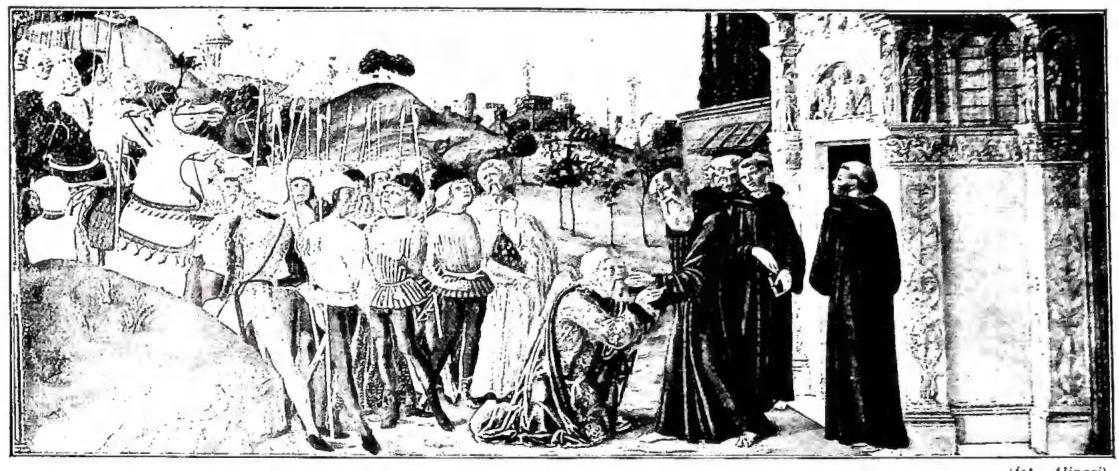
TOTILA - T. visits St. Benedict at Montecassino. Painting by Francesco di Giorgio and Neroccio di Lando (1472) - Florence, Uffizi Gallery.
TOTILA. - King of the Ostrogoths, d. in July 552. Nephew of King Ildibad, he commanded the garrison of Treviso when he was acclaimed king (541). His name was Baduila; T. (= immortal) was merely a nickname.
He immediately faced the Byzantine armies, defeating them at Faenza and in the Mugello. Continuing his advance southward, he occupied Benevento, Cumae, and Naples (543), bringing all of southern Italy under his power. In 544 he occupied Tivoli, and in 545 he besieged Rome, entering it in Dec. 546. The deacon Pelagius, who during the siege had sought to have hostilities suspended, obtained that the citizens be spared, but the city was sacked, destroyed, and plundered. After the mission of Pelagius himself to Constantinople to reach an agreement failed, T. continued his raids throughout Italy, but while he was at Ravenna, Belisarius was able to occupy Rome (547), fortifying himself there and defending it against the assaults that T., having returned immediately, launched. The sudden recall of Belisarius to the East allowed T. to reoccupy the city (550), but this time he showed himself more benign and indeed favored the material and social recovery of the city itself. This is probably to be attributed to political reasons, but the conversation T. had with St. Benedict at Montecassino in 546 cannot have been unrelated (cf. St. Gregory the Great, Dial., II, 14 ff.; ed. U. Moricca, Rome 1924). While T., now master of Italy, occupied Sicily, Sardinia, and Corsica and raided the coasts of the Adriatic and the Ionian, a strong Byzantine army commanded by Narses marched into Italy. In the naval engagement near Ancona T. suffered a defeat and, shortly afterward, was definitively beaten near Tagina (Gualdo Tadino), where he died as a result of the wounds sustained in combat.
Bibliography5 worksE. Kampfner, T., König der Ostgoten, Inowrocław 1882; H. Grisar, Roma alla fine del mondo antico (Italian trans.), II, Rome 1930, pp. 99 ff.
BIBL.: E. Kampfner, T., König der Ostgoten, Inowrocław 1882; H. Grisar, Roma alla fine del mondo antico (Italian trans.), II, Rome 1930, pp. 99 ff., 117-23; G. Romano - A. Solmi, Le dominaz. barbariche in Italia, Milan 1940, pp. 244-50; O. Bertolini, Roma di fronte a Bizancio e ai Langobardi, Bologna 1941, pp. 160-85; A. Mundò, Sur la date de la visite de T. à St Benoît, in Revue bénédictine, 50 (1949), pp. 203-206.
Amore, Agostino. “Totila.” In Enciclopedia Cattolica, vol. XII, col. 377. Città del Vaticano: Ente per l’Enciclopedia Cattolica e per il Libro Cattolico, 1954. https://azioneromana.com/article/totila.
MLA
Amore, Agostino. “Totila.” Enciclopedia Cattolica, vol. XII, Ente per l’Enciclopedia Cattolica e per il Libro Cattolico, 1954, col. 377. Azione Romana, https://azioneromana.com/article/totila.
BibTeX
@incollection{ec12_totila,
  author    = {Amore, Agostino},
  title     = {Totila},
  booktitle = {Enciclopedia Cattolica},
  volume    = {XII},
  pages     = {377},
  note      = {Cited by column},
  publisher = {Ente per l’Enciclopedia Cattolica e per il Libro Cattolico},
  address   = {Città del Vaticano},
  year      = {1954},
  url       = {https://azioneromana.com/article/totila}
}
One of some 20,000 entries brought back from the twelve printed volumes (1948–54). Spotted something? Help us improve it.
Click or scroll to zoom · drag to pan · Esc to close