
TOTEMISMO. –
I. DEFINITION, DIVISION, ELEMENTS OF T
The term totem (totam, todam, ndodem) originates in the language of the Odjibwa (Algonquians), Indians of southern Canada, and means kinship, the emblem of the family, or also the personal protecting spirit. Scholars do not agree in determining which of the various forms of veneration of animals and natural things properly constitutes T.; the following seems to be the most appropriate definition: T. consists in special ideological and reverential relations of kinship between a social group or an individual person and animals, plants, or even natural phenomena, from which there functionally derive a set of prescriptions and customs.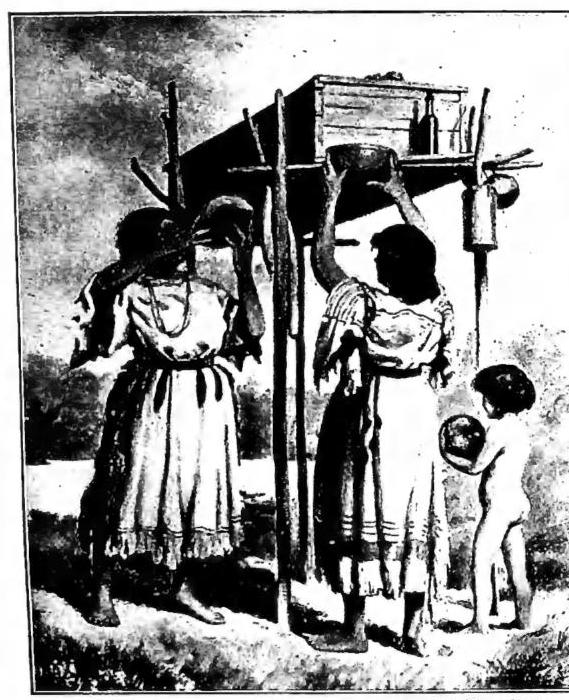
This division has merely a classificatory value and, in particular, does not mean that these different forms of totemism must also stand in a genetic relationship to one another.
The elements and characteristics that may be more or less common to all these species of totemism are essentially the following: 1) a constant emotional, mystical, reverential, magical, mythical, and kinship relationship between an intertribal unit (clan, local group, etc.) or an individual and animals or natural objects regarded as totems. The group regularly stands in a relationship with an entire species of animals or plants. 2) The totem is regarded as a protector, helper, companion, or relative; nevertheless, it is also held in awe and feared. It often possesses supernatural powers. 3) The names and emblems that refer to the totem. 4) Identification with the totem. 5) Tâbu and laws of separation in relation to the totem (not killing it, not eating it, not touching it). 6) Ritual in relation to the totem.
Other elements that may be found incidentally in group totemism are: 1) the interpretations and legends of the groups concerning the origin of the totems: a) the origin of the totem, that is, the kinship group considers itself to have come directly or indirectly from the totem. If the human group and the animal species have the same ancestors, the totemism is called «twin totemism». b) The events and experiences of the group’s ancestor with the totem, which was his helper or friend, or from which he suffered. 2) Exogamy and specific marriage relationships among the groups. 3) The hereditary transmission of the totem within the group, which may be patrilineal or matrilineal. 4) Totem groups with names (which directly or indirectly refer to the totem), with totemic emblems or symbols, and with the common tâbu of the totem. 5) The associations and coordinations of totems on the basis of real or fictitious analogies or for other reasons. Thus one speaks of «multiple totems» (several totems within a group) and of «articulated totems», that is, primary and secondary ones.
These various elements and characteristics of the totemic complex do not always all exist together among individual peoples, nor does the absence of certain characteristic elements always signify a decline of totemism. The veneration of particular animals or natural objects found among an entire tribe, such as the cult of the bear, the ox, etc., does not fall within the sphere of totemism, because forms of worship and beliefs of another nature may be based on particular figures of animal-shaped ancestors and mythical beings, deities and superior beings with animal characteristics, and astral, chthonic, and sacred animals. The designation «tribal totemism» is justified, at most, only when it can be shown that the formation of the tribal groups derives from the totemistic clans of former times. In any case, the essential feature of social totemism lies in the division of the tribe into tribal subgroups.
II. FORMS OF T
a) Clan t. — This is the most widespread form of group t. The religious or ideological aspect is sometimes greatly reduced in comparison with the social aspect. For the most part, this t. represents something purely profane and social, a rigid system in which only names, emblems, and formal tâbu give the clan a totemistic veneer. The sense of kinship and the clan exogamy arising from it are not always determined by belief in descent from the totem, but are often founded solely on a real or fictitious consanguinity which, in itself, has nothing to do with t. Yet the totem that unites the group can give a special sanction to the sense of kinship or to group solidarity. Clan t., however, is only one of the possible ways of coordinating the ideas of belief and social groups.Non-totemic clans or sippi (large economic families) may be ideologically determined by the common possession of cult objects, sanctuaries, traditions, and belief in ancestors and heroes. Among individual tribes, totemic clans have also become complex ritual units which, according to their totems and natural symbols, perform magical actions in the interests of the entire tribe. Various forms of religion and ceremonial may also be joined with clan t., such as the cult of ancestors, representations of the dead and of souls, belief in a magical force, fertility festivals, etc.; these contribute to a transformation of the totemic system. In its various forms, clan t. is found principally among the agricultural peoples of East Africa, the Sudan, the forests of the Congo, anterior India, and sporadically in posterior India and in Indonesia, Micronesia and Melanesia, eastern and southwestern North America; it is weakly represented in South America. It is rare among pastoral tribes and hunting peoples (African Pygmies, Australians, those of western Siberia, southern Canada, Venezuela, and others). A special form is the cult t. of the Australian tribes, which, through its relation to the ancestors and heroes of ancient times and through its characteristic myths and songs, sacred places, cult objects, paintings on sand and rocks, dramatization of the actions of totemic ancestors, rites for the multiplication and magical control of animals and plants, and places of the spirits of children (the belief in the preternatural origin of children from totemic ancestors), represents an exceptionally complex, yet secondary, phenomenon. A similar cult t. also exists in Melanesia.
b) T. of the halves of a tribe. — Often the totemic clans of the two halves of a tribe or village, which are for the most part exogamous and antagonistic and of matrilineal descent, may have totemic characteristics (the animal dualism). The dual totemic system may also exist without the division of the clan. The totemic character of these halves is generally weakly developed. The connection between moiety systems and totemic clans often led to an enlargement of the tendency already inherent in clan t. to coordinate animals and natural things according to particular points of view, a tendency which in this form of t. is directed principally toward the dual principle. Thus, according to the halves and the clan, all things and forces of nature, the heavenly bodies, and the regions of the sky that are considered important are symbolically divided, so that the organization of the tribe represents an image of the cosmos and each clan is symbolically and magically regarded as a part of nature.
c) T. of families and local groups. — This is rarer; it exists principally among Australian tribes and in certain regions of Africa and North America. In most cases, these are the oldest forms of group t., or else local and particular forms whose components can sometimes be clearly distinguished. They may provide points of support for the question of the origin of clan t.
d) Individual t. — It generally consists in a stable relationship of friendship and protection between a person and a particular animal or natural thing, a relationship strongly accentuated in its emotional, mystical, and magical aspects. The individual totem generally confers special powers and abilities upon its possessor. Individual t. is reinforced by belief in the alter ego, which consists in a bond between a human being and an animal or a natural thing, a bond of life and destiny so intimate and reciprocal that the harm, illness, or death of one is the harm, illness, or death of the other. Naturally, these totem become especially strict taboos. Personal totem of this kind are principally the totem of the leading members of families and groups, that is, chiefs, medicine-men, and other socially important persons. A further development of the ideas of individual t. may be seen in the “real” totem of the rulers of the Negro kingdoms of East Africa, where the king or prince is linked principally with notable birds of prey and carnivorous animals, such as the lion, leopard, etc. It is likely that the veneration of animals in the districts of ancient Egypt is connected with an old individual t. of the local princes. Individual t. is also frequently found in shamanism: the helping spirits of shamans are sometimes personal totem in the sense of an alter ego. At times there is a tendency to transmit the individual totem by inheritance as well; this may provide an indication of totem connected with social groups. Individual t. is widely diffused. It exists among both simple hunting tribes and agricultural and pastoral peoples. Here and there it has also penetrated higher cultures and is found even in the popular beliefs of Europe. Personal t., in its expression as belief in an alter ego, is founded principally on a particular conception of the human soul, which, above all as a “shadow” or “external soul,” may be mystically linked with animals or natural things; the close connection of destiny between the individual human being and the individual animal seems to be based on this. The alter ego perhaps arises in the most hidden meanders of the human soul.
Individual t. is sometimes connected with the belief in protective spirits found among North American Indians, according to which one may acquire a personal protective spirit through visions or dreams obtained by fasting or meditating in solitude. But this does not always seem justified, because, although there are often broad analogies between the two phenomena, they must nevertheless be regarded as essentially different. The essence of individual t. lies in an animal or in a concrete natural thing, whereas belief in a protective spirit, strictly speaking, consists in possessing a spiritual being, which may also appear in the form of an animal or a natural object.
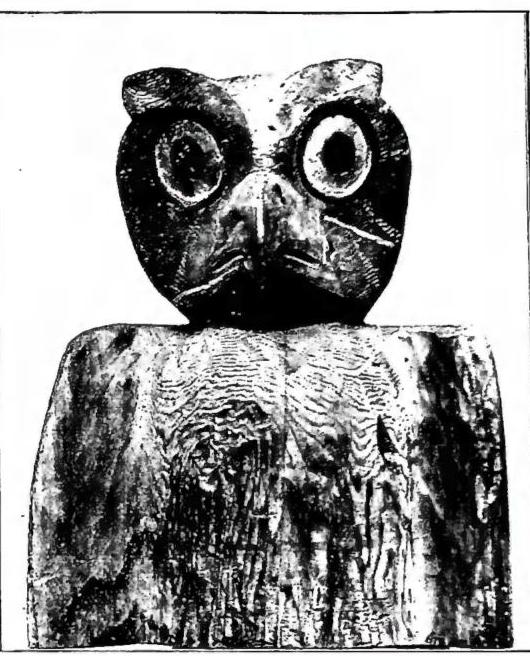
(photo. Enc. Catt.)
TOTEMISM - Gufa carved in wood (totem), originating from the tomb of a Canadian Indian - Rome. Pontifical Lateran Ethnological Missionary Museum.
III. THE HISTORICAL-CULTURAL AND HISTORICAL-RELIGIOUS SIGNIFICANCE OF T
The conclusion reached by historical ethnology—that t. does not belong to the cultural heritage of the most ancient humanity and does not constitute a general stage in the cultural development of all peoples (as evolutionism maintained)—remains valid even today. The great mass of the ethnologically most archaic peoples has no typical clan t. Likewise, the view that t. lay at the foundation of society (exogamy) and religion, indeed that the latter derived from it (Robertson-Smith, Durkheim, S. Freud’s “Oedipus complex”), has been completely disproved, above all by the investigations of W. Schmidt, F. Boas, R. Lowie, and others.The first formation of clan t. occurred in any case in very remote times, probably already among those tribes where the men were still hunters, while the women were already practising a simple form of agriculture. Greater stability was then achieved, creating the conditions whereby kinship groups (sippi, clan), organized unilaterally, came to be formed from the small family and local groups of archaic hunters and gatherers; these groups subsequently acquired, in part, a totemistic character. It is certain that the totems of the clans were originally animals, and that plant, cosmic, and other types of totem are of later origin. As for the question of whether clan t. should be traced back to a single origin, in the sense of the “totemistic culture cycle” of Gräbner and W. Schmidt, or whether it arose independently several times in different places and periods, this is a problem that cannot yet be resolved with certainty. Recent research (Baumann, Haekel), however, provides a considerable number of indications favouring the latter possibility. Clan t. is found in civilizations that are often fundamentally different; it is therefore no longer possible to say what its original cultural elements were. The totemistic culture cycle formulated by Gräbner and refined by W. Schmidt, according to which t. first arose within the culture of a tribe, can for many reasons no longer be maintained today. Among other things, the following elements were assigned to this culture cycle: advanced hunting, the spear and edged weapons, the spear-thrower, the domed-roof house, prefe-
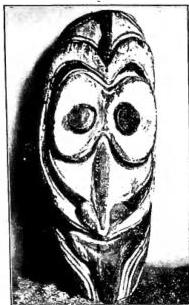
(phot. Enc. Catt.)
TOTEMISMO – Totemic Mask of New Guinea – Pontifical Lateran Missionary Ethnological Museum.
Family and local totemic groups could be formed even within the civilizations of hunters; but in agricultural civilizations as well, a totemistic transformation of small local and kinship societies is sometimes found. Individual t., together with the beliefs in the alter ego and in the protective spirit—which is partly akin to it, but not identical—appears to be older than group t., since it can also exist among tribes of simple hunters. Individual t., however, was able to continue to exist in all forms of civilization, including the higher ones. Given the marked uniqueness and relative uniformity of the phenomena of individual t., one may perhaps, with good reason, admit a single origin, although there is no complete evidence for II. Several indications show that group or clan t. in some regions came to be formed from individual t. through the fact that the individual totem of a chief of families or local groups, or of an ancestor, was inherited by his descendants, and respect for it became obligatory for the entire group. There are, however, other possible origins of clan t. as well.
The ideological and religious background of t. undoubtedly lies in a view of the animal world (Baumann’s protototemism), which was and is characteristic above all of strongly hunting-oriented peoples. These tribes either have no group t. or developed or acquired it only later. The interest of these hunters is directed entirely toward animals, to which they feel bound by manifold ideological and religious relationships permeated by powerful emotions.
Preference for artistic works and for craft specialization, patriarchy, men’s and youths’ houses, age classes, platform burial (desiccation of the corpse), sun worship, intensified magic. The thesis of the old historical ethnology, that specific matriarchy is originally independent of t., remains valid today; nevertheless, given a polygenetic origin of t., matrilineal tendencies may always be joined to clans, without thereby entailing a transformation into matriarchy.
From the whole picture, however, it appears that the majority of tribes with t.
These relationships are manifested chiefly in the following ideas and practices: the animal as helper and companion; kinship between animal and human being; the special powers of animals, which human beings seek to appropriate; transformations into animals; the entry of the totemic soul into the animal; reincarnation in the animal; the patron of animals; the inspecting spirits of animals; the ancestor of the tribe regarded as an animal; reconciliation with the game killed; preservation of the bones of animals, so that game may arise from them again; animal pantomimes; hunting magic in various forms.
These ideas and practices are not yet in any way systematized, and they vary in value and meaning among the individual tribes. Fundamentally, however, they constitute a unified complex of the superior hunters, which can be followed and traced back to the Upper Paleolithic of Eurasia and Africa. It must be noted, however, that this “animalism” does not constitute the whole religion of these hunters. It belongs chiefly to the “lower” spheres of religious activity, limited to the field of daily hunting, an activity strongly oriented toward magic. There also survives, in part as the persistence of an older cultural stratum, belief in a Supreme Being, or in a figure who is Lord and distributor of animals as means of subsistence, as well as in an ancestor of the tribe and bearer of civilization. Through the stronger orientation toward lower beings, animals, and so forth, belief in the Great God generally acquires a character of zoicity. It may also be influenced by belief in a universal force or power (dynamism), which for the most part should be regarded as an emanation of the Supreme Being, but which may be concentrated especially in game, in particular natural things, and in human beings. It would nevertheless be erroneous, as is sometimes done, to speak in this case of a belief in a “preanimistic” force, as though the idea of souls, or a simple animation or anthropomorphism of animals and natural things, did not already exist. Although it is not always possible to make a clear distinction between belief in force and belief in spirit, there is nevertheless no reason to speak of a preanimistic religion.
Now, these magical and religious ideas of the superior hunters constitute the foundation for the formation of the various forms of t. Generally speaking, it may be said that t., in the course of the history of civilization, has made no noteworthy contribution to the religion of humanity. Insofar as it retained religious elements, it confined itself solely to certain spheres of the superhuman, without exerting any broader influence on the world of higher powers.
(fot. Alinari)