
VENEZUELA. –
I. GEOGRAPHY
The northernmost of the Atlantic states of South America, and the only one whose territory lies entirely north of the Equator.Almost three times the size of Italy (912,050 sq. km.), it is divided by the broad belt of plains (llanos) through which the Orinoco flows into two distinct parts. The northern part alternates a mountainous region (the Cordillera of Mérida, which rises to over 5,000 m., and the much lower Caribbean Mountains) along the western border and parallel to the Atlantic, with a series of flat coastal strips, extending chiefly around Lake Maracaibo. Southern V. Guiana, which rises above 2,500 m.; it is almost uninhabited but covered with magnificent forests. The climate of V., tropical in the llanos (with a dry season lasting 5–7 months), gradually becomes equatorial, more humid and unhealthy, toward the south and in the Orinoco delta, which is as large as Sicily.
The population (5 million inhabitants, approximately 6 to 8 per sq. km.) consists nine-tenths of mixed-blood people (mestizos and mulattoes), with barely 4% whites (65,000 Italians): three-quarters live in the northern regions, while the rest of the country is almost deserted (in the territory of Amazonas there is one inhabitant for every 33 sq. km.).
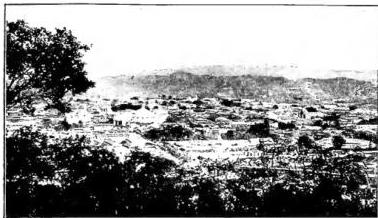
(from K. van Schumacker, Sudamerika, Berlin 1931, pl. 96)
VENEZUELA - View of Caracas.
Mercury and, more recently, iron), and industry is limited, despite the variety of its branches.
Of the inhabited centers, besides the capital, Caracas (500,000 inhabitants), the notable ones are Maracaibo (232,000 inhabitants), the principal exporting port; Barquisimeto (105,000 inhabitants) and Valencia (90,000 inhabitants), in the interior.
V. is a federal republic of 20 states, 2 territories, and a federal district, with a bicameral parliamentary government and a president elected every 5 years.
Giuseppe Caracci
II. HISTORY
In a letter of 18 July 1500, on his return from a voyage to the New World, Amerigo Vespucci, describing to Lorenzo de' Medici the regions he had visited, wrote as follows: «... gli abitanti tenevano le loro chase fondate sul mare chome a Vinega, con molto artificio et maraviglia»; from this resemblance to the Serenissima, the name of little Venice given to the island of Aruba would subsequently pass to the adjoining coast, which from that time would be called V.Sighted during the third Columbian voyage (1498) and summarily visited in 1499 by Ojeda’s expedition, of which A. Vespucci was a member, the Spaniards took no interest in occupying V., limiting themselves to establishing settlements along the coasts for pearl fishing and to collecting natives to sell as slaves in Cuba and Hispaniola. In 1527 the Spaniard Juan de Ampuez founded the first colony there (Santa Ana de Coro), governing it wisely; it would, however, be the Germans who attempted a serious penetration into the interior of the country, following a regular licence granted to them for twenty years in 1528 by Charles V. The most notable among them, acting on behalf of the Welser bankers of Augsburg, were Ambrosius Alfinger, who met his death on the rio Magdalena; Georg von Speier, who, in search of the mythical «El dorado», would advance as far as the rio Guaviara; and Nicolas Federman, who would reach the region of the Muisca almost simultaneously with the Spanish expeditions of Belalcazar, coming from Quito, and of Quesada, who arrived there from S. Marta. After these, particular mention must be made of the explorations undertaken by Fr. Samuele Fritz, followed by many groups of courageous Franciscan and Jesuit religious during the seventeenth century. The present capital, Caracas (Santiago de León de Caracas), would be founded in 1567, under Governor Ponce de León, by Captain Losada; subsequently, or contemporaneously, foundations would be established at Borburata, Barquisimeto, Valencia, and Trujillo.
Organized like the other Spanish lands of America, V., until 1742 incorporated into the viceroyalty of New Granada, would in that year be raised to the status of a captaincy general. Despite its undoubted agricultural resources (cocoa, tobacco, cotton, indigo), it lived almost exclusively on smuggling and on the commercial traffic of the Spanish galleons that travelled to and from Europe (Maracaibo, Puerto Caballo) throughout the seventeenth century. Around 1728 this situation would be brought to an end by entrusting a Guipuzcoan company with exclusive control of the trade, on condition that it combat the smuggling and piracy carried out by the Dutch (Curaçao) and the English (Margarita, Trinidad, Leeward Islands). As the colony developed considerably as a result of these measures, two insurrectionary movements provoked by landowners and government employees were suppressed (1749, 1752), a university was opened, and the seat of the archbishopric was established at Caracas (1803). Although sparsely populated (approximately 412,000 inhabitants, including 12,000 Spaniards, 100,000 Spanish Americans, and 300,000 indigenous people, blacks, and mulattoes), scattered over an area of one and a half million sq. km., V. would leap to the forefront through its revolutionary activity against the antiquated Iberian colonial regime. In the movement aimed at the country’s independence, Francisco de Miranda, precursor of the South American revolution (1750–1816), and Simón Bolívar (1783–1830), its achiever, stand out.
The entire history of Venezuela from 6 May 1830, when General Paez and Bermudez proclaimed before the Congress convened at Valencia the separation of the region from Gran Colombia and the birth of the State of V., may be said to be contained in the politics of the two parties—the conservative and the liberal—and in the activity of four statesmen who, each in his own way, imposed his will upon the Republic. In chronological order, they were: José Antonio Paez, hero of the wars of independence; José Tadeo Monagas; Guzman Blanco; and Juan Vincente Gomez. Through the multifaceted abilities of these men, the entire political life of V. unfolded down to the present day, when power lies in the hands of a military junta presided over by Colonel C. Delgado Chalbaud, who, having dissolved Parliament, has governed since December 1948. The distinctive character of these men, military leaders and politicians according to the circumstances imposed by domestic affairs, was expressed not only during the years in which they were directly in the presidency, but also continued through the subsequent presidents whom they had elected, imposing their will upon the country even through third parties. Among the latter, other figures came to prominence who led the country toward the normalization of internal life, recognition by the other powers, a decisive movement toward social reforms, the restoration of the public debt, and subsequently the thorough development, with the aid of foreign capital, of the exploitation of petroleum, the region’s chief and inexhaustible source of wealth.
Among the events of the years closest to our own, the work of Gomez deserves particular mention. At the head of V. from 1908, «pressocché illetterato, ma dotato di naturale intelligenza, di astuzia, di rimarchevole senso negli affari», he succeeded in maintaining the Republic on good terms with foreign countries, in settling disputes favourably in the Netherlands, Belgium, and the United States, in remaining neutral during the First World War, in joining the League of Nations in 1920, in settling frontier questions with Columbia (1922) and Brazil (1929), and in absorbing the entirety of the foreign public debt in 1930–35. His successor, General Lopez Contreras, in office from 1936 to 1941, made a significant contribution to the reform of the Constitution, restored political, press, and assembly freedoms to the people, and was the driving force behind a three-year plan for the development of the economy and agriculture and for social improvements. He was succeeded as president by his minister of war, General Medina Angarita, who broke relations with the Axis countries after the Japanese attack on Pearl Harbor, supplied large quantities of raw materials to the United States, which strongly assisted him in industrialization and in the exploitation of natural resources, intensified the struggle against illiteracy, expanded social-security provisions, and outlawed the communists, dissolving their leagues (although in 1945 he was compelled to recognize the legality of that party).
At the end of 1945, after a popular uprising had forced Medina to take refuge in the United States together with Lopez Contreras, the economist Romulo Bethancourt became president, following a brief interregnum by a popular junta. Although he performed good deeds during the years of his government, he failed to live up to the country’s expectations, to the point of provoking, after several insurrectionary movements, a coup d’état at the end of 1948. Since that year, as stated, Colonel Chalbaud has been at the head of the Republic.
III. EVANGELIZATION
A first missionary attempt in V. was made in 1513 by the Dominican Francisco de Cordoba, who, together with a lay brother, departed from Haiti for the Coast of Pearls, west of the Island of Trinidad. Because of the pearl merchants, who sold the indigenous people into slavery, the attempt ended with the massacre of the two missionaries. A second attempt, undertaken from 1516 to 1519 by Dominicans and Franciscans, likewise failed after its initial successes because of the Spaniards’ slave hunting, and ended with the killing of the missionaries. The same fate befell the colonization of the Coast of Pearls, conceived by Bartolomeo de Las Casas.In the 16th century Spanish colonization and the Dominican and Franciscan mission were confined to the northwestern part, where flourishing cities arose, such as Coro and, from 1578, Caracas as the seat of government. In 1531 Coro was made a diocese, later transferred to Caracas in 1637. Eastern V., on the other hand, like the lowland region of the interior, remained unexplored. After various unsuccessful attempts, the Franciscans succeeded in founding a convent on the Island of Trinidad at the end of the 16th century. From there they advanced toward the Orinoco delta, at first without success. Only after 1656 did they establish a flourishing mission among the Indian tribes in Piritù, and during the 18th century they also penetrated the regions south of the Orinoco River. From about 1760 the missions depended on the Apostolic College of the Franciscans of Piritù.
The Franciscans were assisted, from 1650 in Cumanà and from 1678 in Guyana, by the Capuchins, who established fine reductions. At the beginning of the 18th century the Jesuits founded several missions in the Upper Orinoco region. With the so-called « Concordia » of 1734, the various fields of activity of the Franciscans, Capuchins, and Jesuits were given clearly defined boundaries. Following the expulsion of the Jesuits in 1767, the Franciscans took over their missions in the Upper Orinoco. In 1787 the Franciscans administered 68 missions with approximately 35,000 Christian Indians; the Capuchins, in 1789, administered 30 missions with approximately 25,000 Christian Indians.
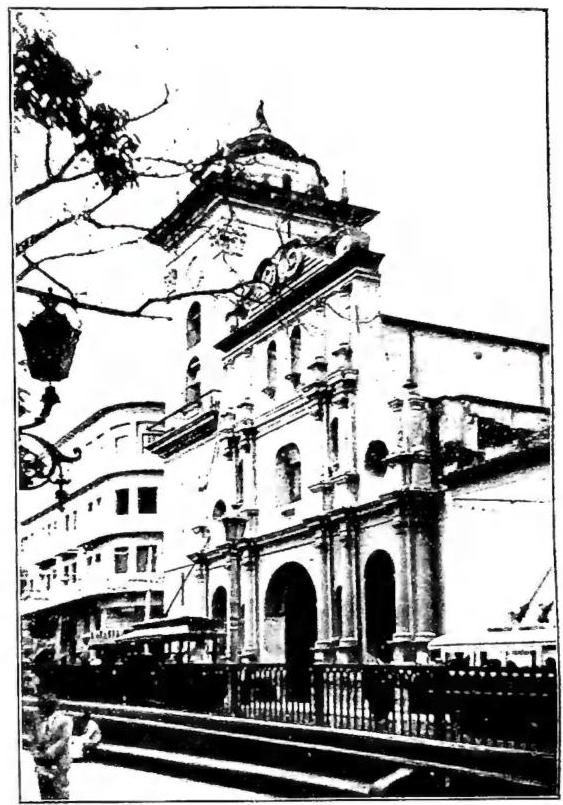
(courtesy of Mons. A. P. Frutari)
VENEZUELA - Cathedral of Caracas (17th century).
IV. LEGAL STATUS OF THE CHURCH
It is dominated and characterized by the question of the national Patronato. From the time of the separation of “Great Colombia” from Spain (Columbia, V., Equatore, Panama), the new government claimed to continue exercising the Patronato as heir to the privileges granted by the Holy See to the Kings of Spain and subsequently arbitrarily expanded. These claims were asserted and consolidated in the Ley de Patronato Eclesiastico of 28 July 1824, definitively confirmed, as far as the V. was concerned, by the Constituent Congress through the law of 15 March 1833, and always regarded by the government as the basis and foundation of relations between Church and State. All the Constitutions, including that in force since Apr. 1953 (art. 50), make explicit reference to II. Some of the numerous rights which the government intends to exercise by virtue of the Patronato, such as, for example, those relating to the celebration of Councils, pastoral visits, etc., are not in practice asserted. Others, however, such as the creation of new dioceses, appointment to cathedral and parish benefices, and election of bishops, are matters to which the government adheres absolutely. For its part, the State grants the Church substantial financial subsidies. The Holy See has never recognized these rights, but has merely tolerated them. This state of affairs could not but harm the life and development of the Church in the V., depriving it in particular of the necessary freedom in the appointment of bishops and encouraging interference by the state authorities in ecclesiastical affairs that was as extensive as it was undue.The Constitution guarantees all the inhabitants of the Republic religious freedom under state control (art. 35, 6°) and barely touches upon the matters of greatest concern to the Church, namely, education, marriage, the family, and the social question, continually referring the matter to special laws, which for the most part are still inspired by the atheistic and anticlerical principles of the preceding century. Civil marriage is in force, and divorce is granted readily. Education, both public and private, is regulated by the Provisional Statute of Education of 25 May 1949. It provides for such detailed state intervention as to obstruct the free conduct of the activities of private colleges and to reduce to very little the freedom of teaching sanctioned by the Constitution (art. 35, no. 13) and reaffirmed in art. 2° of the Statute. It must be acknowledged, however, that it represented a considerable improvement over the preceding Organic Law, promulgated in Oct. 1948, partly eliminating the odious differences between private and official education and removing suspicions concerning the work of Catholic colleges. The same Statute also restored religious instruction in state schools, for two hours weekly, for pupils whose parents or representatives request II.
In 1876 the Holy See established an apostolic delegation in the V., Santo Domingo, and Haiti, with its residence in the latter two Republics; the first delegate was Msgr. F. Rocco Cocchia. In 1909 Msgr. G. Averse was appointed apostolic delegate for the V., and in 1913, with definitive status, Msgr. C. Pietropaoli. Pope Benedict XV raised the apostolic delegation to an internunciature in 1916 and subsequently, in 1920, to a nunciature. The first nuncio was Msgr. F. Marchetti Selvaggiani, already internuncio since 1917 and later a cardinal. By apostolic letter of 7 Oct. 1944, Pope Pius XII constituted Blessed Virgin Mary “de Coromoto,” venerated in Guanare de los Cospes, the principal heavenly patroness of the Republic of Venezuela (AAS, 41 [1949], pp. 318–19).
V. ECCLESIASTICAL CIRCUMSCRIPTION
Ecclesiastically, it is divided into the two metropolitan sees of Caracas (with suffragans at Barquisimeto, Calabozo, Coro, Cumanà, Guayana, and Valencia del V.) and Mérida (with suffragans at S. Cristoforo di V. Zulia), the apostolic vicariates of Caroni and Machiques, or the Mission of Guajira-Perjia, and the apostolic prefecture of Alto Orinoco.VI. For literature: V. ISPANO-AMERICANA LETTERATURA, XII.
VII. ART
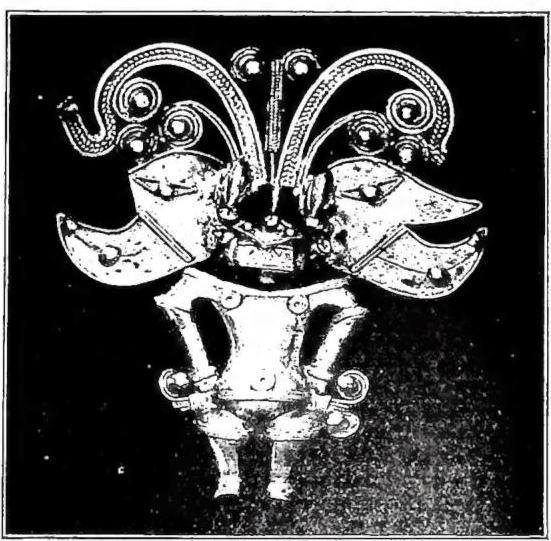
Scholars of pre-Columbian civilization assign V. to a region called “intermediate,” comprising, in addition to the Republics of the Central American isthmus, Colombia and Equador. Mediating between the influences of the advanced northern cultures (Aztec, Maya, Totonac) and southern cultures (Chimu, pre-Inca, Inca), the region as a whole reveals no marked characteristics of originality. The present political boundaries of the various States do not even approximately correspond to the distribution of the ancient cultures. As far as this matter is concerned, for example, the separation of the western provinces of V. from the northeastern ones of Colombia would be entirely arbitrary. The systematic exploration of this immense and arduous territory has, however, only just begun, carried out chiefly by North American scholars, and it is therefore still impossible to outline a complete and satisfactory panorama of the primitive civilizations that flourished there. The principal archaeological discoveries concern the so-called calzadas, paved roads, found especially in the territory of Barinas (v. di nord-ovest),(from Pal Kelemen, Medieval American art. II, Nuova York 1956, plate Fil. 69, C)
VENEZUELA - Gold ornamental object, with an anthropomorphic figure, from La Guajira, now in the collection of Dr. R. Requena - New York.
which reveal an advanced building technique, serving a civilization founded on exchange.
It nevertheless seems that no architectural monuments of any importance exist. In western Zulia, engraved stones have been found bearing ideograms and allusive figures, dating from a still insufficiently defined civilization of the Tiot-tio. Other epigraphic discoveries of considerable interest were made by Aguirre and Vigirama along the coast of the Caribbean Sea.
The area of Lake Valencia, west of Caracas, has been more intensively explored, also by native scholars, since the last century. There, on the lakeside peninsula of La Caprera, an important necropolis was discovered, yielding a great deal of pottery material of the highest artistic interest. A deep strip of the mountainous territory, from Barquisimeto to S. Cristobal, along the Cordillera de Merida, has likewise been extensively explored.
Among the most singular artifacts of the northwestern area are the smooth grinding stones (metates), carved in the form of wild animals—mostly pumas or jaguars—with borders decorated with graffiti and geometric reliefs. Ceramics have been classified into six different areas.
Many pottery forms are unrelated both to Inca art and to that of the Mexican civilizations. In general, anthropomorphic symbolism is intensified through summary and impressionistic stylization. Small terracotta heads have also been found, executed with a delicacy comparable to that of products of archaic Egyptian or Chinese art (Kelemen). In short, one is confronted here with another pottery civilization, inferior to the Peruvian in the delicacy of its ornamentation, but equally advanced in sculpture. During the first period of Spanish colonization, architecture developed modestly in V., both because of limited European emigration and because the Spanish authorities sought to prevent what had occurred in Mexico, where the conquistadores had established dangerous monopolies by erecting sumptuous residences and evading the control of the mother country. There was also the continuing difficulty of obtaining the materials necessary for solid construction. Thus, civil building was predominantly in wood, while only religious building employed brick.
The only religious buildings of artistic importance known from the sixteenth century are the convent and adjoining church of S. Francesco in Caracas, now so extensively transformed that their original form can be understood only from the plans and drawings preserved in the Archivo de Indias in Seville. The designs were by Antonio Ruiz Ullán (1593). The church had three naves, a solution quite rare in Spanish colonial art.
The façade, with its central loggia in the attic rising above the sloping roofs of the lesser naves, reveals that the architect had late Renaissance models in mind, deriving the elements of the decoration from the works of Serlio and Vignola.
Subsequently, the forms of exuberant Spanish Baroque triumphed. In Caracas arose the hybrid Cathedral, inspired by the architectural works of the Jesuits; the church of Altagracia; the Cathedral of Coto; and S. Rosalia; in Maracaibo, the church of S. Francesco. Public buildings, too, displayed sumptuous forms and occasionally achieved results of assured taste (the Miraflores Palace in Caracas). Neoclassicism appeared during the Napoleonic period and dominated during the wars of independence (Bolívar’s house in Caracas).
In the second half of the nineteenth century, Venezuelan architecture followed the fate of all American countries: frenetic building growth welcomed the most disparate European and North American influences and, in a hybrid mixture of academic bad taste and functional ineptitude, promoted the construction of entire new districts in Caracas and in the cities that were meanwhile gaining economic and commercial importance: Trujillo, S. Cristobal, Mérida, etc. In religious building, Neo-Romanesque and Neo-Gothic styles prevailed, with a predominance of Spanish models. More recent architecture, especially in the new center of Caracas, possesses instead a formal dignity that places it among the finest products of modern urban planning.
In the other arts, the level remained modest until the wars of independence. Sculpture and painting were practiced almost exclusively for sacred purposes and, unlike what occurred in other regions of Latin America, obeyed an external and programmatic set of rules rather than an indigenous impulse.
Craft production, on the other hand, was excellent, especially carved woodwork (the choir of the Iglesia di S. Francesco in Caracas) and sacred furnishings.
From the dramatic and glorious events of the wars of independence, sculpture drew, in the first half and then throughout the nineteenth century, the inspiration for an intense output, marked by strained and often obtuse realism. The names of Rafael de la Cova (author of the equestrian statue and bronze monument of the Libertador) and Eloy Palacios (1847-1909), a popular sculptor of commemorative monuments scattered throughout the principal cities of the State, received the greatest acclaim (among other works, he created the famous India desnuda). E. Rubin Hernandez devoted himself in particular to sacred sculpture (statues of S. Gabriele in Saragozza, José Felix Ribas in Tucupido, Francisco Cabral in Arragua di Barcellona, and Padre Guasco in Valle de la Pascua).
In most of the painters who gathered around Pedro Lovera, Domingo de Tovar, and Antonio José Carranza, founders of the local school, the illustrative intention did not rise above oleographic effect. Among them, the best was perhaps Carmelo Fernández. But exchange with the countries of Europe soon became frequent, benefiting Manuel Cruz, who derived the manner and even the subjects of his genre painting from the Italian milieu; Celestino Martínez, a diligent academic painter who executed sacred pictures for the churches of Caracas; and Ramor Bilet, an initiator of local landscape painting.
The artists of the second generation, whose renown was no longer merely provincial, displayed greater vigor, including Tovar y Tovar, author of battle scenes that in some respects approach the taste of those by our Fattori, preserved in the Capitol of Caracas; Michelena; Herrera-Toro; Maury; and Rivero Sanabria.
Above the others, for his ardent imagination and sureness of palette, stands Cristobal Rojas, one of the foremost artists of South American Romanticism. His most celebrated painting is Purgatorio, but Orfandad, La Taberna, La miseria, and Beatriz andando por la senda de los lirios are no less worthy of attention.
Tito Salas, too, educated in Paris and curious about contemporary European art, acquired some merit.
The historical cycle decorating Bolívar’s house in Caracas is the work of his brush.
VIII. SCHOOL SYSTEM
In the Republic of V., the school system is similar to that of the other Republics of Central and South America; in all of them, one notes a growing development of education, which seeks to extend itself, insofar as possible, to all rural areas and is the fruit of the ever-increasing importance being assumed by educational problems in guiding the entire population toward cultural renewal.There is therefore compulsory primary education beginning at the age of 7 and continuing until 14; after this, pupils enter secondary education, which is divided: a) into colleges, with a five-year course granting access to the university, or b) into the various types of specified schools: “normal schools,” of four years, for the training of teachers of urban primary schools; “teachers’ schools,” of two years, for the training of teachers of rural primary schools; “vocational schools,” generally of three years, comprising the following types: agricultural, commercial, technical-industrial, arts, and teacher-training. Higher or university education in V. includes: the University of Los Andes at Mérida, the Central University of Caracas (founded in the eighteenth century), rebuilt and modernized in 1944, the University of Zulia in Maracaibo, and the Pedagogical Institute. In addition, the Workers’ University was established in Caracas in 1947.
An indication of the development achieved by education is provided by the two censuses of 1941 and 1950. The 1941 census indicated that 56.6% of the inhabitants aged ten and under were illiterate; the 1950 census recorded 1,374 adult education centers with 33,000 attendees.