
COLOMBIA. – State of South America; the only one on the continent that borders both the Pacific and the Caribbean Sea.
I. GEOGRAPHY. - It is a very large country (1,100,000 sq. km., almost four times the size of Italy), but it is still not entirely well known, and only a small part of it has been developed. Apart from the narrow coastal strip along the Pacific, lacking good harbours and sparsely inhabited, C. consists of a western, mountainous section (the Andes), with broad intervening valleys (Atrato, Magdalena, Cauca), and an eastern, flat section, furrowed by the tributaries of the Orinoco and the Amazon. The latter alone encompasses more than half the country; covered with forests in the S. and savanna in the N., it is nevertheless almost uninhabited.
The population is instead concentrated in the Andean region, where altitude (in the so-called Tierras templadas, at 1,000–2,000 m., 50% of the inhabitants live) tempers the excesses of the hot, humid, and at times exceedingly rainy tropical climate (7,000 mm. of annual precipitation on the Pacific slope). C. has immense natural possibilities, but their development is delayed and hampered by the low population density (9 inhabitants per sq. km.; as in Norway), by the difficulty of communications (mostly river-based; there are 3,440 km. of railways), and by the government’s relative instability. The latter is related to the population’s lack of homogeneity (over 10 million inhabitants in 1946), of whom approximately 40% are mestizos, 15% mulattoes, 10% blacks, 7% Amerindians, and just over 25% pure whites (among the foreigners there are approximately 2,000 Italians). Agriculture and extractive industry are balanced as productive activities. Coffee and petroleum are the articles on which exports are based, but C. is also well suited to the cultivation of bananas, tobacco, cotton, and sugar cane, which now flourish there, while the subsoil also yields gold, silver, platinum, coal, precious stones, etc.; livestock raising already accounts for a considerable animal wealth (12 million head of cattle), and the forest (more than 50% of the country’s area) may still be said to be untouched.
C. is a unitary republic with bicameral representation. The country has the following administrative division.
The capital is Bogotá (600,000 inhabitants in 1948), at 2,640 m. above sea level.
The state religion is Roman Catholicism; pagan cults are nevertheless preserved among the indigenous tribes of the interior.
| Area in sq. km (1000) | Population in thousands, 1947 census | Capitals (1000 inhabitants) | |
|---|---|---|---|
| a) Departments: | |||
| 1. Antioquia | 67 | 1 405.5 | Medellín (237.2) |
| 2. Atlántico | 3 | 366.5 | Barranquilla (224.4) |
| 3. Bolívar | 60 | 968.3 | Cartagena (106.8) |
| 4. Boyacá | 65 | 777.5 | Tunja (27.1) |
| 5. Caldas | 13 | 1006.4 | Manizales (117.8) |
| 6. Cauca | 30 | 427.4 | Popayán (36.0) |
| 7. Chocó | 47 | 112.1 | Quibdó (32) |
| 8. Cundinamarca | 24 | 1 390.2 | Bogotá (600) |
| 9. Huila | 21 | 233.8 | Neiva (39.5) |
| 10. Magdalena | 54 | 426.4 | S. Marta (44.0) |
| 11. Nariño | 30 | 537.4 | S. José de P. (61) |
| 12. Santander N. | 21 | 409.7 | S. José de C. (74) |
| 13. Santander S. | 32 | 718.5 | Bucaramanga (71.2) |
| 14. Tolima | 23 | 691.4 | Ibagué (84.8) |
| 15. Valle del Cauca | 21 | 889.6 | Cali (147.2) |
| b) Intendencies: | |||
| 16. Meta | 85 | 52.1 | Villavicencio (40) |
| 17. S. Andrés y Providencia | 0.06 | 6.6 | S. Andrés (4) |
| c) Commissariats: | |||
| 18. Amazonas | 124.3 | 6.5 | Leticia (2) |
| 19. Arauca | 26 | 11.3 | Arauca (2) |
| 20. Caquetá | 103 | 21.1 | Florencia (4) |
| 21. Goajira | 12 | 53.9 | Uribia (0.3) |
| 22. Putumayo | 26 | 15.8 | Mocoa (1) |
| 23. Vaupés | 150 | 7.8 | Mitú (0.3) |
| 24. Vichada | 103 | 9.2 | P. Carreño (0.4) |
| TOTAL 1140 10 544.7 |
New Granada, initially an “audiencia” of the viceroyalty of Peru, was elevated in 1739 to a viceroyalty comprising C., Panama, Ecuador, and Venezuela. In 1806 the movement for independence began; after some reverses, it led to the foundation of the Republic of C. in 1819.
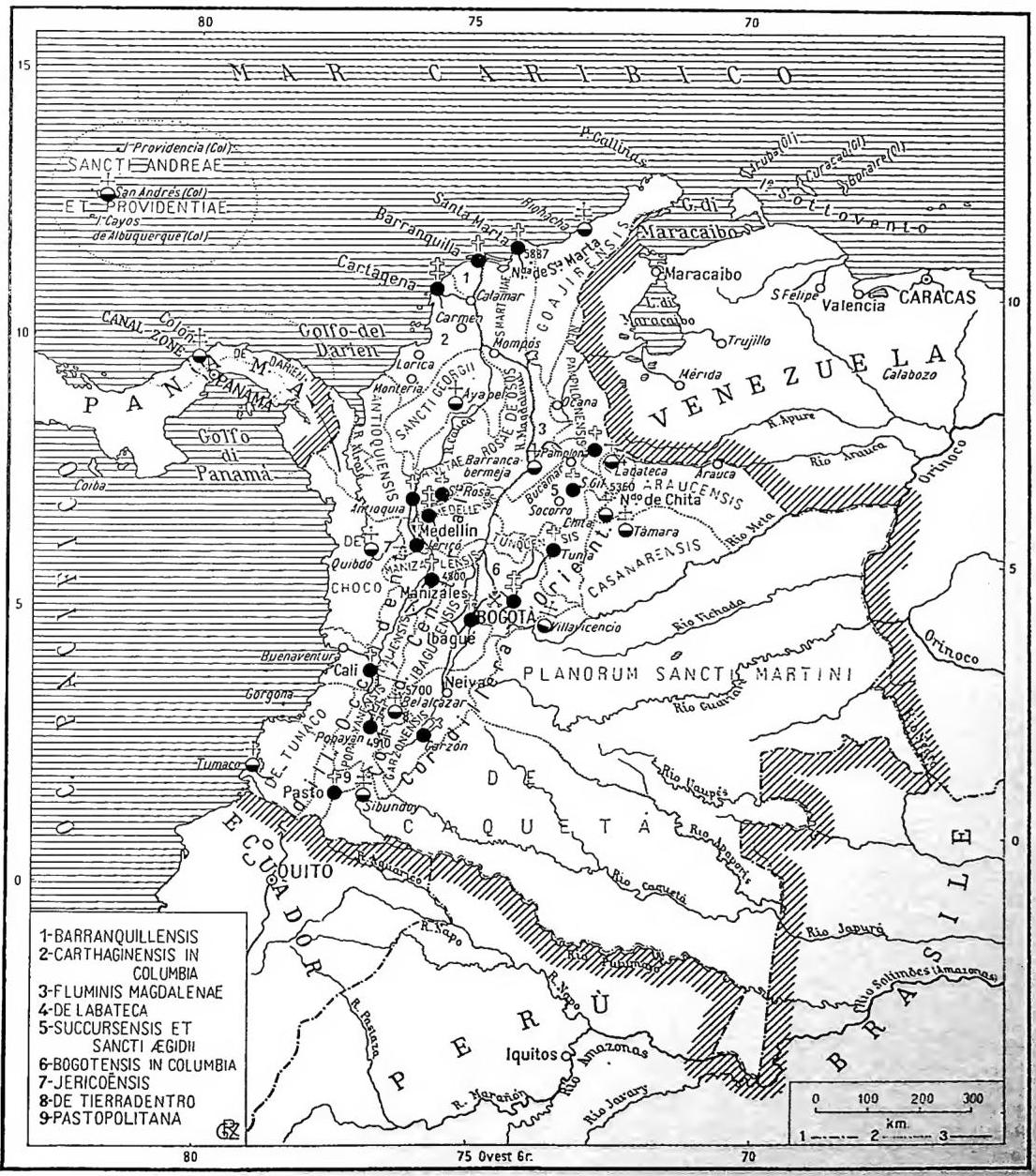
With the foundation of S. Marta, the evangelization of the Indians of the northern coast began. The Dominicans established themselves at S. Marta and Cartagena, which had been created dioceses in 1534, thus forming centers of missionary activity among the Indian tribes of the region. A school for the sons of the chiefs was opened in Cartagena. It was in Cartagena that the Dominican St. Lodovico Beltrán developed his beneficial activity among the Indians in the sixteenth century. The first missionaries of Popayán (erected as a diocese in 1546) were the Mercedarians, while with Quesada the Dominicans of S. Marta came to Bogotá (elevated to an archdiocese in 1564, with the suffragan sees of Popayán, Cartagena, and S. Marta). In 1566 the Dominicans administered 170 “doctrinas” in New Granada and founded an independent province in 1577. From 1550 the Franciscans worked in New Granada, which they erected into a province in 1565. The country also included the Hermits of S. Augustine, with their first foundation in Bogotá in 1575, and the Augustinian Recollects, who, from their first foundation, “El Desierto de la Candelaria,” in 1597, were called Candelarios.
During the sixteenth and seventeenth centuries, the mission was generally restricted to the mountainous regions because of their salubrious climate; the aforementioned Dominicans, Franciscans, Augustinians, Hermits, and Recollects had organized their “doctrinas” among the Chibchas and the country’s numerous other tribes. In the seventeenth century, missions also began among the Indians of the unhealthy lowlands of the coast and rivers, and the eastern plains (Llanas). They were undertaken principally by the Jesuits, who at first, from 1598, had worked in the colleges of the Spanish colonies. In 1604 they founded the vice-province of New Granada. From 1624 and, after an initial setback, again from 1659, they began the missions of the Llanas, founding, especially in the eighteenth century, reductions in Casanare, along the Meta and the Orinoco; in 1754 these comprised 10,000 Indians. Farther south were the famous reductions of Mainas, which extended partly into the territory of present-day C. The Jesuits also cared for the numerous black slaves landed at Cartagena; among them, St. Peter Claver distinguished himself (v.). The Augustinians, Dominicans, and Franciscans continued during this period to undertake new missions alongside the existing “doctrinas.” The Franciscans founded two missionary colleges: Pamasqui (in 1699), transferring it to Popayán in 1747, and Cali (in 1756), for the Indians of Caquetá, Chocó, and Urabá. The Capuchins began the mission of Goajira in 1693, and it continued until the wars of independence.
The expulsion of the Jesuits in 1767, whose missions were initially administered by the Dominicans and Franciscans, and the upheaval caused by the wars of independence greatly hindered missionary work, which collapsed completely in the nineteenth century. In the early years of the Republic of C., the convents, the principal centers of missionary activity, began partly to disappear, owing to the lack of support from Spain.
The reorganization of missionary work among the half-civilized and uncivilized Indians also began with the concordat (1887). For their evangelization, the following vicariates and prefectures were established: Goajira, Capuchins (who returned to the mission in 1883; apostolic vicariate in 1905); Casanare, Augustinian Recollects (apostolic vicariate in 1893); Caquetá, Capuchins (begun in 1895, apostolic prefecture in 1904; apostolic vicariate in 1930); the plain (Llanos) of S. Martino, Montfort Fathers (two apostolic prefectures in 1903–1904; a single apostolic vicariate in 1908); Tierradentro, Lazarists (from 1905, apostolic prefecture in 1921); Chocó, Claretians (apostolic prefecture in 1908); San Andrés y Providencia, Mill Hill from 1912, Capuchins
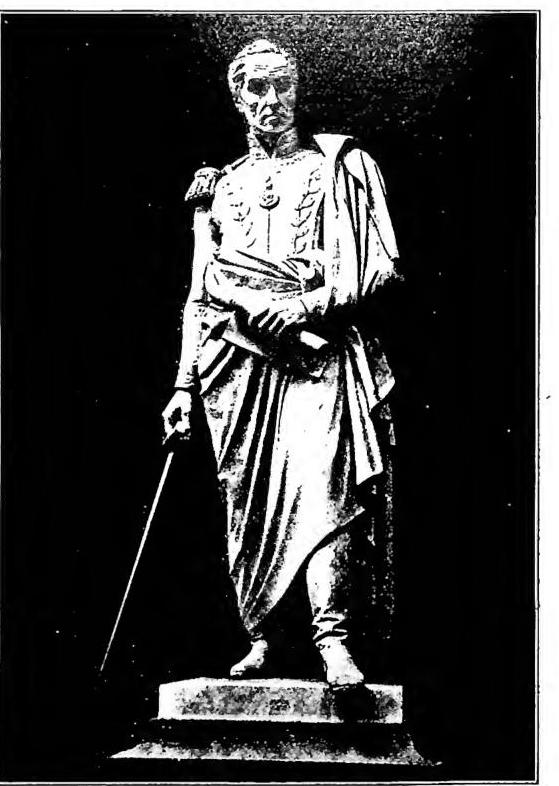
2. Modern History. - At the Congress of Angostura, on 17 Dec. 1819, the Republic of C. arose. Its first president was Simon Bolivar, « Libertador de C., padre de la patria, terror de los tiranos ». The new State (Gran C.) comprised not only present-day C., but also Venezuela and Ecuador. The constituent assembly of Cucuta in 1821 showed itself highly favorable to the Catholic religion, and the new republic immediately sought to establish ties with the Holy See, but this intention was obstructed by the right of patronage which the king of Spain exercised over the South American dioceses. The mission to Rome of the Colombian envoy Texada consequently failed in Sept. 1824. Only after the battle of Ayacucho (9 Dec. 1824), which marked the definitive end of Spanish rule in South America, and the recognition of the new State by Great Britain, did Leo XII decide on 18 Jan. 1827 to proceed motu proprio with the provision of the vacant episcopal sees. This measure, joyfully welcomed by the Catholics of C., received the particular approval of Bolivar, who subsequently issued a series of laws favorable to the Church. After the assassination of Sucre, the « Libertador »’s favorite disciple (4 June 1830), and Bolivar’s resignation and death (17 Dec. 1830), the Republic of C. was divided into the three states of Venezuela, Ecuador, and New Granada, and in 1861 its name was changed to the present one of C. Since the convention of the new State had expressed the most fervent wishes to establish regular relations with the Holy See, President Santander entrusted the aforementioned Texada with the relevant negotiations; in Nov. 1835 he obtained recognition of the Republic by the Holy See and the establishment of a papal diplomatic representation in Bogotá. Under the presidency of General Herran, a new constitution was promulgated in 1843; the Catholic religion was recognized as the religion of the State, and the Society of Jesus, expelled in the time of Charles III, was readmitted into the territory of the Republic. The two subsequent decades, until 1867, witnessed the triumph of radicalism and the sectarian predominance of Mosquera, who exiled the bishops, confiscated the property of the convents, and sought by every means to subject ecclesiastical ministers to state authority: in fact, the new constitution of 21 May 1853 and the law of 15 June of the same year had sanctioned the separation of Church and State. The internal life of the Republic was disturbed by continuous revolts and party struggles. Liberals and conservatives, federalists and centralists, ceaselessly contested for power, until the constitution of 5 Aug. 1886 marked the triumph of the conservatives and the centralists. The name United States of C., in use since 1861, was replaced by that of Republic of C., and the federal states, having lost their autonomy, became departments under the dependence of the central authority. On 31 Dec. 1887, a concordat with the Holy See was signed in Rome, proclaiming the Catholic religion the religion of the State, assuring the Church full freedom, and guaranteeing that education would be conducted in conformity with Catholic dogmas and morality: the concordat had been made possible by the new constitution of 6 Aug. 1886 (cf. especially arts. 51 and 56, the latter now modified by arts. 13 and 34 of the law of 5 Aug. 1936). In 1892 there was also a supplementary convention concerning ecclesiastical jurisdiction, cemeteries, and civil status; and on 29 Dec. 1902 an agreement was concluded for the erection of new apostolic prefectures. In 1903 a revolt broke out in the department of Panama which the troops of the central government were unable to suppress: as a result, the department, with the support of the United States, established itself as an independent republic. During the First World War, the diplomatic representation of the Holy See was raised to the rank of nunciature. On 5 May 1928, an agreement was concluded between the Holy See and C. concerning mission territories, establishing among other things (art. 12) that the appointment of civil officials in mission territories would be made only after consultation with the apostolic nuncio, so as to ensure that they were persons favorable to the missions. A convention containing additions and modifications to the concordat of 1887 concerning the appointment of bishops, the full recognition of the civil effects of canonical marriage, and the transfer of cemetery administration from ecclesiastical to civil authority was signed in Rome on 22 Apr. 1942.
III. ART OF C
Like all the other countries of Central America, at the time of its discovery C. possessed a flourishing indigenous civilization, which became completely extinct with European infiltration, except in a few manifestations of popular art. After the conquest, the influence of the Spanish Baroque was felt especially in architecture and in the sculptural and pictorial decoration of church interiors.In painting, particular prominence was attained by Gregorio Vásquez Ceballos of Bogotá (1638–1711), a pupil of Gaspare de Figueroa, who was the first painter of distinction in C. Vásquez’s art, almost entirely unfamiliar with European forms, achieved especially happy moments in the Portrait of d. Enrique Burbasa (1698) in the church of the Rosario and in the Preaching of s. Francesco Soverio in the Sagrario of Bogotá. After him, other painters and sculptors, among them Paolo Caballero and Miguel de Santiago, Giovanni de Cabrera and Antonio de Pimentel, faintly reflected Italian influences. In the 19th century, after national independence had been won, a new expressive language was introduced into C. by artists such as the painter Epifanio Garay, who had studied in Europe, and by foreigners who had gone to C., such as the Italian sculptor Cesare Sighinolfi, for many years a teacher at the Academy of Fine Arts in Bogotá.
For literature, V. BRAVO-AURICANA LETTERATURA.
IV. THE SCHOOL SYSTEM OF C
The educational reform of 1930 was carried out through the efforts of the Colombian educators Agustín Nieto Caballero, Luis Lopez de Mesa, Gustavo Santos, and Carlos Grazia Prada. The entire school system is divided into kindergartens lasting 2 years, primary schools lasting 5 years, complementary schools, also called vocational or rural schools, lasting 2 years, secondary schools called « Colegios de bachillerato » lasting 6 years, and professional schools divided into normal schools and universities.The universities are as follows: Universidad Nacional, in Bogotá, founded in 1867; Universidad de Antioquia in Medellín; Universidad de Bolívar in Cartagena; Universidad de Nariño in Pasto; private institutions: in Bogotá, the Catholic university « Colegio Mayor de Nuestra Señora del Rosario », founded in 1652; the Universidad Libre, founded in 1923; Bogotá (v.), and Medellín (v.).
The following missionary schools exist in C.: 83 catechism and prayer schools, 538 primary schools, 13 lower secondary schools, 13 upper secondary schools, 2 normal schools, and 1 professional school. The education of the Catholic clergy is carried out in the 13 major seminaries and the 3 minor seminaries, of which that of Las Casas is a missionary seminary. — Vedi Tav. CXXVI.