
NORWAY. –
I. GEOGRAPHY
The territory of N. corresponds to the western part of the Scandinavian Peninsula, from North Cape to the Skager Rak, and consists of the narrow Atlantic strip over which the inland plateau rises precipitously, as well as a portion of the opposite southwestern slope. Mountains and plateaus predominate there (in the interior), together with long, deep valleys that open onto the coast in the characteristic fiords, generally bordered by swarms of small islands. The prevalence of humid westerly ocean winds and the beneficial presence of a warm sea current ensure the coastal zone a relatively mild climate, with winters that are not severe and cool summers; the rainfall, abundant everywhere, permits luxuriant growth of meadows and forests (conifers) in the less elevated areas. The Atlantic watercourses are numerous but short; those that flow into the Skager Rak are somewhat longer (the longest being the Glommen), and all are usually interrupted by rapids or waterfalls.Barely 3.5% of the territory consists of arable land and meadows, one-sixth of forests, and the remainder is unproductive. The shallow seabed along the coast and the mild temperature of the marine waters permit the development of a rich fish fauna (cod in the N., herring and mackerel in the S.). The country’s economy is therefore founded on maritime activity (fishing and commerce), but industry also plays a relatively large part, owing to the abundant availability of hydroelectric power, timber (cellulose, paper), and mineral resources, which are more varied (copper, silver, nickel, molybdenum, zinc) than plentiful (iron and pyrites, however, are available in good quantities). Particularly flourishing are metallurgy, electrochemistry, and mechanical industries, alongside which should be mentioned the fish industries (oils and canned goods) and food industries (condensed milk, cheese, butter), which are connected with extensive animal husbandry (including fur-bearing animals).
(courtesy of the British Council)
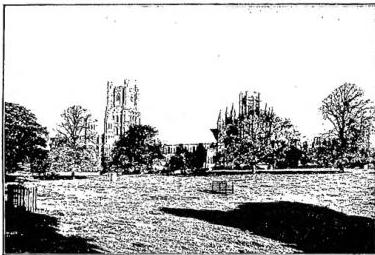
NORTHAMPTON, DIOCESE OF – Ely Cathedral (in the diocese). Founded in the 7th century and rebuilt in the 14th century.
N. is a constitutional monarchy: legislative power belongs to the Storting (150 representatives, elected for four years by direct universal suffrage), which in turn is divided into the Lagting (or upper chamber; one-fourth of the representatives) and the Odelsting (or lower chamber). Almost the entire population is Lutheran (the Catholics number no more than 3,000).
The Arctic archipelago of Svalbard (63,000 sq. km.), with a fluctuating population of miners (coal) and seal hunters, and Jan Mayen Island in the Arctic belong to N.; as do the Bouvet, Peter, and Principessa Ragnhild Islands in the Antarctic.
II. CIVIL AND ECCLESIASTICAL HISTORY
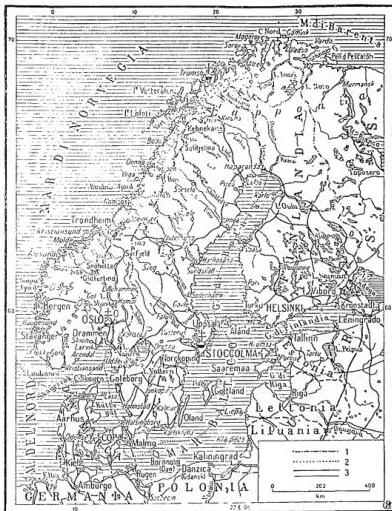
In pagan N., the first attempts to Christianize the country date back to King Haskon the Good, who was baptized and educated in England and, in the 10th century, unsuccessfully attempted to convert his people. His mission failed, but it was taken up again by King Olaf Trygævesson, who, around the year 1000, succeeded in introducing the religion of Christ into the country and persuaded most of his subjects to renounce paganism. His successor Olaf Haraldsson (1015–30), venerated as a saint after his death, was likewise a fervent supporter of Christianity and requested that the archbishop of Hamburg-Bremen sendNORVEGIA - 1) State boundaries; 2) ecclesiastical circumscription boundary; 3) railways.
 | Regions (and Provinces or Fylker) | Area in sq. km | Census population 1946 | Density per sq. km |
|---|---|---|---|---|
| Northern N. (Finmark, Troms, Nordland, Nord-Trøndelag) | 134,954 | 494,163 | 3.6 | |
| Central N. (Sør-Trøndelag, Møre og Romsdal, Sogn og Fjordane, Oppland, Hedmark) | 105,670 | 797,879 | 7.5 | |
| Southern N. (Bergen, Hordaland, Rogaland, West Agder, Aust Agder, Telemark, Vestfold, Buskerud, Østfold, Akershus, Oslo) | 81,299 | 1,865,215 | 22.9 | |
| Total (including inland waters) | 324,132 | 3,157,257 | 9.7 |
of German missionaries. Under the reign of Olaf the Taciturn, the dioceses of Bergen, Oslo, and Nidaros (Trondheim) were established during the eleventh century; they remained under the jurisdiction of Hamburg-Bremen until 1104, when they passed under the authority of the newly erected archdiocese of Lund. In 1152 the Holy See sent to N. Cardinal Breakspear, the future Pope Adrian IV, as apostolic legate; he proceeded to establish the archbishopric of Nidaros with ten suffragan dioceses: Bergen, Stavanger, Oslo, Hamar, the Faroe Islands, Gardar in Greenland, Holar and Skalholt in Iceland, the Orkney Islands, and Man. The Church acquired ever greater importance in the life of the country.
From the fourteenth century onward, the history of N. became closely intertwined, because of the struggles over the succession, with that of Sweden and Denmark. The Union of Kalmar in 1397 also outwardly united the three Scandinavian states: from then on, the kings of Denmark were likewise kings of N. After the abdication of Christian II (1523), the ties between Denmark and N. were severed, and for a moment it seemed that N. would no longer be subject to Danish rule. The political energy of Frederick I and Christian III nevertheless succeeded in reasserting Danish sovereignty over the country. Meanwhile, the Protestant Reformation had begun to spread in N. The first to preach the new faith there was a German monk named Antonio, who made his first converts at Bergen in 1528. The archbishop of Nidaros, Olaf Engelbrektsson, opposed the spread of Lutheranism; but the accession to the throne of Christian III, who introduced the Reformation into Denmark in 1536 and reasserted his rule over N. by conquering it with arms, forced the metropolitan to flee to Holland, where he died in 1538. The Catholic Church was thus left completely at the mercy of the victor. Christian III proceeded to expel the bishops and confiscate ecclesiastical property. The Danish ecclesiastical ordinance of 1537 also came into force
in N. Lutheranism was proclaimed the state religion. Danish liturgical texts—the Bible of Christian III Pedersen (v.), the Danish version of Luther’s Catechism, etc.—were introduced into the country. Only in 1607, under the reign of Christian IV, did N. receive its own ecclesiastical ordinance; although in substance it was merely the Danish ordinance of 1537 in revised form, it nevertheless took account of the country’s particular conditions. The political rivalry between Denmark and Sweden, both of which sought to assert their dominion over the Baltic Sea and the straits leading to it, also had repercussions in N., whose army took part in the campaigns against Sweden. N. nevertheless always preserved its territorial integrity and remained united with Denmark until the beginning of the nineteenth century. From the religious point of view, in the centuries following the Reformation N. underwent an evolution analogous to that of Denmark. In N. as in Denmark, there was a struggle between the so-called Crypto-Calvinists and the orthodox, who gained the upper hand around the middle of the seventeenth century. During the eighteenth century, Pietism, originating in Denmark and Germany, spread throughout the country. The economic difficulties that directly resulted from the naval blockade of the European coasts proclaimed by England during the Napoleonic era contributed to the national revival, which had been increasingly asserting itself toward the end of the eighteenth century. Suddenly isolated, threatened in the east by Sweden, allied with England, and reduced to extremely critical conditions by shortages of supplies, which were inexorably intercepted by the British fleet, N. was compelled in 1807 to establish a Government Commission, which agreed upon a modus vivendi with England. After the abdication of King Gustavus IV, Sweden allied itself with Russia and the powers of the anti-Napoleonic coalition, declared war on Denmark, and forced it by the Peace of Kiel (1814) to renounce in its favor all rights over N. At first the Norwegians refused to recognize this cession of their country and, having assembled in a constituent assembly at Eidsvoll, drew up a constitution proclaiming N. a hereditary monarchy with a parliamentary system; they subsequently reached an agreement with Sweden. From 1814 to 1905, N. was united with Sweden, an arrangement that guaranteed it full autonomy and independence on the basis of the fundamental law of Eidsvoll, but with the king of Sweden as head of state (personal union). The union was dissolved, after negotiations between the two states, in 1905; and, following a popular referendum in favor of a monarchical form of government, Prince Charles of Denmark was proclaimed king, taking the name Haakon VII. During the First World War, N. succeeded in maintaining its neutrality. This was not the case, however, during the Second World War: in April 1940 it was attacked by the Germans; after fierce resistance, the Sovereign was forced to seek refuge in England, and Germany took advantage of the situation to install in the country a collaborationist government headed by Vidkun Quisling. After the war ended, Haakon VII returned to his homeland. In 1949 N. was one of the states that signed the Atlantic Pact.
Apostolic vicariate and prefectures. - On 23 September 1783, the apostolic vicariate of Sweden was erected; it also included N. The latter was established as a mission tui iuris on 7 August 1868, elevated on 17 August 1868 to an apostolic prefecture, and on 11 March 1892 to an apostolic vicariate.
On 1 June 1913, the islands of Spitsbergen (or Svalbard) were annexed to the vicariate, which received the name Apostolic Vicariate of N. and Spitsbergen. By decree of 15 December 1925, it was restored to its former name. In 1931, the northern and central territories were detached in order to establish the district of Central N. (7 April 1931) and the district of Northern N. (8 April 1931). The apostolic vicariate of N. was Oslo (v.). On 10 March 1944, the two apostolic districts became apostolic prefectures.
The Apostolic Prefecture of Central N., entrusted to the Congregation of the Sacred Hearts of Jesus and Mary, has an area of 56,234 sq. km and a population of 500,000 inhabitants, of whom 235 are Catholics. There are 5 priests, 49 nuns, 1 elementary school with 6 pupils, and 4 chapels; the Ordinary resides in Trondheim.
The Apostolic Prefecture of Northern N., entrusted to the Missionaries of the Holy Family, has an area of 176,760 sq. km and a population of 360,000 inhabitants. There are 226 Catholics, with 8 priests and 27 nuns. There are 4 churches, 1 elementary school with 72 pupils, and 3 hospitals with 125 beds.
III. LITERATURE
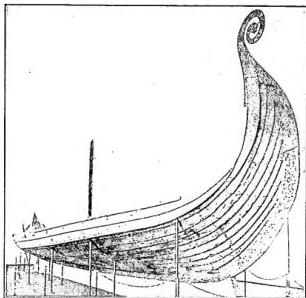
At its beginnings, Norwegian literature is difficult to separate from Icelandic literature, to such an extent that the comprehensive term Norse literature was coined. Mythological and heroic material common to the entire Scandinavian world and, in part, also to the Germanic world is found in the songs of the Edda, and the skalds of Iceland were famous throughout the North; they soon replaced the local skalds even at the Norwegian courts. The prose sagas, too, although so characteristic of Iceland, frequently contain echoes and recollections of the Norwegian world, and it was to an Icelander, Snorri Sturluson (1179–1241), that the first historyNORVEGIA — Viking ship — Bygdøy, near Oslo.
With the conversion to Christianity and the introduction of writing, the conditions for a national literature seemed to be taking shape; but during the Middle Ages N. produced nothing of note, having declined both politically and economically. When, around the sixteenth century, there was a revival in the cultural sphere as well, there was practically no longer a Norwegian language, but only dialects, and the literary language was that of the conquering country, Denmark. For another two centuries, therefore, individual Norwegian authors would work within Danish literature.
Of the scant medieval literature in Latin, besides several historical works and collections of laws and sermons, it is worth recalling a few fine religious hymns, including the sequence in honour of S. Olaf, Lux illuxit laetabunda, still sung in Norwegian Catholic churches. The numerous Folkeviser, transmitted orally for generations, are probably no more than a local reworking of Danish Folkeviser; perhaps of native Norwegian origin are the so-called Trollevier, of a more fantastic inspiration. There are numerous translations and adaptations of the chivalric poems widespread in medieval Europe: more interesting are a Kongespeilet (“Mirror of Kings”) of 1260 and a Draumkvaedet (“Vision”) of apocalyptic tone, composed around 1300. N. has nothing to say, either politically or literarily, during the fourteenth, fifteenth, and sixteenth centuries: the influence of Humanism brought about a slow awakening of letters and of national consciousness, but the “Reformation” soon followed, accepted everywhere without opposition and without any felt need for a translation of the Bible of their own. Among the works due to humanists are Om Norges Rige (“On the Kingdom of N.”) by Absalon Pedersson Beyer (1528–75), also known for his Diary, and the Norges Beskrivelse (“Description of N.”) by the Protestant pastor Peder Claussen Friis (1545–1614), translator of Snorre’s sagas of the Norwegian kings, which thereby became part of the national heritage. Greater circulation outside N., because it was written in classical Latin, was enjoyed by the Chronicum regum Norvegiae of Hallvard Gunnarsøn (1545–1608). The Protestant pastor Peter Dass (1647–1707) acquired great popularity with his poetic work Nordlands Trompet (“Trumpet of the North”), in which the nature and inhabitants of northern N. are described for the first time. The psalms of Dorothea Engelbretsdatter (d. 1716) are baroque and sentimental. The lyric poetry of Peter Christopher Stenersön (1723–76) and Christian Baumann Tullin (1728–65) may be considered Norwegian; the work of the dramatist L. Holberg (1684–1754), however, though Norwegian by birth, belongs to Danish literature, as do the writings of the so-called “Norwegian Society,” founded in Copenhagen in 1772 by Norwegian students (N. did not have its own university until 1811), with vague literary and nationalistic aims. Rather than in Germany, from which the first romantic voices were coming, these young men sought their literary models in France: J. Nordal Brun and Niels Krogh Bredal, among others authors of tragedies in that classicistic style so effectively parodied by J. H. Wessel (1724–85) in Kaerlighed uden Strømper (“Love without Stockings”), are regarded as epigones of classicism in the French taste, albeit within an atmosphere of vague pre-Romanticism. Of the other members of the group, it will suffice to recall Claus Fasting, Jens Zetlitz, and E. Storm. N. was the last of the Scandinavian countries to accept, not without reservations, the new Romantic gospel, brought to the North by the Norwegian H. Steffens (1773–1845). The Romantic concept of “nation,” however, contributed to the national awakening: in 1814, not a few members of the “Norwegian Society” would take an active part in the proclamation of independence. Meanwhile, amid political struggles and new national problems, two currents were also forming in the literary field: that of the “intellectuals,” culturally linked to Denmark and, through it, to Germany and Europe, and that of the “patriots,” interested only in whatever was Norwegian, as demonstrated by the novellas of Mauritz Hansen and the works in the Norwegian dialect of H. Anker Bierregaard. The clearest representative of the new Norwegian world then taking shape was H. Wergeland (1808–45). A gifted and highly energetic temperament, endowed with great powers of persuasion and genuine poetic gifts, but incapable of formal rigour and self-criticism, he looked enthusiastically upon the contemporary nationalist movements in Europe; yet what truly interested him was N. and its people. Of his production, now largely superseded, it is more worthwhile to recall the two collections of poems Første Ring and Anden Ring (“First Ring”; “Second Ring”) than the cosmic drama Skabelsen, Mennesket og Messias (“Creation, Man, and the Messiah”) of 1830, in which the figure of Christ is presented in the light of the new political and social ideas that would lead in France to the July Revolution. The temperament of the other representative of Romanticism, J. S. Welhaven (1807–73), was quite different; in vehement polemic with Wergeland, he contributed considerably to the development of N.’s literary life. For him, the breaking of relations with Denmark and Germany meant the end of N. Although he yielded to the fashionable romantic nationalism, his sense of proportion always made him an enemy of every rhetorical exaggeration concerning the documents of the national past, even though he urged young people to study them. Welhaven, too, is chiefly important as a lyric poet, as shown by the four collections of poems published from 1839 to 1860.
The greater political stability that followed 1840 helped to temper the bitterness of the literary polemics; the ancient documents, too, began to be studied with genuine scholarly interest. Thus arose the collections of national fairy tales and legends by Asbjørnsen and Moe (Norske Folkeeventyr; Folkesang), while the Folkeviser, still transmitted orally in the countryside, were transcribed and published by Landstad and Bygge. The desire for a national language and the ever-growing interest in dialects led to the opposition of the “Riksmaal,” very close to Danish despite the increasingly widespread desire for differentiation, and the “Landsmaal,” artificially created as a literary language but scientifically based on the country’s oldest dialectal tradition. The creator and codifier of the new language was Ivar Aasen (1813–96), author of the Norske Folkesprogsgrammatik (“Grammar of the Norwegian Popular Language,” 1848), the Ordbog over det norske Folkesprog (“Dictionary of the Norwegian Popular Language,” 1850), and poems in “Landsmaal.” Despite the contribution of O. Vinje (1818–70), “Landsmaal” established itself only with difficulty as a literary language, nor has it yet succeeded in entirely replacing “Riksmaal.” While O. Vinje’s Ferdaminni paa Sumøven (“Travel Memories”) already heralds Naturalism, a conventional Romanticism is still found in the dramas of A. Munch (1811–84), also the author of fine lyrics, and in the works of J. Moe (1813–82), the collector of popular legends.
Having completed its artistic and literary apprenticeship, N. was now ready to appear on the European literary stage. The Wergeland–Welhaven pairing seemed to be repeated in a different climate and with far greater European resonance with the appearance of H. Ibsen ([v.] 1828–1906) and B. Bjørnsen: tempestuous and tormented the former, enthusiastic and optimistic the latter, both formed by the Romantic experience and both committed to a naturalistic representation of the problems of contemporary society.
If Ibsen seemed to take up Welhaven’s task as critic of his own people, Bjørnsbjørne Bjørnsen (1832–1910) consciously continued Wergeland’s inspiring work among the young. Open to every influence and every enthusiasm, trusting in life and in men to the point of naivety, despite his moral intransigence, Bjørnsen, unlike Ibsen, possessed the gift of stirring the masses as a lecturer, journalist, dramatist, and novelist, despite the opposition of certain conservative circles. This makes it difficult to assess the value of his vast output, part of which has been forgotten. Of purely literary interest are the dramatic works of his first Romantic and Grundtvigian period, inspired by Nordic antiquity, whereas the short stories of the same period are among his finest works. A small masterpiece is Synnøve Solbakken (1857), in which the world of the Norwegian peasantry is presented with an immediacy that directly recalls the tradition of the sagas. But around 1870 Bjørnsen rejected the world of Grundtvig and Danish Romanticism in favor of that of Brandes, Darwin, and Spencer, although his intransigence in ethical matters soon led him to assume an isolated position. After several dramas of democratic tendency, he provoked a genuine storm with the drama En Handske (“A Glove,” 1883), in which his proclaimed equality of the sexes led him to demand premarital chastity for men as well. Greater in both human and poetic value is the drama Over Aevne (“Beyond Our Strength,” part 1, 1883; part 2, 1895), imbued with a religious spirit despite its ever-present anti-Christian polemic. The burning issue of En Handske is taken up more fully in the novel Det flager i Byen og paa Havnen (“Flags over the City and the Harbor,” 1884); perhaps superior is Paa Guds veje (“On God’s Paths,” 1889), with which Bjørnsen returns to the world of the peasants that had inspired his first short stories, in order to proclaim a human morality not bound to any confession.
With Ibsen and Bjørnsen, the golden age of Norwegian theater comes to an end (the dramas of Gunnar Heiberg may still be recalled): from now on, in order to make their voices heard in the political and social struggle, writers will turn to the novel, following the path already marked out by Bjørnsen and, earlier still, by Camilla Collett (1813–95), who contributed greatly to the nation’s intellectual and literary development, even beyond the field of women’s claims. Among other things, she encouraged Asbjørnsen and Moe in their work of collecting the national heritage and, even before Ibsen, presented contemporary society with the problems of women and marriage in the novel Amtmandens Døtre (“The Prefect’s Daughters,” 1855), her masterpiece.
The great age of the novel now begins for N.: the fruit of a fruitful grafting of French naturalism and the Russian novel onto the native narrative tradition of the saga. The first novelist of the new generation is Jonas Lie (1833–1908), who did not intend to become a reformer of morals, content to alternate naturalistic descriptions of setting and impressionistic landscape sketches with gloomy visionary fantasies.
Whereas Lie was concerned exclusively with the life of the individual, taking pleasure in subtle psychological investigations, A. Kielland (1849–1906), a tempestuous fighter, addressed himself exclusively to the political and social problems of his age. Coming from the upper bourgeoisie, his wealth produced in him something like a sense of guilt that led him, at least in literary terms, into the democratic camp, which he soon abandoned, disappointed. Endowed with great formal taste, he did not neglect to shape his style through contact with French naturalism, although he used literature as a means of struggle: proof of this is provided by the two novels Garman og Worse (1880) and Skipper Worse (“The Sailor Worse,” 1882), his finest works.
More than Elster, who continued Jacobsen’s work in N., and Amalie Skram, who was likewise interested in the problems of women and marriage, Arne Garborg (1851–1924) deserves mention. At once mystical and intellectual, brought up in a rigid Pietist environment and therefore hostile to Brandes and Bjørnson, in his youth he was unable to resist the influence of European naturalism, later arriving at Symbolism and a vague aestheticizing religiosity; his opposition to naturalism is also deliberate in his lyric poetry.
Heir to the now-established Norwegian narrative tradition, although he began his literary career by protesting against the four great writers (Ibsen, Bjørnson, Lie, Kielland) in favor of the younger generation, is Knut Hamsun (born in 1859). An admirer of Dostojewski and Nietzsche and bound by an almost physical love to his native land, after a brief journey to America he united in his protest industrialization, socialism, pacifism, feminism, and internationalism; against these he set, on the one hand, an unrestrained individualism and, on the other, the most ancient values of the land and of the ancestors, seen in the light of a romantic nationalism. His novels enjoyed great success throughout Europe; the utopian Markens Grode (“The Seed of the Earth,” 1917) earned him the Nobel Prize.
Joined with Hamsun in protesting against the leveling of modern life, but very far from him in his conclusions, is Hans E. Kinck (1868–1926), a fine writer and an intelligent investigator of the soul of his people. In his wake, or rather in that of Hamsun, many novels of a, so to speak, “homespun” type have appeared in N. in recent years: worthy of its European reputation is Den sidste Viking (“The Last Viking”) by Johan Bojer (1872), which describes the harsh life of the fishermen of the Lofoten Islands.
The profoundly Christian Norwegian Middle Ages, although largely based on pagan tradition, comes to life again in the magnificent historical novel Kristin Lavransdatter (“Kristin, Daughter of Lavrans,” 1920–22) by Sigrid Undset (v. 1882–1949), the first Norwegian writer and the first Scandinavian Catholic woman to receive the Nobel Prize.
A very different milieu is presented in the social novels of the proletarian writers Johan Fahlberget (1879) and Kristofer Uppdal (1878), while Olaf Dunn (1876) attempts, with Juvifolke (“The Juvikinghi,” 6 vols., 1918–23), to create a powerful saga-like epic extending from prehistoric times to the present day.
The spiritual and economic distress of the postwar period is present in both the narrative and dramatic works of Helge Krog and Sigurd Hoel (1890), who, from the radical camp, took part in the struggles of those years and were soon sadly disappointed in their revolutionary enthusiasms. The poet Arnuld Overland (1889) underwent a similar experience, expressing in a form of classical sobriety his prophetic anguish over what was threatening the world. The revolutionary polemic of Rudolf Nilsen (1901–29) is more direct.
Lyric poetry has, on the whole, remained inferior to narrative, despite the excellence of certain poets, including Ibsen and Bjørnson. But nothing essentially new is found in the sentimental poems of Nils Colett Vogt (1887), inspired by Wergeland; more inspired are the Symbolist poems of Sigbjørn Obstfelder (1866–1900), the expression of a poet’s hypersensitive temperament, pervaded by a sense of anguish before the mysteries of the universe (his novels Korset [“The Cross”] and En Praest Dabgog [“The Diary of a Pastor”] should also be recalled). At the beginning of the century, the great Scandinavian lyric poetry of Drachmann and Jacobsen, Fröding and Heidenstam exerted a considerable influence: the influence of the Danish poets on Herman Wildenwey (1885) was direct. The greatest of modern Norwegian
poets is undoubtedly Olaf Bull (1883–1933). Among the poets writing in “Landsmaal,” the greatest is Olaf Ankrust (1883–1929).
To return to the novel, around 1830 the echo of the worldwide crisis also makes itself felt in Norwegian literature: social concerns, psychoanalysis, American narrative, and journalistic style are the experiences of novelists such as Nils Johan Rud, Aksel Sandemose (1899), Arthur Omre, Johan Borgen, and Gunnar Larsen.
Less “modern” in this sense, but interesting for their psychological analyses and an almost religious sense of guilt, are the novels of Sigurd Christiansen; the long path that would lead women to definitive emancipation is once again indicated by Cora Sandel in her cycle of novels concerning Alberta.
Among the novelists more directly engaged in the social struggle and, subsequently, in the struggle against the invading Germans, the foremost is Nordhal Grieg (1902–43), who fell tragically over Berlin before his great love of his country and his communist creed could produce any conflict within him.
IV. ART
From the prehistoric ages (beginning with the Stone Age), numerous artistic testimonies exist in N., represented by engravings and rock paintings with exceptionally vivid depictions of animals; in historical times bronze and iron were introduced early, probably in the pre-Roman period. During the Migration Period (A.D. 400–800) and the Viking Age (800–1050), the type of civilization and art is revealed more clearly through the objects found in the ships of Viking chieftains.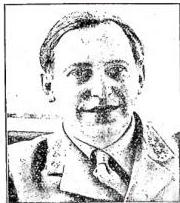
The following are built of stone, in a heavy but distinctive style: the church of St. Mary in Bergen and the most important church in N.: St. Olaf of Trondjem, which for centuries was the coronation church of the Norwegian kings and is now almost in ruins. As for civil architecture, the lords’ palaces, fortifications, and simple dwellings were likewise built of wood; the first royal palace in stone, in Bergen, was commissioned by King Haakon Haakonsson in the 13th century.
(from Norway, Oslo 1933, plate following p. 21)
NORVEGIA - Portrait of Nordahl Grieg, Norwegian poet and hero.
Few examples of minor wooden constructions remain: the finest are in the Folk Art Museum near Oslo. In the succeeding centuries, the influences of the British Isles were joined by those of the rest of Europe: in the late Renaissance a greater sense of balance can be observed, as appears in the façade of the Ronskranstz tower at Bergen, dating from 1560. In the eighteenth century, a period of greater economic prosperity, architecture received considerable impetus, and the influences of French Rococo became more pronounced, also in wooden architecture, which sometimes imitated the Louis XVI style.
After the union with Sweden, there were greater contacts with the rest of Europe, and an official neoclassical architecture emerged (the Royal Palace of Oslo, 1824–48; the University of Oslo, 1841–53). In the second half of the nineteenth century, there were German influences, to which Holm Munthe (1848–98) reacted by introducing the so-called “dragon style,” national in character but eclectic and floral in spirit.
From 1920, the neoclassical style returned to fashion; in modern times it has been challenged by the “functional” style, which entered through Sweden. An interesting example of a modern interpretation of medieval forms is Oslo City Hall.
Norwegian sculpture, like painting, is represented principally by portraiture, an art form cultivated in N. from the earliest times: portraits of kings and bishops, both in wood and in stone, were found in medieval churches, and many of them, fragmentary, are preserved in museums (Oslo, Bergen, Larvik). With the introduction of Lutheranism, sculptural representations were restricted, and the severity imposed meant that the nude appeared only in the nineteenth century.
The painting of the early centuries preserves antependia with tempera figures in a distant Catalan style: many wooden churches are painted inside, like that of Torse, with Byzantine representations and iconography; later, painting reflects Gothic and German influences, while landscape was introduced rather late. Jacob Munch (1776–1839) spread a neoclassical taste, while Matthias
Stoltenberg (1799–1871), a Dane, gave impetus to Norwegian genre painting. Frederick Collet (1839–1914) was the first Norwegian painter of “plein-air” painting. Impressionist tendencies and those of other international movements followed: Revold and Khrohg Rolfsen cultivated fresco painting with Cubist overtones.
But the art forms that best express the local character are craftsmanship and applied art. The earliest examples are the objects found in the ships of the Vikings, discovered near the Oslo fjord; after serving for navigation, these had been used as tombs for chieftains and buried beneath large mounds. Two of them are preserved in the Industrial Museum at Bjgdo near Oslo: the Gokstad ship and the Osebergh ship, so called from the places where they were found. They are respectively 17 and 23 metres long and, besides demonstrating the perfection of Norwegian naval architecture in the ninth century, yielded shields, weapons, sledges, wagons, ornamental objects in wood and metal, carved and engraved objects, and textiles of the period, of incomparable historical and artistic importance.
V. EDUCATIONAL SYSTEM
Following the ideas of N. Grudtvig, the Norwegian school seeks to cultivate in young people a spirit of Christian solidarity according to Protestant conceptions, and love of the fatherland.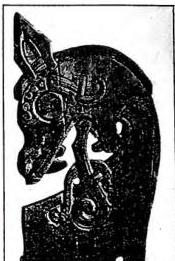
The Norwegian school system comprises: a) primary popular schools, mainly municipal, but also denominational, state, and private; b) secondary schools of various types: mainly theoretical, preparing students for higher studies; technical; vocational; teacher-training; post-elementary schools for adults. University and higher education are provided at the two Universities of Oslo (founded in 1811) and Bergen (founded in 1948), and at the nine Higher Schools: of agriculture at Aas; of technology at Trondheim; of
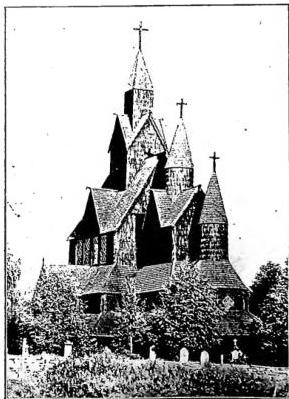 (from Norway, Oslo 1915, plate after p. 55) NORVEGIA - Medieval church (Stavekirke) - Urnes (Sognefiord). | 1. | 2. | 3. | 4. | 5. | 6. |
|---|---|---|---|---|---|---|
| C' | sum | BFIO | bucifano | B | bu | |
| D' | bu, bsm | BDC | bruto | D | bu | |
| E' | bu | BDCS | bruto | ft | bu | |
| H' | bu | BDUM | bruto | ft | bu, fcc | |
| M' | bu | BDIS | bruto | M | bu | |
| N' | bu | BTATEM | bruto | ft | bu, u | |
| P' | pu, pu | N | nu | ft | bu, u | |
| R' | bu | TT | tradu | P | bu, u | |
| S' | bu, tu | TT | tradu | S | bu | |
| T' | bu | TT | tradu | TT | bu | |
| 2. | 2. | 2. | 2. | 2. | 2. | |
| AT | bu | M | mu | ft | bu |
(from V. Steffens, Pultographic latine, French ed., Tressiri 1918, p. 33)
NOTAIE IURIS - Table of abbreviations drawn from juridical manuscripts.
dentistry at Oslo; veterinary medicine at Oslo; commerce at Bergen; fine arts at Oslo; Protestant theology at Oslo; physical education and teacher training at Trondheim. - Vedi tav. CXXIII.