
MOZAMBICO. – Portuguese colony in southern Africa (also called Portuguese East Africa), enclosed between the territories of Tanganyika, Niassa, Rhodesia, and the Union of South Africa.
It covers 771,125 sq. km., that is, more than two and a half times the area of Italy, and consists of a series of plateaus of granite formation, surmounted here and there by isolated elevations (Mount Namuli, 2,700 m.) and preceded along the coastline by a flat belt extending south of the Zambezi. The territory, also on account of its climatic conditions (hot and dry on the plateaus), is suitable for white settlement and lends itself to various tropical crops, foremost among them sugar cane (as well as cotton, peanuts, rice, coconut palms, etc.). Livestock raising is of little importance; mineral resources are perhaps considerable, but have so far remained almost entirely unexploited (small amounts of gold and coal are extracted).
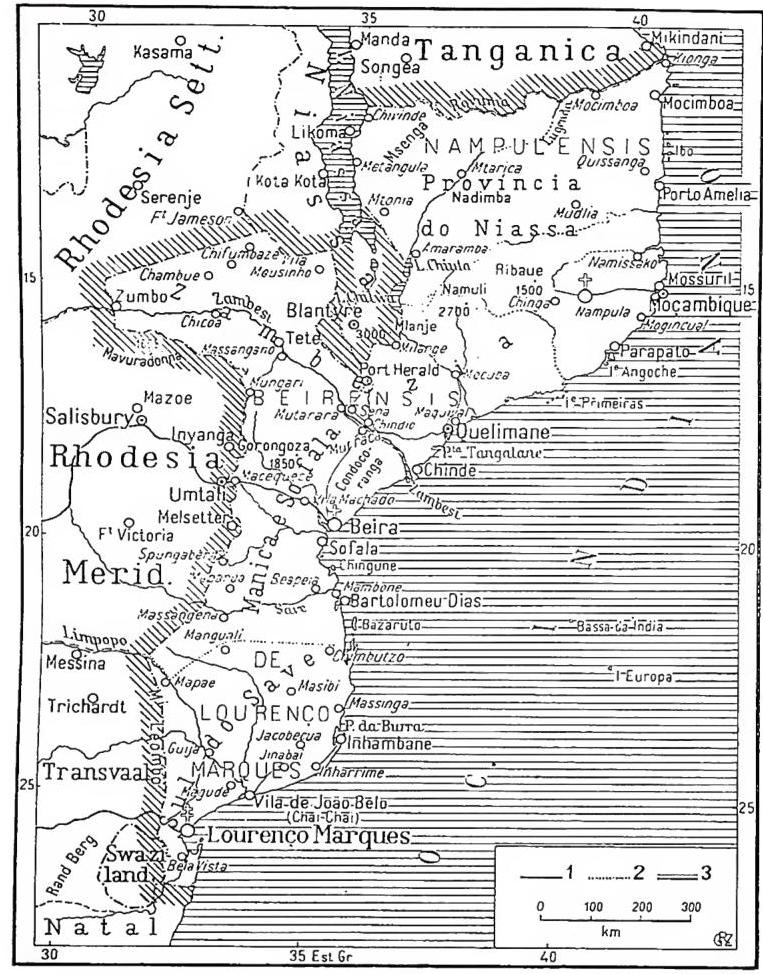
Bantu and mixed-race people. The capital, Lourenço Marques (70,000 inhabitants), is the principal port and outlet for the nearby Transvaal.
From 1563 the Dominicans began the evangelization of the indigenous peoples along the Zambezi River. In 1607 the Jesuits returned to work among the Negroes. In 1612 M. was separated from the archdiocese of Goa as a vicariate or perpetual administration, and from 1783 as a prelature with a titular bishop. The mission among the Negroes made progress, extending after the Portuguese victory over Monomotapa in 1629 also to that Kingdom. But in the 17th century the mission began to decline, owing to the fierce resistance and counterattacks of Islam, the slave trade, and the shortage of capable missionaries. After the Jesuits were expelled in 1759,
missionary activity declined still further, so that in 1822 the Dominicans, the only missionaries remaining, served just six churches in all. With the suppression of the religious Orders in Portugal and the colonies in 1834, the mission had practically come to an end. Only toward the end of the century was missionary activity resumed by the Jesuits, who arrived in the lower Zambezi in 1881; with great sacrifices they founded seven stations, and conversions multiplied. The Portuguese mission in M. itself was renewed through the work of the prelate Antonio José de Sousa Barroso (1891–97), who founded several stations and entrusted them to zealous secular priests. Their number, however, was too small to achieve success on a large scale. In 1898 the Portuguese Franciscans came to their aid. The Jesuits, on the other hand, were again expelled after the Portuguese Revolution of 1910. The Fathers of the Divine Word succeeded them in the Zambezi mission, but were themselves expelled because of the world war in 1915; the secular clergy and the Franciscans took their place. In 1922 the Montfort Fathers began a mission in M., and in 1926 the Missionaries of the Consolata; both achieved slow and limited results among the Muslim population or those under the influence of Islam. The missionary agreement concluded in 1940 between the Holy See and Portugal established the division of M. into three dioceses: the archdiocese of Lourenço Marques with the suffragan dioceses of Beira and Nampula. New missionary forces arrived. In Lourenço Marques, whose archbishop Teodosio Clemente de Gouveia (prelate from 1936 and archbishop from 1941) was honored by Pius XII in 1946 with the cardinal’s purple, there work, in addition to the secular clergy and the Franciscans, the Missionaries of the Society of Cucujães, the Dutch Eucharistines (from 1947), and the Lazarists in the seminary (from 1942). In the diocese of Beira the Franciscans work in the coastal region, the Jesuits are rebuilding the Zambezi mission, and from 1945 the White Fathers have been entrusted with a territory of their own. In the diocese of Nampula the Missionaries of Cucujães, the Montfort Fathers, the Missionaries of the Consolata, and, from 1947, the Capuchins are active. This new organization has given new life to those missions which depend not on Propaganda but on the Sacred Congregation for Extraordinary Ecclesiastical Affairs. The number of Catholics rose from 30,000 in 1936 to 131,000 in 1947, among a total population of 5 million.