
MOZARABICA, LITURGIA. — Liturgy officially used in Spain until the second half of the 11th century, when the Roman liturgy prevailed, but preserved in the following centuries, from the 12th to the 15th, in certain parishes of Toledo and, from the 16th century to the present day, in the chapel of the “Corpus Christi” in Toledo’s primatial cathedral.
I. ORIGIN
It can be stated with certainty that the Mozarabic liturgy as a whole is not of Eastern but of Western origin, and that its general character and numerous rites were imported from Italy, probably from Rome, by the first preachers of the Gospel in Spain; the rest is the work of the bishops, doctors, scholars, and musicians of the peninsula (cf. M. Pérotin, Liber ordinum, cited in the bibliography, p. XIII). It is therefore a liturgy clearly of Latin origin, specifically Roman in its beginnings, but developed especially from the sixth century (when the political unity achieved by King Leovigild gave impetus to liturgical unity, with the conversion of his son Reccaredo to the Catholic faith [587]) until the beginning of the seventh century within its native environment, without further foreign influences. The fathers of the Visigothic period shaped this unity, among whom the most deserving of mention are: Pietro di Lerida (fifth–sixth centuries), St. Leandro di Siviglia (d. 599), and Giovanni, bishop of Saragozza (d. 631). Special mention should be made of the archbishops of Toledo, who worked with great dedication not only to restore the liturgy but also to enrich it with new elements: Eugenio (d. 657), who took a special interest in chant, which was therefore called Eugenian chant; St. Ildefonso (d. 669), author of many Masses and several canticles in honor of St. Leocadia di Toledo; and St. Giuliano (d. 690), who composed hymns and a Missal.II. ABOLITION
In the 11th century the official abolition of the Mozarabic liturgy in Spain took place, at least in Castile, Aragon, and Navarre, although indications remain that in some places, even afterward, the celebration of the Mozarabic liturgy was joined to that of the Roman liturgy, and that the latter was considerably influenced by the former until the unification of the Mass and the Divine Office with the publication of the Missal and Breviary of St Pius V. error, which provoked strong aversion and open hostility toward the Mozarabic rite and led the papal legations sent to examine the rites to abolish II.Apparently, the celebration of the Roman Mass and Office in place of the Mozarabic began in the monastery of S. Salvador de Leyre (Navarre) in 1067, under the reign of King Sancho. The same occurred in March 1071 in the Aragonese monastery of S. Juan de la Peña. Reliable data are lacking concerning the introduction of the Roman rite into Catalan territory, but it may be asserted with considerable probability that in the 8th and 11th centuries the two rites coexisted, or that the Roman rite influenced the Mozarabic rite, especially in chant. The codices preserved in the cathedrals of Vich and Gerona seem to confirm these assertions. Gregory VII continued the work of his predecessors, addressing the king of Spain, the abbot of Cluny, and Bishop Simeon, and making clear his intention of preserving unity in the Church through liturgical unity. The consequence was the establishment of the Roman rite in the kingdoms of Castile and León, in accordance with the decision of the Council of Burgos in 1080; the monks of Cluny, and also Queen Ines herself, the first wife of Alfonso VI, played a considerable part in this change. The result achieved by the Pope was not, however, complete. Toledo, still subject to the Moors, retained its own rite; but after the city fell into the hands of Alfonso VI (25 May 1085), he and the archbishop, with papal approval, imposed the Roman rite. The Mozarabic rite nevertheless remained in the six existing parishes—S. Giusta and Rufina, S. Marco, S. Eulalia, S. Sebastiano, S. Luca, and S. Torquato—as indeed it continued to do until the beginning of the 16th century.
Another cause that brought about the decline of the Mozarabic rite was the fact that there was neither a plenary Missal nor a Breviary, but only the individual books for those taking part in the celebration of the liturgical Offices. There was also the serious inconvenience that these books were written in Visigothic script, whose reading became increasingly difficult for most readers. As the Mozarabic Office was gradually forgotten by those who were supposed to preserve it, it would inevitably have fallen into ruin had the intelligence and zeal of Cardinal Francisco Ximenes de Cisneros not ordered the publication of the plenary Missal (1500) and Breviary (1502), and established the Mozarabic chapel of the «Corpus Christi» in the Primate Cathedral of Toledo, where the Mozarabic liturgy alone now survives.
It cannot be said, on this account, that the liturgy found in the Missal and Breviary of Cisneros is, in all its purity, the Mozarabic liturgy, because it is undeniable that, despite the immense work of the commission of parish priests presided over by Canon Ortiz, it was not possible to formulate the Mass and the Office according to the true Hispanic liturgy.
III. MOZARABIC LITURGICAL CODEXES
The literary sources of the Mozarabic rite are currently found in the codices of the cathedral of Toledo, the National Library of Madrid, the Academy of History, the private library of the King of Spain, the library of the abbey of Silos, the cathedral of León, etc., as well as in various foreign libraries, such as the National Library of Paris, the Chapter Library of Verona, and the British Museum in London. The most important are: the Sacramentary of Toledo (cod. 35, 3), from the second half of the eleventh century; the Orational of Verona, from the end of the seventh or the beginning of the eighth century, the oldest of the Mozarabic codices, originating from the church of Tarragona (cod. LXXXIX: ed. J. Vives, Barcelona 1946); the Liber Ordinum of the abbey of Silos, from the eleventh century; the Antiphonary of León, from the end of the ninth or the beginning of the tenth century (cod. 8 of the cathedral of León). All the codices currently known, with the exception of the Orational of Verona and the Antiphonary of León, date from the tenth or eleventh century; nevertheless, it is certain that they are copies of older, now-lost codices, and thus, logically, the liturgy they present is that which was living in Spain in the preceding centuries.IV. MOZARABIC MISSAL
Some of these codices were recast in the compilation of the Gothic or Mozarabic Missal, published by Cardinal Francesco Ximenes de Cisneros: Missale mixtum secundum regulam beati Isidori, dictum mozarabes, Toledo 1500; another edition, Rome 1755, edited by A. Lesley and M. Azevedo (PL 85); and yet another, Rome 1804, under the auspices of Cardinal F. A. Lorenzana.V. IL BREVIARIO MOZARABICO
The Gothic Breviary according to the Rule of St. Isidore, also published at Toledo in 1502, does not contain, as the preface states, the prayers “prout antiqui ea regula fruebantur simpliciter, sed secundum quid.” This should not be taken to mean that the prayers, readings, antiphons, etc., were invented; rather, in transcribing what was known from the manuscripts consulted, the Office was arranged in such a way as to make it easier to recite by combining the two existing forms, the monastic and the cathedral, into one. Cardinal Lorenzana produced a new edition of it (Madrid 1775).VI. HORARIUM
This is the third book currently in use in the m. chapel, and it contains the Office of the Minor Hours; in addition, it contains the common of the other hours of the saints. At the beginning there is the Mass of the apostle s. Giacomo the Greater and an introductory exposition of both the Mass and the Divine Office, also by Cardinal Lorenzana, then still archbishop of México (Puebla de los Angels 1770; Toledo 1875).VII. THE MASS
That the present Mozarabic Mass is not entirely the Hispanic, Gothic, or Mozarabic Mass is critically certain; but it would be going too far to assert on this basis that it is a mixture which leaves us unable to know the true «cursus» of the authentic Mozarabic Mass. Although at certain specific points it coincides with the Roman-Toletan liturgy, it is nevertheless difficult in these coincidences to determine which of the two was influenced, and it would not be rash to say that the Mozarabic liturgy influenced the Toletan more than the latter influenced the Mozarabic.1. Mass of the catechumens. — The greatest number of coincidences with the Roman liturgy is found in the Mass of the catechumens, where many elements were certainly incorporated. The first part (ante Missam) consists principally of readings, canticles, antiphons, and certain prayers. It should be noted that in the present Mozarabic «ordo», in which the psalm Judica and the Confiteor are found, although in a particular formula evidently influenced by the Roman rite, the preparation of the offerings is made immediately after ascending the altar, before beginning the praelegendum, in the manner of an introit. According to the codices, it is probable that in ancient times this preparation of the offerings took place in the sacristy, after the priest had already vested. In the Sunday Masses of Lent it is performed after the reading of the prophecy. The priest then descends to the foot of the altar, holding in his hands the chalice thus prepared and singing several very melodious prayers.
After preparing the offering, the priest proceeds with the « ad Missam officium » according to the rubric of the Cisnerian Missal, or « ad praelegendum », as the codices say, similar to the Introit of the Roman rite. He continues with the Gloria, except during Lent, in the middle of the altar; at its conclusion, after saying « per omnia semper saecula saeculorum », he goes to the Epistle side, where he reads the prayer in the manner of a Collect. He then returns to the centre of the altar with his hands extended before his breast, saying: « Per misericordiam tuam, Deus noster, qui es benedictus et vivis et regnas in saecula saeculorum ». Having greeted the people with « Dominus sit semper vobiscum », he goes to the Epistle side for the two readings, the first of which is always prophetic, whether from the Old or the New Testament, and the second from the New Testament, interspersing a « psallendo » in the manner of a gradual. Sometimes, particularly in weekday Masses, there are more than two readings, and for this reason the Mass begins without « ad Missam Officium », Gloria, or prayer. The Gospel is not followed by the kissing of the book or by the invocation: « Ave, verbum divinum, reformatio virtutum, restitutio sanitatum ». The Lauda then follows in the manner of an Alleluia, which, according to canon 12 of the Fourth Council of Toledo, must always be sung after the Gospel. The priest then offers the Host and the Chalice and afterwards asks the faithful to assist him with their prayers in the action of the Sacrifice, with these words: « Adiuvate me, fratres, in orationibus vestris, et orate pro me ad Deum », to which the choir responds: « Adiuvet te Pater et Filius et Spiritus Sanctus ». He then recites the « Sacrificium » (Offertory in the Roman Mass) and goes to the Epistle side for the Lavabo, immediately returning to the centre of the altar, where, deeply inclined, he recites the prayer: « Accedam », composed by s. Giuliano. The « omnimode » Mass of the « Liber Ordinum » of Silos places this prayer at the beginning of the Mass, when the priest arrives at the altar (Dom Férotin, Liber Ordinum, ca. 229).
2. Mass of the faithful
In this part there are more variations in relation to the Roman Mass. In the Roman Canon, in fact, except on a few feasts of the liturgical year, there are no variations; or, if they exist, they are of little importance, since the Mystery being celebrated is recalled in only a few words. In the Mozarabic liturgy, on the other hand, the Canon properly so called contains nine prayers that always vary, both in the temporal and in the sanctoral cycle, and in the common of the saints: Oratio, Alia, Post nomina, Ad pacem, Inlatio, Post Sanctus, Post pridie, Ad orationem dominicam, Benediciones. This gives the Mozarabic liturgy a literary richness far superior to that of all other Eastern and Western liturgies.After reciting the prayer « Accedam », the priest, placing his hands upon the altar, continues the Mass with the liturgical greeting « Dominus sit semper vobiscum », to which the choir responds « et cum spiritu tuo ». The first proper prayer follows. After reciting « Per misericordiam », the priest says Oremus, without adding anything else, and the choir responds: « Agios, Agios, Domine Deus, Rex eterne! Tibi laudes et gratias ». The priest then says that the whole Church is to be kept in mind in prayer, so that the Lord may grant her steadfastness in faith, hope, and charity; and sinners, prisoners, the sick, and pilgrims, so that the Lord may look upon them favourably and redeem, heal, and comfort them. To this the choir responds: « Grant it, eternal and almighty God ». He continues with the second proper prayer, called Alia, and after this comes the reading of the diptychs, preceded by a kind of Preface in which, besides recalling the pope first of all, it is said that the Sacrifice is offered in union with the other bishops, for oneself and for all the clergy and peoples of the Church, for each person individually and for all the Christian people; and that the Sacrifice is also offered for all priests, deacons, clerics, and all the faithful present, for themselves and for their loved ones. The choir reinforces this affirmation by saying: « They offer it for themselves and for the universal brotherhood ». When this Preface has ended, the reading of the diptychs is followed by the commemoration of the Apostles and martyrs, preceded by the names of the Virgin, Zaccaria, Giovanni, and the Holy Innocents. After this the choir responds: « And of all the martyrs ». There then follows the mention of several great Doctors, the most important of the Western Church, including—
(phot. Rodriguez - Toledo)
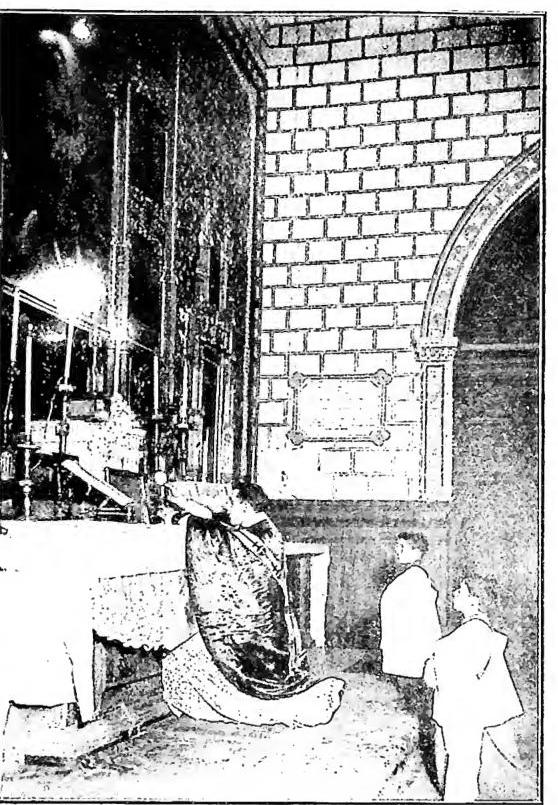
MOZARABICA. LITURGIA - Mozarabic Mass. Moment of the Et incarnatus est of the Creed - Toledo, chapel of the Primate Cathedral.
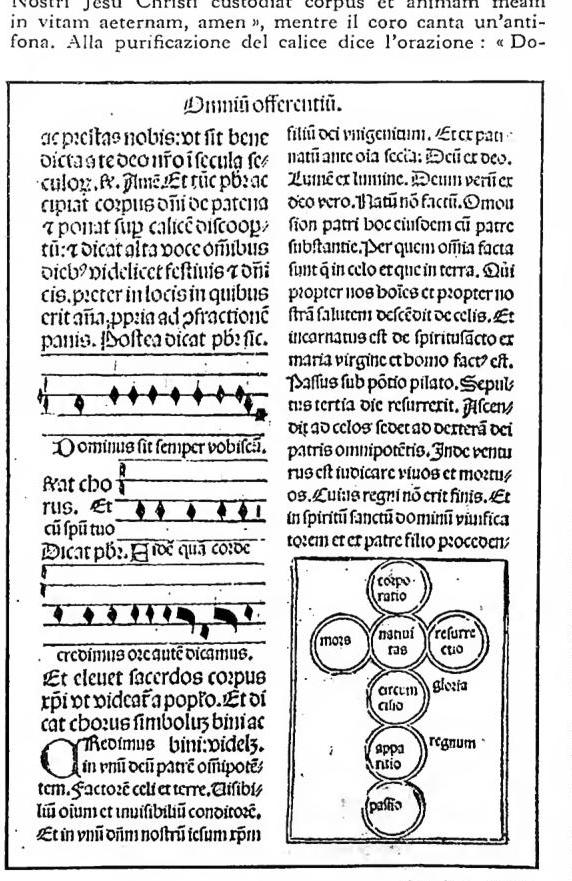
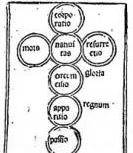
After the elevation of the Host and the chalice (an elevation which is not properly Mozarabic) the priest continues with the proper prayer « Post pridie », ending with « Te prestante... »; he makes the sign of the Cross over the offerings, as in the Roman liturgy, at the words: « Santificas, vivificas, benedictus et prestas nobis », and, while saying: « Ut sit benedictus a Te, Deo nostro, in secula seculorum », makes the sign of the Cross; at this point the priest recites the Creed (when the feast requires it), holding the Host in his right hand above the chalice and first saying the admonition: « Fidem quam corde credimus, ore autem dicamus ». When the Creed is not recited, the antiphon « Ad confractionem », proper to the solemnity or common, is said. The breaking of the Host into two equal halves follows, and immediately the first is divided into 5 and the second into 4, while the principal mysteries of the Lord are enumerated with the words: « Corporatio, Nativitas, Circumcisio, Apparitio, Passio, Mors, Resurrectio, Gloria, Reguum »; the 9 particles are arranged on the paten in the form of a Cross, and the « Memento pro vivis » is said, at the end of which the prayer « ad orationem Domi-
(fot. Rodriguez - Toledo)
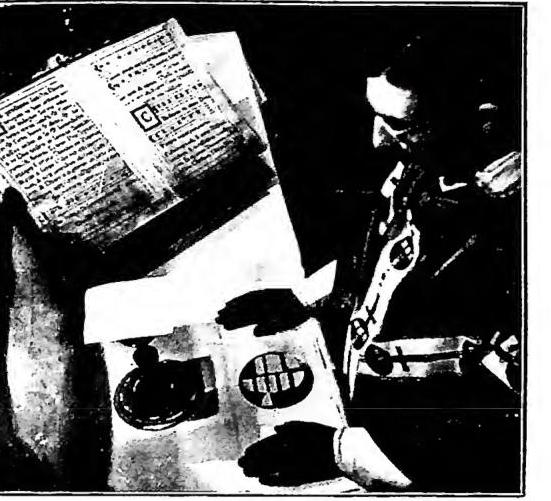
MOZARABICA, LITURGIA — Mozarabic Mass. Division of the Host into nine parts placed on the paten in the form of a cross. The two whole pieces placed on the right are used for the commistio (below) and for the priest’s Communion (above) — Toledo, chapel of the Primatial Cathedral.
Nat cho i rus. Et ci fui tuo Dicat pbr. Et ne qua code
Et cleurt facerdos corpus rpi ut vidcat a popto. Et di cat chorus fimbolus bini ac
finii dei visigenium. Et et pan nati ante oia fecia. Dici et deo. Zume et lumine. Deum verii et deo vero. Flani no facii. Omou tion parti bec ciufbem di parte fubfianne. Per quem offia facia funt q in celo et que in terra. Oii popter nos bolos et popter no ftri faluem befecat oecalis. Et incarnamus et de ipriruficeto et marta virgine et bono facet et. Pafius sub posto pilato. Sepul rus tertia oie refurrecti. Pisem di 30 celos foter ad oeterni dei patris omnipotris. Inde venui rus et iuricare vicos et mortus. Cuius regni no crit finis. Et in iprirufi sancti dominii vinifica totem et et patre filio poocem:
(fot. Enc. Catt.)
MOZARABICA, LITURGIA - Canon of the m. Mass. Creed and depiction of the partition of the Host in the Editio princeps of the Missale mixtum secundum regulam b. Isidori dictum mozarabet. Toledo 1500. fol. 227r. - Copy in the Vatican Library.
“... mine Deus...” and concludes by gathering up the corporal and covering the chalice. He recites a prayer in the manner of a “Post communio” at the Epistle side, then, with his hands extended before his breast, goes to the center, saying: “Per misericordiam...” as before the Collect. Having said “Dominus sit semper vobiscum,” he dismisses the people with “Sollemnia completa sunt. In nomine Domini Nostri Jesu Christi votum nostrum sit acceptum cum pace”; on less solemn feasts, with these words: “Missa acta est. In nomine Domini Nostri Jesu Christi, perficiamus cum pace”; and, descending to the foot of the altar, recites the Salve Regina with the prayer Concede, after which he again ascends to the altar and gives the blessing to the faithful, tracing a cross above the altar and kissing it, while saying: “in unitate sancti Spiritus”; then he raises his eyes and hands toward the Cross and says: “benedicat vos”; and, turning toward the people, gives them the blessing, saying: “Pater et Filius.” Thus the m. Mass ends.
3. Kiss of peace
A characteristic of the m. rite is the place occupied by the kiss of peace. Whereas in the African liturgy, according to the testimony of s. Agostino, and at Rome, according to the “Ordines Romani,” it is given immediately before Communion, the m. liturgy brings it forward to before the beginning of the Canon, at the Inlatio. The kiss of peace was exchanged among the assistants without having been transmitted by the celebrant: this is what the Council of Compostela (a. 1056) says in can. 1, and this same practice seems to be indicated by the phrase still used today according to the Cisnerian Missal: “Quomodo adstatis, pacem facite.” At present the celebrant kisses the paten and gives the kiss of peace to the deacon, so that he may transmit it to the choir and the people; in Masses without ministers, he kisses the aspergillum presented to him by the altar boy, who by this means gives it to those in the choir. In giving the kiss to the paten he says: “Habete osculum dilectionis et pacis, ut apti sitis sacrosanctis mysteriis Dei.”4. Public character of the liturgical act
The participation of the people in the m. Mass is much more active than in the Roman Mass. In it there are no secret prayers, except for the prayer immediately preceding the consecration and the one that follows II. Everything is said aloud, and the people respond.5. Consecration
The formula of Consecration in the m. rite is not the same as that of the Roman rite. As can be seen in the “omnimode” Mass of the Silos ritual, the formula of Consecration, like the words preceding it, is entitled “Missa secreta” and is taken from I Cor., 11:23–26, whereas that of the Roman Mass is taken from the Synoptics. This formula of the “Missa secreta,” which, it seems, was abolished in the time of Pope Giovanni X, is reproduced in the edition of the plenary Missal of Cisneros, without there being any other formula in the text, both in the Ordinary of the Mass for the First Sunday of Advent and in the Ordinary of the Mass that follows Holy Saturday.VIII. MOZARABIC OFFICE
Although the Mozarabic plenary Breviary did not have the 200 years required by s. Pio V, since it was the work of Cardinal Cisneros at the beginning of the sixteenth century, it could nevertheless continue to be used because its cursus was more than 200 years old. The prayers, readings, hymns, canticles, psalms, and antiphons are in fact the same as those which, already in remote times, constituted the corpus of the Divine Office.The hours currently in use in the Mozarabic Office are the following: Vespers, Compline, Matins and Lauds, Prime, Terce, Sext, and None (in some ferial Offices another hour, called Aurora, precedes Prime). The internal arrangement of each of them differs entirely from the Roman rite. Particularly noteworthy is the absence of the Psalter: some psalms are recited, especially in the Sunday and ferial Offices, but the ordered and complete recitation of the Psalter is not found. This psalmody, which is currently absent from the Mozarabic Office, does not seem to be the authentic one. From the known codices, especially the Rituale antiquissimum of Silos, the Psalterium Toletanum, those in the British Museum in London bearing the numbers 30.844–46, all deriving from Silos, and those numbered 35.5–35.7, from Toledo Cathedral, it may be deduced that in antiquity, especially in the «cursus monasticus», the psalms constituted almost the corpus of the Divine Office.