
CIRCUMCISION (from Latin circumcisio, “cutting around”; Greek περιτομή; Hebrew milāh). — Total or partial removal, or even a simple incision, of the foreskin in men, and cutting of the clitoris in women (in the classical sense, usually the circumcision of men is meant). A religious practice widely diffused among various peoples of antiquity, it is still practiced by about one-seventh of humanity (as early as 1880 the anthropologist R. Andrée gave the approximate estimate of over 200 million people: Archiv f. Anthropol., 12 [1880], p. 76).
OUTLINE:
I. In the Jewish people
II. Among other peoples
III. Feast of circumcision.I. IN THE JEWISH PEOPLE
I. History
Circumcision (milāh) in the Jewish people was and is a national-religious rite of fundamental importance. Its institution is linked to the covenant between God and Abraham with all his descendants (Gen. 17:10-14). As a seal of the covenant, God prescribed circumcision, to be performed on the eighth day for all male newborns, including slaves born in the house or purchased, even if of another race; whoever was not circumcised would be cut off from the chosen people (17:14). The rite was first performed by Abraham on himself at the age of 99, on his son Ishmael at age 13, and on all his servants (Gen. 17:23-31); when Isaac was born, he was circumcised on the eighth day (21:4). The practice became widespread among the people of Israel, who, during their stay in Egypt, enjoyed the advantage of being on the same moral level as the Egyptians, among whom circumcision was held in high honor. It seems, however, that during their sojourn in Egypt the practice fell somewhat into disuse or at least was not always observed. Even Moses was found at fault for not having circumcised his son, but, warned by God, he had him circumcised immediately by his wife Zipporah, who therefore called him “a bridegroom of blood” (Ex. 4:25). The precept of circumcision was implicitly recalled by Moses in the institution of the Passover on the eve of the Exodus, as a necessary condition for eating the Passover lamb (Ex. 12:44, 48), and then explicitly in the Sinaitic legislation (Lev. 12:3; cf. John 7:22).From Josh. 5:4-7 we learn that all the males who came out of Egypt and died in the desert were circumcised, but those born in the desert remained uncircumcised. It is difficult to give an adequate explanation of this fact. In any case, no reproach is ever made to the Israelites for this omission, which authorizes the belief that there was a suspension of the law by God’s will, perhaps on account of the people’s continual infidelities and the severe punishment that followed, so that, the covenant being broken, circumcision, which was its sign, lost its meaning (cf. Josh. 5:6). The precept came back into force with Israel’s entry into the Promised Land. After crossing the Jordan, in the vicinity of Gilgal, not far from Jericho, Joshua, by God’s command, had all the new generation born in the desert circumcised with stone knives (which many identified with the flint knives of that shape found in considerable numbers in excavations carried out in 1870 near that site: DB, II, col. 775). The event, which is given particular emphasis, is presented as a “second circumcision” (5:4). Not that the Israelites (as Origen thought) were circumcised a second time (which is expressly excluded; 5:6), but in the sense that, after the temporary suspension, the law definitively came back into force at the very moment when, with Israel’s entry into the Promised Land, a new era began: and just as the institution of the covenant had been celebrated with a solemn first circumcision (Gen. 17:9-14, 23-27), so its fulfillment was sanctioned with a new general circumcision. On that occasion God said to Joshua: “Today I have rolled away from you the reproach of Egypt” (Josh. 5:9): words difficult to interpret (A. Fernandez, Comm. in Josue, Paris 1938, pp. 74-76), perhaps to be understood in the sense that with the definitive restoration of circumcision the Israelites would no longer be an object of scorn for the civilized people of Egypt (for whom it was a disgrace to be uncircumcised) or, more probably, that the “reproach,” that is, the “servitude” of Egypt, completely ceased when the Israelites, entering the Promised Land and submitting to circumcision, were readmitted to the favor of Yahweh.
Those rationalist critics (Hollenberg, H.-J. Holtzmann, A. Dillmann, etc.) who attributed Gen. 17 to the “Priestly Code” P (composed, according to J. Wellhausen’s thesis, around 500 B.C.) maintain that Israel did not practice circumcision before the definitive entry into Palestine, after having learned it from the Egyptians. But this hypothesis clashes with Josh. 5:4-7, in which it is wrongly sought to see an interpolation by the redactor, and with other biblical texts (not least John 7:22 and Acts 7:8) and the entire Jewish tradition, which consistently trace circumcision back to a period before Moses, that is, to Abraham. According to H. Gunkel (Genesis, 1910, p. 269), followed by others, the J document derives circumcision from the Midianite Zipporah (Ex. 4:25), the E document from Joshua (Josh. 5:2 ff.), and P from Abraham (Gen. 17). But this supposition is based solely on the Wellhausenian theory of the sources of the Pentateuch. Moreover, the biblical narrative excludes that Israel took circumcision from Egypt, as Herodotus, Celsus, and Julian thought in antiquity and as various rationalists today (J. Spencer, W. Nowak, E. Meyer, J. C. Matthes, R. Reitzenstein, etc.) believe.
The rite was directly instituted and imposed by God as a sign of the covenant (Gen. 17). Abraham, who during his stay in Egypt (Gen. 12:10 ff.) must certainly have known this custom, did not practice it until he received a formal order from God at the age of 99. Nor is it a difficulty that God chose an ancient rite already in use among other peoples, for He gave it an altogether new meaning and the essential value of a sacred sign. Female circumcision, which was never widely diffused in antiquity and appears as an extension of male circumcision, is not known in Israel. From the time of Joshua circumcision was universally observed and became the sacred seal of the people of God: its omission was a cause of dishonor and ignominy (cf. Judg. 14:3; 15:18; 1 Sam. 14:6; 17:26, 36; Ezek. 28:10; 31:18; 32:19 ff.). It was also a sign of distinction from the neighboring peoples, most of whom were uncircumcised, especially the Philistines, the “uncircumcised” (’arelîm) par excellence. It is true that some texts (Jer. 9:26; Ezek. 3:18; 32:19-42) seem to suppose that circumcision was practiced only by the Jews and by no pagan people: but this must be understood of circumcision “iuris divini,” that is, as it existed in Israel by divine prescription and with its well-defined meaning. The distinction lay, more than in the material rite, in its meaning. Although a religious meaning must be admitted also among other peoples, especially in Egypt, the meaning of circumcision in Israel (sign of the covenant with God, admission to the chosen people, purification) finds no parallel among other peoples. Through it the newborn entered into the sacred community and shared in the divine blessings promised to Abraham and his descendants. It is true that to be a perfect Jew it sufficed to be a descendant of Abraham by flesh (an ethnic element, indispensable), but circumcision was the first act of religious and moral life of the community and fundamentally included the acceptance of the entire Torah. The symbolism of the rite (consecration, spiritual rebirth) was further highlighted by the fact that the child was circumcised on the eighth day after birth (unlike other peoples, who usually circumcised at the age of 3 or 4 or 7 years or even at puberty). With circumcision the custom arose of giving the newborn a name (cf. Luke 1:59; 2:21), just as God had given Abraham a new name at the institution of the rite (Gen. 17:5).
During the Babylonian exile, the Sabbath and circumcision became the two supreme symbols of Judaism; so too in the Hellenistic-Roman period, when circumcision became a subject of debate among pagans. While Hellenistic influence produced deserters (some Jews ashamed to appear circumcised in the eyes of pagans in public gymnasia attempted to conceal the signs of circumcision: 1 Macc. 1:15), the majority of Jews remained faithful to ancestral prescriptions and heroically resisted the persecutory laws of Antiochus Epiphanes, who had forbidden circumcision (1 Macc. 1:51); many women risked their lives to circumcise their sons (1 Macc. 1:65–66). Under the Hasmonean dynasty, circumcision was imposed as a sign of Judaization even upon non-Israelite subjects within the borders of Palestine, namely the Idumeans and Itureans; however, care was taken not to extend it to the Philistine cities. Disputes arose even in the time of the tannaim regarding the obligation of circumcision for proselytes (v.): R. Joshua, representing the liberal school, held that any ritual of purification (such as the ritual bath) sufficed to make a proselyte and circumcision was not necessary; whereas R. Eliezer, representing the stricter school, maintained that circumcision was always necessary.
The emperor Hadrian prohibited circumcision along with castration under severe penalties (Lex Cornelia de sicariis: Dig. XLVIII, 8, 4, 2); under Antoninus Pius (c. AD 138)
the law was repealed for Jews but remained in force for Arabs and Nabataeans of the desert, as well as for Samaritans and Egyptians: only Egyptian priests who could prove their sacerdotal lineage were permitted to be circumcised.
In the early centuries of Christianity, the rabbis (e.g., R. Jammael, R. Akiba) vigorously defended circumcision against both pagans and Christians, increasingly emphasizing its necessity and significance, even asserting that circumcision includes all 613 precepts and equals in value all the other commandments combined, and that one who is uncircumcised is incapable of learning the Torah.
For Jews by race, circumcision remains today, in different countries, the first and fundamental practice, faithfully observed even by unbelievers, as a distinctive sign of race. On the other hand, circumcision is now excluded for proselytes; besides the official decision of the Reform rabbis of America at the New York conference of 1892, cf. A. Pallière, Le sanctuaire inconnu, Paris 1926.
2. Rite. — In biblical times it was usually the father (or mother) who circumcised the newborn. Later, the office—which is quite delicate—was entrusted to a special operator (mōhēl, “circumciser”): an honorary office performed gratuitously. Circumcision takes place on the eighth day, even if it falls on the Sabbath, according to very ancient tradition (cf. John 7:22). The rite is accompanied by a twofold blessing, one pronounced by the mōhēl and the other by the father of the newborn; then follow wishes of happiness and the imposition of the name, and finally a longer blessing that celebrates the divine covenant with Abraham and its sacred sign, circumcision. A feast is customarily held, to which at least ten men are invited. Among the principal guests seated near the father, besides the mōhēl, is the sandiq, a kind of godfather who holds the child on his lap during the rite (this is the most honorable office). The chair on which the sandiq sits during the circumcision is commonly called the chair of the prophet Elijah, who is believed to attend invisibly at every circumcision and is popularly called “the Angel of the Covenant” (cf. Mal. 3:1; 4:5).
The symbolism of circumcision soon led to its metaphorical significance, namely spiritual circumcision of the mind and heart (purification of the spirit, submission to God), a condition far more necessary than carnal circumcision for pleasing God and enjoying the benefits of the promise. Already in Deut. 30:6 the necessity of this spiritual circumcision is emphasized (cf. Jer. 4:4: “circumcision of the heart”), and in Lev. 26:41 the wicked and rebellious are called “uncircumcised in mind” (cf. Jer. 6:10; 9:26; Acts 7:51: “uncircumcised in heart and ears”). St. Paul observes that circumcision was given to Abraham as a sign and seal of the righteousness that comes through faith (Rom. 4:11). Therefore carnal circumcision presupposes and imposes spiritual circumcision, of which it is a symbol and reminder. Even Jesus subjected himself to the law of circumcision (Luke 2:21). But with the institution of Christian Baptism, the obligation of circumcision ceased. Against the Judaizers who wished to impose circumcision on all converts from the Gentiles, the Apostles took a stand at the Council of Jerusalem (Acts 15:1 ff.) and especially St. Paul, who repeatedly demonstrated the uselessness of the rite after the redemptive death of Christ (cf. Gal. 5:2 ff.; 6:12 ff.; Col. 2:11 ff.; etc.).
II. AMONG OTHER PEOPLES
Circumcision in antiquity is attested first of all among the Egyptians in a period prior to Abraham, at least under the Fourth Dynasty (c. 2400 B.C.). In addition to the well-known testimony of Herodotus (II, 36, 37, 108) and other writers (Diodorus Siculus, I, 28; Philo, De circ., 1; Flavius Josephus, Ant. Iud., VIII, 10, 3; Contra Ap., I, 22; Ps. Barnabas, 9; PG 2, 752; Clement of Alexandria, Stromata, I, 15; PG 8, 768, etc.), there is the evidence of mummies and monuments. In a good number of mummies the signs of circumcision are still evident; the same is true of the statue of Būlāq, Fifth Dynasty, and in the tomb of Saqqarah, Sixth Dynasty; in a bas-relief from Karnak coming from the temple of Ḥons, Twentieth Dynasty, the circumcision of a boy from 6 to 12 years old is depicted. According to Herodotus (II, 36), it was practiced, at least in ancient times, by all classes of the population. But it is difficult to establish whether and when it was obligatory: the mummies of many Egyptians show it, while many others do not (J. C. Matthes, in Zeitschr. f. Altst. Wiss., 29 [1909], pp. 70 ff.). Probably circumcision was a practice, more or less widely observed according to different epochs and regions. It was held in particular honor among the priestly class, which attached to it a sacred and religious meaning, so much so that in time “uncircumcised” (ama) became almost a synonym for “impure.” Later it fell into disuse, and in the Hellenistic-Roman period, when attacks by Greco-Roman writers multiplied, it was practiced almost exclusively by priests who clung tenaciously to it and made it a necessary condition for the exercise of priestly functions (cf. Flavius Josephus, Contra Ap., II, 13; Origen, In Rom., II, 43; Ambrose, Ep., II, 72, 5): according to a papyrus from Tebtunis (II, no. 293) an uncircumcised priest cannot perform sacred functions. Circumcision did not come to the Egyptians from the Hebrews or other descendants of Abraham, as the author of the Rec. Clem. supposes (PG 1, 1227), because it is more ancient. It is one of those typical rites whose origin is lost in the obscurity of time.Circumcision was also practiced by the Colchians and Ethiopians, as Herodotus informs us (II, 104). The same historian is of the opinion that the rite passed from Egypt also to the Phoenicians and the “Syrians who dwell in Palestine” (i.e., the Hebrews, and perhaps other neighboring peoples, such as the Ammonites and Moabites). But it is disputed whether the Phoenicians practiced circumcision. It seems that the Ammonites and Moabites practiced it, at least for some time. The same is true of the Idumeans and Midianites. It is known, however, that at the time of the Hasmoneans, circumcision was imposed on the Idumeans by the Jews. Among other Western Semites, the Arabs practiced circumcision, which they have preserved down to our own day. There are no traces of it, however, among the Eastern Semites (Assyrians-Babylonians) or among the Indo-European, Mongolian, or Finno-Ugric peoples.
Ethnological research has established the existence of circumcision among numerous tribes of primitives, who still practice it: in Australia, Polynesia, Central America (Mexico, Nicaragua, Yucatán) and South America (Amazonia), and especially in Africa, where circumcision is so widespread that it is easier to list those who do not practice it than those who do. It is usually performed with a stone knife, proof of its great antiquity. Circumcision has remained in use also among the Coptic Christians of Egypt and the Monophysites of Ethiopia (under Jewish or Islamic influence), who, however, do not attribute to it a religious but rather a nationalistic-social meaning.
The greatest diffusion of circumcision is due to the Islamic religion. It is commonly held that circumcision was already in use in ancient Arabia. Islam maintained the practice, and although the Qur’an does not mention it, the ḥadīth (“tradition”) speaks of it repeatedly. In the traditional estimation of the people, abstention from pork and circumcision are considered in many places as the fundamental practices of Islam (Enzykl. d. Islām, II, 1028); and this is connected with the tradition according to which Muḥammad was born already circumcised (in North Africa a child born with a short foreskin is considered a blessing from heaven). Only in the Ḥanafite or orthodox rite is circumcision obligatory (for both sexes), but in practice it is generally observed in different countries (Arabia, Persia, Asia Minor, the Balkans, North Africa, Ethiopia, India, Malaysia, etc.); male circumcision (properly called khitān) is more common, though female circumcision (khafḍ) is also frequent. The rite is everywhere performed with notable solemnity. In some places the boy, before the operation, is subjected to a sacred bath, amid prayers and songs.
The ritual and method vary according to different peoples. Even more varied is the age, which ranges from the seventh day after birth to the fifteenth year: the Southwestern Arabs circumcise children on the seventh, fourteenth, twenty-first, or twenty-eighth day; at Mecca (where the rite is called ṣahārah) from three to seven years (also girls, though there is no special rule); the Mazequas in East Africa between the first and second month; in Egypt between five and six years, in other countries of North Africa the age varies from the seventh day to thirteen years; from ten to fourteen or fifteen years in Java (girls from two to eight years); in Persia in the third or fourth year; Coptic Christians between the sixth and eighth year. Almost all others, including primitives, circumcise at the age of puberty, which is generally the preferred age, as it was already in ancient Egypt. This circumstance seems to confer on circumcision a value of youthful initiation in the passage from childhood society to that of adults and warriors, as well as an initiation to marriage: this would, according to many, be the original and fundamental meaning of the rite, to which was soon added a religious meaning, which is not always easy to define; it appears evident, for example, in the circumcision of priests in ancient Egypt and among Muslims.
Various other explanations have been attempted: a motive of hygiene, especially in hot countries; a mark of racial distinction; a sacrificial motive; purification of generative power, etc. Worthy of note is the hygienic motive, already adduced by Herodotus for the Egyptians, and for the Hebrews by Philo (who, however, sees in circumcision essentially the sign of holiness and of the election of Israel: cf. Philo, De spec. leg., I, 1-12; De migr. Abr., 12; Quaest. in Gen., III, 47), later by Maimonides, and often repeated in modern times down to E. Baras, who suggests various considerations on the hygienic advantages of the cut. But these advantages are not clearly demonstrated, and the hygienic motive retains for many only a historical value (Jewish Enc., IV, 93).
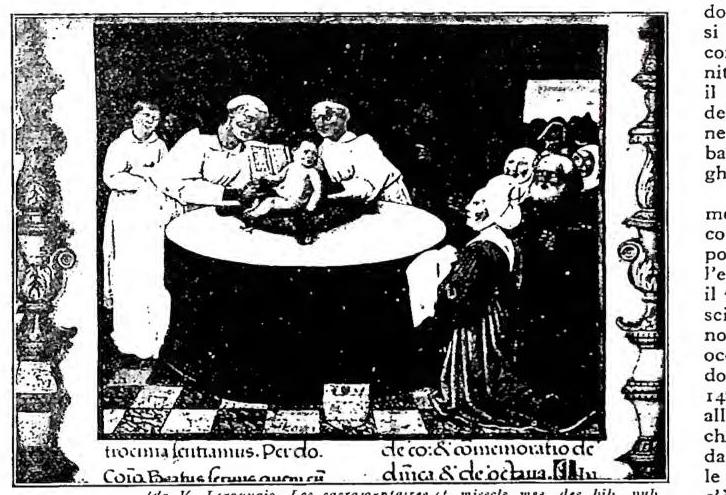
CIRCUMCISION — Rite of c. in the c. of Jesus, Roman Missal in use at Tours (16th cent.) — Paris, Bibliothèque Nationale, ms. lat. 886, f. 29.
tiorum auctoritas quantum ad Israelitarum instituta (Commentat. Bibl. 8), Innsbruck 1933, pp. 61-66; G. Ricciotti, Storia d'Israele, I, Torino 1934, pp. 147-50; E. Baras, La Circoscision, son histoire et son importance au point de vue hygiénique, Parigi 1896; The Jewish Encycl., IV (1903), pp. 92-102; Encyclopædia Judaica, IV (1929), pp. 346-61. Per l'antico Egitto sono tuttora importanti: R. Reitzenstein, Beschneidung und Priesterordnung (Zwei religionsgeschichtl. Fragen), Strasburgo 1901; P. Wendland, Die hellenistischen Zeugnisse über die ägyptische Beschneidung, in Archiv. f. Pap. Forschung, 2 (1902) pp. 22 sgg.; A. Wiedemann, Beschneidung im alten Ägypten, in Orient. Literaturzeitung, 6 (1903), p. 99 sgg. Gaetano Stano
III. FEAST OF THE C
Among the early Christians, the Kalends of January were merely a civil feast.In many places it was celebrated with unrestrained joy, almost like that of the pagans, so much so that the Fathers of the Church were repeatedly compelled to call the people to greater seriousness. At Ravenna, for example, St. Peter Chrysologus (Serm., 155) forbade participation in and attendance at unseemly dances and masquerades. Similar disorders also occurred in Gaul and Spain in the 5th century (cf. Council of Tours [567], cann. 17 and 22, and of Toledo [633], can. 11). To suppress these abuses, the bishops of Tours and Auxerre had instituted processions of penance with the singing of litanies and other expiatory sacred functions on that day. Another reminder of such abuses is found in various liturgical books which, beginning with the so-called Leonian Sacramentary, have for January 1st a Mass ad prohibendum ab idolis, to counter the paganizing entertainments of the Kalends of January or New Year’s Day (v.). Since Christianity had, however, harmonized its religious calendar with the salient events of Christ’s life rather than with the civil calendar, New Year’s Day simply coincided with the Octave of Christmas.
The Kalends of January as an ecclesiastical feast were in fact unknown in Rome around 600. Soon, however, like Easter and Epiphany, the Nativity of Our Lord also had its octave, and consequently the eighth day was simply called Octava Domini, or in octava Domini; this shows that that day was not considered as a feast in its own right. In the calendar of the evangelary of St. Genevieve, copied ca. 714–31, it is called Natale s. Mariae (ed. F. G. Fronteau, Paris 1652), almost as if to insinuate a profound and delicate thought, namely, to dedicate to the Mother of Jesus, on the eighth day after the birth of the Son, a special remembrance, since the day of the Nativity is entirely for the Divine Infant. To this end, a formulary for the office was composed that is one of admiration and praise for the Virgin Mother, and in the prayers of the Mass too a special commemoration is made of her virginal motherhood. Moreover, the Statio was dedicated to her in the basilica of St. Mary ad Martyres (the Pantheon); but after Gregory IV had set up a crib at St. Mary in Trastevere, in imitation of the Liberian Basilica, the Statio was transferred there as well. The Homiliary composed ca. 786–97 by Paul the Deacon names January 1st as in octavas Domini i. e. Calendae Ianuariae (ed. Wiegand, p. 27).
Outside Rome, and particularly in Gaul, the memory of the Circumcision prevailed instead, as is evident from the Lectionary of Victor of Capua (546), from canon 17 of the Second Council of Tours (567), from the Statuta of Sonnatius of Reims (614–31: PL 80, 446), from the Missale Gothicum (ed. Muratori, II, p. 552), from the calendar prefixed to the evangelary copied by the monk Gotescalcus (781–82: ed. F. Pieper, Berlin 1858), etc. This memory then passed into the title of the present liturgical observance of January 1st, despite the texts that chiefly recall the divine maternity of the Blessed Virgin Mary.