
CALENDAR. - Initially, this term indicated among the Romans the register in which bankers noted the interest on loans accrued on the first (kalendae) of each month: the list of festive and working days was called Fasti. The word kalendae, from a root kal- also common to Greek, meaning "to call" (καλεῖν, kalare), retained in Latin only in sacred language, refers to the convocation of the people on the Capitoline by one of the minor pontiffs when the first lunar crescent appeared in the sky, to notify them of the days on which the nones (first quarter) and the ides (full moon) would fall.
The word later came to signify the entire month (Ovid, Fasti, III, 99; Martial, I, 99, 6) and thus the annual measurement of time. The calendar is therefore closely related to the observation of astronomical phenomena. All religions have a calendar that divides the year into monthly segments determined by the phases of the moon and have adopted various systems to reconcile this series of 12 lunations, which is shorter (354 days, 8h, 48', 38''), with the solar year, which is longer (365 days, 5h, 48', 46'').
SUMMARY:
I. The Primitives
II. Non-Christian Religions: 1. East Asia: China, Japan; 2. Pre-Columbian America: Mexico, Peru; 3. Egypt; 4. Semites: Babylonia, Hebrews, Arabs;5. Indo-Europeans: India, Iran and Persia, Greece, Rome
III. Christianity: 1. Western Church: origin of the year, Gregorian reform;6. Eastern Churches
IV. Calendar of the French Republic
V. Masonic Calendar
VI. Further Proposals for Reform.I. THE PRIMITIVES.
The objective determination of time, necessary among human groups that have reached a certain degree of civil and social stability, is not required among primitives, for whom the periodicity of lunar, solar, and stellar phenomena does not affect the internal and social life of the clan, but only concerns the return of seasons suitable for hunting, fishing, gathering the fruits of the earth, and the works of a primordial agriculture. Rather than precise measurement, they keep track of meteorological phenomena (summer, winter; drought, rain), especially in relation to the appearance of certain constellations, e.g., the Pleiades.
The beginning of these operations is consecrated by special rites (festivals) aimed at ensuring, through the efficacy of action and formula, the seasonal rhythm. Apart from this sacro-magical concern, which over time will lead to the permanent establishment of the religious calendar, the primitive has no objective knowledge of time, which for him flows uninterrupted and, above all, is not determined by fixed laws independent of his own action; indeed, this action is deemed necessary so that the periodic succession of natural phenomena repeats for the benefit of the group. The festivals listed in the calendar serve to make the community feel its unitary character, both through the recollection of myths and legends that narrate the origin and raison d'être of the group, and through the performance of rites (dances, processions, banquets, sacrifices) by which the group enacts and effectively lives its social unity.
Festivals interrupt the series of ordinary occupations; they are often prepared by rites of purification (fasting, abstinence, Truce of God) and are sacramentally consecrated by changes of clothing, games, fairs, and markets.
The annual calendar is considered a single cycle, at the entrance of which propitiatory rites are performed, while at its exit purification rites are conducted to eliminate all the evil accumulated during the year (v. CAPODANNO). But even larger divisions of the year itself are conceived—triennial, quadrennial, octennial, nineteen-year, centennial—often in relation to astronomical phenomena: in which the entire period of time elapsed between the beginning and the end is imagined as a unity and involves rites of purification and consecration.
II. NON-CHRISTIAN RELIGIONS.
### 1. EAST ASIA:
#### a) China.
The Chinese calendar is lunar, consisting of 12 months, which do not have their own names but are distinguished by their ordinal number and alternate between 30 and 29 days; in total, 354 days. To align the lunar year with the solar year, seven complementary months are intercalated over a span of 19 years. The New Year falls on the new moon of the lunation in which the sun enters the constellation of Pisces (February).
The Jesuit missionary Father Matteo Ricci adapted the Chinese calendar to the lunisolar rhythm of the West, which remained in use until 1930, when the Chinese Republic, succeeding the Manchu dynasty in 1911, officially adopted the Gregorian calendar.
#### b) Japan.
Japan also adopted the Chinese calendar reformed by the Jesuits in 1684.
January, Shōgwatsu (= month of beginning)
February, Ni-gwatsu (= 2nd month)
March, San-gwatsu (= 3rd month)
April, Shi-gwatsu (= 4th month)
May, Go-gwatsu (= 5th month)
June, Roku-gwatsu (= 6th month)
July, Shichi-gwatsu (= 7th month)
August, Hachi-gwatsu (= 8th month)
September, Ku-gwatsu (= 9th month)
October, Jū-gwatsu (= 10th month)
November, Jū-ichi-gwatsu (= 11th month)
December, Jū-ni-gwatsu (= 12th month)
In the ancient lunisolar calendar, used in Japan prior to the adoption of the Gregorian calendar, each month (or rather, lunation) had various names, but the most commonly used, with their generally accepted meanings, are:
1st lunation, Mutsuki (= month of social relations)
2nd lunation, Kisaragi (= month in which clothes are doubled)
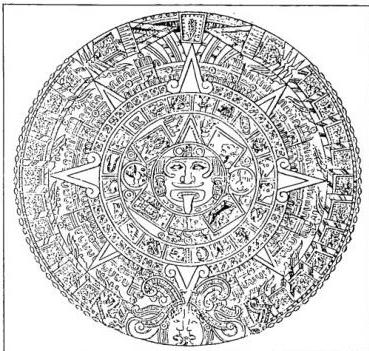
CALENDAR – Mexican C., discovered in 1790 in the foundations of an Aztec temple in Mexico City. At its center, the sun surrounded by four squares, symbolizing the epochs of Aztec cosmogony. In the outer circle, the symbols of the 20 days of the Aztec month; around it, 8 pointed rays symbolizing the 8 parts of the day.
3rd lunation, Yayoi (= month gradually growing)
4th lunation, Utsuki (= month of the deutzia scabra, a well-known flower in Japan)
5th lunation, Satsuki (= month of transplanting rice seedlings into the paddies)
6th lunation, Minazuki (= wet month, as it corresponded to the summer rainy season)
7th lunation, Fumizuki (= month of literature)
8th lunation, Hazuki (= month of leaves, i.e., when leaves fall)
9th lunation, Nagazuki (= month of long nights)
10th lunation, Kaminazuki (= month without gods, as it was believed that in this month all the kami gathered at the temple of Izumo, abandoning the rest of Japan)
11th lunation, Shimotzuki (= month of frost)
12th lunation, Shimasu (= possibly contracted from toshi hatsu; the year ends).
Japanese scholars disagree on the derivation of the above names and thus on their meaning, but the interpretation given above is the most generally accepted.
7. PRE-COLUMBIAN AMERICA: a) Mexico
The Mexican year was divided into 18 months of 20 days each, totaling 360, to which were added at the end 5 supplementary days called nemontemi, plus a sixth nemontemo every 4 years. Each month was dedicated to a special deity.Months of the Mexican C.
| Mesi | Divinità |
|---|---|
| Atlacahualco (2-21 febbr.) | Tlaloc |
| Tlacaxipehualitzi (22 febbr.-13 marzo) | Xipe |
| Tezoztoutli (14 marzo-2 apr.) | Tlaloc |
| Hueytozoztli (3-22 apr.) | Centeotl |
| Toxcatl (23 apr.-12 maggio) | Tezcatliposa |
| Etzalqualitzli (13 maggio-1 giugno) | Tlaloc |
| Tecuilhuitziutli (2-21 giugno) | Huiztocihuatl |
| Hueytecuhilhuitli (22 giugno-11 luglio) | Xilonen |
| Tlaxochimaco (12-31 luglio) | Yacatecuhtli e Huitzilopochtli |
| Xocotlhuetzi (1-20 ag.) | Xiutecuhtli |
| Ochpauztli (21 ag.-9 sett.) | Toci |
Teutleco
(10–29 Sept.)
Tepeilhuitl
(30 Sept.–19 Oct.)
Quecholli
(20 Oct.–8 Nov.)
Panquetzaliztli
(9–28 Nov.)
Atepozli
(29 Nov.–18 Dec.)
Tititl
(19 Dec.–7 Jan.)
Itzcolli
(8–27 Jan.)
28 Jan.–1 Feb.: five supplementary days (nemontemi).
b) Peru. – The Peruvian year was lunar, consisting of 12 months, and was aligned with the solar year through the intercalation of 11 days during a common year and 12 in a leap year.
The year began with the spring equinox (21 Sept., in the southern hemisphere) and was later shifted to the winter solstice (22 Dec.). The month was divided into decades, after each of which one day was dedicated to rest.
Months of the Peruvian calendar
Camay chiglia (22 Dec.)
Atuu pukuy (22 Jan.)
Pacia pukuy (22 Feb.)
Paucar huara (22 Mar.)
Ayrihuay (22 Apr.)
Huaca gliusche (22 May)
Canay (22 June)
Tarpui chiglia (22 July)
Coya raymi (22 Aug.)
Uma raymi (22 Sept.)
Aya marca raymi (22 Oct.)
Kapac raymi (22 Nov.)
8. EGYPT
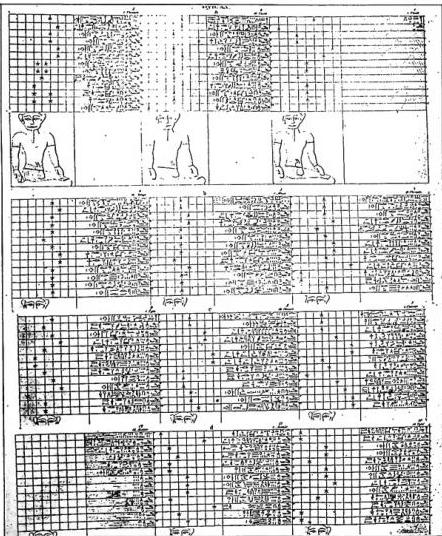
The ancient Egyptian year consisted of 12 months of 30 days (= 360), to which were added at the end 5 intercalary days called epagòmeni, or "added," dedicated respectively to Osiris, Horus, Set, Isis, and Nephthys (Plutarch, De Iside, 12). The year was called "wandering" because, not accounting for the 6 hours belonging to the solar computation, every four years a one-day shift occurred, every forty years a ten-day shift, and so on, until, within a period of 1,460 years, the New Year, after falling on all 365 days, returned to its original position. The period of 1,460 years was called the "great year" and had a sacred meaning of renewal; thus, it was never abolished by the Egyptian priesthood, even when, to remove the wandering character of the year, a sixth epagòmeno was added every four years. Ptolemy III Euergetes had already attempted this reform in 239–38 B.C.,All the gods
Gods of the dead
Mixcoatl
Huitzilopochtli
Tlaloc
Ilumatecutli
Xiuhtlecuhtli
but it was implemented only by the Romans in 30 B.C.
Months of the Egyptian calendar
| Thouth | 29 ag. | Pauni | 26 maggio |
|---|---|---|---|
| Paophi | 28 sett. | Epiphi | 25 giugno |
| Athur | 28 ott. | Mesori | 25 luglio |
| Cohiac | 27 nov. | 1 epagòmeno | 24 ag. |
| Tybi | 27 dic. | 2 epag. | 25 ag. |
| Mechir | 26 genn. | 3 epag. | 26 ag. |
| Phamenoth | 25 febbr. | 4 epag. | 27 ag. |
| Pharmuthi | 27 marzo | 5 epag. | 28 ag. |
| Pachon | 26 apr. |
9. SEMITES: a) Babylonia
The Assyro-Babylonian year was lunar. The 12 months had a length of 29 or 30 days, alternating irregularly. The year(from R. Lepeius, Denkmäler, III, pl. 527)
The lunar year was aligned with the solar year by introducing an intercalary month called dirigē, dēru (named second Adāru because it was added after the month of Adāru) five times (in the 3rd, 6th, 11th, 14th, and 17th years) within a 19-year cycle, which restored the positions of the sun and moon to the same point.
Given the development of astrology in Mesopotamia, the correspondence between the positions of the stars and the unfolding of life was particularly observed: celestial cycles were seen as images of earthly events, and the task of science was to interpret them. The names of the months were all astral, and each month was dedicated to a special deity. In every month, the 1st, 7th, 15th, 21st, and 28th days were sacred, corresponding to the lunar phases.
The New Year coincided with the spring full moon and was marked by the solemn expiatory and propitiatory ceremony of the akītu.
Mesi del c. babilonese
| Nome | Divinità |
|---|---|
| 1 Nisānu (marzo) | Anu |
| 2 Ajāru (apr.) | Ea |
| 3 Simānu (maggio) | Sin |
| 4 Du'ūzu (giugno) | Nimurta |
| 5 Abu (luglio) | Ningišzida |
| 6 Ulūlu (ag.) | Ištar |
| 7 Tišrītu (sett.) | Šamaš |
| 8 Arahṭanma (ott.) | Marduk |
| 9 Kislīmu (nov.) | Nergal |
| 10 Tebētu (dic.) | Papsukkal |
| 11 Šabātu (genn.) | Adad |
| 12 Adāru (febbr.) | Sibitti |
The month (hōdheš = new moon) was originally designated by the characteristics of the individual seasons: 'Abhībh, later Nisān, Zīw, 'Ethānīm, Būl are the only surviving ancient Phoenician names used by the Hebrews. More common, however, was the designation by ordinal numbers, a method that persisted even after the introduction of Babylonian names.
The beginning of the month (v. NEOMENIA) depended on the visibility of the new moon; some exegetes appeal to this empiricism to explain the uncertainties in the calculations. Months were normally lunar, consisting of 29 or 30 days. To reconcile the lunar year with the solar year in the post-Exilic period, the Babylonian practice of intercalating a month, the second 'Ādhār (Wē'adhār), was adopted, seemingly every three years, likely based on the need to align Passover with the full moon after the spring equinox.
In determining the year, the Hebrews had no fixed rules, unlike the Egyptians, for example; only in a later period did they adopt precise calculations. Tradition attributes these norms to Hillel II (4th century A.D.), though in reality, full codification occurred around the 10th century A.D. The religious year, the "liturgical cycle," appears to have begun in spring (Nisān); however, the common (agricultural) year started in autumn (Tišrī: Ex. 23, 16), and this system has remained in use (rōš haš-šānah = 1 Tišrī).
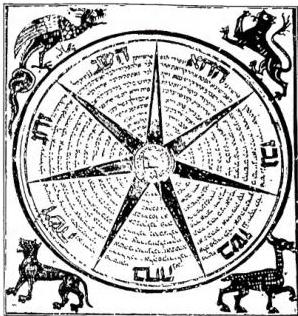
CALENDARIO – Hebrew Calendar. Table containing the weekly division of the Pentateuch. From manuscript 20 (13th century) of the Bibliothèque Nationale de Paris.
The Bible does not properly speak of seasons, but only of summer and winter (Gen. 8:22), whereas the Gezer calendar (v. GEZER) divides the 12 months into 8 agricultural periods. The modern Hebrew calendar is lunisolar. The day consists of 24 hours, which begin to be counted from the evening, that is, from 18:00.
Months of the Hebrew Calendar
| Mese | Feste |
|---|---|
| 1 Nisān (marzo) | Pasqua |
| 2 'Ijār (apr.) | |
| 3 Sīwān (maggio) | Šābhu'ōth («settimane») o Pentecoste |
| 4 Tammūz (giugno) | |
| 5 'Ābh (luglio) | |
| 6 'Elūl (ag.) | |
| 7 Tišrī (sett.) | Capo d'anno; Kippūr («espiazione»); Sukkōth («capanne» o «tabernacoli») |
| 8 Marhešwān (ott.) | |
| 9 Kislēto (nov.) | |
| 10 Tebēth (dic.) | |
| 11 Šēbhāt (genn.) | |
| 12 'Ādhār (febbr.). |
c) Arabs. — The Islamic calendar is lunar, consisting of 354 days, with months of 29 and 30 days, not aligned with the solar year. Thus, each year it falls behind by 11 days compared to the previous one, and over the course of 33 years, the feasts end up occurring in every season.
Since 12 astronomical lunations amount to 354 days plus 12 hours and 44 minutes, each year in the Muslim lunar year there is a deficit of 8 hours and 48 minutes, which, repeated 30 times, sums to 11 full days. These are added to the last month of the years 2, 5, 7, 10, 13, 16, 18, 21, 24, 26, and 29 of the thirty-year cycle, which are therefore called abundant, as opposed to the other 19, which are called common.
The months of the Islamic year are divided into weeks distinguished, as in the Hebrew and Christian religious calendars, by a progressive number starting from Sunday, rather than by the names of astral deities. The sixth day (Friday) is when the religious assembly takes place in the main mosque of the locality.
Months of the Arab-Muslim calendar
1 Muharram = sacred
2 Safar = empty
3 Rabi' I = first spring
4 Rabi' II = second spring
5 Gumādā I = first dry
6 Gumādā II = second dry
7 Ragab = dangerous
8 Sa'bān = assembly
9 Ramadān = burning
10 Sawwal = work
11 Dū 'l-Qa'dah = of the gathering
12 Dū 'l-Hijjah = of the pilgrimage
The principal feasts of the Muslim religion are six; they all begin at night and fall on:
1. The 10th of Muharram: the reunion of Adam and Eve after their expulsion from paradise; Noah’s exit from the ark; the death of Husayn, grandson of the Prophet.
2. The first of Rabi' I: the birth of Muhammad.
3. The 27th of Ragab: the ascension of Muhammad.
4. The 27th of Ramadān: the Night of Power, when angels determine the fate of men for the coming year.
5. The first of Sawwal: marking the end of the month-long fast of Ramadān ("lesser Bairam").
6. The 10th of Dū 'l-Hijjah: during the pilgrimage to Mecca ("greater Bairam").
10. INDO-EUROPEANS: a) India
In Vedic and Brahmanic India, the calendar was lunar and divided into three four-month sections corresponding to the three seasons: hot, wet, and cold, each marked by solemn feasts. The difference with the solar year was remedied by inserting an intercalary month every fifth year (H. Zimmer, Altindisches Leben, Berlin 1879, p. 365 ff.).Currently, the Hindu calendar is lunisolar, as an entire lunation is intercalated to align with the solar year. Each month is divided into two fortnights, one bright (śukla) and one dark (kṛṣṇa).
Months of the Hindu calendar
| 1 Caitra | 5 Śrāvana | 9 Mārgaśrīsa |
|---|---|---|
| 15 marzo | 15 luglio | 15 nov. |
| 2 Vaiśākhā | 6 Bhādrapada | 10 Paṣṇa |
| 15 apr. | 15 ag. | 15 dic. |
| 3 Jayṣṭha | 7 Āsvina | 11 Māgha |
| 15 maggio | 15 sett. | 15 genn. |
| 4 Āṣādha | 8 Kārttika | 12 Phālguna |
| 15 giugno | 15 ott. | 15 febbr. |
15 March (Caitra): New Year’s festival.
15 September (Āsvina): festival of Gaurī or Pārvatī, wife of Śiva. Particular homage is paid to the household gods, personified in domestic objects, and to those of various trades.
15 October (Kārttika): festival of the Ancestors (Mahā-navamī, also called Dasara), with the offering of the usual sacrifices and oblations for nine days. Schools and the army also celebrate the solemnity.
Late November (Mārgaśīrṣa): festival of lamps (Dīpāvalī), dedicated particularly to fire, with the lighting of lamps to promote vegetation.
15 February (Phālguna): festival of the most venomous snakes, called Nagara-pāñchamī, with offerings of milk and vegetables to the cobra (= nagara).
When the sun enters the zodiac sign of Capricorn, the festival of the sun’s rebirth, called Pongal or Makara-saṅkrānti, is celebrated, coinciding with the winter solstice. It lasts three days: 1) visits and exchange of gifts; 2) sun festival: threshing (pongal) and tasting of rice; 3) cattle pongal: sprinkling of animals with water infused with saffron powder and seeds and leaves of particular plants; triple circumambulation of the cattle, garlanded with flowers and fruit, by men (women are excluded), with fourfold prostration (sattanga) at the four corners. Then the fruit is snatched up in competition by those present, and the animals are driven at will into the fields for the whole day. This, the most popular festival in India, concludes with a procession of divine simulacra, featuring displays of obscene dances and songs to ensure fertility.
b) Iran and Persia. – Before Zarathustra, the Iranian calendar was modeled on that of neighboring Babylonia. The Zoroastrian reform gave it a distinctly Mazdean character, as the months were named after religious figures of Mazdean theology.
The Mazdean year begins at the spring equinox (21 March) and consists of 12 months of 30 days, plus 5 additional days at the end. The 6 unaccounted annual hours were, and still are, compensated every 120 years by the addition of a thirteenth month. This was no longer added after Persia’s conversion to Islam, and thus the Mazdean (or Parsi) year is currently vague.
Each month is under the protection of saints (Ameśaspenta) and venerable beings (Yazata). It is divided into four sections, the first two of 7 days, the last two of 8.
Each day of the month also has its own protective genius or deity.
Months of the current Mazdean calendar.
The names of the protective deities are listed, corresponding to the names of the ancient Avestan calendar:
| Mese | Divinità | Mese | Divinità |
|---|---|---|---|
| 1 Farvardin | Fravashi | 7 Mihr | Mithra |
| 21 marzo | 17 sett. | ||
| 2 Ardibahisht | Asha Vahista | 8 Aban | Āpō |
| 20 apr. | 17 ott. | ||
| 3 Khōrdād | Haurvatat | 9 Ādar | Ātar |
| 20 maggio | 16 nov. | ||
| 4 Tir | Tishtrya | 10 Dai | Dathush |
| 19 giugno | 16 dic. | ||
| 5 Murdād | Ameretat | 11 Bahman | Vohu Manō |
| 19 luglio | 15 genn. | ||
| 6 Shahrevar | Khshatra | 12 Asfandār- | Spenta Ar- |
| Vairya | mad | maiti | |
| 19 ag. | 14 febbr.- | ||
| 15 marzo |
From March 16 to 20 follow the five intercalary days, which also bear the names of Avestic sacred entities and are therefore called Gah (Gatha) days: Ahunavati, Ushtavati, Spenta Manyu, Vohukhāthra, Vahiṣṭati.
Independently of the religious celebrations related to the Mazdean sacred entities, the Parsis observe six seasonal festivals:
1) Mētāzarmi (mid-spring, May 5), offering of first fruits and auspicious gifts;
2) Mētākem (midsummer, July 4), marking the end of hay harvesting;
3) Pētīsa (bringer of cereals, September 16), marking the end of the harvest, with offerings of grain and fruit;
4) Āyārīsu (end of summer, October 16), festival for the fertility of livestock;
5) Mētyariya (midwinter, January 4);
c) Greece. - In ancient Greece, each city-state had its own calendar, differing from others in the names of the months and in its festivities. Of the 14 calendars whose existence is known, that of Athens is cited here as the most well-known and important.
The Athenian year was lunar, consisting of 354 days; it began at the first new moon after the summer solstice (July 15). It was aligned with the solar year through the addition of intercalary months, first every two, then every three and every eight years. From the time of Pericles onward, thanks to the calculations of the astronomer Meton, these months were distributed in a 19-year cycle, at the close of which the solar year and the lunar year coincided. Months alternated between 30 days (full months, πληρεις) and 29 days (hollow months, κοιλιοι).
The month was divided into three decades: of the beginning month (ἐσταμένος), the middle (μεσούντος), and the waning (φθίνοντος); the third decade was numbered in reverse, as with the nones, ides, and calends in Rome.
Principal months and festivals of the Athenian calendar
| 1 Ecatombeone (luglio-ag.) | Panatenee (24-29) |
|---|---|
| 2 Metagittione (ag.-sett.) | Metagittie (giorno incerto) |
| 3 Boedromione (sett.-ott.) | Genesie (5) Mist. eleusini (16-24) |
| 4 Pianepsione (ott.-nov.) | Teamoforie (9-13) Apaturie (19-21) |
| 5 Maimacterione (nov.-dic.) | Maimacterie |
| 6 Posideone (dic.-genn.) | Dionisie rustiche (6) Alòe (10) |
| 7 Gamelione (genn.-febbr.) | Lenee (12) |
| 8 Antesterione (febbr.-marzo) | Antesterie (11-13) Piccoli misteri (19-21) Diasie (23) |
| 9 Elafebolione (marzo-apr.) | Grandi dionisie (9-14) |
| 10 Munichione (apr.-maggio) | Delfinie (6) Munichie (16) Olimpie (19) |
| 11 Targhelione (maggio-giugno) | Targhelie (6) Callinterie (19) Bendidie (20) Plinterie (28) |
| 12 Schiroforione (giugno-luglio) | Schiroforie (12) Diipolie (14) |
For the description of the festivals, V. the individual entries.
For the Hellenistic period, knowledge of the names of the Macedonian c. is useful, which also began in mid-July.
I Loos = 15 July
VII Peritios = January
II Gorgiaios = August
VIII Dystros = February
III Hyperbretaios = September
IX Xanthibis = March
IV Dios = October
X Artemisios = April
V Apellaios = November
XI Daisios = May
VI Aydynaios = December
XII Pánemos = June
d) Rome. - The Roman religious c. was lunar, consisting of 12 months (the ten-month Romulean year is to be discarded), with alternating 29 and 31 days; in ancient times, it began in March, but from 153 B.C. the beginning was fixed for civil purposes on 1 January, the day on which the consuls took office. It was aligned with the solar year by intercalating, every two years, a month of 22 or 23 days, called intercalaris or mercedonius. The intercalation was carried out at the discretion of the pontifical college, a discretion that led to such abuses that Julius Caesar entrusted the reform of the c. to the Egyptian astronomer Sosigenes. In 45 B.C., Sosigenes added 445 days (including the 90 days accumulated over time, for which that year was called the annus confusionis), established from 45 B.C. a year of 365 days and 6 hours (whereas in reality it is 365 days, 5 hours, 48 minutes, and 46 seconds), adding one or two of the eleven missing days to the individual months, if—
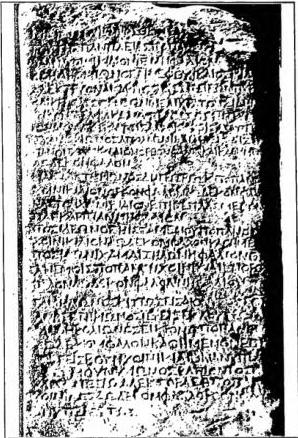
CALENDAR - Athenian C. from the time of Hadrian (2nd century).
The month comprised three major divisions derived from the phases of the moon (v. above); the intermediate days were numbered by counting backward the days separating them from the immediately following division.
The Roman calendar was an effective means of religious unification not only for Italy, where the surviving calendars, numbering 28 in total and more or less complete, have revealed their fundamental uniformity, but also wherever the civil or military imperial administration was in force.
The Roman calendar has remained in its oldest parts from the regal period (certainly prior to 500) and is therefore attributed to Numa, the organizer, according to tradition, of the sacred antiquities of the city. The most ancient festivals are engraved in surviving ferials in large majuscules. These are fixed-date festivals (istativae), numbering 45: the months of September and November lack them, perhaps because these months were of no interest to the farmer. Later-added festivals are in smaller characters. The conceptivae festivals, that is, those proclaimed each year according to the season (Sementine, Fornacali, Florifertum, Augurium canarium, Paganali, Compitali), are not fixed by the ferial.
Festivals of the same calendar
| 1 Martius | Equirria (14), Liberalia (17), Quinquatus (19), Tubilustrium (23) |
|---|---|
| 2 Aprilis | Fordicilia (15), Cerialia (19), Parilia (21), Vinalia (23), Robigalia (25) |
Mesi del c. romano
| MARZO MAGGIO LUGLIO OTT. | GENN. AG. DIC. | APR. GIUGNO SETT. NOV. | FEBBR. | |||
|---|---|---|---|---|---|---|
| 1 | kalendis | kalendis | 1 | kalendis | kalendis | |
| 2 | VI | IV | 2 | IV | IV | |
| 3 | V | III | 3 | III | III | |
| 4 | IV | prid. nonas | 4 | prid. nonas | prid. nonas | |
| 5 | III | nonis | 5 | nonis | nonis | |
| 6 | prid. nonas | VIII | 6 | VIII | VIII | |
| 7 | nonis | VII | 7 | VII | VII | |
| 8 | VIII | VI | 8 | VI | VI | |
| 9 | VII | V | 9 | V | V | |
| 10 | VI | IV | 10 | IV | IV | |
| 11 | V | III | 11 | III | III | |
| 12 | IV | prid. idus | 12 | prid. idus | prid. idus | |
| 13 | III | idibus | 13 | idibus | idibus | |
| 14 | prid. idus | XIX | 14 | XVIII | XVI | |
| 15 | idibus | XVIII | 15 | XVII | XV | |
| 16 | XVII | XVII | 16 | XVI | XVI | |
| 17 | XVI | XVI | 17 | XV | XIII | |
| 18 | XV | XV | 18 | XIV | XII | |
| 19 | XIV | XIV | 19 | XIII | XI | |
| 20 | XIII | XIII | 20 | XII | X | |
| 21 | XII | XII | 21 | XI | IX | e nel |
| 22 | XI | XI | 22 | X | VIII | bisestile |
| 23 | X | X | 23 | IX | VII | |
| 24 | IX | IX | 24 | VIII | VI | |
| 25 | VIII | VIII | 25 | VII | V | bis VI |
| 26 | VII | VII | 26 | VI | IV | V |
| 27 | VI | VI | 27 | V | III | IV |
| 28 | V | V | 28 | IV | prid. kalend. | III |
| 29 | IV | IV | 29 | III | prid. kalend. | |
| 30 | III | III | 30 | prid. kalend. | ||
| 31 | prid. kalend. | prid. kalend. |
For the description of these festivals V. the individual entries.
Nicola Turchi
### III. CHRISTIANITY.
11. WESTERN CHURCH
a) Origin of the year. - The Christian religious calendar disregards seasonal changes and commemorates throughout the year the principal moments in the life of the Founder, from the announcement of His coming (the 4 Sundays of Advent), to Christmas (25 Dec.), to Epiphany or His public manifestation (6 Jan.), to Easter (the full moon following the spring equinox), to the Ascension (40 days after Easter), to Pentecost (50 days after Easter), to the 24 Sundays after Pentecost that recall the expansion of the Church in the world and lead to the first Sunday of Advent (v. ANNO LITURGICO).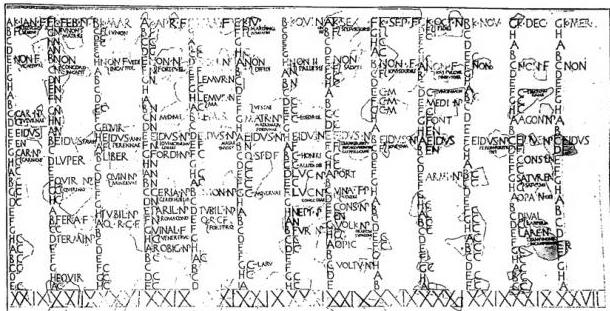
However, for civil purposes, Christianity adopted the Julian calendar, introducing into it the week, which was foreign to it, and re-establishing its connection with the phases of the moon for the determination of Easter.
The week, imitated from the Jews and in use at least since the second half of the 1st century, begins with feria I, generally called dies dominica, and ends with feria VII, which is called sabbatum. For Easter, the Council of Nicaea in 325 established that it be celebrated on the first Sunday after the 14th moon of the first month (nfsdn), that is, on the one that fell on the day of the spring equinox fixed on 21 March, or that followed it (v. PASQUA).
Initially, the 19-year lunar cycle introduced by Meton and followed by the Alexandrian Church was considered sufficient for the calculations to determine the 14th moon, while the Church of Rome followed an old 84-year cycle. The divergences between the two computations regarding the date of celebration
(fot. museo delle Terme)
CALENDAR - C. of Anzio preceded, painted on plaster, discovered in Anzio in 1915, transported to the Museo delle Terme. Its peculiarities: the 13th month (Mercedonius); alternating months of 29 and 31 days; the names Quintilis and Sextilis for July and August. - Rome.
The divergences between the two computations regarding the date of Easter were such that Emperor Theodosius I invited Theophilus, later Alexandrian patriarch, to establish a new cycle. He set it at 437 years, later reduced by himself to 100 and by his nephew Cyril, who succeeded him in the patriarchate, to 95; while in the West, after the notable discrepancies of the years 379, 403, 417, 428, 444, 455, Pope St. Hilary (successor of St. Leo the Great, who had already written [July 454] to the Churches of Gaul and Spain to adhere, for the sake of concord, to the Eastern usage) asked the mathematician Victorius of Aquitaine to find a way of reconciliation, which he did by proposing a cycle of 532 years. This cycle was accepted and perfected by Dionysius Exiguus by combining the solar cycle of 28 years with the cycles of Theophilus, Cyril, and Meton (525). This is the cycle that remained in force in Christendom until the Gregorian correction (1582), except for a minor remnant in the Celtic Churches (Irish and Bretons), which wished to remain faithful to the Roman usage received at the time of their first evangelization and only toward the end of the 8th century adhered to the Dionysian cycle, which was that received by the Anglo-Saxons together with the mission of Augustine of Canterbury.
b) Gregorian reform. - The Julian year had already in the Middle Ages been subjected to various calculations that discovered minimal differences between it and the tropical year, but such as to lead to serious errors over the centuries, so much so that the equinox, in the 16th century, was to fall, according to the official c., on March 11; the difference of one day every 312 years was also found for the phases of the moon.
Already a Scottish monk, John of Holywood, in 1232, had in the De anni ratione proposed a modification to the intercalation of the leap year; in 1252 the astronomers who, by order of Alfonso X of Castile, compiled the Alfonsine Tables, calculated that the tropical year was not 365 days and 6 hours, but 365 days, 5 hours, 49 minutes, and 12 seconds; Roger Bacon, in the Opus maius to Clement IV, proposed a reform. Clement VI in 1345 entrusted the study to two French mathematicians. In the 15th century, the Councils of Constance and Basel dealt with it; Sixtus IV entrusted the study of a reform to the famous Regiomontanus (Johannes Müller of Königsberg). Leo X, in the Fifth Lateran Council, convened by Julius II in 1511 and continued under the presidency of the Medici pope from 1513 to 1517, gave new impetus to the reform of the calendar, also availing himself of the cooperation of Paul of Middelburg, thanks to which the preparatory work could be considered nearly complete. Emperor Maximilian also had the question examined: the mathematicians (Pighius, Lucidus, Pitatus, Sepúlveda, and others) dedicated themselves to it; finally, the Council of Trent, in its last session of December 4, 1563, entrusted the reform to the Pope, together with those of the Breviary and the Missal.
Gregory XIII, therefore, made use of the work of the most famous mathematicians, including the Calabrian Antonio Giglio (Lilius), whose brother Luigi had drafted the project examined by the commission, the Dominican Ignazio Danti, constructor of the gnomon of S. Petronio in Bologna, the German Jesuit Christoph Clavius (Clau), and the Spaniard Pedro Chacón (Ciacconio).
It has been calculated that the Gregorian reform still leaves an error of 6 days every 10,000 years, but in any case, for another 2,000 years, corrections are not practically necessary.
The Gregorian c., adopted almost immediately in Catholic countries, encountered resistance elsewhere, but was eventually definitively accepted by Sweden in 1753; in Switzerland, given the different religions and the autonomy of the Cantons, between 1584 and 1817; in Germany in the 18th century; in England in 1750; in Japan in 1873.
The schismatic countries of the East, Greeks, Russians, Serbs, Bulgarians, Romanians, Armenians, Georgians, Copts, did not accept the reform; indeed, the four Byzantine patriarchs and many bishops gathered in Synod in Constantinople in 1593 to hurl anathema against the reform, as if it were contrary to the decrees of Nicaea. The Soviet government in 1917 accepted the reform, which, however, is still rejected by the Moscow Patriarchate. With the bull Inter gravissimus of February 24, 1582, Gregory XIII decreed: 1) that the day following October 4, 1582, be computed as October 11, remedying the discrepancy between the civil year and the solar year, which brought the spring equinox back to March 21, in accordance with the situation that had occurred at the time of the Council of Nicaea; 2) that to avoid the recurrence of the error (taking into account that the civil year exceeds the solar year by 11 minutes and 12 seconds), one day be subtracted every century, making common the secular year that would be a leap year, except for that whose first two digits are divisible by 4. This subtraction is called the solar equation, as it re-establishes the agreement between the civil year and the solar year. Carmelo Trasselli
12. EASTERN CHURCHES
The Eastern Churches of the Byzantine rite still preserve the ancient tradition of Constantinople, according to which the ecclesiastical year begins in the month of September (1st or 13th, depending on whether they have accepted the Gregorian correction or not). In the computation of years, the Christian era is followed everywhere, and only on great solemnities is it followed by the Byzantine era or that of the Seventy.When Gregory XIII proceeded with the reform of the old Julian c., he sought to come to an agreement with the patriarch of Constantinople as well, but his attempts had no positive result; indeed, his reform was explicitly condemned in the Synod of 1593. Such aversion of the dissident Eastern Churches to the new c. continued everywhere until 1923, the year in which the Patriarchate of Constantinople, the Churches of Athens, Cyprus, Poland, and Romania adopted it for fixed feasts, followed later by the Georgians (1927) and the Melkites of Alexandria (1928). The "pan-Orthodox" Synod of Moscow in 1948 left freedom of choice in this matter to the churches of the Soviet orbit (cf. G. de Vries, Il Sinodo « panortodosso » di Mosca, in Civ. Catt., 1949, II, 157 ff.; 287 ff.).
Its adoption by many national churches occurred not without difficulty, and throughout the Christian East, with regard to movable feasts, the old Julian c. continues to be used. The same Byzantine-rite Catholic churches do not yet all observe the reform of Gregory XIII, and Rome wisely does not insist on this, trusting in the inevitable progress to introduce it everywhere. The Maronites, for example, accepted the Gregorian c. as early as 1606, the Syrians from 1836, the Melkites from 1857, the Romanians only in 1924. Among the Armenians, who have a wholly special ecclesiastical year, the Gregorian reform was accepted by the Catholics in 1890 and made obligatory in 1911. In the Chaldean rite, the year begins on December 1, and the Gregorian c., introduced among the Catholics in 1836, was gradually accepted without great difficulty.
Also in the Antiochene rite — Syrians and Maronites — the ecclesiastical year for the sanctoral begins on October 1. The old c. of the Church of Antioch has been reconstructed based on the collection of the Homilies of Severus and filling the inevitable gaps with the help of the Panegyrics of St. John Chrysostom and the Syriac martyrologies.
The Coptic calendar of Alexandria was reconstructed by Nilles with the aid of information provided by a Coptic bishop, Monsignor Agapio Basi. There is no doubt that the Copts inherited an already formed calendar, to which they made additions without altering its primitive foundation, which can be considered as consisting of a threefold division: Major Feasts (Annunciation, 29 Phamenoth; Nativity, 28 Choiak; Baptism, 11 Tobi; Palm Sunday; Easter Resurrection; Ascension; Pentecost), Minor Feasts (Circumcision, 6 Tobi; First Miracle, 13 Tobi; Presentation in the Temple, 8 Mechir; Last Supper; Thomas Sunday, the first after Easter; Entry into Egypt, 24 Pachôn), and Simple Feasts, called Pinisti and Pikudri; the latter concern the Virgin and the saints, while the former pertain to the life, passion, and death of Jesus Christ. In the Coptic calendar of Alexandria, the ecclesiastical year begins on 10 September (1 Thôut).
Byzantine Calendar
| 1 Septémbrios | 7 Martios |
|---|---|
| 2 Octóbrios | 8 Aprílios |
| 3 Noémbrios | 9 Maiós |
| 4 Dekémbrios | 10 Iounios |
| 5 Ianoudrios | 11 Ioulios |
| 6 Febroudrios | 12 Augoustos |
This calendar is proper to the Churches of the Byzantine rite: Greek, Slavic, Romanian, Georgian, and Melkite.
The names of the months used in the regions of the Christian East follow.
Syro-Arabic Calendar
| 1 Tifrín primo | = ott. | 7 Nísán | = apr. |
|---|---|---|---|
| 2 Tifrín secondo | = nov. | 8 Ijár, ajjár | = maggio |
| 3 Kánún primo | = dic. | 9 Hazírán | = giugno |
| 4 Kánún secondo | = genn. | 10 Tammúz, tamúz | = luglio |
| 5 Šbát | = febbr. | 11 Áb | = ag. |
| 6 Adár | = marzo | 12 Itál | = sett. |
C. armeno
| 1 Navasard | = 11 ag.-9 sett. |
|---|---|
| 2 Hori | = 10 sett.-9 ott. |
| 3 Salmi | = 10 ott.-8 nov. |
| 4 Tré | = 9 nov.-8 dic. |
| 5 Khalots (Khaghots) | = 9 dic.-7 genn. |
| 6 Arats | = 8 genn.-6 febbr. |
| 7 Mehekan | = 7 febbr.-8 marzo |
| 8 Areg | = 9 marzo-7 apr. |
| 9 Ahekan | = 8 apr.-7 maggio |
| 10 Mareri | = 8 maggio-6 giugno |
| 11 Margats | = 7 giugno-6 luglio |
| 12 Hrotits | = 7 luglio-5 ag. |
Coptic Calendar
| 1 Thôut | 29 ag.-27 sett. |
|---|---|
| 2 Paopi | 28 sett.-27 ott. |
| 3 Athór | 28 ott.-26 nov. |
| 4 Choiak | 27 nov.-26 dic. |
| 5 Tobi | 27 dic.-25 genn. |
| 6 Mechir | 26 genn.-24 febbr. |
| 7 Phamenoth | 25 febbr.-26 marzo |
| 8 Pharmonthi | 27 marzo-25 apr. |
| 9 Pachôn | 26 apr.-25 maggio |
| 10 Paóni | 26 maggio-24 giugno |
| 11 Epép | 25 giugno-24 luglio |
| 12 Mesóré | 25 luglio-23 ag. |
C. Ethiopian
| 1 Maskaram | 29 ag.-27 sett. |
|---|---|
| 2 Tékèmt | 28 sett.-27 ott. |
| 3 Hédár | 28 ott.-26 nov. |
| 4 Tshfát | 27 nov.-26 dic. |
| 5 Tér | 27 dic.-25 genn. |
| 6 Jakátit | 26 genn.-24 febbr. |
| 7 Magábit | 25 febbr.-26 marzo |
| 8 Mijdzjá | 27 marzo-25 apr. |
| 9 Génbót | 26 apr.-25 maggio |
| 10 Sané | 26 maggio-24 giugno |
| 11 Hamlé | 25 giugno-24 luglio |
| 12 Nabasé | 25 luglio-23 ag. |
IV. CALENDAR OF THE FRENCH REPUBLIC.
The calendar underwent another temporary reform during the French Revolution, which modified it ostensibly both to facilitate the people’s forgetting of Christian worship and to render the computation of time more rational, as well as to imitate the Roman reckoning ab urbe condita. The new calendar, approved by the Convention on 5 Oct. 1793, began the year with 22 Sept. 1792, the date of the proclamation of the Republic and the true autumnal equinox for Paris; upon Laplace’s recommendation, it was abolished by the Senate effective 1 Jan. 1806. The year consisted of 12 months of 30 days each, divided into 3 decades; the remaining 5 days (6 in leap years), called epagòmeni or sanculottides, were added after the last day of Fructidor. The following table begins with the date of approval for clarity.
Concordance between the French calendar and the Gregorian year:
| anno rep. | II | III (bisest.) |
|---|---|---|
| anno greg. | 1793-94 | 1794-95 |
| mese rep. | ||
| 1 vendemmiale | 22 sett. 1793 | 21 sett. 1794 |
| 1 brumale | 22 ott. | 22 ott. |
| 1 frimale | 21 nov. | 21 nov. |
| 1 nevoso | 21 dic. | 21 dic. |
| 15 nevoso | 4 genn. 1794 | 4 genn. 1795 |
| 1 piovoso | 20 genn. | 20 genn. |
| 1 ventoso | 19 febbr. | 19 febbr. |
| 1 germinale | 21 marzo | 21 marzo |
| 1 fiorile | 20 apr. | 20 apr. |
| 1 pratile | 20 maggio | 20 maggio |
| 1 messidoro | 19 giugno | 19 giugno |
| 1 termidoro | 19 luglio | 19 luglio |
| 1 fruttidoro | 18 ag. | 18 ag. |
| 5 epagòmeni | 6 epagòmeni | |
| IV 1795-96 | V 1796-97 | VI 1797-98 |
| 1 vend. 23 sett. 1795 | 22 sett. 1796 | 22 sett. 1797 |
| 1 bru. 23 ott. | 22 ott. | 22 ott. |
| 1 fri. 22 nov. | 21 nov. | 21 nov. |
| 1 nev. 22 dic. | 22 dic. | 21 dic. |
| 15 nev. 5 genn. 1796 | 4 genn. 1797 | 4 genn. 1798 |
| 1 piov. 21 genn. | 20 genn. | 20 genn. |
| 1 vent. 20 febbr. | 19 febbr. | 19 febbr. |
| 1 germ. 21 marzo | 21 marzo | 21 marzo |
| 1 fior. 20 apr. | 20 apr. | 20 apr. |
| 1 prat. 20 maggio | 20 maggio | 20 maggio |
| 1 mess. 19 giugno | 19 giugno | 19 giugno |
| 1 term. 19 luglio | 19 luglio | 19 luglio |
| 1 frutt. 18 ag. | 18 ag. | 18 ag. |
| 5 epagòmeni | 5 epagòmeni | 5 epagòmeni |
| VII 1798-99 | VIII 1799-1800 | IX 1800-1801 |
| 1 vend. 22 sett. 1798 | 23 sett. 1799 | 23 sett. 1800 |
| 1 bru. 22 ott. | 23 ott. | 23 ott. |
| 1 fri. 21 nov. | 22 nov. | 22 nov. |
| 1 nev. 21 dic. | 22 dic. | 22 dic. |
| 15 nev. 4 genn. 1799 | 5 genn. 1800 | 5 genn. 1801 |
| 1 piov. 20 genn. | 21 genn. | 21 genn. |
| 1 vent. 19 febbr. | 20 febbr. | 20 febbr. |
| 1 germ. 21 marzo | 22 marzo | 22 marzo |
| 1 fior. 20 apr. | 21 apr. | 21 apr. |
| 1 prat. 20 maggio | 21 maggio | 21 maggio |
| 1 mess. 19 giugno | 20 giugno | 20 giugno |
| 1 term. 19 luglio | 20 luglio | 20 luglio |
| 1 frutt. 18 ag. | 19 ag. | 19 ag. |
| 6 epagòmeni | 5 epagòmeni | 5 epagòmeni |
| X 1801-1802 | XI 1802-1803 | XII 1803-1804 |
| 1 vend. 23 sett. 1801 | 23 sett. 1802 | 24 sett. 1803 |
| 1 bru. 23 ott. | 23 ott. | 24 ott. |
| 1 fri. 22 nov. | 22 nov. | 23 nov. |
| 1 nev. 22 dic. | 22 dic. | 23 dic. |
| 15 nev. 5 genn. 1802 | 5 genn. 1803 | 6 genn. 1804 |
| 1 piov. 21 genn. | 21 genn. | 22 genn. |
| 1 vent. 20 febbr. | 20 febbr. | 21 febbr. |
| 1 germ. 22 marzo | 22 marzo | 22 marzo |
| 1 fior. 21 apr. | 21 apr. | 21 apr. |
| 1 prat. 21 maggio | 21 maggio | 21 maggio |
| 1 mess. 20 giugno | 20 giugno | 20 giugno |
| 1 term. 20 luglio | 20 luglio | 20 luglio |
| 1 frutt. 19 ag. | 19 ag. | 19 ag. |
| 5 epagòmeni | 6 epagòmeni | 4 epagòmeni |
| XIII 1804-1805 | ||
| 1 vend. 23 sett. 1804 | 1 germ. 22 marzo | |
| 1 bru. 23 ott. | 1 fior. 21 apr. | |
| 1 fri. 22 nov. | 1 prat. 21 maggio | |
| 1 nev. 22 dic. | 1 mess. 20 giugno | |
| 15 nev. 5 genn. 1805 | 1 term. 20 luglio | |
| 1 piov. 21 genn. | 1 frutt. 19 ag. | |
| 1 vent. 20 febbr. | 5 epagòmeni | |
| XIV 1805 | ||
| 1 vend. 23 sett. 1805 | 1 fri. 22 nov. | |
| 1 bru. 23 ott. | 1 nev. 22 dic. |

# V. CALENDARIO MASSONICO.
(fut. museo delle Terme)
It retains the subdivision of the year into months and days according to common usage, but replaces the names of the months with the sequence of ordinal numbers from 1 to 12, starting from the month of March, in accordance with the ancient Roman calendar and the Venetian style of the Christian era. The reckoning of years is advanced by 4000 years over the Christian era, and is done with the cardinal number, preceded by the formula "anno della vera luce" (year of the true light). In documents, the dating with the Masonic era system is always used alongside the Christian era in the style of the Circumcision. Thus, in an act of 15 June 1812, issued by the Masonic Lodge of Malta, one reads: L'an de la V. L. [Vraie Lumière] 5812, le 15e Jour du 4e Mois, et de l'ère vulgaire le 15e Juin 1812; and in the escatocol: Donné à l'Orient de Malthe, les Jour, Mois et an que dessus (cited by C. Paoli, Diplomatica, new edition edited by G. C. Bascapè, Florence [1942], p. 211, note 2).
VI. FURTHER PROPOSALS FOR REFORM.
CALENDARIO - UNIVERSAL CHURCH CALENDAR
(photo: Soprintendenza Monuments)
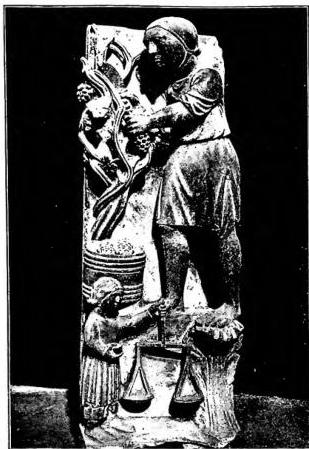
CALENDARIO - Representation of Autumn, work by B. Antelami (ca. 1200) - Parma, Baptistery.
The most significant and delicate of all these reforms is that of the date of Easter, which follows the lunar calendar rather than the solar one and can vary from March 22 to April 25, dragging with it all other movable feasts. This detachment of Easter from the lunar computation could be achieved by fixing the average date among possible Paschal lunations, in which the Passion and Resurrection of the Lord actually occurred, but it runs counter to the uninterrupted liturgical tradition of the Church, consecrated by the Council of Nicaea, which has always associated Easter with the lunar cycle.
Without revisiting the oldest proposals for calendar reform, it is worth recalling that: in 1922, the International Astronomical Union, convened in Rome, presented its project to the League of Nations; in 1930, a society for calendar reform was founded in New York, with the Journal of Calendar Reform as its organ; in 1937, at the request of the Bureau International du Travail, a project was presented to the League of Nations aimed at fixing the position of the days of the week within the month and establishing the date of Easter. It was proposed, while respecting the division of the year into weeks, to divide the year itself into four trimesters, each of four weeks, all beginning on Sunday
and ending on Saturday, totaling 91 days, which multiplied by four gives 364 days. The 365th day would be added at the end of December, and the leap day every four years at the end of June. As for Easter, freed from the lunar cycle, it could be fixed on the Sunday of April 8. The most recent exposition of these ideas is found in the pamphlet by Fr. C.-M. Morin, cited in the bibliography.
CHRISTIANITY: For the Western Church V. UNIVERSALISTI. - EASTERN CHURCHES: N. Nilles, Kalendarium manuale utriusque Ecclesiae Orientalis et Occidentalis academis clericarum accomodatum, 2nd ed., Innsbruck 1896; Calendrier de l'Église copte d'Alexandrie, compiled by Fr. N. Nilles, in Revue de l'Orient Chrétien, 2 (1897), pp. 307-39; C. Tondini de' Quarenghi, Etude sur le calendrier liturgique de la nation arménienne, Rome 1906; R. Janin, Les Eglises Orientales et les Rites Orientaux, Paris 1926; C. Gatti-C. Korolevski, I riti e le Chiese Orientali, I, Rome 1942, p. 107. - GREGORIAN REFORM: F. Kaltenbrunner, Die Vorgeschichte der Gregorianischen Kalenderreform, in Sitzungsb. Ab., Vienna 1876, 289-414; F. Ferrari, Il c. gregoriano, Rome 1882; D. Mazzi, La questione della riforma del c. nel V Concilio lateranense, Florence 1896; P. Tacchi Venturi, Storia della Compagnia di Gesù in Italia, I, 1, 2nd ed., Rome 1931, pp. 181-84.
PROPOSALS FOR REFORM: V. Botto, Il c. unificato e comparato con la liturgia, Rome 1919; A. Obrecht, Il c. gregoriano, Bergamo 1925; Société des Nations, Classification et résumé des projets de réforme du calendrier, Geneva 1927; P. Sconzo, Sulle questioni della nuova riforma del c., Palermo 1935; Abbé Chauve-Bertrand, Vers un calendrier nouveau, in Éphemerides liturgicae, 54 (1940), pp. 67-87; C.-M. Morin, L'année jubilaire 1950 sera-t-elle l'ère d'un nouveau calendrier civil et ecclésiastique?, offprint from Culture, Québec, December 1947. - Nicola Turchi