
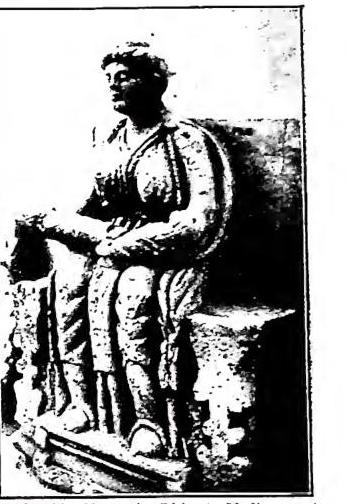
MATER MATUTA and MATRALIA. — Mater Matuta is an ancient goddess of the Italic and Roman religions. An important sanctuary dedicated to her was located at Satricum (Conca), where many votive statuettes depicting women holding children in their arms have been found. In Rome, her temple stood in the Forum Boarium, adjacent to that of Fortuna, sharing the same dedication day: June 11, which in the oldest calendar appears as the festival of the goddess, the Matralia.
The ancients identified the goddess with the Greek Ino Leukothea, nurse of Dionysus. They associated her both with motherhood and with the dawn, partly due to her double name. Her cult preserved several distinctive archaic traits that are difficult to interpret. Only *univirae* women (those who had married only once) could enter her temple. Yet, on the day of her festival, a slave woman was nevertheless led into the temple, but only to be mistreated and driven out. The women prayed to the goddess not for their own children, but for the children of their sisters (cf. the myth of Ino, sister of the mother of Dionysus).
Angelo Brelich
THE DIVINE MOTHERHOOD OF MARY. — This is the principal privilege of Mary and the root of all others. The nature and foundations of this divine motherhood were illuminated by Pius XI in the encyclical *Lux veritatis*, issued for the fifteenth centenary of the Council of Ephesus.
Human motherhood, in general, implies a permanent relationship between mother and child, founded on generation. It requires that a woman (the generating principle) communicate to the child (the generated term) a nature identical to her own (the term according to which the subject is generated) through true generation (conception, gestation, and birth). Thus, there is a genuine relationship whose constitutive elements are: the generating principle, the generated term (the subject or person generated according to a specific nature), and the foundation, namely, generation. Applying these notions to the divine motherhood of Mary, it can be said that it consists in a permanent relationship between Mary (the generating principle) and Christ (the term or person generated, according to human nature), founded on generation. Since Mary truly generated the divine person of the Word according to human nature, she possesses a true and proper divine motherhood. This is well understood when one considers that in Christ there is only one person (the divine person of the Word) in whom two natures subsist, the divine and the human. Consequently, the same person (the divine person of the Word) generates the divine from eternity from the Father according to the divine nature and was generated in time by Mary according to human nature. The denial of the unity of the person in Christ led Nestorius (v.) to admit that Mary was only *Christotokos* (Mother of Christ) and not *Theotokos* (Mother of God). He admitted in Christ not only two natures but also two persons, the divine and the human, in a perfect moral union of wills. This heresy was solemnly condemned at the Council of Ephesus (431) with the singular exultation of all the faithful (cf. Denz.-U., 148).
This dogma is explicitly contained in Revelation. In Holy Scripture, Mary is presented as the mother of Jesus, whom she conceived and gave birth to (Is. 7:14; Mt. 2:11; Lk. 1:31; 2:7; Jn. 2:1, 3, 5, 12; 19:25-26; Gal. 4:4). Jesus is then presented as God. Therefore, since Mary is the mother of Jesus, who is true God, she is in the true and proper sense the Mother of God. This is how St. Elizabeth greeted her, inspired by God, when she exclaimed: “And why is this granted to me, that the mother of my Lord should come to me?” (Lk. 1:43). The term “Lord” is synonymous with “God,” since in the same chapter it is used fourteen times always in the sense of “God,” and Elizabeth herself adds: “for behold, when the voice of your greeting came to my ears, the babe in my womb leaped for joy. And blessed is she who believed that there would be a fulfillment of what was spoken to her from the Lord” (Lk. 1:41-45).
Christian tradition, from apostolic times, has explicitly attested to the divine motherhood of Mary: St. Ignatius of Antioch (*Ephes.*, 7), St. Irenaeus (*Adv. haer.*, III, 16, 22; PG 7, 921, 955), Tertullian (*De carne Christi*, 17; PL 2, 781-82), St. Hippolytus (*Contr. haeres. Noeti*, 17; PG 10, 825-28). Regarding the technical term *Theotokos*, it was so universally accepted that St. Cyril of Alexandria could appeal, against Nestorius, to the common usage of the holy Fathers who had preceded him (*Liber ad Reginas, De recta in D. N. I. C. fide*: PG 76, 1218).
The dignity derived by Mary from her divine motherhood is entirely singular and, in a certain sense—morally—infinite, since, as St. Albert the Great asserted, the Son renders the goodness of the Mother infinite (*Mariale*, q. 197). It places the Virgin in the closest possible relationship with each of the persons of the Most Holy Trinity. By itself, the divine motherhood surpasses incomparably all orders of nature, grace, and glory, elevating the Virgin to the highest of all created orders, the order of the Hypostatic Union, to which she belongs as the instrumental cause of the Incarnation of the Word. For this reason, the holy Fathers, Doctors of the Church, and ecclesiastical writers have employed the most beautiful titles to exalt the transcendent dignity of the Mother of God.
Liturgical Feast. — A particular feast in honor of Mary’s divine motherhood was instituted only in the 18th century. At the request of the Portuguese clergy and of Giuseppe Emmanuele, Benedict XIV, by decree of the Sacred Congregation of Rites (January 22, 1751), granted it to Portugal to be celebrated with a major double rite on the first Sunday of May, and he himself prepared the Mass and Office for it (cf. Benedicti XIV, *Opera*, VI [Prato 1842], pp. 212). In due course, it was extended to the Venetian Republic (1752), the Kingdom of Naples (1778), the diocese of Perugia (1800), Tuscany (1807), England (1843), etc. Then, in memory of the fifteenth centenary of the Council of Ephesus, Pius XI (encyclical *Lux veritatis*, December 25, 1931; AAS, 23 [1931], pp. 516-17) extended it to the universal Church with a double rite of the second class and a proper Mass and Office (cf. F. G. Holwick, *Fasti Mariani*, Freiburg im Br. 1892, pp. 224-25). Vedi tav. XXVII.
Maternal Spirituality of Mary
**I. The Fact.** — That the Blessed Virgin Mary, besides being the natural mother of Christ, the God-Man, is also the spiritual mother of all Christians who are members of the Mystical Body of Christ, is an incontestable fact, since it is taught in the ordinary magisterium of the Church and is the conviction of all the faithful. In the words addressed by the crucified Jesus to His Mother and to St. John: “Behold thy son... Behold thy mother” (Jn. 19:26), many exegetes, both ancient and modern, have seen the solemn promulgation of the fact of Mary’s spiritual motherhood (e.g., St. Ambrose, St. John Damascene, George of Nicomedia, Eadmer, Philip of Harvengt, Rupert of Deutz, Gerhoch of Reichersberg). In two strophes of a Latin sequence from the 15th century on the Virgin’s compassion, it is said: “The mother is given to the disciple, and this is a great mystery; under the name of John, every faithful is included” (cf. U. Chevalier, Repertorium hymnologicum, I, Louvain 1892, p. 418, no. 6983).
The Roman Pontiffs, in official documents, have likewise interpreted Christ’s words in this sense. Benedict XIV, in the bull *Gloriosa Dominae* of 27 September 1748, affirmed that “the Catholic Church, under the illumination of the Holy Spirit, has always professed the most filial devotion to the Blessed Virgin, seeing in her the most loving mother, a mother left by her dying Spouse with His last words” (Bullarium, II, Prato 1846, p. 428). Leo XIII, in the encyclical *Adiutricem populi* of 5 September 1895, explicitly taught that “according to the perennial sense of the Church (*quod perpetuo sensu Ecclesia*),” Christ, in the person of John, designated all mankind, especially those united to Him by faith” (A. Tondini, *Encicliche Mariane*, Rome 1950, p. 22). The same declaration has been made by Pius VIII, Benedict XV, and Pius XI.
**II. Nature.** — When it is asserted that Mary is our mother, this is not meant in a merely metaphorical sense, as if she loved us as a mother does, but in a proper sense. Nor is it meant in a merely juridical sense, as if she had merely adopted us as children, but in a real sense, that is, as a direct communication of life. It must however be borne in mind that the life communicated directly by Mary is not natural life but the supernatural life of divine grace, incomparably superior to the natural life communicated by an earthly mother.
**III. The Foundation.** — The fundamental reason for this supernatural motherhood is to be sought in the doctrine of the Mystical Body of Christ. Indeed, by the Incarnation in Mary’s womb, the Word made flesh became the mystical Head of all humanity (which is the synthesis of all creation), and humanity became His mystical body. Therefore, by giving natural birth to Christ, Mary also gives supernatural birth to the mystical members of Christ, that is, to all humanity. The Head and His members became the fruit of the Virgin’s womb, and Mary became the mother of the whole Christ, Head and members: naturally the mother of Christ and supernaturally the mother of all His mystical members.
It must however be noted that Mary’s universal and supernatural motherhood, at the moment of the Incarnation and by virtue of the same, existed only in a potential state (not yet in act), since only initially was all humanity then included in Christ, or rather, in the humanity He assumed. This potential inclusion of humanity and its individual members becomes actual and personal when individual men are incorporated into the Mystical Christ through faith and Baptism, which are indispensable for attaining eternal life (cf. Mk. 16:15-16; Jn. 3:5-6), since they make of Christ and us an indissoluble supernatural reality, one mystical person. Even this actual supernatural generation of the individual to the supernatural life of divine grace takes place only in Mary, through the operation of the Holy Spirit. In Baptism, what occurred potentially for all humanity in the Incarnation now takes place actually for the individual. In Baptism, the Virgin mystically actualizes her potential motherhood.
Besides communicating directly, together with Christ, the supernatural life of grace, Mary nourishes and develops this same life in each of her children through actual graces, all of which pass through her hands. This maternal action perdures until the individual has attained in heaven the fullness of Christ’s stature.
**IV. The Extension.** — If Mary’s spiritual motherhood has its foundation in our incorporation into Christ, it follows that it extends as far as Christ’s quality as Head of His Mystical Body extends. Now, Christ’s quality as Head extends to all creatures, both angels and men, since all, though in different ways, are mystical members of Christ, and therefore the supernatural life of divine grace flows from the Head to all.
Therefore Mary’s spiritual motherhood extends to all creatures, angels and men, since she cooperated in uniting them and incorporating them into Christ as members to the Head. Not all, however, are so in the same way or to the same degree. For some, Christ is Head in act; for others, He is Head only in potency; and for others, in no way at all. He is Head in act of the faithful, sinners, just, and blessed, though in very different degrees. Of the faithful who are sinners (deprived of grace but united to Christ by faith), Christ is Head (and Mary is mother) in a certain respect only; of the just faithful, Christ is Head (and Mary is mother) in every respect; of the blessed, both angels and men, Christ is Head (and Mary is mother) in a most excellent manner. Christ is Head in potency (and the Virgin is mother in potency) of the unbelievers, who perhaps one day will be united to Christ by charity or at least by faith. Christ is in no way Head (and Mary, in no way, is mother) of those who, whether angels or men, are damned, since they are in no way united to Christ, either in act or in potency, being definitively separated from Him.
**