
BREVIARY. – It is the liturgical book that contains the divine office (v.) according to the rite of the Roman Church. The term b. (brief note, compendium), already used in theological language (Breviarium fidei), administrative language (Breviarium imperii, of Augustus), and juridical language (Breviarium extravagantium), in the liturgical language at first indicated a sheet or booklet placed at the beginning of the psalter, which noted the divine offices to be performed at a given time, together with their respective formularies and cross-references.
In its present arrangement, the b. consists of the following parts: 1) The bulls (Quod a nobis of s. Pius V, dated 9 July 1568, in which the reasons for publishing the new text and the work undertaken to ensure its correction are set forth, as we shall see below, and Divino afflatu of 1 Nov. 1911, by which Pius X ordered a new arrangement of the psalter for weekdays. 2) The short treatise De anno et eius partibus, which is a collection of brief astronomical notions, formerly necessary when everyone had to make these calculations for himself, but now superfluous because of the use of the Ordo divini Officii, published each year with all the rules necessary for reciting the b. 3) The Calendar, with all the feasts to be celebrated according to their proper rite. 4) The general Rubrics, which are a novelty in the b. of s. Pius V. They were corrected and enlarged under Clement VIII and Urban VIII (1602 and 1635), and constitute the text of the rules governing the recitation of the divine office. Other particular rules are scattered throughout the body of the b. A precious source for the rubrics is provided by the ancient Ordines or Ordinarii (v.). 5) The Ordinary of the divine office contains the general structure of the individual canonical hours, together with those formulas (hymns, chapters, responsories...) that are said every day throughout the year, or at least during its principal liturgical divisions: Advent, the season after Epiphany and after Pentecost, called per annum, Lent, Passiontide, and the Easter season. 6) The Psalter, the fundamental element of the b., was formerly said to follow the order given by Sacred Scripture (Psalterium non feriatum). Under the influence of monks and Popes, certain psalms were chosen for particular canonical hours, at first simply indicated by marginal notes, and later according to the order of the office (Psalterium feriatum). The present psalter contains the psalms and canticles distributed according to the days of the week, together with the hymns of the hours for the ordinary season. It follows the text of the Vulgate, emended by s. Jerome in 389 and first adopted in Gaul, hence called Psalterium gallicanum; the Psalterium romanum, that is, the version of the Vetus latina, which until the time of s. Pius V was in use in the Roman basilicas and almost throughout the Latin Church, was retained at St Peter’s in Rome, at St Mark’s in Venice, in Milan, and in a few other churches. Pius XII, by Motu proprio of 24 March 1945, permitted the use, in the public and private recitation of the psalms, of the newest critical version from the original Hebrew text, prepared by the Pontifical Biblical Institute and arranged according to the disposition given to the psalter by Pius X. 7) The Proper of the Time, with the proper parts for each day of the Christological cycle, begins with the first Sunday of Advent (v. TEMPORALE), followed by the Proper of the Saints, with the proper parts for the feasts of the saints, which begins with the feast of s. Andrew the Apostle, the feast closest to the first Sunday of Advent (v. SANTORALE). Both cycles, according to the order of the days and months, continue until the last week after Pentecost (v. YEAR). 8) The Commune Sanctorum provides the common parts for all the offices of saints who do not have proper ones, and is arranged according to the order of the litanies of the saints: Apostles, Evangelists, one or more Supreme Pontiffs, single or multiple Martyrs, Confessor Pontiffs, Doctors, Abbots, Confessors who are not Pontiffs, Virgins, non-Virgins; in addition, the Common of the feasts of the Dedication of a Church, of Our Lady, and the Office of the Dead. 9) Finally, some formulas of common prayers and blessings, necessary or useful in sacerdotal practice, are added, together with the gradual and penitential psalms and the litanies of the saints.
The b. was formed gradually, and every century contributed to II. The authority of the Pontiffs intervened only rather late, more to protect its progress and development than to halt them.
Three principal periods may be distinguished: 1) the period of formation up to the first plenary breviaries (11th century); 2) from the 11th century to s. Pius V; 3) from 1568 to the present. At the beginning, several books were needed for the recitation of the divine office: the canticles were taken from the psalter or the antiphonary, the hymns from a special hymnal, the passages of Sacred Scripture directly from its codex or from a special lectionary, the readings of the Fathers from the sermonary or homiliary, and the lives of the saints from the passionary (v.); the prayers to be recited at the end of the individual Hours or, at an earlier period,
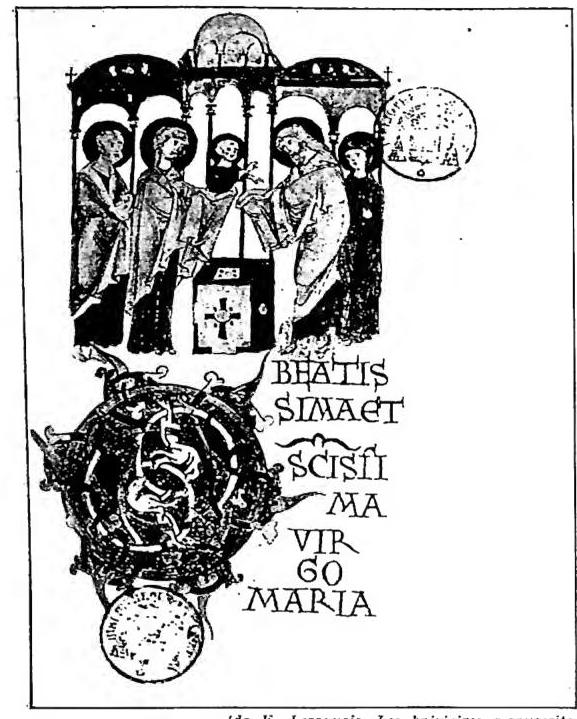
BREVIARIO - Presentation in the Temple. B. of Montecassino (1099–1105) - Paris, Bibliothèque Mazarine, ms. 364, fol. 19.
The texts of the individual sacramentary (v.) or from special collections (collectary [v.], orationary). When, however, the recitation of the divine office began to be made obligatory for ecclesiastics not only in the choir of a church but also privately, with the additional obligation of adhering to the form followed in communal recitation, the gathering of all these books into a single volume became indispensable. To the psalters were first added the antiphons, versicles, and prayers. Cod. Vat. Reg. 11 (8th–9th centuries) is the oldest example of a psalter with a hymnary. In the 11th and 12th centuries the plenary b. began to take shape, and soon became customary. As rural parishes multiplied, the need was then felt to abbreviate the office, in order to avoid the inconvenience of having to carry many books for its recitation. The Roman Curia set the example. Indeed, Radulphus of Tongeren says that, whether by order of the Pope or on their own initiative, the clerics constantly shortened the office, and often modified it according to the convenience of the cardinals (PL 87, 1273 ff.). Thus, in the 12th century, there arose the Breviarium secundum consuetudinem Romanae Curiae, which enjoyed wide diffusion because it was also adopted by the Order of Friars Minor when it was founded and spread throughout the West. This new form of b. represents an impoverished liturgy, designed not to be sung solemnly in abbey or cathedral churches, but to be recited privately by those attached to the Curia during intervals in their official duties, by university students and professors, amid the labors of the apostolate, and during pauses in travel. Nevertheless, the ancient liturgical office still appeared intact in its overall structure: the Roman Curia and the Franciscans had done nothing more than make it shorter. Later, however, the suppression or abbreviation of certain traditional parts of the office led to the introduction of other secondary elements, such as the multiplication and development of particular feasts, local devotions, new hymns, the daily office of the Virgin, the office of the dead, and the penitential and gradual psalms. In the second half of the 15th century, triumphant humanism attempted to transform the b., replacing the customary Latin with classical Latin, while some even, for reasons of taste, preferred to recite it in Greek. The hymns too were restored to the classical system. The premature death of Leo X prevented this movement from spreading. Clement VII, however, permitted the private use of the new hymns. In opposition to the contrary movement of the traditionalists, who defended the ancient rites and forms, the moderates prevailed, among whom were cardd. Francesco Quiñonez, Sadoleto, Contarini, and Gregorio Cortese. Quiñonez was commissioned to prepare a new b., faithful in all respects to the institutions of the Holy Fathers, neither difficult nor lengthy. It appeared in 1535 and was called Breviarium Sanctae Crucis, after Quiñonez’s titular church. Although it had merits, it also had defects, especially that of breaking too sharply with tradition and introducing many novelties into the liturgical sphere. After only a few years of use, Paul IV prohibited its reprinting in 1558. In 1562, the question of a complete reform of the b. was brought before the Council of Trent, and a commission appointed for the purpose prepared one which St. Pius V published in 1568 with the bull Quod a nobis. This new b. decisively returned to the ancient form, while taking changed circumstances into account: it abolished every other existing b., except those that had been in use for more than 200 years or had been directly approved by the Holy See. The right to order or modify the b. was thus reserved to the Holy See itself, and the principle of the unity of the office in the Latin Church was established. Despite universal approval, this reform provoked some criticism because of the suppression of certain feasts and the inadequate correction of historical errors. Gregory XIII and Sixtus V restored some of the suppressed feasts, and the latter in 1588 established the Sacred Congregation of Rites, for the purpose of regulating the entire Latin liturgy and the liturgical books. Clement VIII published a new edition of the b. in 1602, with additions and corrections. Finally, Urban VIII, with the bull Divinam Psalmodiam of 25 January 1632, ordered another edition, with emendations and with the correction of the hymns prepared by himself and several Jesuit Fathers. This b. has remained in use to the present day, apart from the addition of new feasts by Urban VIII’s successors. Meanwhile, various particular b. had come into use throughout almost the whole of France; they were too deeply marked by the ideas of their compilers, who were imbued with Jansenism or Gallicanism. Those of Mgr. De Harlay of 1680 and of Cardinal De Ventimille, prepared in 1736, enjoyed the greatest popularity. At the beginning of the 19th century, after the concordat of 1801, amid the confusion caused by the new reorganization of the dioceses, the French bishops sought to unify the liturgy of France, but complete agreement was lacking; thus further innovations appeared, which eventually produced a reaction. Meanwhile, the need to conform to Rome was increasingly felt. The first to adopt the Roman b. was Mgr. Parisis, bishop of Langres, in 1840; he was followed by Cardinal Gousset, archbishop of Reims, and soon by all the other French bishops, so that in 1853 Pius IX was able to congratulate the French episcopate on France’s return to the unity of the Roman liturgy. An attempt at reform had meanwhile been made by Benedict XIV, who appointed a special commission for the purpose, but for various reasons the desired conclusion was not reached. Further reforms were undertaken by Pius IX, Leo XIII, and Pius X, who, with the bull Divino afflatu of 1 November 1911, ordered a new arrangement of the psalter, so that all the psalms would be recited during the week.
Manuscript b. are found almost everywhere. One of the oldest, from the 11th century, is preserved in the Vatican Library (lat. 7018), which also houses the one used by Francesco Petrarca (Vat. Borg. 364) and the one made for Mattia Corvino, king of Hungary (Vat. Urbinate 112). In general, choir b. are more richly illuminated than portable ones. Those belonging to princes, bishops, abbots, and other dignitaries are illuminated; thus, for example, that of Giovanni d’Amboise contains 172 miniatures (15th century), that of Filippo il Buono 134, that of Carlo V 186, and that of the duke of Bedford several thousand. In Italy, the oldest are due to the Cassinese Benedictines; the most important were those of the papal court: Breviarium de Camera, Breviarium
secundum usum Curiae Romanae, established at least from the time of Innocent III (1198–1216). The subject matter of the miniatures is drawn from Sacred Scripture and from the liturgical theme of the day, or consists of symbolic attributes of the months, scenes from religious and secular life, and ornaments. A list of the first b. printed between 1468 and 1543 may be found in Enc. Ital., VII, p. 838.
For the Divine Office and its various parts, V. ORE CANONICHE.
THE B. IN ART. — The illustrations of the b. are connected with the various artistic schools. Those of medieval b. do not differ substantially from the miniatures of Gospel books or Bibles; at the end of the 14th century, however, a type of illustration proper to the b. arose, shaped by the liturgy of Paris (or, more precisely, of the royal chapel of the 15th century, itself derived in large part from the cathedral of Notre-Dame). The names of the first miniaturists in this category are largely unknown. To the artistic centre formed in the second half of the 15th century at the court of Burgundy belongs the school of Bruges, to which are owed the b. of Filippo il Buono (Brussels Library), illuminated by Vrelant and J. le Tavernier before 1467, and the b. Grimani of the Marciana Library in Venice. This b., the finest known, was illuminated around 1510 by various artists, among them Horenbout, Gossart, and the Bening family, who sought to surpass even the «livre d'heures» of the Limbourg brothers of Chantilly. Three fine miniatures by Paolo di Limbourg from the b. of Giovanni Senza Paura are preserved in the British Museum.
After the invention of printing, the use of the b. became increasingly widespread; but the illustrations, which nevertheless, also on account of their rarity, are noteworthy documents for the history of engraving, are poor in iconographic value. — Vedi Tav. V. BIBLICA.: S. de Vries e S. Morpurgo, Das B. Grimani, Leipzig 1910; G. Coggiola, Il B. Grimani della bibl. Marciana di Venezia, Leiden 1910; H. Leclercq, s. V. in DACL, II, 1, cols. 1262-1316; T. De Marinis, in Enc. Ital., VII, pp. 834-38 (con bibl.); V. JALABERT, LOUIS, Le B. de Philippe le Bon, Paris 1929; P. Durrieu, La miniature flamande au temps de la Cour de Bourgogne, Brussels 1921.