
SIXTUS V, POPE. — Born in Grottammare (Ascoli Piceno) on 13 December 1520; died in Rome on 27 August 1590.
I. BEFORE THE PONTIFICATE
Felice Peretti, from an exceedingly poor family of Montalto Marche, engaged from childhood in the humblest agricultural labor. At the age of twelve he entered the Order of the Friars Minor Conventual; at Fermo he obtained a degree in theology (1548). He acquired a broad education, especially in theology; assembled a rich library; and gained a reputation as an outstanding preacher. He was inquisitor at Venice (1557), consultor to the Roman Inquisition (1560), procurator general and, later, vicar of the Conventuals; he was sent to Spain with Cardinal Boncompagni, and became bishop of S. Agata dei Goti (1566) and of Fermo (1571–77). He enjoyed the confidence of s. Pio V, who created him a cardinal in 1570; by contrast, he was not on cordial terms with Boncompagni, Gregorio XIII. He then lived in retirement, devoting himself to study and in particular to a new edition of the works of s. Ambrogio, which proved defective because of its entirely personal method and its distance from sound criticism. Upon the death of Gregorio, in a conclave in which religious interests prevailed over political ones, the “cardinal of Montalto” was elected pope by unanimous vote (24 Apr. 1585).II. CHARACTER AND PROGRAMME OF S
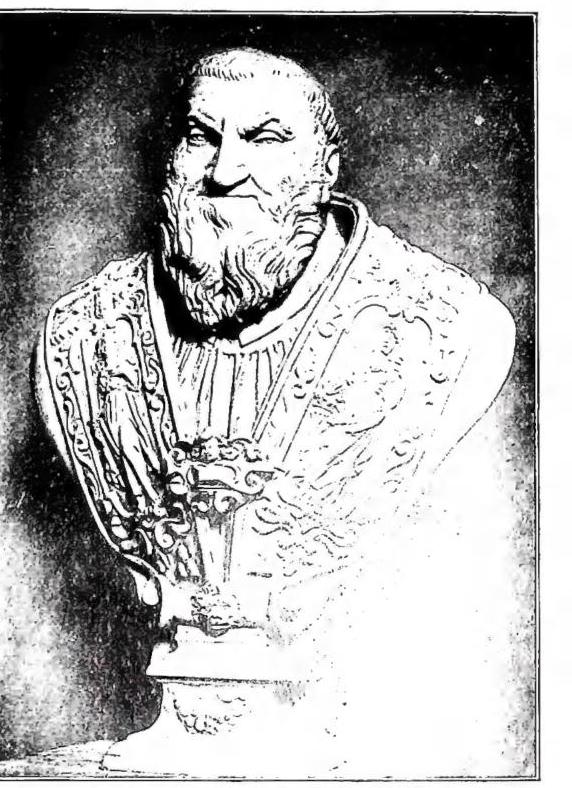
During his pontificate, S. displayed the indomitable energy of a “terrible” nature; his rigid, authoritarian, violent, tenacious character was nevertheless joined with piety, simplicity of life, and generosity. Although advancing the fortunes of his own family, he kept clear of the excesses of nepotism; placing at his side his nephew Alessandro, who had received from him at the age of fifteen his surname and the purple, as well as other trustworthy advisers, he nevertheless reserved every matter of importance to himself. And he devoted his pontificate to the defence of the Catholic faith, the reform of the Church, and the exaltation of the Apostolic See.III. DEFENSE OF THE FAITH AND OF PAPAL AUTHORITY
Not fond of doctrinal controversies, S. avoided taking a firm position in the question of Grace, then particularly intense between the Jesuits and the Dominicans: when the Faculty of Louvain, at the instigation of Baius, already condemned by the preceding pontiffs, censured 34 propositions of the Jesuit Lessius, S. imposed silence on both parties, tacitly disapproving the censure; but he took no further measures. He nevertheless expanded the jurisdiction of the Roman Inquisition and sought the establishment of new tribunals belonging to it; he also considered publishing a new Index, which was prevented by his death.(Alinari photograph)
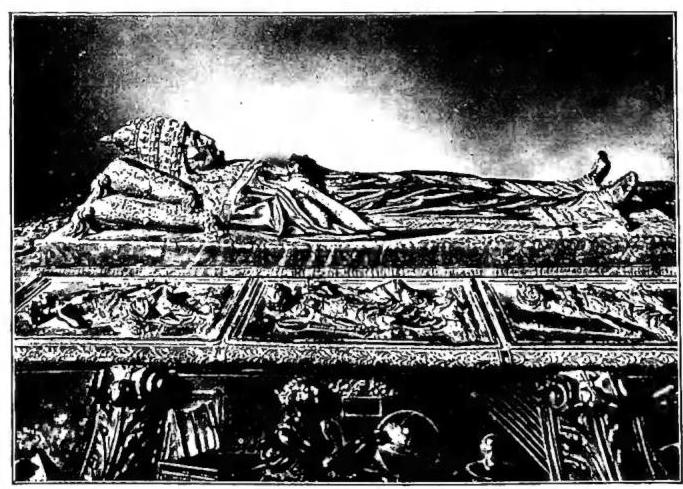
SISTO IV, POPE — Detail of the funerary monument of S. IV, the work of A. del Pollaiolo (1484–93). The Virtues are depicted in the frieze, while the Liberal Arts, together with Theology, Philosophy, and Perspective, are depicted on the base — Vatican, Grotte.
He wished to give religious doctrine a firm scriptural foundation by promoting editions of the Bible. The Greek text of the Septuagint and its Latin version were published (1587–88). A commission was entrusted with preparing a critical edition of the Vulgate; but S. took the conclusions upon himself and wished to establish the text in his own hand, with corrections, the introduction of marginal notes, and arbitrary omissions. The Sistine Vulgate appeared in 1590 from the press of Basa, preceded by a bull declaring it the only authorized version. But the criticisms, which were interpreted even by Bellarmino, were such that the Pope does not seem to have seen to the promulgation of the bull in the proper forms, and consequently it did not have the force of law. After his death, the sale of the new Vulgate was suspended and copies were withdrawn: Clemente VIII prepared a new edition, while nevertheless retaining for it the name of S.
Extremely jealous of the pontiff’s authority, he resisted not only the claims of the representatives of Filippo II in Italy, but also measures taken by the king himself: when the latter issued a Prammatica dei titoli, which also regulated those of ecclesiastics (1586), S. threatened to place it on the Index and even spoke of excommunicating the king.
IV. REFORMATIVE WORK
Catholic reform was foremost among S.’s concerns. He attended to the improvement of the Roman clergy; imposed penalties for simony; prevented violations of cloister discipline; and saw to the observance of the obligation of residence by bishops and parish priests. He fostered religious devotion by restoring the stational services in the Roman basilicas, introducing the feast of the Presentation of Mary, extending that of S. Anthony of Padua to the universal Church, canonizing the Dominican Ludovico Bertrand (1586) and the Franciscan layman Diego de Alcalá (1588), and proclaiming s. Bonaventure a Doctor of the Church.He was particularly benevolent toward the Franciscan Order; but he was also generous with favors to other Orders: he approved the Feuillants, a branch of the Cistercians, and the Camillians (1586). Although not especially friendly toward the Jesuits, he nevertheless approved the decrees of the Inquisition in their favor concerning the validity of simple vows pronounced by those who had not yet professed, and ordered the release of four fathers arrested by the Spanish Inquisition. But he wanted a commission to review the Ignatian Constitutions and required the general, Acquaviva, to change the name «Society of Jesus», a measure not implemented because of his death.
Through his nuncios he promoted Catholic reform and the repression of heresy in central Europe; he succeeded in having titular bishops appointed to the sees of Hungary, which had long been vacant; and he founded a university at Graz, entrusted to the Jesuits (1588). The weakness of the emperor Rudolf II and his conflicts with the Pope prevented greater advances for Catholicism. Greater results were achieved in Switzerland and western Germany through the restoration of the Catholic Church in the mountains of Appenzell and the conversion of the margrave of Baden.
S. supported the Jesuit missions in Japan, where he erected a bishopric at Funai, and those of the Dominicans and Franciscans in the Philippines and Latin America; he attempted to unite the Eastern Churches and the Egyptian Copts with Rome.
Certain measures taken by S. were of particular importance in the life of the Church. As early as 20 Dec. 1585 he imposed the visit of bishops «ad limina Apostolorum», placing the Head of the Church in contact with the individual dioceses. With the bull Postquam serus (3 Dec. 1586) he highlighted the high dignity of the cardinals, their duties, and the desirability of choosing them from the various nationalities (v. II). He gave the Curia the organization it retained until the reform of Pius X (v. I), establishing with the bull Immensa Dei (22 Jan. 1588) 15 congre-
V. ACTIVITY IN INTERNATIONAL POLITICS
The interests of the Church were S.’s constant aim in his political activity as well. Necessarily bound to the king of Spain, who presented himself as the champion of orthodoxy, S. took care to prevent the dangerous increase of his power and endeavoured to maintain peace among Christians.In Italian politics, he held firmly to Venice, in which he saw not only a bulwark against the Protestants and the Turks, but also a limitation on Spanish predominance; and he favoured the designs of Carlo Emanuele I, which indirectly worked to Spain’s disadvantage.
The confused and changeable condition of France placed S. in very grave difficulties, among which he had to proceed with extreme caution and was unable, or perhaps not permitted, to avoid contradictions and errors. He would have liked the Huguenot heresy to be stifled there and the succession of its leader, Enrico di Navarra, to be prevented; but he did not approve of the rebellious attitude of the Guises and the Catholic League towards King Enrico III, fearing on the one hand that the latter might join forces with the Huguenots, and on the other that a victory by the League with Spain’s assistance might increase Spain’s power. He therefore sought to have the Catholics form a bloc around the king; and when the latter concluded an ephemeral alliance with the League (7 July 1585), he issued a bull against Navarra and Conde, declaring them deprived of every right to the succession and to the obedience of their subjects (9 Sept. 1585). This was followed not only by a violent reaction from the Huguenots, but also by the adherence to Navarra of many Catholics, impatient of papal interference in the dynastic question. After the King’s break with the League, the triumph of the duke of Guise in Paris, the King’s flight, the assassination of the duke and cardinal of Guise, and the imprisonment of the cardinal of Borbone and the archbishop of Lyon by order of the king (1588), S., while also censuring Guise’s conduct, condemned the King’s cowardice and the «homicidio» with which he had sought to redeem it, deplored the killing of the cardinal of Guise as a «delitto sacrilego ed inaudito», and made the release of the two prisoners a condition for absolving the King. But he refused the more energetic action desired by Spain; he did not join the revolt of the League and the «Union» of Paris against Enrico III and, when the latter joined Navarra against Paris, he issued against him a «medicinale et non mortale» monitory (24 May 1589). After Enrico III was killed (1 Aug. 1589), he sought to exclude Navarra from the throne if he persisted in heresy, and came into conflict with Venice, which had recognized him as King Enrico IV. But he took no stringent measure against the republic and showed himself highly reserved towards the League and cardinal of Borbone, proclaimed by it as King Carlo X. And although he sent to Madrid a project for an alliance with Spain, he did not ratify the Treaty, did not accept Spain’s demands that the Catholics adhering to Enrico IV be excommunicated and their legate expelled from Rome, and threatened to excommunicate Filippo II, who seemed ready to withdraw from obedience to the Pontiff in order to defend alone «la causa di Cristo». After Carlo X died (9 May 1590), with the victory of Enrico IV, still a heretic, already taking shape, S. had a new treaty with Spain prepared; but he did not ratify this one either and, faced with pressure from Spain, threatened to denounce its ambitious designs and declared that he did not wish to close to Navarra the path of return to the Church and hence access to the throne. He was thus preparing the future recognition of the convert Enrico IV by the Pope and the revival of France, which he considered necessary for the balance of Europe.
Against Elisabetta of England, «the new Jezebel», S., while Maria Stuart was still alive, urged armed intervention by France and Spain; but there is no serious proof that he had any part in the designs of the conspiracy known by the name of Babington. After the killing of the Stuart, he made concessions and promises to Filippo II; but he did not grant him investiture of the kingdom, limiting himself to stipulating, in a secret pact with him (29 July 1587), that a Catholic king would be elected in England. And although he renewed the excommunication and sentence of deposition against Elisabetta, he did not cease to hope that the queen, whose singular qualities he did not deny, might be moved to convert. Having little confidence in the success of the expedition of the great Spanish «Armada», he did not, after its defeat (July–Aug. 1588), give Filippo II money for new war preparations.
He revived the plan of a crusade against the Turks, urging Venice to prepare secretly. He welcomed King Stefano Báthory of Poland’s intention to subjugate Russia and attack the Turks with Polish and Russian forces and with the assistance of Persia and the Tartars. After the King’s death (12 Dec. 1586), he favoured the candidacy of one of the Habsburgs, from whom he hoped for aid for the crusade; but he recognized the victorious Sigismondo of Sweden as king and, through his nuncio, sought peace between him and the Habsburgs. He also contemplated a war against the Barbary peoples of Africa and the conquest of Egypt; but he failed to win Filippo II over to the enterprise, as the latter was absorbed in his plan for hegemony over Europe.
VI. GOVERNMENT OF THE PAPAL STATE
To the Pope’s spiritual authority and his reforming work, S. wished to provide firm support in the temporal State. His first task as sovereign was the relentless struggle against brigandage, which had become a scourge under the weakgovernment of his predecessor. The prohibition against carrying weapons under penalty of death, immunity and rewards for anyone who handed over a bandit, alive or dead, the prohibition against ambassadors, barons, and communes obstructing the arrest of bandits, agreements with neighboring states to prevent them from finding refuge, capital executions even of persons of distinction, and the display of their heads at the Ponte S. Angelo—if they did not eradicate the evil growth entirely, they effectively checked its spread for as long as the Pontiff lived. The coasts were defended by a small fleet, so that a commemorative medal could boast that in the State there was «terra marique securitas».
S.’s severity appeared excessive in punishing, with very numerous sentences, including death sentences, offenses more or less serious, such as adultery, incest, abortion, sodomy, theft, blasphemy, betting and gambling, violation of the Sunday precept, and the dissemination of false or calumnious reports. The measures against prostitutes and luxury did not achieve the aim of fully moralizing the city, although they improved its conduct.
In order to gather in Castel S. Angelo a treasure of 4 million gold scudi, which was to serve the Church’s and the State’s supreme needs, S. not only resorted to strict economies but also extended the sale of offices, increased the number and capital of the «Monti», loans made to the State, which, in exchange for interest, assigned the proceeds of certain revenues, and increased taxes, endangering the economic activity of his subjects: measures customary in that age, but neither praiseworthy nor useful.
Highly deserving of praise, on the other hand, were his care for a strict and impartial administration, his solicitude for the «causes de poveri», his protection of industry and commerce, the provisioning of Rome, the work he provided for thousands of unemployed people in a house at Ponte Sisto, and the opening of a shelter for the poor for those unable to work. And his undertaking to drain the marshes at Ravenna, below Orvieto, at the mouths of the Tiber, and above all in the Pontine Marshes was a bold and most noble enterprise; he pursued their reclamation for three years with marvelous vigor.
S. showed particular favor to his native region: he founded a Montalto college in Bologna for young men from the Marches; established a supreme tribunal at Macerata; raised Fermo to the rank of an archiepiscopal see, and Montalto, S. Severino, Tolentino, and Loreto to episcopal sees; at Loreto he carried out important works, including the city’s new fortifications.
VII. S.’S PATRONAGE; SISTINE ROME. — Like the most celebrated popes of the Renaissance, S. was a generous protector of culture and art. He favored the Roman University by renewing the College of Professors (1586); founded the Universities of Fermo, Graz, and Quito; established, in addition to the College of Bologna, the Franciscan College of S. Bonaventura in Rome; had a new grandiose building constructed in the Belvedere courtyard for the Vatican Library, with a vast, richly decorated hall depicting the triumphs of the Church and of S.; opened a printing press in the Vatican entrusted to Domenico Basa; granted privileges and subsidies and procured books and manuscripts for the publication of distinguished works, such as the writings of s. Bonaventura and Baronio’s Annals.
But above all, he wished the flourishing Papacy to have a worthy seat in Rome. While still a cardinal, he had had the magnificent Villa Montalto built between the Viminal and the Esquiline, according to a design by Domenico Fontana, who later became the principal executor of his great works as Pope. During his pontificate he entrusted Giacomo della Porta with completing the dome of S. Peter’s, inside whose lantern his name and the date, 1590, are inscribed in mosaic; he began the construction of the new Vatican Palace, which is still the habitual residence of the Pontiffs; had the monumental staircase from the Vatican to S. Peter’s built; completed and enlarged the Quirinal Palace; and raised the Lateran Palace and the northern façade of the Basilica, with the benediction loggia. Near the Lateran he transferred the Scala Santa, adding the two side chapels and the portico to the Sancta Sanctorum. He rebuilt many Roman churches; at S. Maria
Through gigantic labor he restored the Alexandrian aqueduct, the «Acqua Felice», which reached as far as the Aracoeli and the Pincio and supplied large fountains, including the Moses fountain at S. Susanna. To facilitate the influx of pilgrims to the basilicas, he built very long roads, such as the straight road from S. Maria Maggiore to the Pincio, part of which still bears the name Via Sistina. He enlarged the squares and planned the construction of a large basin in Piazza Termini, bringing water there from the Aniene.
He did not always display good artistic taste in these works; nor were ancient and venerable monuments respected: imposing remains of the Baths of Diocletian and the Septizonium of Septimius Severus were destroyed. But the Trajan and Antonine Columns were restored and surmounted by statues of the Apostles, to demonstrate how the pagan world had prepared the triumph of Christianity. The obelisks were taken from the ruins of Roman buildings and erected at the beginning of the Via Sistina, at S. Giovanni, at S. Croce, and in Piazza del Popolo. The most famous was that in Piazza S. Pietro, which was transported from Nero’s circus and raised under Fontana’s direction amid the enthusiasm of the people (1586): the inscriptions on the obelisk and its base, celebrating the victories and Kingdom of Christ, demonstrate what the Pope’s thinking was.