
PIO V, POPE, saint. – The last canonized Pope, born on 17 January 1504 at Bosco, near Alessandria, to Paolo Ghislieri and Domenica Augeria: he entered the Dominican Order at Voghera in 1518 and there received the name Michele; he was ordained a priest in 1528 and shortly afterward became a lecturer at Pavia; he was also Inquisitor-Commissioner for the diocese of Pavia and later inquisitor at Como and Bergamo. Through this activity he won the favor of Cardinal Carafa, who in 1551 had him appointed commissary general of the Roman Inquisition and, having become pope under the name of Paolo IV, appointed him bishop of Sutri and Nepi in 1556, cardinal in 1557, and grand inquisitor on 14 December 1558.
Under Pio IV he fell into disfavor because of his relations with the Carafa family, and therefore devoted himself exclusively to the Inquisition and to the reform of the bishopric of Mondovì, which had been entrusted to him in 1560. In the Conclave of 1565, following the agreement between Borromeo and Farnese, he was elected pope on 7 January 1566 to general surprise, after the candidacies of Morone, Sirleto, and Ricci, favored by Cosimo I, had foundered. He was consecrated on 17 January. His enduring merit is that, having implemented the Council of Trent, he acted with the utmost seriousness in every sphere of ecclesiastical life: he sent the decrees as far as Goa, Mexico, Venezuela, and the most distant lands. In the diocese of Rome he personally initiated the canonical visitation and had the clergy reformed by Niccolò Ormaneto, a trusted associate of Carlo Borromeo. He appointed apostolic visitors for the bishoprics of the Papal States, the Kingdom of Naples, and Upper Italy. Borromeo’s provincial synods at Milan be-
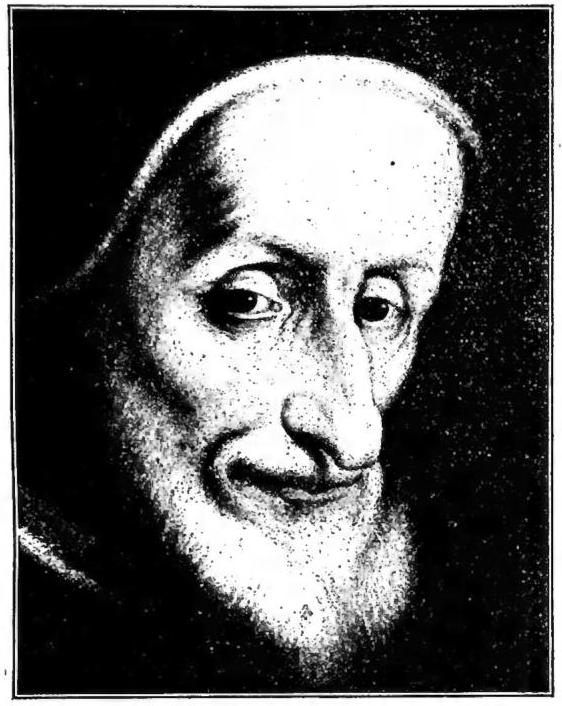
(courtesy of Mons. A. P. Frutar)
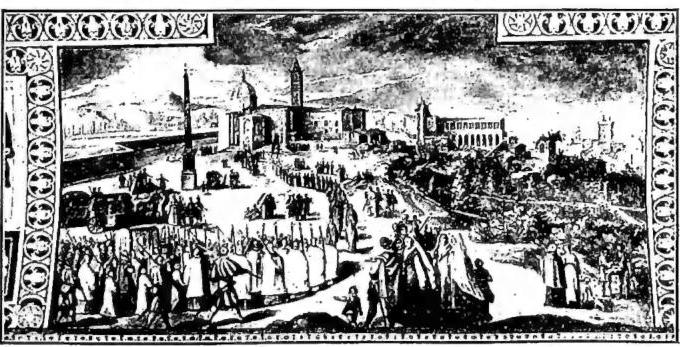
From the standpoint of Church politics, the pontificate of P. V is distinguished by continual tension with the sovereign of the greatest Catholic power, Filippo II, because of ecclesiastical demands concerning royal patronage and requests for money for the Spanish Church; only with difficulty did the nuncio in Madrid, Giambattista Castagna, avert a complete rupture. During the Second and Third Wars of Religion, the Pope supported the French Catholics with subsidies and military aid; insufficiently informed about events, he also approved the conduct of the Duke of Alba toward the insurgents in the Netherlands. He disapproved, however, of the relationship between the Queen of Scotland, Maria Stuart, and Bothwell, but could not prevent the collapse of Catholicism in Scotland after the queen was taken pri-
soner. On 25 February 1570 he excommunicated Queen Elisabetta of England and released the English Catholics from their oath of allegiance. The difficulties with the Emperor Massimiliano II were caused especially by his unclear religious position toward Protestantism and by his yielding attitude toward the Austrian Protestants. The Emperor protested against the appointment of Cosimo I as Grand Duke of Tuscany, ratified by the Pope (5 March 1570). P. V’s greatest political achievement consisted in bringing about the anti-Turkish Holy League with Venice and Spain; their fleet, commanded by Don Giovanni d’Austria and Marcantonio Colonna, won a naval victory at Lepanto on 7 October 1571, breaking the preponderance of the Turkish fleet in the Mediterranean. The Pope, of whom Carlo Borromeo said that for a long time the Church had not had a better and holier head, died on 1 May 1572. He was initially buried in the chapel of S. Andrea in S. Pietro, from where he was transferred on 9 January 1588, under Sisto V, to the Chapel of the Nativity in S. Maria Maggiore. He was beatified by Clemente X on 1 May 1672, and Clemente XI canonized him on 22 May 1712. His feast is celebrated on 5 May.