
MONDOVÌ, DIOCESE of. — Diocese and city of Piedmont. The diocese comprises 181 parishes (84 municipalities: 70 in the province of Cuneo and 14 in the province of Savona). Priests: 396, 50 regular; 10 religious houses for men and 107 for women. Population: 164,000; area: 2,159.65 sq km. It borders the dioceses of Cuneo, Fossano, Alba, Acqui, Savona, Albenga, and Ventimiglia. It has a major and a minor seminary. Patron: St Donatus, bishop of Arezzo (feast: 7 August).
M., of communal origin, was erected as a diocese, almost a bulwark of Romanitas against the Western Schism, by Urban VI, with the bull Salvator Noster, issued at Perugia on 8 June 1388. At the same time the Pontiff bestowed upon it the title of city. The new diocese was separated from that of Asti and made a suffragan of Milan. In 1515, when Turin was elevated to metropolitan status, it passed to that ecclesiastical province. It subsequently underwent territorial changes: in 1768 it received additional parishes from Asti and Alba; it was then reduced by the establishment of the diocese of Cuneo (1817), but received extensive areas from Alba. The bishop holds the title of count and is perpetual commendatory abbot of S. Dalmazzo. The Church of Mondovì has counted among its distinguished historical figures Cardinal Michele Ghisleri (St Pius V); the learned Cardinal Vincenzo Laureo (1566–1587); Michele Casati (1753–82), known for the catechism that took its name from him; and Tomaso Ghilardi (1843–73), a resolute defender of the rights of the Church.
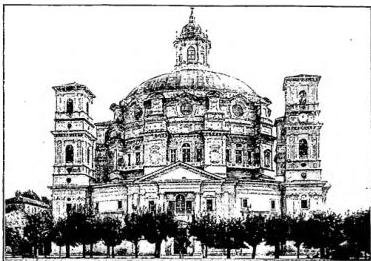
(phot. Pedrini — Turin) MONDOVÌ, DIOCESE of. — Sanctuary of Vicoforte — Mondovì.
Roman remains are scarce in the Mondovì area (the remains of Augusta Bagiennorum near Benevagienna are worth noting); medieval buildings are more frequent; and fifteenth-century paintings are numerous, especially in rural chapels. The finest architectural works date from the eighteenth century.
M. stands in a commanding position, surrounded by the Langhe, the plain, and the Alpine crown. It is divided into two parts: in the upper section (Piazza) are notable the Bressani tower and the Belvedere; the Cathedral by F. Gallo; the bishop’s palace, with magnificent rooms; the church of the Mission, formerly S. Francesco Saverio, by Giovenale Boetto, with paintings by Andrea Pozzo representing the preaching and glory of the Saint; the Jesuit Palace (now the courthouse); S. Chiara; the Misericordia (F. Gallo); and Piazza Maggiore, with arcades, still possessing a medieval character. The lower section (the Piani), more commercial, also has several noteworthy buildings: S. Filippo, by F. Gallo, and SS. Pietro e Paolo (the dome by Vittone and the façade with its characteristic «Moor»). In the fifteenth century the city had one of the earliest printing presses; from 1560 it was the seat of a university, where St Robert Bellarmine taught; it thereafter always maintained a good tradition of study and education. It possesses two libraries (the seminary library and the civic library) and various archives. An authoritative local historian, toward the end of the eighteenth century, was the canon G. Grassi di S. Cristina. Numerous charitable institutions and varied philanthropic initiatives are a source of pride for M.
#### MONENERGISMO: V. ADOZIANISMO.