
ROBERTO BELLARMINO, saint. — Doctor of the Church, b. at Montepulciano on 4 October 1542, d. at Rome on 17 September 1621. Of noble family (his mother Cintia was the sister of Cardinal Cervini, the future Marcellus II), he was to leave for the University of Padua when, in 1558, shortly after the arrival of the Jesuits at Montepulciano, Lainez (v.) to enter the Society of Jesus.
Admitted to it on 21 September 1560. R. successfully attended at the Roman College the philosophy MARIANO, (v.). After five years (1563–67) of literary teaching in the Colleges of Florence and Mondovì, he began the theological course at Padua, completing it at Louvain, where in 1569 St. BORGHESIA (v.) sent him as a preacher against Protestantism in the Netherlands. Ordained a priest at Ghent on 25 March 1570, B. achieved considerable success in preaching and in the struggle he undertook against the errors of Michael Baius (already condemned by Pius V on 1 October 1567), immediately after beginning to teach theology in the Jesuit house (October 1570), where he adopted as his textbook, commenting upon it, the Summa Theologica of St. Thomas. Recalled to Rome for reasons of health by Father General Mercurian, he was entrusted at the Roman College with the new chair of controversies, which he was to make illustrious through the Disputationes et controversiae christianae fidei, composed over fourteen years of assiduous teaching (1575–88). In October 1589 he left for Paris as theologian to Cardinal Legate Gaetani, sent by Sixtus V to safeguard Catholic interests after the assassination of Henry III. B.’s balanced attitude won the admiration even of Henry IV, who, after converting, always regarded the Saint as a sincere friend. After the death of Sixtus V (27 August 1590), B. returned to Rome, where he worked intensely on the Sixto-Clementine edition of the Vulgate (1591–92). He resumed the office of spiritual father at the Roman College (the assignment had been given to him in 1588, at the end of his teaching in controversies), and in this capacity, during the final months, directed St. Aloysius Gonzaga, assisting him at the moment of his death (21 June 1591).
Rector of the Roman College in 1592, he attended the following year the Fifth General Congregation of the Order, where he was appointed a member of the Commission established to put the final touches to the Ratio studiorum
the Celestines in 1289, receiving the habit from Pietro Celestino, to whom in 1294 he announced his elevation to the papacy, vainly exhorting him to hide in the forests.
When his holy master then offered him the dignity of the cardinalate, he humbly declined II. Ordained a priest in 1298, he subsequently held the offices of prior and procurator general; he opened new monasteries. He was especially distinguished for his spirit of mortification, prayer and contemplation, charity and patience. He was
of the Society. B. made wise proposals, unanimously accepted, especially that of establishing as a rule the following of St. Thomas in speculative (scholastic) theology. In 1595 he was appointed provincial of Naples, where his moral qualities earned him the highest esteem even from St. Bernardino Realino. After the death of Cardinal Toledo, the Pope’s theologian, Clement VIII, on the advice of Baromo, chose B. for that office and therefore recalled him to Rome at the beginning of 1597, appointing him at the same time consultor of the Holy Office and examiner of bishops, until on 3 March 1599 he created him a cardinal, with the title of S. Maria in Via, later changed, out of devotion to St. Charles Borromeo, to that of S. Prassede. A member of many congregations (Holy Office, Rites, Index, Reform of the Breviary, Examination of the marriage of Henry IV) and an esteemed adviser to Clement VIII, Cardinal B. continued his earlier theological activity, changing nothing in his habits as a humble religious. An enemy of flattery, he made known to the Pope, with noble frankness, the abuses requiring correction in the government of the Church, in the well-known memorandum De rebus reformandis. In the controversy over Grace, vigorously debated in the Congregation de auxiliis, B. substantially supported the position of Molina (v.) and his Order, while seeking common ground between the two parties and advising the Pope not to proceed further; with a certain vehemence he announced to Clement VIII that he would never arrive at a definitive resolution of the controversy.
When the archbishopric of Capua became vacant, B. was elected to that see and consecrated bishop by the same Pontiff on 21 April 1602. Whatever the reasons for this sudden removal from Rome may have been, St. R. B. immediately went to Capua to reside there and gave proof of excellent pastoral qualities—in preaching, the teaching of catechism, synodal provisions, reforms, and relations with his clergy, for whom he wrote the Spiegazione del Simbolo (Rome [?], 1604). After the death of Clement VIII (3 March 1605), B. took part in the subsequent conclaves, where he received many votes and from which, within a short interval, emerged Leo XI and Paul V; the latter wanted St. R. in Rome, and he, renouncing the see of Capua, became a member of the new Congregation de auxiliis, charged with bringing to an end the now excessively prolonged controversy over Grace. Once the debate had ended without any theoretical decision, B. worked with great energy on the subsequent serious politico-religious questions in which the Holy See became involved: the Venetian controversy (1606–07), rekindled by ARPI (v.), in which B. refuted point by point the errors of Sarpi and of the seven Venetian theologians who collaborated with him; the Anglican controversy (1607–09), provoked by the anti-papal oath imposed by the English king James I on his Catholic subjects on 5 July 1606. On 22 September 1606 the Pope declared this act illicit, but Archpriest Blackwell refused to publish the papal brief; B., drawing on an old friendship with the archpriest, showed him in a letter full of charity and learning how the oath implied rejection of the primacy of the Apostolic See; Blackwell persisted in his error and was deposed. King James wished to intervene polemically in the affair: in 1608 he circulated an anonymous work, Triplici nodo triplex cuneus (the three knots were the two papal briefs and B.’s letter); the cardinal replied under the pseudonym Matteo Torti. The English monarch republished the preceding pamphlet in expanded form, prefacing it with a pompous introduction in which, addressing the Emperor Rudolf II and his colleagues on the continent, he presented himself as the defender of the divine right of kings; B. replied with an apologia for his response (1609). James I remained silent, but in his place Andrews, Bishop of Chichester, continued the controversy with Tortura Torti (London 1609), to which two of the cardinal’s confrères replied. The Gallican controversy (1610–12) originated with the posthumous and anonymous publication of the work of the Catholic jurist William Barclay: De potestate papae (London 1609), in which the author advocated the absolute independence of civil power from ecclesiastical power, denying the Roman Pontiff any power, even indirect, over temporal affairs: in his anti-papal indictment Barclay attacked B.’s De Romano Pontefice in particular. The cardinal masterfully refuted the deceased jurist’s work, providing further clarification of the doctrine of indirect power, which he considered the best expression of Catholic teaching on the matter. B.’s work, submitted to the Parliament of Paris, was prohibited on 10 November 1610. The timely intervention of Paul V and a letter from B. to the regent Maria de’ Medici succeeded in having its execution suspended. Meanwhile Barclay’s son wrote a book defending his father’s work, to which a confrère of St. R. replied.
In the final decade, the cardinal continued to be “the porter of the Roman Congregations” (as B. was called by his colleagues), undertaking further labors for the good of the Church: the administration of the diocese of Montepulciano (1607–11), the arduous and fruitful protectorate of the Celestines (reconciling the two branches of France and Italy), active participation GALILEA (v.), BRUGNATO (v.), CAMPANELLO (v.), the support he gave to s. Francesco di Sales for the approval of the Visitandines (1616), and the defense of the doctrine of the Immaculate Conception (1616–17). After taking part in the Conclave from which Gregory XV emerged on 9 February 1612, B., worn out by age and exertion, obtained permission to retire to S. Andrea del Quirinale, where, visited by the Pontiff and his colleagues, he piously died.
Regarded as a saint by all, his cause of beatification began the year after his death and was not concluded until 1923. The delay was due to a complex of historical circumstances, among which the animosity of the Gallican courts and the considerable period during which the Society was suppressed stand out. The heroic nature of the virtues of the illustrious cardinal, acknowledged verbally but not officially by Benedict XIV, was proclaimed by Benedict XV in July 1920. Beatified in 1923 and canonized on 29 June 1930 by Pius XI, he received the title of Doctor of the Church on 17 September 1931.
WORKS. - An extraordinarily prolific author, B. treated almost every subject of ecclesiastical science.
1932. Theological controversy
His masterpiece is the Disputationes de controversiis christianae fidei adversushuius temporis haereticos (3 vols., Ingolstadt 1586–93; 2nd ed., revised by the author, 4 vols., Venice 1596, which served as the model for all the numerous subsequent editions, of which the most highly regarded are: Paris 1608, Prague 1721, Rome 1832–33), in which he develops the entire body of doctrine disputed between Catholics and Protestants according to a simple and comprehensive plan: I. CHRIST: 1. The Word of God, revealed (Inspiration), written (the Bible), and handed down orally (Tradition); 2. the Incarnate Word, Head of the Church: Trinity, Incarnation, Hypostatic Union, Christ’s human knowledge, descent into hell; Christ’s mediation;
3. the Supreme Pontiff, Vicar of Christ: the primacy of the Roman pontiff, the pope and the Antichrist, infallibility, the pope’s power in temporalibus
II. CHURCH: 1. gathered in Council and dispersed throughout the world; 2. members of the Church militant (clerics, monks, the laity); 3. the suffering Church: purgatory;4. the triumphant Church (the happiness and worship of the saints, the veneration of images and relics, practices of devotion toward the saints)
III. SACRAMENTS: 1. in general; 2. in particular (Baptism and Confirmation; the Eucharist: real presence, sacrament, sacrifice; Penance and Extreme Unction, Orders and Matrimony). IV. GRACE: 1. man’s primordial state; 2. original sin; 3. restoration through the work of Christ (the communication of Grace; predestination; Grace and free will); 4. justification and merit.On the occasion of the numerous religious debates in which he played a major part, B. developed, in further writings, particular points touched upon or sketched out in the major work. The principal ones are: De exemptione clericorum (Paris 1599), which was later incorporated into De membrii Ecclesiae in the Controversiae; De indulgentiis et iubilae (Cologne 1599), written in preparation for the Jubilee of 1600. Particularly interesting for the history of the Church and theology are B.’s replies to the attacks directed against Rome on the various occasions mentioned above: Iudicium de libro Concordiae (Ingolstadt 1585), a critical source on the celebrated symbolic book of Lutheranism; De translatione imperii Romani a Graecis ad Francos (Antwerp 1589); replies to Flacius Illyricus, who denied the transfer of the empire effected by pontifical authority; on the occasion of the interdict imposed on Venice, S. R. replied to Sarpi and his associates with four pamphlets in Italian, later translated into Latin.
1933. Exegesis
In omnes Psalmos dilucida expostio (Rome 1611); there were more than thirty subsequent editions: although not free from certain errors of literary interpretation (B. was self-taught in Hebrew), this learned expostio, imbued with profound piety, nevertheless helped to make the clergy aware of the doctrinal and ascetical value of the Psalter; De editione latina vulgata, quo sensu a Concilio Tridentino definitum sit. ut ea pro authentica habeatur (posthumous, Würzburg 1749).1934. Asceticism
Numerous pamphlets reveal his intense fervor: De ascensione mentis in Deum (Rome 1615); De aeterna felicitate sanctorum (ibid. 1616); De gemitu columbae seu de bono lacrymarum (ibid. 1616); De septem verbis a Christo in Cruce probatio (Antwerp 1618); De arte bene moriendi (Rome 1620); De cognitione Dei (posthumous, Leuven 1861).For those persons to whom God has given greater social responsibility, the Saint set down precise norms for personal sanctification and for the good government of the Church and the State: De officio primario Summi Pontificis et eisadem Pontificis responsiones (in an appendix to the Epistolae familiares); Admonitio ad episcopum Theanensem, nepotem suum, quae necessaria sint episcopo qui vere salutem suum aeternam in tuto ponere velit (Paris 1616); De officio principis christiani (Rome and Antwerp 1619), dedicated to Prince Ladislaus, son of the Polish king Sigismund III.
1935. Oratory
S. R. was a constant preacher, who cared less for elegance of style than for vigor of reasoning and solidity of doctrinal content: Conciones habitae Lovanii (Cologne 1615); Exhortationes domesticae (posthumous; Brussels 1899). Fr. Tromp is now editing the Opera oratoria postuma (10 vols., Rome 1940 ff.; several volumes have already appeared).1936. History
De scriptoribus ecclesiasticis (Rome 1613): a list of Christian authors from the origins to 1500.(courtesy of Fr. Archiviata of the Pontifical Gregorian University)
ROBERTO BELLARMINO, santo - Letter in which B. offers his Disputationes to the Library of the Roman College (12 Dec. 1608). Rome, Archives of the Pontifical Gregorian University.
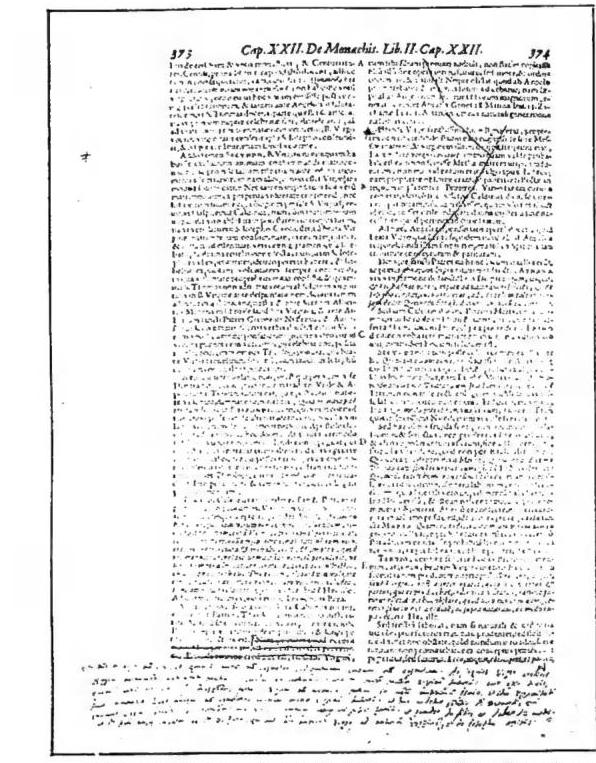
ROBERTO BELLARMINO, santo - A page from the Disputaciones de controversia christiana fidei adversa huius temporis haereticus. II, Venice 1599, cols. 2754, with autograph corrections by B. This is the copy mentioned in the letter of 1608 - Rome, Archives of the Pontifical Gregorian University.
At the request of Muzio Vitelleschi, then assistant for Italy, B. wrote the Autobiografia (1613), as documentation for the history of the Society of Jesus: this account, which reflects the Saint’s candor, became a weapon in the hands of his adversaries. Recupero librorum omnium R. B. (ibid. 1607): a kind of retractationes of his entire scholarly production.
1937. Catechetics
His works enjoyed wide circulation: Dottrina cristiana breve (Rome 1597); Dichiarazione più copiosa della dottrina cristiana (ibid. 1598). For other works, published and unpublished, V. le Bachelet, Auctarium Bellarminianum, Paris 1913.The Opera omnia had the following principal editions: 7 vols., Cologne 1619–20; Paris 1619, Venice 1722–29; 8 vols., Naples 1856–62; 12 vols., Paris 1870–1938.
EVALUATION. — S. R. B., who by acuity of intellect (as is evident from his personal stance in the de auxiliis controversy) and by theological sensitivity (he was quite capable of creating new theories, for example, on Grace and on the power of the pope) could have been a second Cardinal Gaetano, preferred another path. While recognizing the high value of medieval speculation (his opposition to scholasticism is a fable), particularly that of Thomism, he nevertheless, as a man sensitive to the problems of his time, understood that after the attacks of Protestantism it was necessary to repel the adversary on the same field and with the same weapons. The direct contact he had, in the prime of his years, at Louvain with Protestant heresy, in its various forms and derivations, contributed to giving his powerful intellect that unsuspected success.
B., endowed with a particular sense of concreteness, fought the Protestantism of the second generation,
which, through a kind of withdrawal into itself, had sought to provide Luther’s and Calvin’s personal experiences with an apparatus of proofs, drawn from Scripture and the early ecclesiastical writers, which were supposed to justify them in the eyes of their numerous followers. Therefore, in B.’s Controversies one must not seek the Luther of history, the man of profound and at times sincere inner emotions, but Luther as he had by then been fixed in features imposed upon him by the admirers of the second hour. The theologian of the Roman College fought against the cold and robed Lutheranism of Melanchthon, especially that of Martin Chemnitz, of whom it was said: si Martinus [Chemnitz] non Juiset, Martinus [Lutherus] non steisset.
His struggle was comprehensive and intended to be so, in order to force the enemy to retreat along the entire line. His predecessors had answered this or that difficulty; B. wished to answer them all, and therefore his work is a true summa of all the anti-Protestant controversies. The method he followed reflects the demands of the moment, of that particular mental structure which humanism and the «Reformation» had created and spread throughout Europe: Scripture, documents, history, not syllogisms, not speculation or school disputes. Bellarmine’s tactics took account of this psychology of the adversary, and therefore his answers are measured and pertinent. After setting out Protestant doctrine, drawn from direct sources (perhaps no Catholic in the sixteenth century read more critical works by B. at Louvain), and doing so with unusual confidence (which scandalized some Catholics), even though the various parts do not always appear well articulated, the author sets Catholic teaching against II. This teaching draws upon biblical texts, interpreted literally through patristic sources, of which, for his time, he demonstrates a broad and profound knowledge. Scripture is not taken in its full and complex meaning, as the modern biblical scholar can do, possessing an organic knowledge of the whole of written Revelation; rather, it is used as a locus theologicus, in the sense of Melchior Cano, as an argument ad hoc. By the same criterion he draws upon the Fathers, citing the characteristic text that responds to that particular denial; the context is disregarded. B. made such use of reason as could interest and move a Protestant mind: he brought to light the moral aspect of Catholic doctrine, its intimate connection with real life, and its requirement of a natural and incontrovertible logic. However poor and meager this equipment of the great controversialist of the sixteenth century may seem today, it should be remembered that it achieved the desired aim, since its success was immediate, widespread, and lasting. Protestants implicitly recognized that the answer was superior to the attack: at Heidelberg in 1600 a Collegium antibellarminianum was founded, and for half a century the Saint’s work was the principal target of anti-Catholic polemic: more than 200 works were written against the Controversies.
Catholics felt the full pride of having such a defender; the flattering judgments of Cardinal Baronio and of St. Francesco di Sales are well known. These were not merely conventional praises, since all the theology of the seventeenth through nineteenth centuries, and in part that of our own century, is indebted, in its fundamental structure, to the method instituted by B.
His work and his method have left a profound mark on the history of the Church and of theology; his doctrines on the Pope and the Sacraments (e.g., on the opus operatum) enriched the doctrinal tradition of Catholicism; his spiritual booklets nourished the piety of many souls; his catechism, inspired by the concrete mentality of the people, instructed a large part of Christendom for centuries; his dedication to Christ and to His Mystical Body was such that it became an example more admirable than imitable.
F. Segarra, S.R.B. y el primado del Romano Pontefice, in Rozoa y Fe, 90–93 (1930), pp. 5–21; L. Isaga, Ideas políticas de s. R. B., ibid., pp. 12–28, 118–37; E. Raitz V. Frantz, Die ässetisch. Schriften des Kard. B., in Zeitschr. für Ässese und Mystik, 5 (1930), pp. 213–33; J. Gemmel, Die Lehre des Kard. B. über Kirche und Staat, in Scholastik, 5 (1930), pp. 357–79; J. Brodrick, B. doctor of the universal Church, in The month, 1931, pp. 401–91; X. le Bachelet, B. et Giordano Bruno, in Gregorquum, 14 (1933), pp. 193–210; F. X. Arnold, Die Staatslehre des Kard. B., Munich 1934; A. Bernier, Un cardinal humaniste, s: Robert Bellarmin et la musique liturgique, Montreal 1935; E.A. Ryan, The histor. scholarship of S. B., New York 1936; M. Grabmann, Stor. della teol. cat., Italian trans., 2nd ed., Milan 1939, pp. 227–28; Y. de Montschen, La place de st R. B. dans la théologie, in Mélanges théolog., Paris 1946, pp. 129–37. Antonio Piolanti