Machine translation of the 1948–1954 Italian original. The original text is authoritative.
FRANCESCO BORGIA (DE BORJA), saint. — Third superior general of the Society of Jesus, born at Gandia (Spain) on 28 October 1510, died at Rome on 30 September 1572. Great-grandson of Pope Alessandro VI and of Ferdinando il Cattolico. After an initial education received chiefly at home, under the influence of his grandmother and of an aunt who was a Poor Clare, he took refuge during an uprising in Saragossa with his uncle the archbishop, where he devoted himself to study, music, and arms. From 1523 to 1535 he lived at Tordesillas (Valladolid) as a page to Giovanna, mother of Carlo V, and, after returning to his uncle, completed his philosophical studies. In 1528 he went to the Emperor’s court and the following year, at the wish of Carlo V, married donna Leonora de Castro, the Empress’s favorite lady-in-waiting, and was appointed marquis of Lambal and chief equerry. F. B. already distinguished himself at that time for piety, honesty, and nobility. The death of the Empress and his meditation on the vanity of the world at the sight of her decomposing corpse, in Granada (1539), brought about the Saint’s complete conversion to God, strengthened by the counsels of S. Giovanni d’Avila. Appointed viceroy of Catalonia (1539-45) and having become duke of Gandia (1543), F. B. governed his people with great wisdom and prudence until, upon his wife’s death (1546), he was admitted into the Society of Jesus by S. Ignazio. Having taken solemn vows in 1548, he remained, with the Pope’s dispensation, in charge of the duchy until he had settled the position of his children. On 31 July 1548 he obtained from Paolo III the bull Pastoralis officii, approving the book of the Spiritual Exercises, and on 15 October 1549 another, Licet debitum, which granted important privileges to his Order, to which he also entrusted the university college established at Gandia. In 1550, having gone to Rome for the Jubilee and having been solemnly received there, he decided to abdicate, which he carried out upon returning to his homeland, to the great emotion of all Europe.
Ordained a priest (23 May 1551), he began preaching journeys that drew great crowds. Appointed general commissary for Spain and Portugal (1554), the Saint extended and strengthened the young Order, organizing three provinces with their dependent missions (Florida, New Spain, and Peru), and founding houses (Placencia, Valladolid, Seville, Simancas, etc.). Carlo V, who had always held him in esteem, wished to have him with him several times at the monastery of S. Giusto, where he had retired, appointing him his testamentary executor (1558). A period of trials followed, with misunderstandings with Filippo II because ill-wishers had calumniated the Saint, and perplexity over the condemnation by the Spanish inquisitor of F. B.’s works. Only later was it learned that the measure had been prompted by the fact that the publishers, without the Saint’s knowledge, had printed alongside his writings the unorthodox writings of certain unknown authors. Summoned to Rome by Pio IV, F. B. was appointed assistant for Spain and vicar general and, after the death of S. Llanes, succeeded him in the government of the entire Order (1565), which he strengthened both internally and externally, arranging for a new Latin version of the Constitutions, promulgating the Regulae communes (1567), and improving the formulation of the rules for the individual offices. Spiritual practices and customs were established with greater precision. F. B. founded the Collegio Romano, the novitiate of S. Andrea al Quirinale, the College of Penitentiaries, and the Roman Seminary. He secured the expansion of the Society of Jesus in France and Germany, its introduction into Poland, and its establishment in the missions of the West Indies. He was held in high esteem by S. Pio V, whom, however, he respectfully resisted when the Pope wished, by changing the constitutions, to introduce into the Order the obligation of choir recitation. Sent by the Pope on a diplomatic mission to Spain, Portugal, and France for the league against the Turks, and having fulfilled this important assignment (1571), F. B. died at Rome. He was beatified in 1624 and canonized by Clemente X on 12 April 1671. — Vedi tav. CV.
BIBL.: Monum. histor. S. J.: Monumenta Borgiae. 5 vols., Madrid 1804-1911; Sommervogel, I. cols. 1808-17; A. Astrain, Historia de la Compañía de Jesús en la asistencia de España, II. Madrid 1910-17, pp. 110-14; P. Susu, Hist. de st. Fr. de Borgia, Paris 1910; O. Karrer, Der hl. F. V. B., Freiburg 1921; M. da Fonseca, S. Fr. de Boria, Rio de Janeiro 1912. Arnoldo Lanz
(by courtesy of the Chierici Regolari Minori)
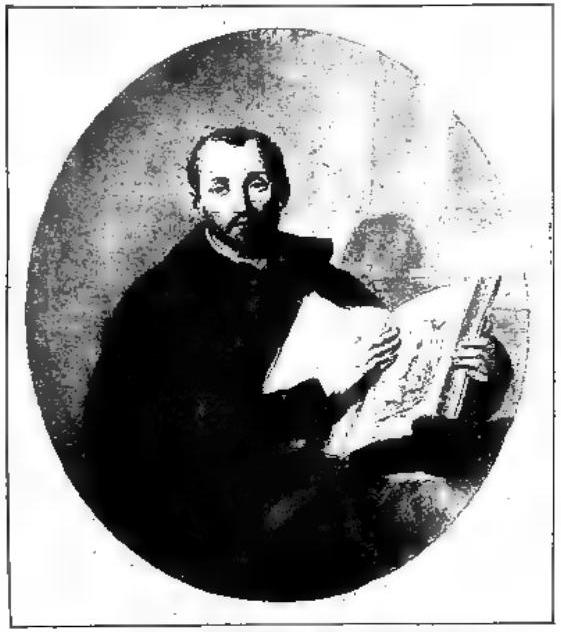
FRANCESCO CARACCIOLO, saint — Portrait.
Cite this article
“FRANCESCO BORGIA (DE BORJA), SANTO.” Enciclopedia Cattolica, vol. V (1950), p. 959. Azione Romana digital edition, https://azioneromana.com/article/francesco-borgia-de-borja-santo.