
JUBILEE. – The year of J. is called in the Mosaic books, and allegorically in the prophetic books (Ex. 46:17), the year of remission (Septuagint: ἕως τῆς ἀφῆσαις), which was appointed for every fiftieth year and brought about the restoration of full social normality, first and foremost the remission of debts and the liberation of slaves. In Catholic penitential discipline, the term was adopted with a purely spiritual meaning, and implies the remission of sins and liberation from the penalties due to divine justice.
SUMMARY:
I. Hebrew J
II. Ordinary Christian J. (Holy Year). – III. Extraordinary Christian J.I. HEBREW J.
From Hebr. jōbhēl “ram’s horn,” since the announcement of the J. was made by the priests to the sound of a ram’s horn. At the end of the last year of each cycle of seven sabbatical years, the sound of the horn announced the beginning of the fiftieth year, that is, the jubilee year. At the end of every seven-year period, the act of remission was likewise performed; this entailed that every creditor remit, literally “let fall,” whatever he had lent to his neighbor, his fellow believer. The year of remission also entailed the liberation of Hebrew slaves (Deut. 15:12). Israel, enslaved, had been liberated by the Lord (v. oō'ēl), and God’s example was to be followed by his faithful.
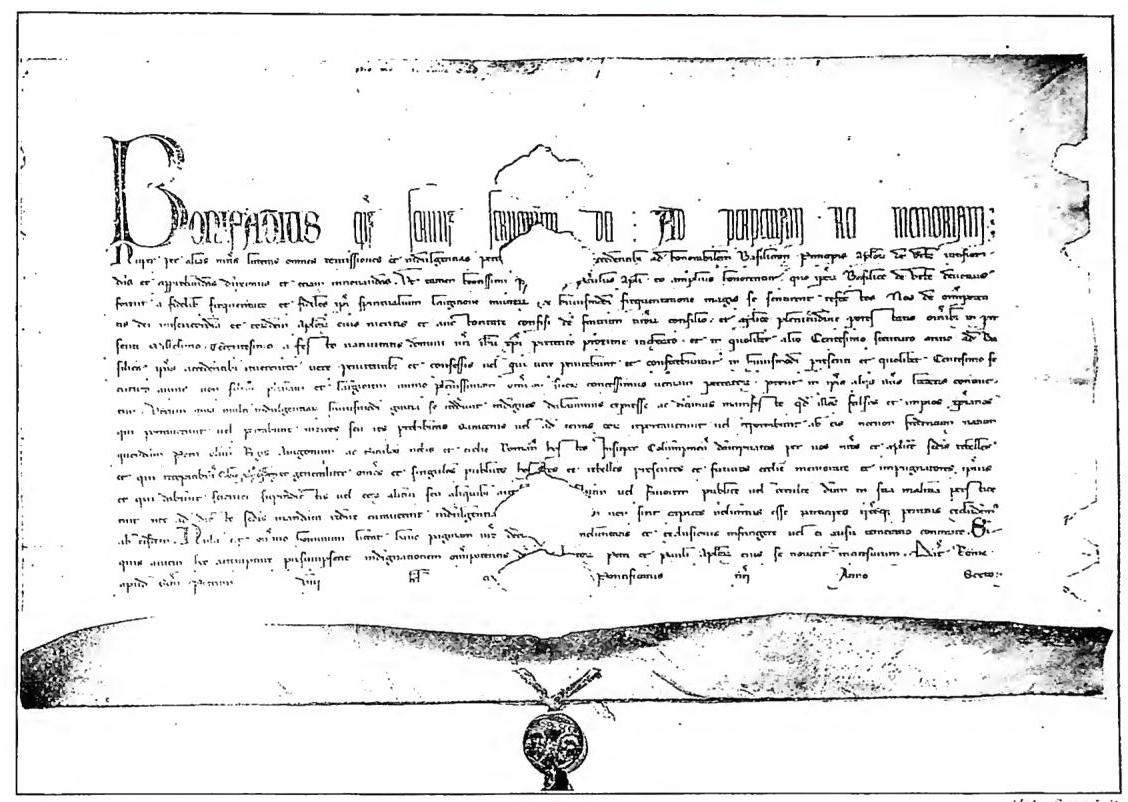
GIUBILEO – Bull by which Boniface VIII excluded the Colonnesi from the jubilee indulgences (22 February 1300). Chapter Archives of St Peter’s.
This spontaneous produce was not to be stored in the granaries, but could be gathered little by little by everyone: by the owner, but also by anyone else and, naturally, first and foremost by the needy. The seventh year and the jubilee year were thus a practical application of the principle that the earth belonged to the Lord and therefore to everyone.
The jubilee year also signified the proclamation of freedom for all the inhabitants of the land and the proclamation of restoration to their own possessions, without, however, preventing transactions of free sale and purchase in the years preceding the J. year, since such transactions were carried out with due regard to the greater or lesser proximity of the jubilee year. The restoration of landed property in the seventh year and in the jubilee year, together with other legal institutions of the same kind, was based on the principle that the inhabitants and owners of the fields were «protected and received by the Lord» (Lev. 25, 23 ff.).
Through the institution of the seventh and fiftieth years, «the imbalance in the distribution of the land and among the social classes was remedied. In practice, some trace of these institutions is found among the Jews before the exile; but after the exile there is no record that the law of the J. was ever observed. On the other hand, the sabbatical year remained fully in force until the destruction of the Jewish state (A.D. 70)» (A. Vaccari).
St Paul sets forth his ideas concerning slaves and free men in I Cor. 7, 20 ff.: it is not the seventh year or the J. that makes a person free, but the Lord’s calling.
Eugenio Zolli
II. ORDINARY CHRISTIAN J. (HOLY YEAR).
I. NOTIONS
In its essence, according to the theological concept, the G. is defined as: a solemn plenary indulgence granted by the Roman pontiff, together with special faculties for confessors, for the benefit of the faithful who gain the G.Considered in terms of its duration, that is, the year during which the jubilee indulgence may be gained, the G. is commonly called the Holy Year; and this not only because it begins, unfolds, and concludes with solemn sacred rites, but also because it is intended to promote holiness of conduct (apostolic constitution Infinita Dei misericordia of 29 May 1924, in AAS, 16 [1924], p. 209).
II. HISTORY
The J., as it was practiced in the Church from 1300 onward, did not emerge already formed in all its parts according to the pre-established prescriptions of a superior ecclesiastical authority. Arising under the influence of popular devotion, it subsequently experienced various influences over the centuries, which gradually transformed its outward manifestations while always preserving its original character. Its necessary prerequisites were the indulgence, whose prototype was that granted for the Crusade; and pilgrimage to the most venerated shrines, especially to the tombs of the Apostles Peter and Paul. Both elements are closely related to the penitential forum with regard(phot. Sansani)
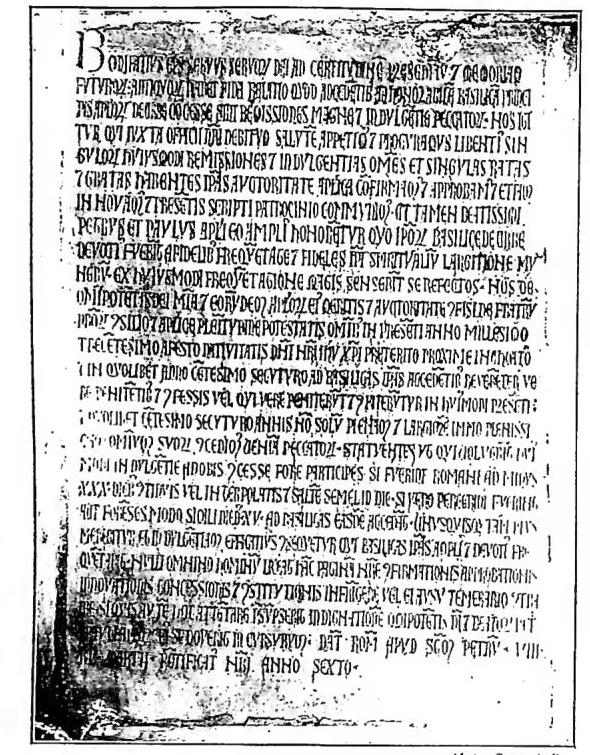
GIUBILEO – Bull proclaiming the first G. (22 February 1300), engraved on marble – Basilica of S. Pietro, atrium.
of absolution from sins and the gravest censures, and to satisfaction for the corresponding canonical penalty. It cannot be denied, however, that there was also some distant reference to the ancient Jewish G., which was nevertheless of an entirely different nature; but more directly preparatory to its emergence were those penitential movements of Joachimite inspiration which can be observed, especially in Italy, beginning in 1260. On the evening of the first day of 1300, an imposing multitude of people rushed into the Basilica of S. Pietro, convinced that they would gain an extraordinary indulgence, and the phenomenon was repeated in the days that followed. Appeal was then made to an ancient tradition according to which the centenary year was to be regarded as a year of universal forgiveness; but no record of this was found in the Roman Curia. In any event, on 22 February Bonifacio VIII issued from S. Pietro a bull by which there was to be a universal G. every hundred years, with liberation from guilt and penalties pro poenitentibus et confessis for those who completed 30 visits, if Romans, and 15, if foreigners, to the Basilicas Vaticana and Ostiense. This G. resounded throughout Europe, which sent throngs of pilgrims to Rome, becoming the object of papal concern with regard to their protection and provisioning.
In the autumn of 1342, a delegation of Romans asked Clemente VI, who was residing in Avignon, to grant the G. every 50 years, so as to open to a greater number of the faithful the possibility of gaining II. The Pope did in fact grant it for 1350; but he did not leave Avignon to hasten to Rome, as the Romans had hoped; meanwhile, the spectacle of innumerable pilgrims arriving from every part to gain forgiveness was repeated.
In the midst of the schism, and certainly in the hope of restoring to unity the scattered members of the
Church, in 1389 Urbano VI established from Rome that, in remembrance of the years of Jesus’ mortal life, the G. should be celebrated every 33 years, and proclaimed it for the following year; and since the visit to the two apostolic Basilicas had been joined by that to the Basilica Lateranense, Urbano decided that the Basilica Liberiana should also be visited; thus the complete number of basilicas to be visited was established. On Urbano’s death, it was his successor Bonifacio IX who celebrated that G., despite the anger of the Avignonese antipope. Nevertheless, pilgrims also began arriving in 1400, at the expiration, that is, of the term established by Clemente VI, and Bonifacio IX himself confirmed the forgiveness for that year as well. Although the 33 years of Urbano VI had elapsed two years earlier, Martino V, with the schism now ended and Rome pacified, celebrated the G. again in 1425, and on that occasion had the holy door of S. Giovanni in Laterano opened; this is the first mention of such a ceremony.
Despite concerns over the Turkish threat and the spread of an epidemic, Niccolò V was able to celebrate the G. in 1450 with extraordinary solemnity and attendance, and it was given particular distinction by the canonization of s. Bernardino da Siena, immensely popular throughout Italy. In 1470 Paolo II considered shortening still further the interval for future G.’s and reduced it to 25 years (Ineffabilis Providentia, 17 Apr. 1470: Bullarium Romanum, ed. Torinese, V, Torino 1860, pp. 200–203); consequently, the new G. was celebrated by Sisto IV in 1475, but left no mark on history. It fell to Alessandro VI to celebrate the G. in the centenary year 1500, and he prepared it with great care and propriety, preserving the ceremonial that is still observed in its general outlines: he established, in fact, that the holy door should be opened in all four patriarchal Basilicas; reserving for himself that of S. Pietro, he appointed three cardinals who, as legates, were to open the other three simultaneously, establishing the rites and prayers.
Despite the religious struggles that troubled the Church during the 16th century, the G.’s were regularly celebrated at their appointed intervals; that of 1575 in particular, at the height of the fervor of religious restoration, proved solemn because of the number of pilgrims, the assistance provided to them, the processions, the preaching, and the special sermons of piety. The splendor that, without harming spiritual inwardness, helped to preserve, in accordance with the customs of the time, the popular character that the G. had possessed from the beginning had by then also been introduced. And with this character the G.’s were subsequently celebrated in the 17th and 18th centuries; but the disturbances created by the French Revolution and the wars that resulted from it prevented the G. from being celebrated in the centenary year 1800; and for a moment it was doubted whether it should be celebrated in 1825. It was claimed that the spirit of the times was too hostile to manifestations of this kind; but Leone XII overcame every uncertainty, and the G. was celebrated according to traditional customs. It was the only one in the 19th century, owing to the political movements. Leone XIII wished the series to resume in 1900 in the traditional forms, which were then also observed by Pio XI in 1925 and by Pio XII in 1950.

(phot. Enc. Cult.)
GIUBILEO - Triple gold ducat of the Jubilee of 1450. Vatican Library, coin collection.
List of the G. of the Holy Years.
1st 1300 Bonifacio VIII
2nd 1350 Clemente VI
3rd 1390 Urbano VI, Bonifacio IX
4th 1400 Bonifacio IX
5th 1425 Martino V
6th 1450 Niccolò V
7th 1475 Paolo II, Sisto IV
8th 1500 Alessandro VI
9th 1525 Clemente VII
10th 1550 (Paolo III) Giulio III
11th 1575 Gregorio XIII
12th 1600 Clemente VIII
13th 1625 Urbano VIII
14th 1650 Innocenzo X
15th 1675 Clemente X
16th 1700 Innocenzo XII, Clemente XI
17th 1725 Benedetto XIII
18th 1750 Benedetto XIV
19th 1775 Clemente XIV, Pio VI
1800, not held, Pio VI.
20th 1825 Leone XII
1850, not held, Pio IX
21st 1875, not held with the usual solemnities, Pio IX
22nd 1900 Leone XIII
23rd 1925 Pio XI
24th 1950 Pio XII
III. OBLIGATIONS AND CEREMONIES
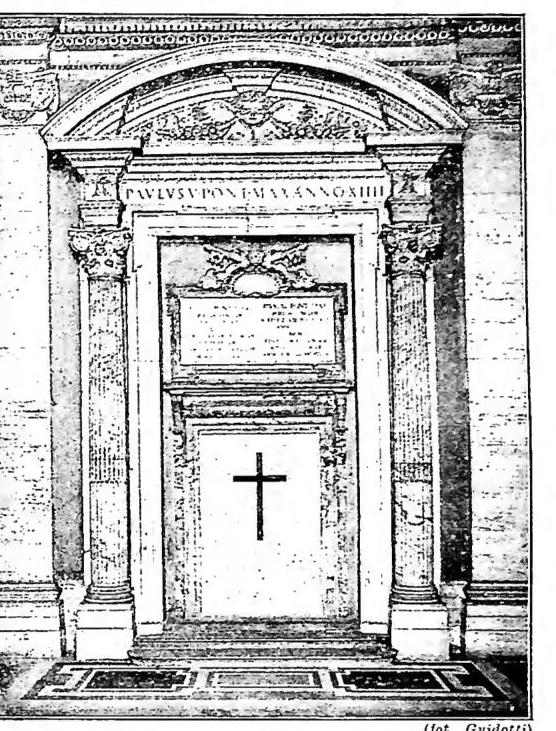
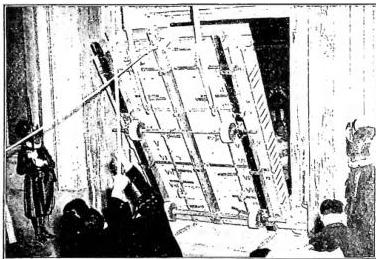
The ordinary Jubilee begins in Rome with First Vespers of the Nativity of the Lord (in memory of the beginning of the year a nativitate) of the immediately preceding year; on that day the holy door of the Vatican Basilica is opened by the Supreme Pontiff, while at the same time three cardinals legates a latere proceed to open the holy doors of the other three major basilicas of Rome, namely, S. Giovanni in Laterano, S. Maria Maggiore, and S. Paolo fuori le mura. It continues throughout the year until First Vespers of the same solemnity of Christmas.In order that the faithful may flock in greater numbers to Rome to gain the Jubilee indulgence, for the duration of the Holy Year all indulgences, both plenary and partial (with only a few exceptions), granted for the living are suspended, but not those granted for the dead (apostolic constitution Fore confidimus of 10 July 1949, in AAS, 41 [1949], p. 337). Indeed, the same indulgences granted for the living may also be gained during that period, provided that they are applied to the dead.
The customary conditions required for gaining the ordinary Jubilee are Confession, Communion, a visit to designated churches, and the recitation of certain prayers.
The Confession required is a current one; consequently, the Confession required for the other plenary indulgences referred to in can. 931 § 3 does not suffice, nor does annual, that is, Easter, Confession. It may in no way be dispensed from or commuted, not even when the penitent has no necessary matter. If, after making Confession, one were to fall again into mortal sin before completing the last prescribed work, Confession must be repeated only if Communion is still to be received; otherwise an act of perfect contrition suffices. Easter Communion does not suffice, unless the person has neglected that precept; it does suffice, however, if received as Viaticum. It may be commuted only in the case of sick persons who are unable to receive II.
(Int. Guidotti)
JUBILEE – The Holy Door of the Basilica of St. Peter.
place. In the episcopal city, among the churches to be visited there must be the cathedral church; elsewhere in the diocese, the parish church. The visit entails entering the church, unless this is prevented either by the crowd or by the doors being closed, in which case it suffices to pray before the church.
Special faculties are granted to local Ordinaries on behalf of those who are prevented from making such visits, for example, nuns, the sick, prisoners, etc., or who make such visits collectively.
The prayers to be recited are not prescribed but are left to the choice of individuals, unless the papal document provides otherwise, as occurred in the G. of 1950, for which they were established in mandatory terms (apostolic constitution Iubilaeum maximum of 26 May 1949, in AAS, 41 [1949], pp. 258–59). These prayers must be vocal, not merely mental, and ordinarily are to be recited during the visit to the designated churches. When fasting is imposed, the provisions of can. 1250 must be observed; eggs and dairy products are therefore excluded, unless it is the Lenten season. Everyone is bound to this fast, including those who, on account of age or for other reasons, are dispensed from it, for example, workers. Those who therefore cannot fast require commutation. Everyone is likewise bound to give alms, including the poor who wish to gain the G. This may be commuted and may be performed by another person, for example, by the husband for the wife, by the father for his children, by the master for his servants, or by the rich person for the poor.
In the ordinary G., special faculties are granted to certain confessors, by virtue of which they may commute or reduce the works imposed for gaining the G., absolve from reserved sins and censures, commute vows, and dispense from irregularities and impediments on behalf of the faithful who intend to gain the G. (apostolic constitution Decessorum Nostrorum of 10 July 1949, in AAS, 41 [1949], p. 340).
How often the G. may be gained depends on the will of the Supreme Pontiff.
Serafino de Angelis
III. G. CRISTIANO STRAORDINARIO.
In addition to the ordinary G. of the Holy Years, from as early as the sixteenth century the practice arose of proclaiming extraordinary G. in order to obtain, through prayers, fasts, good works, and frequent reception of the Holy Sacraments, particular assistance from God in difficult or delicate circumstances, whether for the universal Church or for particular Catholic nations, or at the beginning of a pontificate (in the twentieth century the beginnings of pontificates have no longer been marked by G.). The duration of these G. varied—from a few days to two weeks, several months, or a year—and was always determined in the apostolic constitution by which they were proclaimed. The opening, both in the Urbe and elsewhere, was generally marked by a solemn penitential procession in the morning; in Rome the pope took part in it with his entire court, and it frequently set out from S. Maria degli Angeli and ended at S. Maria Maggiore. The prescribed works included: visiting the four basilicas or some other church, depending on the circumstances; special prayers; fasts (three days: Wednesday, Friday, and Saturday); almsgiving; Confession and Communion. Confessors were granted broad faculties («semel tantum» for each penitent), including in the cases covered by the bull read «die Coenae Domini» (v. BULLA IN COENA DOMINI), and religious men and women could choose their confessor without the permission of their Superior. Outside Rome, publication of the G. was reserved to the Ordinary, who was to establish the practical arrangements.
The plenary indulgence «ad instar» or «per modum», or «in forma Iubilaei», which in itself is merely an ordinary plenary indulgence when it is not accompanied by the particular jubilee privileges—that is, special faculties for confessors—cannot properly be regarded as an extraordinary G., as in the case of the indulgence «in forma iubilaei» granted by Gregory XVI (constitution Catholicae religionis, 22 February 1842) to invite the faithful to pray for the unhappy condition of the Church in Spain, without any mention whatsoever of the said privileges. It becomes such, however, when the pontiff solemnly promulgates it with the aforementioned privileges, which are always indicated in the papal constitution.
There are also several local extraordinary G.: at S. Giacomo di Compostella, when 25 July falls on a Sunday (cf. Leo XIII, Ubi primum, 1 November 1884); in the primatial church of Lyon, when the feast of St. George falls on Good Friday and that of Corpus Christi coincides with the feast of St. John the Baptist, titular saint of the primatial church, which occurs once every century; the last, in 1943, was celebrated on a grand scale (cf. A. Sachet, Le grand jubilé séculaire de St-Jean de Lyon, 1451, 1546, 1666, 1734, Lione 1886, jubilee year); in the church of Notre-Dame of Le Puy, when the Annunciation (25 March) coincides with Good Friday; the last took place in 1932 (cf. A. Boudon, Le grand pardon de N.-D. et l'église du Puy 992-1921, Le Puy 1921, jubilee year). It was also believed in the late Middle Ages and
(courtesy of Monsignor A. P. Fruticci)
GIUBILEO - The Sampietrini remove the wall of the Holy Door (24 Dec. 1949). Basilica of S. Pietro.
It was also believed in the late Middle Ages and even later that a special plenary indulgence could be gained at Montmajour and Comminges when the feast of the Invention of the Cross fell on a Friday, and at Einsiedeln when the feast of the dedication of the Church (14 Sept.) fell on a Sunday (cf. N. Paulus, Geschichte des Ablasses im Mittelalter, I, Paderborn 1922, p. 137; II, ibid. 1923, pp. 19, 327; id., Geschichte des Ablasses am Ausgange des Mittelalters, ibid. 1923, pp. 161, 188).
Pio IV. Spiritus Omnipotentis Dei, 15 Nov. 1560: prayers for the continuation of the Council of Trent (cf. St. Ehses, Concilium Tridentinum, VIII [V of the Acta], Freiburg im Br. 1919, pp. 100–102). It should be noted that the indulgence is not called «in forma Iubilaei»; nevertheless, Pio IV attached the jubilee privileges to it with regard to the faculties of confessors.
Pio V. Cum gravissima, 9 March 1566: the union of the faithful and the defense of Christendom against the Turks.
Sisto V. Virium nostrarum, 25 May 1585: beginning of the pontificate.
CLEMENTE VIII. Quam semper cordi, 23 May 1596: for France: the preservation of the Catholic faith in the Kingdom. - Omne datum, 26 February 1599: for the subjects of Filippo III of Spain: just and faithful governance of the Kingdom.
PAOLO V. Quod in omni, 28 June 1605: beginning of the pontificate. — Benedictus Deus, 28 November 1608: for the Maronites: election of a zealous patriarch. — Universo gregi, 10 October 1609: for the subjects of the Kingdom of Poland: divine aid for the needs of the Kingdom. — Pastoris aeterni, 13 October 1610: for Peru: conversion of the infidels. — Ecce tribulationes, 12 June 1617: needs of the Church. — Dominus ac Deus, 13 January 1619: needs of the Church.