
IMMACOLATE CONCEPTION. – With these terms, Catholic doctrine is indicated, according to which «the Most Blessed Virgin, in the first instant of her conception, by a singular grace and privilege granted to her by Almighty God, in view of the merits of Jesus Christ, Savior of the human race, was preserved immune from every stain of original sin» (bull Ineffabilis Deus).
CONTENTS:
I. The dogma
II. History of the feast in the East
III. History of the feast in the West
IV. Art.I. THE DOGMA
Descending from Adam by way of natural generation, Mary too, like all men, at the moment when the soul was united to the body, should have contracted original sin. But for her, so that she might be a "worthy dwelling of God," an exception was made: therefore, while others were freed by Christ the Redeemer from original sin after having contracted it, the Virgin was preserved from II. This unique exception to the common law was solemnly defined by the Church as revealed by God and thus contained in the sources of Revelation. Theologians have sought to identify the various texts of the Bible and Tradition in which this doctrine is contained, if not explicitly, at least implicitly, that is, in equivalent terms.1. From the 1st to the 4th century. – Among the Fathers and writers of the first centuries, the doctrine of the Immaculate Conception is implicit in the frequent parallel between Eve and Mary (classic texts are those of St. Justin, St. Irenaeus, and Tertullian), which entails a double relation: of similarity—just as Eve came forth pure from the hands of God, so Mary had to come forth immaculate from those same hands; of opposition—she who was to be the restorer of Eve’s ruins could not be overwhelmed by them. In the same period, Hippolytus states that the Savior was "an ark made of wood (the Blessed Virgin) not subject to the decay of sin" (In Ps. 22: PG 10, 610). Similar terms are used by St. Gregory Thaumaturgus, St. Ephrem, and others. These praises exclude in the Virgin any stain of sin.
2. From the 4th to the 9th century. – The doctrine becomes more explicit. St. Ephrem (d. 373) expresses in various ways Mary’s immunity from original sin. He equates the immaculateness of Mary to that of Christ Himself and asserts that such purity is the exclusive privilege of the two: "You alone (O Lord) and Your Mother are beautiful in every respect; for there is no stain in You, O Lord, nor any stain in Your Mother" (Carmina Nisibena, ed. Bickell, Leipzig 1866, p. 40). St. Ambrose asserts that Mary was "ab omni integra labe peccati" (PL 15, 1599). The universal assertion excludes any sin.
In the 5th century, St. Proclus admitted a special intervention of God in the formation of the future Mother of God, so that she might be a new creature, formed "from a clean clay," similar to Adam before sin (De laud. s. Mariae: PG 65, 733, 752, 756, 757); Theodotus of Ancyra opposes Mary to Eve, declaring that although "the Virgin is included in the female sex, she was nevertheless excluded from the wickedness of that sex; she was an innocent Virgin, without stain, without fault, untouched, holy in soul and body, like a lily blooming among thorns" (Homilia in s. Mariam Dei genitricem et in s. Christi nativitatem: PG 77, 1427); Cyrillonas the Syrian, also expounding the antithesis between Eve and Mary, affirms that the Virgin "restored the primitive splendor" of Eve: "Eve had hidden in our mass the leaven of death and sorrow; but behold, Mary appeared and drove it away, so that the whole creation might not be corrupted" (ed. Bickell, in Zeitschr. d. Deutschen morgenl. Ges., 27 [1873], pp. 591-92).
St. Augustine, in the struggle against Pelagianism (v. PELAGIANISMO), was the first to see the question of the Immaculate Conception posed in its terms. There are two relevant texts: one from De natura et gratia (ch. 36, n. 42: PL 44, 267), and the other from the unfinished work Contra Iulianum (bk. IV, ch. 22: PL 45, 1417 ff.), composed toward the end of his life. In the first text, responding to Pelagius, he asserts that all the just of the Old Testament had sinned during their lives, "except the Virgin Mary, concerning whom, for the honor of the Lord, when it comes to sins, I do not wish to raise any question at all, since we know that, for having merited to conceive and give birth to Him who clearly had no sin, more Grace was conferred upon her than was necessary to overcome sin from any quarter." The immaculate sense of this text appeared so obvious that it was inserted into the bull Ineffabilis. In the second passage, responding to Julian, who had objected that with the theory of the universality of original sin Mary would be subjected to the dominion of Satan, he said: "We do not subject Mary to the devil by the condition of birth, but for this (some would read: but to God), because such condition (of birth) is loosed by the grace of rebirth." Evidently here the "grace of rebirth" is opposed to the "condition of birth." Now, if the grace of rebirth, of which the holy Doctor speaks, had not been a preserving grace but only a liberating one from original sin, the Madonna would have been subject to Satan: a thing objected by Julian and resolutely denied by St. Augustine. That the Saint had the notion of a preserving grace is clear from the clause immediately preceding our text, where he speaks of a grace of liberation that consists not in remitting sin but in preserving from it (for objections cf. G. Roschini, Mariologia, I, 2nd ed., Rome 1948, pp. 146-151). St. Maximus of Turin says that "Mary was certainly a dwelling worthy of Jesus Christ, not for the beauty of her body, but for original grace" (Homilia V de natio. Dom.: PL 52, 235).
In the 7th century, St. Sophronius is the first who seems to allude to a preservation from sin. He says, in fact: "You have found with God a grace that no one has received... No one, except you, was prepurified" (Hor. II in Deip.: PG 87, 3248). Toward the end of the 7th or the beginning of the 8th century, the feast of the Immaculate Conception began to be celebrated in the East, as is evident from the Canon of St. Andrew of Crete: "In conceptione sanctae ac Dei aviae Annae" (PG 97, 1305-16). The first homily known on the Conception is that of John of Euboea (PG 96, 1459-1500), a contemporary of John Damascene. By the time of Photius, this feast had already become universal in the Greek Church. To its original object, which was the announcement of the miraculous Conception of Mary made by the angel to her parents, was soon added the present one, that is, the passive Conception of the Mother of God, declared, not infrequently, holy and immaculate. Thus, John of Euboea (d. ca. 750) asserts the intervention of the Most Holy Trinity in the formation of Mary so as to create her in the state of original justice (PG 96, 1485, 1488, 1500). In the Latin Church, however, the feast of the Conception began to be celebrated around the 8th century in Ireland.
In the 9th and 10th centuries, both in the East and in the West, various authors assert in more or less explicit terms the eminent Marian privilege: St. Tarasius, St. Theodore the Studite, St. Joseph the Hymnographer, Photius, George of Nicomedia, Nicetas David, Euthymius, John Geometres, Haimo of Halberstadt, St. Paschasius Radbertus, and St. Fulbert of Chartres (cf. G. Roschini, op. cit., II, II, 2nd ed., Rome 1948, pp. 39-45).
3. From the 11th to the 15th century. – In the Greek Church, a profession of faith in the singular privilege is noted in very precise terms. No one, during this period, as far as is known, denied the great privilege. Among the most explicit proponents were Michael Psellos (b. ca. 1019), Neophytus the Recluse (d. ca. 1220), Germanus II, Patriarch of Constantinople (1222-40), Gregory Palamas (d. 1360), Nicholas Cabasilas (d. 1371), Theophanes of Nicaea (d. 1381), Manuel Palaeologus (1391-1425), and George Scholarius (d. ca. 1472).
While in the Greek Church the doctrine of the Immaculate Conception had achieved its full triumph, in the Latin Church a controversy erupted that persisted, with very lively exchanges, for several centuries. The occasion for the controversy was the feast of the Conception (v. below, History of the feast in the West). Distinguished defenders of the feast Canterbury (v.) and Osberto of Clare. A great proponent of the Immaculate Conception was also the Spaniard Pedro Micha, known as the Compostellan, in his work De consolatione rationis, composed around 1140. Far more vehement than the opposition that arose in England was that stirred in France by the Parisian theologian Jean Belethe and, in a particularly notable manner, by St. Bernard, in his famous letter to the canons of Lyon (PL 182, 323 ff.). The holy Doctor vigorously protested against the introduction of such a feast in the Church of Lyon. Much discussion has taken place not only regarding the authenticity of this letter (which is beyond doubt) but also, and especially, concerning its genuine meaning. It is a fact, however, that the Saint drew no substantial distinction between the sanctification of the Baptist and that of Mary. At least implicitly, therefore, he denied the Immaculate Conception. It should be noted, however, that he ultimately deferred to the judgment of the Church, ready to submit to any eventual teaching of hers contrary to his own. Given his authority, St. Bernard’s letter exerted a considerable influence on the theologians of the following centuries, particularly on the great Scholastics: Alexander of Hales, St. Bonaventure, St. Albert the Great, St. Thomas Aquinas, Peter of Tarentaise (later Innocent V), Henry of Ghent, Giles of Rome, all of whom clearly opposed the singular privilege. The principal causes of this disorientation among such great minds were: a) the theory of Peter Lombard concerning flesh infected by original sin, which would in turn infect the soul at the moment of its union with it; b) the universality of Christ’s redemption, from which the Immaculist theory seemed to exclude Mary; c) the universality of original sin explicitly taught by St. Paul. These objections made a valid contribution to the clarification of the Marian privilege.
Nonetheless, strong supporters of the Immaculist position were not lacking in that same period: Odo, Cistercian cardinal (d. 1273), St. Peter Paschasius (d. 1300), William of Ware O.F.M. (d. 1300), Scotus’s master at Oxford and later professor in Paris, Raymond Lull (d. 1315), and the Parisian master.
Regarding Scotus’s position on the Immaculate Conception, clarification is necessary. In the Theoremata, Scotus denied the Immaculate Conception (cf. C. Balić, Ioannis Duns Scoti doctoris Mariani theologiae Marianae elementa, Sebenico 1933, p. cxxii). Since the time of composition of this work is unknown, it is impossible to say whether this denial represents Scotus’s first or last judgment on the matter. In the Opus Oxoniense, Scotus merely demonstrates the possibility of the Marian privilege, teaching, however, the equal possibility of the opposite, and resolving all arguments both for and against the Maculist position. For Scotus, therefore, the two positions are equally possible. Which of the two was actualized, God alone knows: « Deus novit ». « It seems probable to attribute to the Virgin what is most excellent, provided it does not contradict the authority of the Church or of Scripture ». At that time, ecclesiastical authority had not yet pronounced (the Roman Church, as St. Thomas noted, did not celebrate the feast of the Conception), and Scripture seemed openly opposed, asserting the universality of original sin and of Redemption. For this reason, Scotus proceeded with great caution and, for the moment, did not dare to go further. Only later, undoubtedly moved by his « videtur probabile quod excellentius est attribuere Mariae », he asserts that in heaven « there is the Blessed Virgin Mother of God, who was never His enemy in act by reason of actual sin, nor by reason of original sin: she would have been, however, if she had not been preserved » (In III Sent., d. 18, q. unica). Nevertheless, in the Reportatio Parisiensis, toward the end of his life, Scotus cast doubt on the Immaculate Conception, asserting that the Blessed Virgin « was never God’s enemy in act by reason of actual sin and perhaps not even by reason of original sin ». Was the disciple who wrote the Reportatio faithful in inserting that « perhaps »? Even the famous « potuit, decuit, fecit », so frequently attributed to Scotus, does not belong to him. As for the Parisian dispute, about which legend has embroidered much, it must be said that it either never took place or, if it truly occurred, did not exceed the bounds of an ordinary academic act.
Throughout the 14th century, the theological field remained divided between opponents (the common school) and supporters (especially Franciscans, Carmelites, and Servites). Around the middle of the century, both in France and Aragon, a violent controversy was stirred by some Dominican masters. Ecclesiastical authority in France and civil authority (John I) in Aragon imposed silence and retraction on the aforementioned masters. The fruit of this debate was real progress in Immaculist doctrine. It was then that the biblical argument began to appear, especially that drawn from the Protoevangelium (Gen. 3:15) and the angelic salutation (Lk. 1:28). The feast of the Conception also spread everywhere at that time, particularly among religious orders.
At the beginning of the 15th century, the Immaculist position was already common among the Franciscans and other religious orders, except the Dominicans. This favor grew to such an extent that Cardinal Juan de Torquemada, at the Council of Basel (1438), invoked in favor of the singular privilege the testimony of « almost the entire world ». In that same Council, after three years of discussions—held especially between the Dominicans John of Montenero and Cardinal Torquemada on one side, and Juan de Torquemada and Father Perqueri O.F.M. on the other—in session XXXVI (17 September 1439), a decree was issued declaring that belief in the Immaculate Conception was pious, conformed to the worship of the Church, to the Catholic faith, to Holy Scripture, and to right reason, and therefore was to be held by all Catholics, with a prohibition against teaching the contrary. However, the Council, at the time it issued this definition, was no longer legitimate, having withdrawn from the authority of the Roman Pontiff. Nevertheless, it exerted an exceptional influence on the triumph of the pious opinion and made the feast of the Conception universally observed in fact. Opposition did not diminish, however, on the part of many Dominicans, among whom Raphael of Pornassio and Vincenzo Bandelli, Master General of the Order (from 1501 to 1506), became famous. The latter went so far as to establish the thesis: « It is impious to hold that the Blessed Virgin was not conceived in original sin ». At this point, the Roman Pontiffs began to intervene in an increasingly decisive manner. Sixtus IV, a Franciscan, on 27 February 1477 promulgated the constitution Cum praeexcelsa, with which he solemnly approved the feast of the Immaculate Conception celebrated in many places, with its own Mass and Office, composed by the Veronese Leonardo de Nogarolis (cf. C. Sericoli, Immaculata B. M. Virginis Conceptio iuxta Sixti IV constitutiones, Roma 1945, p. 73 ff.). This Constitution, however, did not succeed in putting an end to the excesses of the opponents, who began to distort the meaning of the feast of the Immaculate Conception, asserting that it dealt—
The aforementioned assertions—that the feast of the Immaculate Conception referred to the sanctification of the Virgin occurring when she was conceived Deo (conceived in relation to God) through purification from original sin—were declared false, erroneous, and contrary to truth by Sixtus IV in the bull Grave nimis, under threat of excommunication. The severe measure, reconfirmed the following year, contributed significantly to advancing the pious opinion, which was embraced by the Universities of Paris (which imposed it by oath upon its doctors in 1469), Oxford, Cambridge, Toulouse, Bologna, and Vienna.
4. From the 16th to the 19th Century
In the Greco-Russian Church, after approximately fifteen centuries of admirable concord in affirming this singular privilege, an era of inexplicable discord began, originating from the growing favor it received in the Church of Rome. Various figures rose in opposition, particularly after the solemn definition. Nevertheless, even in this period of disorientation, convinced proponents of the Immaculate Conception persisted within the Greek Church, employing terms identical to those later used by Pius IX in the definition. Suffice it to mention Cyril Lucaris, Gerasimos I, Patriarch of Alexandria, Nicholas Cursulas, and Elias Miniatis.In the Latin Church, by contrast, the Immaculist opinion moved toward its triumph. Theologians' adherence to it grew to such an extent that Cardinal Cajetan (d. 1534), though opposed, did not hesitate to acknowledge that the doctors who held the Blessed Virgin had been preserved from original sin were infinite in number if one considered modern authors. Nevertheless, the opposing opinion persisted, particularly through the efforts of certain Dominicans. Theological elaboration made further progress. Theologians began to question whether the Immaculate Conception was a truth of faith or at least could become one. The related question also developed: whether the Virgin, preserved from original sin, was also exempt from the more or less strict obligation of contracting it (utrum immunis evaserit a debito proximo vel remoto originalis culpae contrahendae). Biblical and patristic research was enriched with new data, so that during the sixth session of the Council of Trent (1546), a strong current favored the dogmatic definition of this eminent privilege. However, since the Council had been convened against heretics rather than to resolve controversies among Catholics, the idea of definition was set aside, and it was decided to—
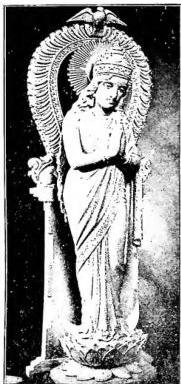
IMMACOLATA CONCEZIONE - Immaculate. Indian ivory statuette (20th century), with the characteristic Hindu arched posture, symbol of veneration. For Indians, the lotus symbolizes purity. Rome, Missionary Art Exhibition 1950.
In the 17th century, three other Popes intervened: Paul V, following the urgent requests of Philip III, King of Spain, who was impressed by the lively disputes between Maculists and Immaculists, prohibited anyone from publicly attacking, in any way, the doctrine favorable to the I. C.; Gregory XV forbade that such a doctrine be attacked even in private, thus imposing silence on the opposing opinion; Alexander VII, then, with the constitution Sollicitudo omnium Ecclesiarum (8 Dec. 1661), determined, against the false interpretations of the few remaining adversaries, the precise object of the feast, declaring that it concerned the preservation of the Virgin’s soul from original sin, in the first instant of its creation and infusion into the body, by a special grace and privilege of God, in view of the merits of Christ her Son, Redeemer of the human race. He also renewed the provisions of his predecessors against the supporters of the contrary opinion. The effect of this Constitution was incalculable. Dioceses, kings, peoples, and cities placed themselves under the protection of the Immaculate Virgin. Various Congregations were founded in her honor. Theologians redoubled their efforts to defend the singular privilege and to pave the way for its definition. Many even went so far as to bind themselves by vow to shed their blood, if necessary, for its defense, e.g., St. Alphonsus. This act of filial love, called the «bloody vow», was strongly opposed by L. Muratori, the last great adversary, in his work De ingeniorum moderatione in religionis negotio (Paris 1714, bk. II, ch. 6) and De superstitione vitanda sive censura voti sanguinarii (Venice [but Milan] 1740). Even among the Dominicans, opponents of the privilege became increasingly rare.
At the beginning of the 18th century, Clement XI, with the bull Commissi nobis (6 Dec. 1708), extended de iure (since it already was de facto) the feast of the I. C. to the entire Church. Throughout the century, the enthusiasm of the faithful and scholars for the singular privilege continued to grow, and with it, the petitions addressed to the Roman Pontiffs by bishops, kings, and religious Orders for the solemn definition of the dogma.
Pius IX, as soon as he ascended to the papal throne (in 1846), decided to satisfy the fervent desire of the faithful. In 1848, he appointed a special commission of cardinals and theologians to thoroughly examine the question of the definability of the Marian privilege. Shortly thereafter (2 Feb. 1849), from Gaeta, he sent a letter to all bishops asking for their opinion. The response was plebiscitary: out of 665 replies, 570 were enthusiastically favorable, a few uncertain about the opportuneness of such a definition, and only 8 opposed. Meanwhile, the commission, after having established by common agreement the necessary requirements for the definability of a doctrine (at least implicit content in one of the two sources of Revelation, Scripture and Tradition), asked: «Are there in Holy Scripture testimonies which solidly prove the Immaculate Conception of Mary?» And it reached a favorable conclusion (cf. V. CAMISARDI, La solenne definizione del dogma dell'Immacolato Concepimento di Maria S.ma. Atti e documenti, I, Rome 1905, pp. 796-804).
Following the favorable response from both bishops and theologians, Pius IX, on 8 Dec. 1854, proceeded in St. Peter’s Basilica to the solemn definition of the dogma, in the presence of over 200 cardinals, archbishops, and bishops, and an incalculable multitude of exultant faithful.
II. HISTORY OF THE FEAST IN THE EAST
Today, this feast is celebrated in all Eastern Churches, both dissident and Catholic, with the exception of the Syriac Monophysite Church and the Chaldean Nestorian Church. The traditional date of the feast is December 9, and the title generally emphasizes the "active conception" of Anna: "The Conception of Anna when she conceived the Mother of God." However, some Churches united with Rome celebrate the feast on December 8 and give it the same title as the Latins.Byzantine Rite. - It is acknowledged that the feast originated in the East, and the oldest document in this regard dates to the 7th-8th centuries: a liturgical canon by St. Andrew of Crete (PG 97, 1305-16). A homily by John of Euboea (ibid. 96, 1459-1580), four by George of Nicomedia (ibid. 100, 1335-1402), one by St. Euthymius of Constantinople, one by Peter of Argos, and the Menologion of Basil II attest to its diffusion. Notably, the Constitution of Manuel Comnenus (1166) (ibid. 133, 750) prohibited court sessions on that day. Examining the menologia and homiliaries (collected by A. Ehrhard, Überlieferung und Bestand... [Texte und Untersuchung, 50, 51, 52]), one observes that the feast appears rarely in the 11th century, more frequently in the 12th, though in some places it was celebrated with a higher liturgical rank than today (cf. A. Schultz, Der liturgische Grad des Festes der Empfängnis Mariens im byzantinischen Ritus vom 8. bis 13. Jahrh., Rome 1941). It was never elevated to the rank of the twelve great feasts of the Byzantine Rite.
The Italo-Greeks, Melkites, and Ruthenians have sometimes adopted the Latin title and enhanced the solemnity of the feast. The Ruthenian Basilians, at their General Congregation of Zyrovice (1661), decreed the addition of an octave to the feast (cf. Capitulorum volumei, Vilna 1900, p. 71), a practice noted only in the Liturgicon of Vilna (1692) and that of Unev (1740). At the Provincial Synod of Lviv (1891), a new Office was composed, and the ancient one relegated to the vigil. The Liturgicon of Rome (1942) restored the ancient title and Office while preserving the feast's liturgical rank.
No one has studied the meaning of the feast among the Byzantines in their literary documents and liturgical texts better than Fr. M. Jugie. His principal conclusion is that the object of the feast is complex, and three perspectives can be distinguished: the Annunciation of the Conception by the Angel, the miracle of the active conception in the barren womb, and the passive conception of the future Mother of God. This last element primarily occupied the minds of orators and poets (cf. DThC, VII, 1, col. 959).
Armenian Rite. - Among dissident Armenians, the feast on December 9 was introduced only two centuries ago (cf. C. Tondini de Quarenghi, Etude sur le calendrier liturgique de la nation arménienne, Rome 1906, p. 2). In the Calendar published by the Mechitarists in Vienna (1877), the title is the Latin one, though the date remains December 9 (cf. N. Nilles, Kalendarium manuale utriusque Ecclesiae orientalis et occidentalis, II, Innsbruck 1897, p. 625).
Syriac Rite. - In a Menologion written in 1166 (cod. Bodl. Dawk. 32) and later in a Calendar compiled by Jacob of Edessa but transcribed in 1635 (cod. Vat. Syr. 37), the feast appears on December 9 with the title used by the Byzantines. However, in many other Menologia of the Syriac Monophysite Church (cf., e.g., PO 10), no mention of it is found.
Conversely, the Syrians united with Rome celebrate it solemnly on December 8 with the Latin title (cf. Synodus Sotorfensis Syrorum a. 1888, Rome 1897, p. 65). Indeed, their Fenqitho (II, Mosul 1886, pp. 376-412) includes the Office with a full octave—a recent creation.
The Maronites also celebrate the feast of the Immaculate Conception. In a Calendar published in Rome (1830), the feast is mentioned on December 9 (cf. N. Nilles, op. cit., II, p. 681), but today they celebrate it on December 8.
In the Calendar of Gibrâ'il ibn al-Golai (1673) (cf. PO 10, 349-53), the feast is not mentioned, nor does it appear among the holy days of obligation in the Synod of Mount Lebanon (cf. Acta et decreta... collectio Lacensis, II, Freiburg 1876, col. 109), as it is today.
Chaldean Rite. - Alone among the Easterners, the Nestorians neither know nor appear ever to have known the feast of the Immaculate Conception. The Chaldeans united with Rome observe it on December 8 with the Latin title, and a certain monk Damian composed an Office for it (cf. Maria, Etudes sur la Ste Vierge sous la direction d'Hubert du Manoir, I, Paris 1949, p. 349). It does not yet appear among the new feasts introduced by Patriarch Joseph II Ma'rûf (1695-1713; cf. Vat. Borg. Syr. 89) or those noted in a 1765 report (cf. J. Vosté, Les actes du synode chaldéen de... 1853, Rome 1942, p. 137), but it certainly existed by the time of Patriarch Joseph Audo (1847-78).
The Malabarians have long adopted the Latin Calendar.
Coptic Rite. - Coptic documents record the memory of Anna's conception on two different dates. The Synaxarion attributed to Michael, Bishop of Malig in the 13th century (cf. J. Forget, Synaxarium Alexandrinum, in Corp. Script. Christ. Or., 3rd series, XIX, p. 252), and a modern calendar of dissident Copts (cf. S. C. Malan, The Calendar of the Coptic Church, London 1873, p. 37) place the feast on 7 Mesri (today, July 31, according to the Julian Calendar). However, other documents from the 13th and 14th centuries (cf. PO 10, 175, 195, 226, 260), as well as a modern calendar (cf. N. Nilles, op. cit., II, p. 700) and the Synod of the Catholic Copts (cf. Synodus Alexandrina Coptorum habita Cairi a. 1898, Rome 1899, p. 67), have the feast on 13 Koiak (today, December 9, according to the Julian Calendar).
The Ethiopians translated the Synaxarion of Michael of Malig in the 14th century (cf. PO 9, 393) and thus still celebrate the feast on 7 Nahasi, i.e., July 31 (cf. G. Nollet, Le culte de Marie en Ethiopie, in Maria, cit., I, Paris 1949, p. 393).
However, the Ethiopians united with Rome celebrate it on December 8. The difference in dates—December 8 and 9—raises a question. Since the Nativity of the Virgin is celebrated by all on September 8, and that feast existed before ours, one wonders how the Byzantines and those who followed them arrived at placing the Conception on December 9. Fr. Pl. de Meester, La festa della Concezione di Maria Santissima nella Chiesa greca (in Bessarione, 9 [1904], pp. 95-97), advances various hypotheses, none of which are satisfactory, while Fr. G. Hanssens, Cinque feste mariane dei riti orientali (in Incontro ai fratelli separati di Oriente, Rome 1945, p. 371), writes: "It seems simpler to us to think that, by placing the Conception on December 9, the intention was to make that day the first of the nine-month period of which the day of the Nativity is the last, just as, for example, Easter Day is the first of the fifty days ending with the entire day of Pentecost, and Christmas Day is the first of the forty days ending with the entire day of the Presentation of the Lord in the Temple."
III. HISTORY OF THE FEAST IN THE WEST
In the Middle Ages, the feast of the Conception of Mary was commonly called the "feast of the Normans," as it was widely believed that they had encountered it in Sicily and southern Italy, from where they subsequently introduced it into Normandy and England. However, the progress of liturgical studies has demonstrated that the origin of the feast in the West is to be sought in the Celtic Church of Ireland.Indeed, the Martyrology of Tallaght (early 9th century) and the Calendar of Oengus (ca. 825) include a feast of the Conception of Mary on 3 May, a date whose provenance is still disputed. In England, prior to the Norman invasion (1066), the feast of the Conception of Mary on 8 December is found in various calendars (Old Minster, Winchester, ca. 1030; New Minster, ca. 1035) and especially in the well-known Missal and Pontifical of Bishop Leofric of Exeter (ca. 1050). Bernold of Constance, author of the Micrologus (d. 1110), provides no information on the feast. In England and neighboring territories, however, it continued to spread; in 1128, it appears in several Benedictine monasteries (Ramsey, Edmundsbury, Reading, etc.); at the same time, it also appears in the ecclesiastical province of Rouen (under Bishop Hugh, ca. 1129). In 1140, the famous dispute occurred in Lyon between the Chapter, which wished to introduce it, and St. Bernard, who rejected II. In 1154, the prior of St. Peter of Regula (diocese of Bazas), upon introducing it into his abbey, declared that nearly all of France celebrated II. Beleth, in his Divinorum officiorum ac eorundem rationum explicatio (ca. 1161-65), while acknowledging its diffusion, rejected it as "non authentica." In Rouen, the feast was granted the same rank as that of the Assumption under Archbishop Rotrou (1165-83). In Paris, the Conceptio was regularly celebrated in 1196.
The feast also made its appearance in Italy, but Bishop Sicard of Cremona (d. 1225), in his celebrated Mitrale, using almost the same words as Beleth, rejected it sharply. For Italy, the information gathered by A. Ebner (Quellen und Forschungen zur Geschichte und Kunstgeschichte des Missale Romanum im Mittelalter. Iter Italicum, Freiburg im Breisgau 1896) is instructive. The feast is already found in a Sacramentary (12th century) belonging to the Augustinian friars of Jerusalem (Rome, Biblioteca Angelica, D. 7, 3), in another from the Vatican Library (lat. 7231) of the 12th-13th century, in a Sacramentary of the Vatican Basilica from the second half of the 13th century (Chapter of St. Peter, F 13), in a "full" Missal of the church of St. Nicholas in Trani from the late 13th century (Vatican Library, Reg. 2049), and in another "full" Missal from the same period belonging to the Carthusians of Santa Croce in Rome (Biblioteca Casanatense, 1394), with the indication: Sanctificatio Virginis gloriosae Mariae. From the 14th century are a Missal of Rome (or of Alatri), now in the Vatican Library (Ott. 356), another from Orvieto (Rome, Biblioteca Casanatense 704), and one from the church of St. Nicholas in Carcere in Rome, where the dedication of an altare Conceptionis is also recorded; from the 15th century, there is a Dominican Missal from the Neapolitan region: Sanctificatio B. Mariae Virginis (Naples, Biblioteca Nazionale, VI E 3), and one of the Carthusians, with the same designation (Vatican Library, lat. 7209). As for books in which the feast was added to the original text, it suffices to mention a few: at Montecassino, in a "full" Missal of the 11th century, the feast was added almost contemporaneously (Montecassino, NN. 540); similarly, in a Sacramentary of the Benedictines of Moggio (Udine) from the 13th century (Udine, Archiepiscopal Library, f. 16); such additions are often found in the Missals of the Friars Minor and other religious orders.
In France, the Council of Le Mans (1247) declared the feast of the Conception de praecepta; at Reims, it was certainly celebrated between 1261 and 1271. Of great importance for its diffusion is the year 1263, in which the General Chapter of the Franciscans established its celebration throughout the Order. In England, while a provincial Synod of Oxford (1222) refused to declare it, though already in use, as a feast de praecepta, the diocesan Synod of Exeter (1287) imposed it even on the secular clergy. Durandus, bishop of Mende, a profound connoisseur of Roman and papal liturgy (d. in Rome in 1296), makes no mention of it in his great work Rationale divinorum officiorum, a general compendium of the liturgical science of that era. In 1300, a Synod of Bayeux included the feast of the Conception among the Marian feasts de praecepta. In 1306, the General Chapter of the Carmelites introduced it into the Order as tatum duplex (i.e., a solemn feast). At Mainz, the feast is attested in 1318. Around 1330, at Avignon, it was celebrated with great solemnity in the church of the Carmelites, and shortly thereafter, it was adopted by John XXII in his own chapel. Around the same time (1334), it was celebrated in the Carthusian monastery of Val-St-Aldegonde, and the following year, throughout the Carthusian Order; in 1343, it received the rank of festum solemne. Between 1338 and 1348, it was adopted in the vast diocese of Trier; in 1350, at Utrecht and Münster in Westphalia. In 1394, it was also accepted by the General Chapter of the Dominicans as tatum duplex. It is impossible to trace the diffusion of the feast in greater detail, but during the 15th century, it became practically universal.
By decree of the Council of Basel, session XXVI (17 September 1439), concerning the doctrine of the Immaculate Conception, the feast gained much ground. A Breviary printed in Mainz in 1507 used the texts of this Council for the second nocturn.
Of great importance for the definitive and universal acceptance of the feast is the pontificate of Sixtus IV. In the inscription (now in the courtyard of the former hospital of the Consolation) containing the grant of many indulgences for the church of Santa Maria delle Grazie under construction (1472), he calls the Virgin "Immaculata virgo" (v. Forcella, Iscrizioni delle chiese e d'altri edifici di Roma, VIII, Rome 1876, p. 324, n. 780); in 1476, he published a bull granting for the feast of the Conception the same indulgences as those granted by his predecessors for the feast of Corpus Domini, adopting the liturgical formularies reduced, by his order, by the notary Leonardo de Nogarolis (Bullarium Romanum, V, Turin 1860, pp. 269-70). These texts were introduced into the books of the Franciscans and enjoyed wide diffusion. He also had a most sumptuous chapel built near St. Peter’s for the use of the choir, dedicated on 8 December 1479 in honor of the Immaculate Conception of Mary and of SS. Francis and Anthony (E. Steinmann, Die sixtinische Kapelle, I, Munich 1901, pp. 11-26), where he wished to be buried (the famous monument by Pollaiuolo).
Pius V, in the reform of the Breviary (1562), replaced the Office of Nogarolis with that of the Nativity of Mary, with appropriate adaptations, adding new lessons. In the edition of the Breviary by Clement VIII, the feast of the Conception was elevated to duplex maius. In many places, it was celebrated with an octave; thus, for example, Alexander VII (1665) granted the octave to the Republic of Venice, Clement IX (1667) to the Papal States, at the same time elevating the feast to the rank of second class. Innocent XII (15 May 1693) prescribed the octave for the entire Church, simultaneously raising the feast to second class. Clement XI (6 December 1708) then imposed the feast on the entire Church de praecepta. Benedict XIV instituted the solemn Papal Chapel on the day of the Conception of Mary.
At the time of the definition (1854), three different Mass and Office formularies were in use throughout the Latin Church, among which that of Nogaroli still held primacy.
At the request of many bishops and by his own desire, Pius IX ordered in 1863 the composition of a new liturgical text "dogmatic in nature," that is, one that would precisely express the defined truth. To this end, he established a special Congregation, which held its first meeting on May 23 of that same year. A formulary (Mass and Office) was proposed for discussion, prepared by Fr. Luigi Marchesi, C.M., and published by him; however, the discussions ultimately led to the rejection of the project. Following direct contacts between the secretary of the Congregation of Rites, Monsignor Bartolini, and Pius IX, the latter, by the Pope's will, prepared a new text himself,
which, after various changes and substitutions, was approved by Pius IX on August 27; the feast was then called that of the Immaculate Conception. On September 25, by a special apostolic brief, Pius IX abolished the existing formularies, prescribing for the entire Church, including those with their own rite, the new text of the Mass and Office for the feast and the octave, and, where in use, the vigil Mass. Of Nogaroli's Office, the main Hymnal remained, with a small but significant innovation: instead of filio suo, filio tuo is now read. Finally, Leo XIII (November 30, 1879) prescribed the vigil for the entire Church as well. Unfortunately, apocryphal readings were introduced into the Office of the feast and the octave. In the feast, the sermo s. Hieronymi of the second nocturn is by Ambrose Autpert (v.), and on the octave day, the homily of the third nocturn is not by St. Epiphanius of Salamis, but by another Epiphanius, known as the Cypriot, who lived in the mid-9th century (Sacred Congregation of Rites, Decreta 1863, App. C).
IMMACOLATISMO
The term "Immaculatism" refers to the theological and devotional movement that, especially from the 19th century onward, aimed to promote and defend the dogma of the Immaculate Conception of the Blessed Virgin Mary. This movement found particular expression in the foundation of religious congregations, the establishment of sodalities, and the spread of devotional practices centered on the Immaculate Conception. Among the most significant manifestations of Immaculatism were the apparitions of Lourdes (1858), where the Virgin Mary presented herself to Bernadette Soubirous with the words: "I am the Immaculate Conception," thus confirming the dogma proclaimed by Pius IX four years earlier.
Theological debates surrounding Immaculatism often focused on the relationship between the Immaculate Conception and the universal redemption wrought by Christ. Some theologians, particularly in the early modern period, had raised objections to the doctrine, fearing that it might compromise the universality of Christ's salvific work. However, the dogmatic definition of 1854 clarified that Mary's preservation from original sin was itself a fruit of Christ's redemptive grace, applied to her in anticipation (praeredemptio).
Immaculatism also had a notable impact on art and popular piety. Numerous churches, chapels, and shrines were dedicated to the Immaculate Conception, and Marian iconography increasingly adopted the image of the Immaculata, often depicted with the moon beneath her feet, a crown of stars, and the serpent crushed underfoot, in reference to the protoevangelium (Gen 3:15). The feast of the Immaculate Conception became a focal point for Marian devotion, particularly in Catholic countries, where it was celebrated with processions, novenas, and other devotional exercises.
IV. ART
In Eastern liturgical texts, as early as the 10th century, the illustrations referring to December 8th, the feast day of the Conception of the Virgin Mary, depict the meeting of Joachim and Anna beneath the Golden Gate of the Temple of Jerusalem; for from that moment, the beginning of Mary’s life is placed in Anna. This concept is also the starting point for the life of the Virgin in the books of the monks of Mount Athos.This representation is repeated numerous times in both Eastern and Western art. Notable examples include Giotto’s magnificent depiction in the frescoes of the Arena Chapel in Padua, a 14th-century painter’s work in the transept of the cathedral of Bressanone, and Dürer’s famous print. At times, this scene is made more complex by the presence of an angel joining the heads of Anna and Joachim, as seen in the fresco by a Giottesque painter in Santa Maria Novella in Florence and in a panel by Bartolomeo Vivarini in Santa Maria Formosa in Venice. Other times, as in a Belgian breviary containing the Office of the Virgin in the Vienna Library (no. 1984), two shrubs grow from the breasts of Joachim and Anna and unite to support a flower bearing the image of the Virgin in its calyx. However, by the end of the 15th century, painters and illustrators of sacred texts tended toward a direct representation of the Immaculate Conception, depicting the Virgin descending to earth by God’s will at the fulfillment of time. Examples include a painting by Luca Signorelli in the cathedral of Cortona and another by Antonio Sogliani in the Uffizi Gallery in Florence.
Meanwhile, other Renaissance painters, such as Francesco Zaganelli da Cotignola in a 1513 painting in the Pinacoteca of Forlì, where the Eternal Father is shown letting fall to earth—where the Virgin stands among saints—a girdle inscribed with the words «Tota pulchra es et macula originalis non est in te», sought to represent the litanic attributes figuratively.
But it is in Spanish art, through the work of the painter Juan de Juanes (1507-76), in a painting created for the church of
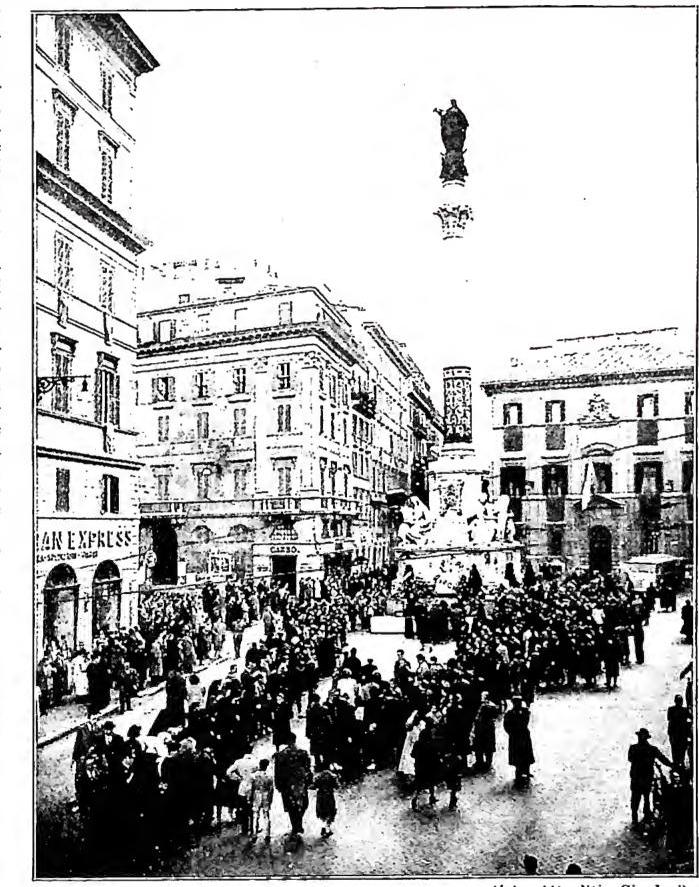
Among the most famous representations of the I. C. in this definitive form—officially established at the time of the dogma’s proclamation (1854)—are Ludovico Carracci’s painting in the Pinacoteca of Bologna, Guido Reni’s canvas now in the Houghton Gallery near London, Tiepolo’s splendid work, also on canvas in the Pinacoteca of Vicenza, and finally the statue that rises upon the column erected in Rome’s Piazza di Spagna by Luigi Poletti on the occasion of the dogma’s proclamation by Pius IX. - Vedi tavv. CI-CII.