
PENTECOST. –
I. HOLY SCRIPTURE
A Jewish feast, 7 weeks or 50 days (hence the Greek appellation “fiftieth” [day]) after Passover, which became a Christian solemnity because on that day the community directed by the Apostles was miraculously inaugurated (Act. 2, 1-14).According to Lev. 23:15-16: “From the day after the Sabbath, that is, from when you have offered the sheaf for waving, you shall count seven complete weeks. Having counted in this way up to the day after the seventh Sabbath, 50 days, you shall offer a new oblation to the Lord.” For the Pharisees, the “day after the Sabbath” on which the (barley) sheaf was offered was 16 nisān; for the Sadducees, it was the day following an actual Sabbath. Therefore, since P., fixed on the 50th day from the offering of the first sheaf, was celebrated by the Sadducees always on the first day of the week, whereas for the Pharisees it fell on the 5th, 6th, or even 7th of the month of nisān (the 2nd month after nisān, corresponding to May–June), for the Sadducees it could also fall on later days.
In the year of Jesus’ death, which occurred on Friday, 14 nisān, 15 nisān, the feast of Passover, coincided with the Sabbath of the week; 16 nisān was therefore Sunday, the first day of the week, and P. consequently likewise fell on a Sunday.
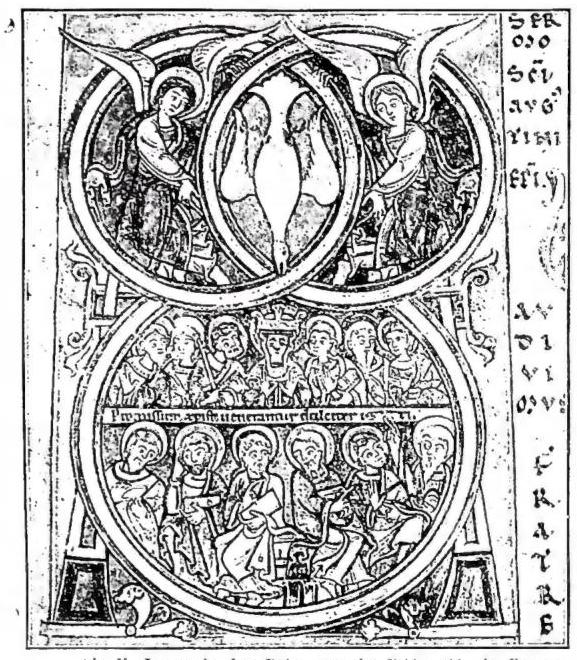
(from V. JALABERT, LOUIS, Les Brèv. mat. des Bibl. publ. de France, Paris 1881, lat. 9)
PENTECOSTE – The descent of the Holy Spirit. Miniature from the Breviary of Montiéramey (12th century) – Paris, National Library, ms. lat. 706, fol. 182r.
mane» (hagh ṣābhu'ōth: Ex. 34, 22; Deut. 16, 10; II Par. 8, 13) or “feast of the firstfruits” (Ex. 23, 16), because loaves made with flour from the newly harvested wheat were offered (Lev. 23, 17). The “freewill” offering mentioned in Deuteronomy (16, 10-11) did not exclude the prescribed offerings, and was to provide the occasion for a joyful banquet, at which the pious Israelite, remembering God’s benevolence in delivering the people from Egypt, allowed the dispossessed, who could not make those offerings, to participate. The original agricultural character of P. was not altered by the prescriptions concerning the date, rites, and sacrifices which, according to the legislation of Lev. 23, 15-22 and Num. 28, 26-31, constitute the feast’s proper character and increase its solemnity. In addition to the characteristic offering of the two “leavened” loaves (Lev. 23, 17), ordinary bread was offered, the bread that served as daily sustenance, because it was something owed to God’s generosity, for which they wished to give him thanks. There was also the holocaust of “seven year-old lambs without defect, and one bullock and two rams” (ibid. 23, 18; according to Num. 28, 27, two young bulls, one ram, and seven lambs); and “one goat as a sin offering and two year-old lambs as a peace offering”: Lev. 23, 19. There were therefore three kinds of sacrifices: the holocaust, the sin offering, and the peace offering of the two lambs. To the meaning of offering the firstfruits to God, in gratitude for the abundant harvest in the fertile and spacious land promised by God to the people, there was later added the commemorative remembrance of the promulgation of the law on Sinai. This does not appear in the Old Testament, nor in Philo and Josephus; it is mentioned only from the 2nd century A.D. onward (cf. H. L. Strack-P. Billerbeck, Kommentar zum Neuen Testament aus Talmud und Midrasch, II, Munich 1924, p. 601).
Both because of its significance and because it fell during the favorable season, the feast of P. was also very well attended by the Jews of the Diaspora (cf. Act. 2, 9-11). On his third journey, too, when returning from Greece, St. Paul did not wish to stop at Ephesus because he was anxious to reach Jerusalem for P. It is also mentioned in I Cor. 16, 8; but particularly important is the account in Act. 2 of the descent of the Holy Spirit that took place on that day.
The meaning of Christian P. emerges from the events that occurred on that day. The mission of the Holy Spirit, repeatedly promised by Jesus (Io. 15, 26; Act. 1, 4-5, 8), with its visible manifestation in tongues of fire, was the beginning of the Church. The Apostles began preaching. The miraculous phenomenon of tongues seems best explained as a phenomenon of glossolalia, as subsequently occurred frequently in the early Church (I Cor. 14; cf. S. Lyonnet, De glossolalia Pentecostes eiusque significatione, in Verbum Domini, 24 [1944], pp. 65-75; J. René, Actes [La Ste Bible, ed. L. Pirot, 11,1], Paris 1949, pp. 55-56).
II. LITURGY
The object of the feast of P. is clearly stated in the antiphon of the Magnificat at the Second Vespers of the day: « hodie completi sunt dies pentecostes... Spiritus Sanctus in igne discipulis apparuit, et tribuit eis charismatum dona: misit eos in universum mundum praedicare et testificari... With P., the Church, born on the Cross from Christ’s side (cf. s. Agostino, Tract. in Johan., XV, n. 8: PL 35, 1513), makes its first public appearance: « dies nobis », says s. Agostino, « gratus illuxit quo sancta Ecclesia fidelium fulget aspectibus, fervet in cordibus » (Sermo 271, 1: PL 38, 1245). In antiquity P. was essentially the conclusion of the Easter solemnities, whose joy continued for 50 days, called « dies pentecostes », « quinquagesima », or simply « pentecostes » (« quinquaginta diebus emensis, quos in laetitia praecipue festivitatis exegimus », said s. Leone Magno, Sermo 81: PL 54, 421). On that day, not only the visible descent of the Holy Spirit upon the Apostles was commemorated, as though it were his dies natalis, as s. Agostino said (« et venit Spiritus sanctus in quinquagenario numero tamquam natalem sibi apud nos faciens »: ed. G. Morin, Roma 1930, p. 185), but also the crowning of « the entire economy of salvation » (Baumstark [cited in the bibliography], p. 170). However, from the time when in the Roman liturgy P. was provided with an octave, it assumed the character of a feast in its own right. In the Byzantine liturgy, as appears from the idiomelon of Leo the Despot, which is sung at the feast of P., the object of the solemnity seems to be almost exclusively the mystery of the Most Holy Trinity. For the Russians too, P. is above all the Sunday of the Most Holy Trinity. The historical remembrance of the descent of the Holy Spirit is commemorated among Eastern Christians on the Monday of P. Christian P. has only the date in common with the Jewish Pentecost (v. SORA).1. Origin
P. (« quinquagesimarum dies », according to Eteria) is as ancient as Easter; however, the references to P. found in the Acts (20, 16) and in the First Letter to the Corinthians (16, 8) refer to the Jewish solemnity. Among the earliest testimonies to Christian P. is that of Tertulliano, who made « Pentecostes », that is, the « quinquaginta dies », a baptismal period like Easter (cf. De baptismo, 19; De idololatria, 14), during which prayer was offered standing as a sign of joy (De ieiuntis, 14; De corona, 3; De oratione, 23). Origene too (Contra Celsum, VIII, 22: PG 11, 1549-52) speaks of « τῆς πεντηκοστῆς ἡμέρας », with a reference to the descent of the Holy Spirit. The joyful character of these 50 days subsequently became so traditional in the Church that, with rare exceptions, fasts and penances were suspended during them, as attested, for example, by s. Ambrogio (« Maiores tradidere nobis pentecostes omnes quinquaginta dies ut paschae celebrandos »: Expositio in Lucam, VIII, 25: PL 15, 1863); Eteria (Itinerarium, 41: ed. H. Pétré, Parigi 1948, p. 244); s. Agostino (« ieiunia relaxantur, et stantes oramus, quod est signum resurrectionis »: Epist. ad Ianuarium, 15: PL 33, 218); Cassiano (Collatio XXI, 11, 19-20: PL 49, 1185, 1193 sqq.); and the Canones Hippolyti (nn. 195-98: ed. L. Duchesne, Origines du culte chrétien, 5th ed., Parigi 1909, pp. 544-45).With the exception of Spain, where the Council of Elvira, at the beginning of the 4th century, had to prescribe the celebration of P. (can. 43: Hefele-Leclercq, I, 1, p. 245 sqq.), from the 4th century onward P. acquired a character of particular solemnity.
For the East, the following may be mentioned: Eteria, who describes the liturgy of P. in Jerusalem, where the remembrance of the Ascension was associated with the descent of the Holy Spirit; the service began at cockcrow and continued until the following midnight (Itinerarium, 43, ed. cit., pp. 246-52); the Constitutiones Apostolorum (V, 20, 14; VIII, 33, 5; ed. F. X. Funk, Paderborn 1905, pp. 299, 538); and s. Giovanni Crisostomo, who calls it «υπρόστινε τῶν ἑορτῶν» (Serm. de sancta Pentecoste, II, 1: PG 50, 463; cf. also In Annam, Sermo IV, 2: PG 54, 662).
For the West, see: s. Ambrogio (De Apol. proph. Duzid, 42: « suscipimus advenientem in nos gratiam Spiritus Sancti die Pentecostes: vacant ieiunia, laus dicitur Deo, alleluia cantatur »: PL 14, 907); s. Agostino (Sermo 269, 1: PL 38, 1234); s. Massimo di Torino (Sermo 63: PL 57, 377); and s. Leone Magno, who recalls that P. « in praecipuis festis esse venerandam » (Sermo 75: PL 54, 400; cf. also Serm. 76-79).
2. The Vigil
As already stated, Tertulliano made the days of P. a baptismal period, and at the end of the 4th century Pope Siricio reminded Imerio of Tarragona of the practice established « apud nos et apud omnes ecclesias » of administering Baptism only at P., and not at other solemnities, to catechumens who for various reasons had been unable to receive it during the Easter vigil (Ep. I, 2: PL 13, 1134). The choice of this « sacrata solemnitas » for the administration of Baptism was due to the fact that P. « de paschalis festi pendet articulo », as s. Leone observed to the Sicilian bishops (Ep. XVI: PL 54, 699-701; cf. Ep. CLXVIII: ibid., col. 1210). The councils of the Carolingian age also insist strongly on the two baptismal days of Easter and P., except in cases of necessity. See the prescriptions issued by the bishops assembled « ad ripas Danubii » in 796; § 4 of the pastoral instruction of Archbishop Arnone in 798; can. 4 of the Council of Mainz of 813 (ed. A. Werminghoff, in MGH, Concilia aevi Karolini, II, 1 [1906], pp. 173-75, 198, 261); and can. 33 of the Council of Paris of 829 (ibid., II, 11 [1908], p. 634).At the vigil of P., approximately the same arrangement as at the Easter vigil was followed, but the rites were considerably reduced: 1) four readings according to the ancient Gelasian and Gregorian Sacramentaries (cf. also Amalario, Lib. officialis, I, 38: ed. J. M. Hanssens, Amalarii ep. opera omnia liturgica, II, Città del Vaticano 1948, p. 181), but six according to Ordo Romanus XI (12th century), which prescribed that they be recited in Latin and Greek (n. 62: PL 78, 1049; ed. L. Duchesne, Le liber censuum, II, Parigi 1905, p. 157), so many of which have subsequently remained in the present Roman Missal; 2) the blessing of the font; 3) Baptism; 4) Confirmation; 5) the Holy Mass. In Rome the vigil was celebrated at the Lateran. As for fasting, which became customary in the Middle Ages, the earliest references are found in prayers of the so-called Leonine Sacramentary (ed. C. L. Feltoe, Cambridge 1896, pp. 25-26) and of the ancient Gelasian Sacramentary (ed. H. A. Wilson, Oxford 1894, p. 120); the prayers of the Gregorian Sacramentary do not mention fasting, which was nevertheless ordered by can. 10 of the Bavarian Council of 740-50 (ed. Werminghoff, cit., II, 1, p. 53). The rite of the night vigil subsequently moved to the afternoon and ended on Saturday morning.
3. The Feast
In Rome, the liturgical station of the day was celebrated at St Peter’s, as is already attested by the Gregorian Sacramentary. Among the most characteristic texts of the feast are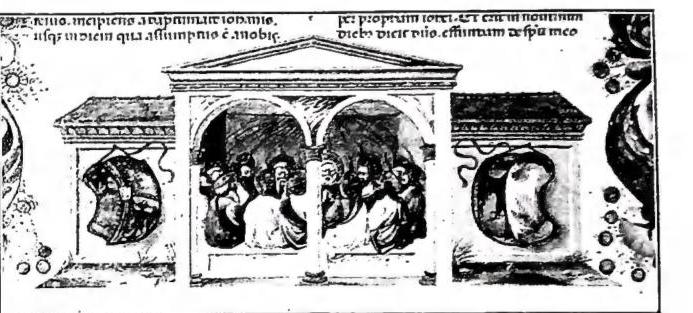
PENTECOST - Descent of the Holy Spirit upon the Apostles, Miniature in the Incipit of the Acts of the Apostles. Bible of Borso d’Este, II, I, 215° (1433-61) - Modena, Biblioteca Estense.
The following are noteworthy: 1) the sequence Veni Sancte Spiritus, an authentic masterpiece, definitively introduced into the Roman Missal by s. Pio V (1570); previously attributed to King Roberto il Pio or to Innocent III, it has instead been claimed for Card. Stefano di Langton, Archbishop of Canterbury (1207-28), on the testimony of a contemporary (cf. J. B. Pitra, Spicilegium solesmense, III, Paris 1855, p. 130; P. H. Thurston, Notes sur les prières les plus usitées, IV. Le Veni S. Spiritus du card. Langton, in Rev. du clergé français, 21 [1915], vol. LXXXIV, pp. 208-24). The Ordo Romanus XIII (n. 26: PL 78, 1120) and many manuscript and printed missals, including the editio princeps of the Missale Romanum (Milan 1474: ed. R. Lippe, London 1899, pp. 240-41), which also contains the Veni S. Spiritus, instead have for P. the sequence Sancti Spiritus adsit nobis gratia (cf. U. Chevalier, Repertorium Hymnologicum, II, Louvain 1897, n. 18557), composed by the monk Notker the Stammerer and clothed in a splendid Gregorian melody; 2) the Preface, one of the finest liturgical compositions in the Roman Missal: it comes from the Gregorian Sacramentary, but the first period already formed part of a Preface for the Vigil Mass of P. in the Leonine and ancient Gelasian Sacramentaries. Exceptionally, at the hour of Terce, instead of the customary Ambrosian hymn, the Veni Creator is recited, in order to recall more directly the hour of the descent of the Holy Spirit upon the Apostles.
4. The octave
The Apostolic Constitutions mentioned above (V, 20, 14) refer to the festive week following P., a custom subsequently adopted also in the West, as attested, for example, by canon 36 of the Synod of Mainz of 813, which strongly urges its observance (ed. A. Werminghoff, ed. cit., II, 1, p. 270), and by the list of obligatory feasts observed at Bologna in the ninth century (« Sabbato Pentecoste venerabiliter celebretur sicut diem sanctum resurrectionis, II, III, IIII, V, VI et sabbatum post pentecostum a mane usque ad missa », ed. G. Morin, in Rev. bénéd. 19 [1902], p. 354). In the course of time this custom declined, to such an extent that the Synod of Constance of 1094 (Mansi, XX, 795-96) had to content itself with restoring it only in part, prescribing that the feast days at Easter and P. be limited to the first three days of the week; but even this partial restoration of the precept was not observed for long. As for the octave, which concludes with None on Saturday, it was not known at Rome in the time of s. Leone Magno, who speaks only of the fasts of the Summer Ember Days. Despite the « orationes ad vespers infra octavas Pentecostes » of the ancient Gelasian, the liturgical organization of the week of P., including the three fast days of the Summer Ember Days, is due to s. Gregorio Magno (cf. Egberto di York, De institutione catholica, interr. XVI, 2: PL 89, 441; cf. A. Chavasse [cited in the bibliography], pp. 75-81). During the seventh century, in order to remove the fast from the octave of P., it was decided to transfer it, at Rome and in various other Churches, to the week of the third or fourth Sunday after P.; but Gregorio VII restored the « aestivale ieiunium » to the octave of P. (cf. Micrologus, 25: PL 151, 997).5. The Sundays after P
Although Book III of the ancient Gelasian Sacramentary (ed. cit., pp. 224-33) contains, without any particular indication, a compact group of 16 Sundays, whose formularies are subsequently found on Sundays V-XX after P. in the ancient Roman liturgical books and in the present Roman Missal, the organization of the Sundays after P. is due to s. Gregorio Magno, who distributed them in this manner: « post Pentecosten », at most 5; « post Nat. Apostolorum », 6; « post Sci Laurentii », 5; « post Sci Cipriani », 7 (or also « post Sci Angeli », that is, s. Michele). The numbering from 1 to 24, in use today, derives from the Gelasian Sacramentary of the eighth century. Since lack of space prevents us from studying the formularies assigned to these Sundays, some of them truly splendid, the relevant treatments by De Puniet, Schmidt, and Chavasse, as well as the studies mentioned in their bibliographies, should be consulted. It is worth observing, however, that in the overall composition of these formularies there is no discernible concern to expound a systematic concept. Finally, attention may be drawn to a peculiarity that can serve to identify manuscript missals: the series of alleluiatic verses for the Sundays after P. in missals prior to 1570 varies from Church to Church; nevertheless, from the tenth to the sixteenth century they remain constant in the liturgical books of any one Church, as V. Leroquais has demonstrated admirably (Les sacramentaires et les mites mis. des Bibliothèques publ. de France, I, Paris 1924, pp. xxiv-vi). In the Byzantine liturgy, the first 14 Sundays after P. are called Sundays of s. Matteo, after the Gospel read on them; the remaining Sundays, up to our Septuagesima, are called those of s. Luca, for the same reason.6. Medieval names and symbolic customs
In medieval documents P. is called: Pascha de medio (May); Pascha militum; Pascha Pentecostes; P. collectorum (P. media was Pentecost Wednesday, while P. prima and ultima were 10 May and 13 June, the extreme dates on which P. can fall). In the later Middle Ages, the practice of symbolically representing the descent of the Holy Spirit upon the Apostles was widespread. P. accordingly also took the name Pascha rosatum, rose-colored Easter, or Easter of roses or dew, from the most common scene of this kind, which consisted in causing a rain of red roses or burning tufts of tow to descend from the upper part of the church, in memory of the tongues of fire that descended upon the Apostles in the Cenacle. At Rome this symbolic rain took place on the Sunday preceding P., « la dominica de rosa », in the stational church of S. Maria ad Martyres, while the Pope spoke from the ambo to the people about the approaching solemnity of P.; at that moment, from the top of the oculus of the rotunda, « rosse in figura eiusdem Spiritus Sancti » were thrown down, as attested in the twelfth century by the Ordo Romanus XI of Benedetto canonico (n. 61: PL 78, 1049; ed. L. Duchesne, vol. 157). At Bayeux, while the sequence Sancti Spiritus adsit nobis gratia was sung, flowers of seven different fragrances were dropped from the vault of the Cathedral to recall the Seven Gifts. Elsewhere, during the singing of the Epistle, the sound of the violent wind mentioned in the sacred text was imitated and trumpets were blown. While the Veni creator was sung, candles were lit and bells were rung, while seven priests vested in chasubles, carrying lit and perfumed thuribles, stood with the bishop at the foot of the altar. In other churches, such as, for example, the basilica of S. Pietro and at Orvieto (where the custom is still alive; for a century now, the ceremony of the palombella has taken place in the churchyard; the little dove traverses the aerial path marked out by the rope amid the firing of « mille scoppi »), doves or birds were released during the celebration of Mass. Where these were lacking, a wooden dove with a host in its beak was lowered onto the altar.For representations of P. in art
V. SPIRITO SANTO
Vedi tav. LXXVIII.1939, pp. 151, 170-71; M. Righetti, Storia liturgica, II, Milano 1946, pp. 209-19; J. A. Jungmann, Pfingstokten u. Kirchbonnse in der römischen Liturgie, in Miscellanea lit. in honorem L. C. Mahlberg, I, Roma 1948, pp. 169-82; H. Schmidt, Die Sonntage nach Pfingsten in den römischen Sakramentaren, ibid., pp. 451-93 (con ampia bibl. precedente; da tener presente le osservazioni di dom B. Botte, in Les questions liturgiques et paroissiales, 31 [1950], n. 411 e del Chavasse); id., De lectionibus soriantibus in formulis identicis sacramentariorum Leoniani, Gelasiani et Gregoriani, in Sacris erudiri, 4 (1952), pp. 100-73 (le formule per la P. a pp. 160-61); P. Bruylants, Les oraisons du Misset Romain, II, Lovanio 1953 (v. indice); A. Chavasse, Les plus anciens types du lectionnaire et de l'antiphonaire romains de la Messe, in Rev. bénédictine, 62 (1952), pp. 3-94. A. Pietro Frutza