
TALMUD (talmūdh “study”). — A great corpus of rabbinic traditions, consisting of the development undergone by the Mišnāh (v.) in the ensuing centuries. The majority of the mišnic tractates are developed in the discussion, called gēmārd, conducted by amorei (v.), who discussed the various legal texts in the periodic sessions of the talmudic academies.
The talmudic academies were called jēšibhōth (jēšibhāh originally signifying the “seat” of the master). In Palestine the most famous was located at Jamnia (Jabneh) and already existed long before A.D. 70; the Palestinian academies ceased to exist around 740. In Babylonia the most famous schools were Sūrā and Pumbēditā; they included regular students, often maintained by the head of the Academy, who received offerings for this purpose. Seventy scholars constituted the “Great Sanhedrin”; behind them sat another thirty scholars, who constituted the “Little Sanhedrin.” Subjects for discussion were proposed from time to time, and the president determined through an examination whether the students had prepared the text for study. Current legal questions were also discussed, and the definitive solution was written down. One special month was devoted to questions coming from abroad. The T. might be defined as the minutes of the sessions of the academies.
There are two recensions of the T.: the T. jērāšalmi, formerly called T. 'ēres Jīšrā'ēl, compiled in Palestine around 425; and the T. babhlī, compiled in Babylonia in the 5th century; the latter was subjected in the following saboreans (v.). The talmudic period is considered to have closed between the 6th and 7th centuries; the activity relating to legal precepts was continued by the “decisors” (v.). The doctors of the T. draw their deductions in matters of legal precepts by employing sui generis hermeneutical rules, called middōth, through which they seek to connect their deductions with the biblical text, often doing violence to II. The number of middōth varies according to the periods; they are associated with the names of three doctors: Hillēl (v.), who established 7 rules, and R. Jismā'ēl (2nd century), who established 13.
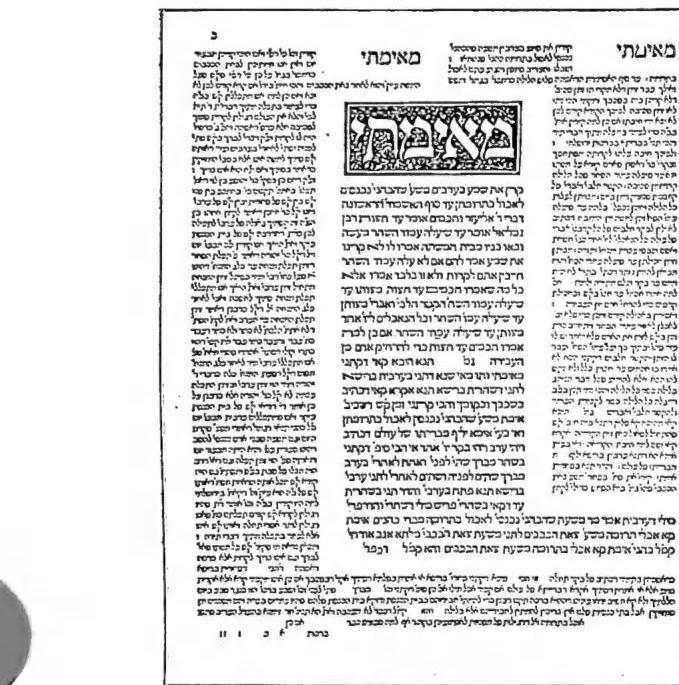
According to the opinion of the rabbis, Moses received the Tōrāh on Sinai, transmitted it to Joshua, Judges (v.), the Judges to the Prophets, and the Prophets to the men of the Great Synagogue (Abāth, 1, 1). The law received by Moses would not be only the Pentateuch, which, committed to writing, was made accessible to all peoples, but also the whole Bible, the Miñāh, and the T. (Bērābhāth, 52); the various masters merely “rediscover” the ideas and the individual norms that formed part of the patrimony given by God to Moses. The T. is intended to represent for the Jews an interest that is for the most part not merely theoretical and scholarly, but eminently practical. The language is for the most part Aramaic; there are numerous Greek and Latin words more or less transformed.