
SEQUENCES. — At first the s. was nothing more than the vocalization on the final syllable of the Alleluia of the Gradual; it was the jubilius or jubilatio, which was divided into sequentiae for the breath between pauses or for the alternation of the choirs. The vocalization was subsequently replaced by a text adaptable to the melody, and the text and its corresponding melody were called s.
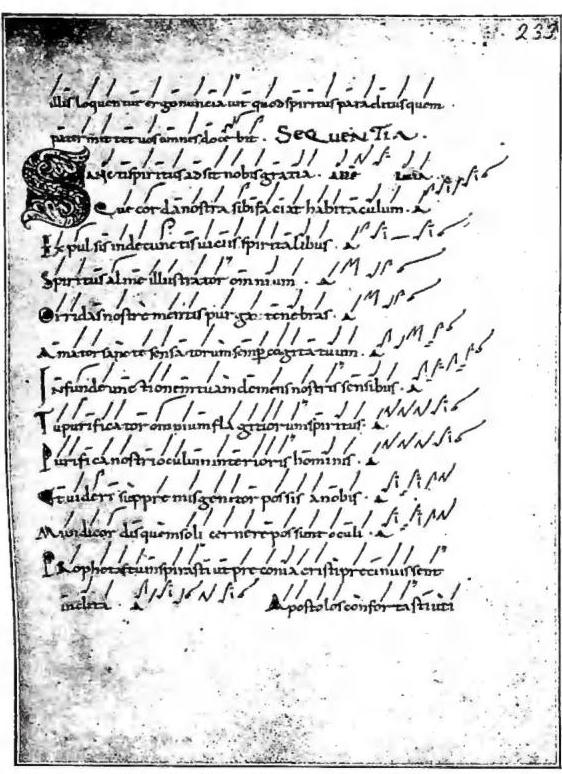
(from E. M. Bannister, Monumenti Vaticani di paleografia musicale latina, Leipzig 1912, pl. 51)
SEQUENCES - “Sancti spiritus adsit nobis gratia,” an ancient sequence for Pentecost, Gradual and troper, perhaps originating from Bologna, transcribed ca. 1936; but, neumatized, Italian notation - Rome, Bibl. Angelica 123 (B. 3, 18), f. 233f.
Some texts of sequences did not please Notker, but moved him himself to compose others along their lines and example. The first fruits of the new composition are provided by these two propositions: Laudes Deo concinat orbis universus, qui gratis est redemptus and Coluber Adae deceptor. Not only the melody of the final syllable ia of Alleluia, but also those of the two preceding syllables le and lu, were subsequently used by Notker for the insertion of the text. At first the sequence was not adorned with homophony. But in the period from the end of the tenth century to the beginning of the twelfth, it appears with frequent assonances and rhymes, and is very free in rhythm, as, for example, Vipone’s Victimae paschali. It then acquires rhythmic regularity, which may be poly-strophic, and, generally choosing a trochaic movement, clothes itself in rhyme and ultimately becomes distinct from the hymn, which is for the most part iambic, differing from it only in its gravity, proper to the solemn trochaic form, and in the melodic multiplicity of its strophes: an example is the Veni Sancte Spiritus, the golden sequence, whose authorship is now attributed, rather than to Pope Innocent III, to Stefano Langton (d. 1228). The sequences are distinguished by names often of obscure significance: they are taken from the beginning of the alleluiatic verse, as Dies sanctificatus for Christmas; from the names of instruments: organa, fedicola, symphonia; others seem to be names taken from or translated from Greek: Graeca, hypodiacontissa, Hieronyma; or from indications of popular melodies used: puella turbata, planctus pueri capti, planctus cigni, etc. The greatest writer of sequences was Adamo da S. Vittore (v.). In the earliest period the texts of the sequences and their corresponding melodies were confined to individual regions. Several periods of local production may be distinguished: the German (S. Gallo), that of northern Italy (Verona, Nonantola), the French (Limoges), and the English (Winchester). In the age of rhymed sequences, some became generally, or almost generally, used throughout Western Christendom: thus, for Christmas, Natui ante saecula; for Pentecost, Sancti Spiritus adsit; for the feast of the Apostles, Clare sanctorum; for S. Giovanni Battista, Sancti Baptistae. France and Germany were the most fertile homeland of the sequences. There were also secular ones, even satirical ones, as the Carmina Burana and the Carmina Cantabrigiensa demonstrate. The Middle Ages showed a predilection for this kind of poem, in which they expressed their profound and characteristic genius and emotions. They left more than 5,000 sequences. Before the unified reform of the Missal carried out by Pius V (1570), the liturgical year contained 150 of them. At present, 5 remain: Victimae paschali, Veni Sancte Spiritus, Lauda Sion Salvatorem, Stabat Mater, Dies irae. The last marks a characteristic final evolution: born from the Alleluia of the Mass, it appears in a Mass without an Alleluia.