Machine translation of the 1948–1954 Italian original. The original text is authoritative.
NOTKERO. – Called “Labeone” on account of his thick lips. Monk of S. Gallo, the third and most illustrious of this name, head of that famous monastic school, which he brought to its greatest splendor. Born around the middle of the 10th century, he died of the plague on 26 June 1022. He was called “nostrae memoriae hominum doctissimus”. His work consists exclusively of translations of Latin classics, especially those used as school reading.
Among the many versions he composed, noteworthy are Boethius’s Consolation of Philosophy, M. Capella’s Marriage of Philosophy and Mercury, Boethius’s commentary on Aristotle’s Categories and On Interpretation, the Psalms, the biblical book most widely read at the time and, indeed, the one from which people learned to read, with the explanations of St. Augustine, and others of lesser importance. Whether he also composed a translation of the Bucolics, Cato’s De moribus, and Terence’s Andria is nevertheless doubtful; but it is certain that some of his completed works were lost, among which there appears to have been a translation of Giobée. The method followed by N. in rendering classical texts into the vernacular constituted an extraordinary innovation in the teaching of his time. Whereas previously, that is, in the school of S. Gallo, only simple superscript or interlinear glosses had been used, N. was the first to compose com-
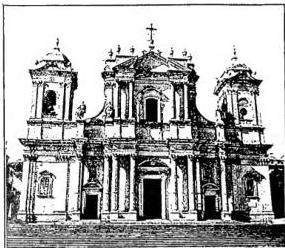
NOTO, DIOCESI di – Façade of the Cathedral (17th century). (phot. Enit)plete versions, which were at the same time explanations and elucidations of the text; thus, rather than complete translations, they may be called annotated interpretations of the Latin models in the German language. The importance of such a work lies, naturally, less in its hermeneutical value than in the philological field. An exceptionally skilled and patient student of the phonetic and morphological aspects of the German language, so that he might be called the first German grammarian after the great Rabanus Maurus, N. introduced several notable orthographic innovations, such as the accentuation of all stressed vowels—the circumflex on long vowels, the acute on short ones—and the so-called law of initial consonants, or “N.’s canon,” according to which an initial voiceless plosive (p, t, k) changes into a voiced one (b, d, g) after a word ending in a vowel or a liquid: this latter innovation, while revealing a point in the Lautverschiebung explicable according to physiological criteria, attests in N. to an extraordinary spirit of observation for that time. Because of his predilection for the vernacular, which seemed almost daring even to him when he declared that he had attempted rem paene inusitatam; because of his passionate pursuit of its purity and grammatical precision in an age when the influence of Roman culture on the spiritual life of Germany was so profound and widespread that even the themes of popular epic were clothed in Latin hexameters, it may be said that he renewed and continued the tendency of the Carolingian age, and thus quite rightly received from posterity the title of “Teutonicus.” Unfortunately, in this work he remained solitary, and found no successors even among his best disciples.
BIBL.: P. Hoffmann, Die Mischprosa Notkers des Deutschen, Berlin 1909; Manitius, II, pp. 694-9; G. Ehrismann, Geschichte der deutschen Literatur, II, 2nd ed., Munich 1932, pp. 416-58. Bruno Vignola
Cite this article
“NOTKERO.” Enciclopedia Cattolica, vol. VIII (1952), p. 1144. Azione Romana digital edition, https://azioneromana.com/article/notkero.