
SAN GALLO. — City and diocese of Switzerland, capital of the canton of the same name. The diocese also includes the two cantons of Appenzell.
It has an area of approximately 2,420 sq. km., with a population of 344,340 inhabitants, of whom 188,553 are Catholics, distributed among 133 parishes served by 341 diocesan priests and 145 religious priests; it has one seminary, 12 male and 31 female religious communities (Ann. Pont. 1952, p. 353).
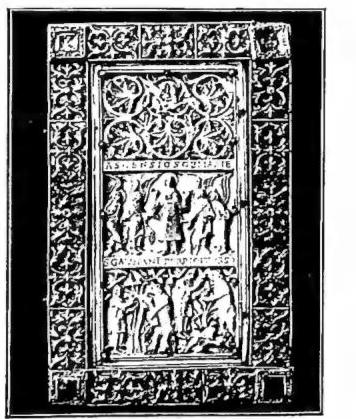
S. Gallo arrived with s. Columbanus on the south-western shores of Lake Constance, at the castrum Arbonae, north of modern-day S. G. While, after smashing the idols, s. Columbanus erected a chapel in honour of s. Aurelia, s. Gallo chose his hermitage between the two rivers Steinach and Reuss, in the place called Hinchinberg, where around 613 the monastery arose in which the Rule of s. Columbanus was adopted. S. Gallo died there on 16 October 627 and was buried in the Oratory. His life was written by Wettin and later, in the 11th century, by Valafredus Strabo of Reichenau. Abbot Otmar, who governed the monastery from 720 to 759, introduced the Rule of s. Benedict there; Abbot Gotbert, following a design by Lotur, bishop of Toul (813-46), began the reconstruction of the monastery in 829, completed in 841, and organized its Library. In the 10th century the monks sang the Gloria and the Pater in Greek and Latin (cf. S. Beissel, Geschichte der Evangelienbücher in der ersten Hälfte des Mittelalters, Freiburg im Breisgau 1906, p. 77). Under Frederick Barbarossa the abbot became a prince of the Empire, and the abbey was consequently transformed into an ecclesiastical principality, which gradually enlarged its boundaries but was already moving toward decline in the 13th century. Its Library was remarkable for the wealth represented by the number of illuminated manuscripts: Bibles, liturgical books, martyrologies, sacramentaries, antiphonaries, lectionaries, and breviaries. Among the most precious are those with miniatures of the Irish school; also the Psalterium quadruplex of Solomon III (891-920), and the Psalterium aureum in uncial script (J. Rud Rahn, Das psalterium aureum von S. Gallen, St. Gallen 1878). The most flourishing period of the scriptorium was under Abbots Bernwick and Engelbert I and lasted from the 9th century to the middle of the 11th: magnificent Carolingian codices from this period are preserved (v.). However, already in the 13th century (there are no examples from the earlier period) the scriptorium had been extremely active and had produced a type of pre-Carolingian script with rounded, regular letters, but harsh in execution owing to Irish influence: indeed, some S. G. codices are written in Insular script (cf. K. Löffler, in Palaeographia lat., 6 [1929], pp. 5-66; id., in Neue Heidelberger Jahrb., 1937, pp. 28-54). Under Abbot Hartmann (921-24), Greek monks were also members of the community. Abbot Artmut (872-73) enriched the monastery with manuscripts, including a psalter; under Abbot Solomon III there appeared the Vocabolarium Salomonis and the two ivory tablets, Evangelium longum; the monk Tutilo made ivory bindings (in the 17th century there was also a printing press established by Abbot P. Reher). During the time of Engelbert II (924-33), owing to the threat of the Magyar invasion, the Library was taken to safety at Reichenau, but not all the finest codices returned; later it suffered from Protestant looting; another sack took place in 1728; in 1797 it was sent to Meherereau to protect it from French plundering, and it returned there in 1804.
Distinguished teachers in the abbey included: Moengallus, Iso, Radpert, and Notker the Stammerer (d. 912), who composed sequences and sacred hymns; Abbot Eckart IV, author of the Casus S. Galli; and outstanding librarians Luitard (861-72), Uto (862), Notker I (890), Waldram (beginning of the 10th century), Ulrich VIII (1463-91), and Peter of Gaisberg (1504-29). In 1804 the abbey was secularized and the principality abolished; in 1805 the monks were expelled; the last abbot was P. Voster, who died in 1829 at the abbey of Muri. Following the agreements between the bishop of Constance and the abbot of S. G. (1613, 1748, and 1814), Pope Pius VII, with the bull Ecclesias of 2 July 1823, created the diocese of S. G., united aeque principaliter with the diocese of Chur, and its first bishop was Msgr. Carlo Schauenstein. After his death, however, an apostolic vicar was appointed in the person of Msgr. G. P. Mirer, who was elected bishop on 10 October 1846 and saw the diocese canonically erected on 8 April 1847.
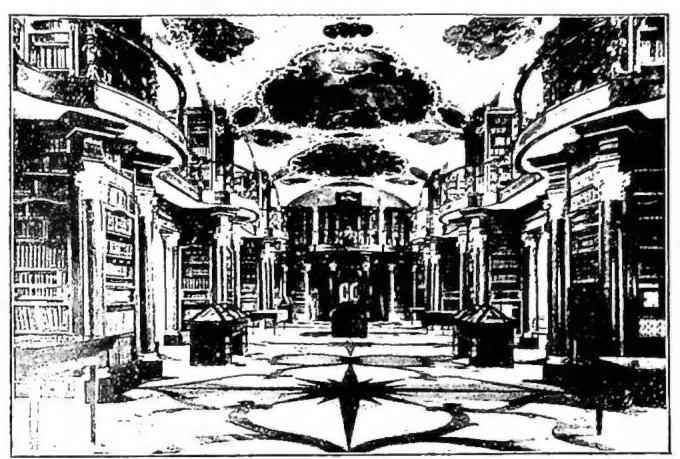
In the Cathedral building, four periods can be distinguished: the first, after approximately 820, attributable to Abbot Eito of Reichenau, with a double choir and crypt; the second, under Abbot Gotbert, with the church of S. Otmar (9th century), modified in the 11th century; the third, under Abbot Norbert, with the church of S. Michael (11th century), and subsequently the present Cathedral, the work of Celestine II Gugger von Standbach (1755–67), at which time the other monastic buildings were also modified. - Vedi tav. CXI.