
MARTYROLOGY. – A catalogue of martyrs and saints arranged according to the order of their feasts.
SUMMARY:
I. Concept
II. Primitive nucleus of the M.: calendars. –III. General M
IV. Historical M
V. Martyrologium Romanum. –VI. Insertion of new eulogies into the M
VII. Liturgical use.### I. CONCEPT.
1. Definition. – According to its etymology (μάρτυρ = witness, martyr; λόγος = discourse), a martyrology signifies a narrative concerning martyrs (cf. canon 63 of the Sixth Council of Constantinople, 680–81; Mansi, XI, 972; G. Penco, Note sui M., in Rivista liturgica, 38 [1951], 22–25, suggests that M. originally denoted collections of martyrs reported by direct witnesses). Indeed, martyrs formed the primitive nucleus of the martyrology. When bishops, confessores, the dedicatio, and the conditores Ecclesiae subsequently entered the martyrology, and thus every liturgical celebration on a fixed date, the concept of martyrology took on an increasingly broad meaning. In its current state, following H. Quentin (Les martyrologes historiques du moyen âge, Paris 1908, p. 1), a martyrology may be defined as: «the book of anniversaries of martyrs and, by extension, of saints in general, of mysteries and events that are the object of an annual commemoration in the Church». According to its present meaning, the term martyrology closely corresponds to that of synaxarion among the Greeks (cf. H. Delehaye, Synaxarium Eccl. Constant., Brussels 1902, pp. II–V).
2. Division. – Considering purely external form, two categories of martyrologies may be distinguished: those that limit themselves to listing under certain dates one or more names of saints, with or without topographical indication (martyrologies or, better, calendars), and those that additionally contain hagiographic narratives or particulars (historical martyrologies). Taking into account, instead, the factor of formation, martyrologies are distinguished into local and general. The former provide the catalogue of feasts of a particular Church or group of Churches (e.g., the Philocalian Calendar and the Calendar of Carthage); the latter, such as the Martyrologium Hieronymianum, result from the combination of various local martyrologies. The territory to which they extend may be a province, a region, half of the Empire, or the entire Christian world. From general martyrologies, with the development of laterculi, derived the historical martyrologies, so dear to the Middle Ages, which form the foundation of the present Martyrologium Romanum.
### II. PRIMITIVE NUCLEUS OF THE MARTYROLOGY: CALENDARS.
1. Origin and formation. – Calendars originated from the cult of martyrs. By the mid-2nd century, Smyrna celebrated the anniversary of St. Polycarp (Martyrium Polycarpi, XVIII, 2; F. X. Funk, Opera patrum apostol., I, Tübingen 1881, p. 303); in Africa, the practice is attested by Tertullian (d. 222: Habes [christianae] tuos; De corona, ch. 13; PL 2, 96) and by St. Cyprian (d. 258), who, in addition to martyrs, recommends noting the confessores, heroes of the faith who, though they did not shed blood, in merit and veneration are equated after death to true martyres (Cyprian, Epist., 37, 2: PL 4, 328; cf. St. Gregory, Ad episc. Alexandriae [a. 598], in MGH, Epistolae, II, p. 28). Thus arose the need to firmly fix the dates of various recurrences, giving birth to the calendar in its simplest form and structure: day and name of the saint, and for cities like Rome, where multiple coemeteria existed, also the indication of the place of the synaxis. The calendar is, therefore, a document of liturgical character.
Five elements contributed to the formation of the calendar: 1) the anniversaria martyrum, that is, their dies natalis or natalicium (day of death or «birth» into heaven), the depositio (day of burial), the memoria (remembrance of the martyr), and finally the translatio of relics. 2) The anniversaria episcoporum. It was natural for Christian communities to piously preserve the burial date of their fathers in the faith and to inscribe them in the annals of their Church. In Rome, martyres and episcopi are listed in a double register. Sozomen speaks of two distinct lists for the cities of Gaza and Maluma, which, even after their fusion into a single see under Julian (361–63), continued to separately celebrate the dies festos of their own martyrs and the commemoraciones of bishops (Hist. eccl., V, 3: PG 67, 1222). These two distinct catalogues, however, did not endure long and eventually merged. An indication of this may be seen in the mutual relation between the two Roman depositiones, where Pope Sixtus II is not remembered in the depositio episcoporum because he is already listed among the martyrs. A clearer trace is found in the title of the Calendar of Carthage (4th century): Hic continentur dies natalicium martyrum, et depositiones episcoporum, quae Ecclesia Cartagenis anniversaria celebrant. 3) The dedicatio Ecclesiae: an element introduced in the 4th century. The earliest testimony is found in the Peregrinatio of Egeria (4th century) for the dedication of the basilica on Golgotha: Dies encaeniarum appellantur quando sancta Ecclesia quae in Golgotha est, quam martyrium vocant, conscruta est Deo. The anniversary of the dedicatio entered the calendar either with a clear indication of the dedication or, more often, as the feast of the titular saint. 4) Memoria of the conditor ecclesiae and benefactors. In the oldest documents, the name of the founder is generally followed by the expression tituli conditor, which serves to identify him. Thus, in the Martyrologium Hieronymianum on 14 August: Ensebii tituli conditoris. More often, however, this indication is lacking, increasing the difficulty of distinguishing the conditor from a saint. 5) The confessores. Once persecutions ceased, when confessor, from hero of the faith (martyr without bloodshed), came to denote the hero of virtue (= spiritual martyrdom = asceticism), and confessores found a place in the liturgy, local calendars fixed their names in their annals, thus completing the series of fundamental elements of the liturgical calendar.
2. Principal calendars. – a) Chronographer of 354. – Furius Dionysius Philocalus (v.), lapicida of Pope Damasus (d. 384), compiled in 354 about ten historical-chronological documents that take his name. Among these are two lists of martyrs and popes venerated in Rome, designated by the titles Depositio martyrum and Depositio episcoporum. These two documents form a whole, the Calendar of festive recurrences of the Roman Church in the first half of the 4th century. Through these lists, the faithful of Rome were informed of the day and place in which the Church rendered official cult to a martyr. The practical purpose led to the preference for arrangement by months and days, as in analogous lists compiled for other communities. The Depositio martyrum has 24 laterculi and names 52 martyrs. It begins on 25 December: Natus Christus in Bethlehem Judaeae, and this, along with that of 22 February: Natale Petri de cathedra, are the only two feasts that constitute an «out of place» in the Calendar, where only feasts of martyrs are listed. This observation led De Rossi, followed by Mommsen and others, to designate the Depositio as feriale ecclesiae Romanae. It commemorates martyrs of Rome, Africa, Albano, and Porto not earlier than the 3rd century. The oldest Roman name of certain date is Pope Callixtus (d. 223); among non-Romans, Perpetua and Felicitas (d. 203). The Depositio episcoporum contains the list of bishops of Rome from
of ecclesiastical metropolis. The list is arranged by months and days, with the name of the saint or feast in the genitive, followed by the indication of the church or monastery where the celebration took place. The calendar reflects the liturgical practice of the Coptic Church, with a strong emphasis on local saints and martyrs. Among the notable entries are the feasts of St. George (23 Pharmouthi), St. Menas (15 Hathyr), and the Nativity of Christ (29 Khoiak). The presence of numerous monastic foundations suggests the importance of monasticism in the religious life of Ossirino. The calendar also includes several biblical feasts, such as the Annunciation and the Epiphany, as well as the commemoration of the martyrs of Persia and other Eastern saints. The document is of great value for the study of the liturgical calendar in Egypt during the early Byzantine period (cf. B. P. Grenfell and A. S. Hunt, The Oxyrhynchus Papyri, XI, London 1915, pp. 137-44; H. Delehaye, Les origines du culte des martyrs, Brussels 1933, pp. 263-65).
BIBL.:
- For the Depositio martyrum and Depositio episcoporum: R. Valentini e G. Zucchetti, Codice topografico della Città di Roma, I, Roma 1942; C. Kirch, Enchiridion fontium hist. eccl., Friburgo in Br., nn. 543-44; L. Duchesne, Liber Pontificalis, I, Paris 1886, pp. CLXXI-CLXXIII; Id., Origines du culte chrétien, Paris 1920, pp. 265-75.
- For the Calendario di Cartagine: J. Mabillon, Vetera analecta, III, Paris 1682; L. Duchesne, Martyr. Hieronymianum, in Acta Sanctorum, Nov. II, 1, Brussels 1894, pp. LXX-LXXI; H. Leclercq, Cartage, in DACL, II, 2, cols. 2445-50; P. Monceaux, Histoire littéraire de l'Afrique chrétienne, I, Paris 1901, pp. 151-55.
- For the Calendario di Carmona: H. Delehaye, Le Calendrier lapidaire de Carmona, in Anal. boll., 31 (1912), pp. 319-21; J. Vives, Inscripciones cristianas de la España romana y visigoda, Barcelona 1942.
- For the Calendario di Napoli: D. Mallardo, Il Calendario marmoreo di Napoli, Roma 1947; A. Ferrua, Note sul testo del « Calendario Marmoreo » di Napoli, in Miscellanea Mohlberg, I, Roma 1948, pp. 135-67; H. Delehaye, Les origines du culte des martyrs, Brussels 1933, pp. 257-62.
- For other Western calendars: H. A. Wilson, The Calendar of st. Willibrord, London 1918; G. Morin, Les quatre plus anciens calendriers du Mont Cassin (VIIe et IXe siècle), in Rev. bénéd., 25 (1908), pp. 486-97; D. Férotin, Le liber Ordinum en usage dans l'Église visigothique et mozarabe d'Espagne du Ve siècle, Paris 1904; Id., Liber comicus sive lectionarius Missae quo Toletana ecclesia ante annos mille et ducentos utebatur, Maredsous 1893.
- For the Calendario d'Ossirino: B. P. Grenfell and A. S. Hunt, The Oxyrhynchus Papyri, XI, London 1915; H. Delehaye, Les origines du culte des martyrs, Brussels 1933.
A. Amore
g) Calendars of Alexandria and Antioch. These are reconstructions: the first by N. Nilles (Calendrier de l'Église copte d'Alexandrie, in Revue de l'Orient chrét., 2 [1897], pp. 307-39; DACL, VIII, cols. 654-57), which provides an approximate idea of what the Calendar of the Church of Alexandria might have been at the beginning of the 6th century. The second was attempted, with less success, by A. Baumstark for the Church of Antioch (Das Kirchenjahr in Antiochia zwischen 512 und 558, in Römische Quartalschrift, 12 [1898], pp. 31-65; 13 [1899], pp. 305-23).
h) Gothic Calendar. — A simple fragment containing a list of feasts from October 23 to November 30, preserved in a manuscript of the Ambrosiana (Ambrosiana AS. 36 sup.). A local calendar, brought from Thrace by the Ostrogoths, similar to the Chronographer of 354. Of 38 days, 31 are blank, and the remaining seven are occupied by anniversaries of interest to the Goths. The Arian profession of faith is evident in the selection; however, the Calendar is a translation of a Greek exemplar (DACL, VIII, cols. 658-61).
III. GENERAL MARTYROLOGIES
From Calendars to general Martyrologies, as has been seen, the step is brief. The oldest representative is the:1. Syriac Martyrology
The manuscript (British Museum ms. add. 12150, fol. 251v-254v) is dated from Edessa (Mesopotamia), month of Tishri II, year 723, corresponding to November 411. However, this is only the date of the translation into Syriac; the Greek original, according to Nau, would have been nothing other than the Martyrology of Nicomedia between ca. 360 and 411.The work has a private character, and the Syriac translation is quite unfortunate. The copyist sometimes abbreviated the original, sometimes expanded it or mixed it with other calendars; for the entire month of July, only three feasts remain, added later.
The title reads: Names of our lords (cf. the medieval domus) martyrs (Syr. mandajá, i.e., "confessors," in the original sense) and victors, with the days on which they attained the crown. The names of the saints follow, divided into two classes: the first with the martyrs of the Roman Empire and the indication of the month and day from 26 Dec. to 23 Nov.; the second with the saints of Babylon and Persia, grouped in a triple series according to hierarchical order: bishops, priests, deacons, without regard to the Calendar and without indication of anniversary. The first list is separated from the second by the rubric: Here end the confessors of the We-
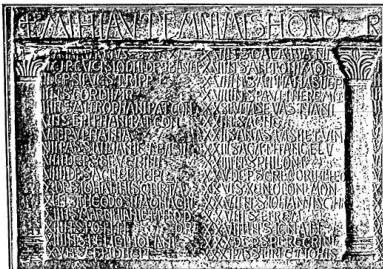
MARTYROLOGY - Month of January from the Marble Calendar of Naples (9th century) - Naples, Archiepiscopal Palace.
of the West (in relation to the province of Osroene, except for Nisibis and Edessa).
The importance of the Syriac M. lies in its antiquity, its universality, and its close relations with the Hieronymian M. It is not certain that Eusebius composed a catalogue of martyrs, but the Syriac might precisely constitute the onomastic index, in chronological order, of works dedicated by Eusebius to the martyrs, now lost. Among these was a "collection of ancient martyrs," an expression that recurs 11 times in the Syriac. It is also symptomatic that in the codex it immediately follows Eusebius's De martyribus Palaestinae. Without doubt, the author made use of Eusebian works, but with additions and interpolations made by himself or others before the manuscript was translated into Syriac (H. Achelis, Die Martyrologien, Berlin 1900, p. 61). Eusebius himself is listed there on May 30. The compiler also drew upon the calendars of various Churches: this explains why many regions and cities of the Roman Empire are represented: Rome, Africa, Illyricum, Thrace, Greece, Scythia, almost all the provinces of Asia Minor, often Antioch and Caesarea of Palestine, Cilicia, Egypt. V. de Buck was the first to note the close kinship between the Syriac and the Hieronymian (Acta SS. Octobris, XII, 185). According to him, this would be explained by the fact that the Frankish redactor of the Hieronymian had before him a Latin translation of the Syriac Menologion; Duchesne, however, believes that the Syriac is an abridgment of the Hieronymian for the part concerning the Roman Empire. It is certain that the Syriac is entirely included in the Hieronymian. One need only glance at the comparative tables of De Rossi-Duchesne (Martyrologium Hieronymianum, pp. LII-LXV). The entry for June 6: Alexandriae, presbyter Arius led Duchesne to conjecture that the M. was of Arian origin. The idea was taken up by K.A.H. Kellner (L'anno ecclesiastico e le feste dei santi, Rome 1906), who devoted an entire chapter to the Syriac, pp. 302-311 (Il Calendario santorale ariano del IV sec.). It does not seem that this rests on solid ground (Cf. F. Nau, op. cit.: PO 10, 9 note 3). The name of Arius was common in the East and may refer not to the heretic but to a namesake, perhaps a martyr (F. Nau, ibid., 10, 17, note to July 6).
2. Hieronymian M
a) Origin. - The archetype of the Syriac M. (4th century) was the principal source of the so-called Hieronymian M. In the first half of the 5th century, that Greek text was translated into Latin by a clericus of Upper Italy and combined with Western documents of the same nature.The name Hieronymian arose from the two letters that head the work. In the first, the two Venetian bishops, Chromatius and Heliodorus, ask St. Jerome to make an extract from the famosissimum feriale of Eusebius and send them the list of the feasts of the martyrs. In the second, St. Jerome replies that the names are so numerous (from 500 to 800 per day) that he is forced to send only the small collection that follows. But critics unanimously deny its authenticity. The unknown clericus used Jerome's name to lend authority to his work (cf. Duchesne, Martyrologium Hieronymianum, in Acta SS. Novembris, II, Prolegomena, p. 1).
The Hieronymian remains a precious anonymous work. That the compiler lived in the region between Milan and Aquileia seems beyond doubt, among other reasons, for his perfect knowledge of the bishops of the 4th and 5th centuries, so much so that Achelis unhesitatingly assigns its origin to Aquileia. As for the sources, Duchesne indicates three principal ones: a) the Roman Chronographer of 354, which provided all that appears under the rubric Romae (cf. A. Urbain, Ein Martyrologium der christlichen Gemeinde zu Rom am Anfang des V. Jahrhunderts, Leipzig 1901); b) the Eastern M., which gives information up to the middle of the 5th century (the anniversary of the death of Simeon Stylites, who died in 459, is recorded); c) a general African M. of the 4th century, which supplied the names listed under the rubric in Africa, names and groups belonging to that region.
2) The recensio Italica had been prepared for liturgical use and more precisely to be read every day at Mass, as a supplement to the diptychs. It is not known whether it was ever used in the liturgy; in the course of the 6th century, the Hieronymian M. is found as a book of edification in monasteries. In 541, Cassiodorus (d. 562) recommends it to his monks (De inst. divin. lect., cap. 32: PL 70, 1147). In 598, St. Gregory the Great clearly speaks of it in a letter to Eulogius, Patriarch of Alexandria (Ep., I. VIII, cap. 29: PL 77, 931). 3) The recensio Gallicana. In the 7th-8th centuries, the Hieronymian M. completely disappeared from the Churches of Italy. Fortunately, toward the end of the 6th century (before 603), it entered Gaul and first at Auxerre. All other manuscripts derive from the one at Auxerre. The need for local adaptations led to additions that have allowed scholars to trace the various stages followed by the manuscripts beyond the Alps. The documents have been grouped into families according to their additional characteristics. Duchesne (Les sources du Martyrologe hiéronymien, in Mélanges d'archéol. et d'hist., 5 [1885], pp. 149-50) distinguishes three: 1. family: Echternach (Bibliothèque nationale de Paris, ms. lat. 10837). The manuscript seems to have been written by a companion of St. Willibrord, founder of Echternach. It represents the state of the Hieronymian at the beginning of the 7th century. It already contains several lists of French saints, especially from Lyon, Autun, and Auxerre. 2. family: Bern (Bibliothèque de Berne, ms. 289). The manuscript dates from the end of the 8th century and was written for a monastery in Metz. The exemplar from which it derives had been made for Bourges, as shown by the proper feasts of that Church. The Bern manuscript is closely related to the fragment of Lorsch (Vat. Palat. 238), from the 8th or 9th century, which adds some historical notes taken from the acts of the martyrs. 3. family, characterized by church dedications and numerous French saints of the 7th century, includes the M. of western France (Neustria), the Corbeiense (Bibliothèque nationale de Paris, ms. lat. 12410) from the beginning of the 12th century, with particular feasts of Corbie, Amiens, and neighboring regions, as well as three bishops of Évreux; the Senonense (half in the Bibliothèque nationale de Paris, ms. nouv. acq. lat. 1604, half in the Vatican, Reg. 567), a fragment from the 10th century with proper saints of Bayeux and Avranches; the subfamily of Fontenelle (archetype written there before 756), represented by the manuscript of Wolfenbüttel (Weissenburg collection) written in 772, and by the two manuscripts of Lucca (Biblioteca Capitolare n. 618 and Biblioteca Comunale n. 428). The latter was used by Fiorentini for his edition.
b) Content. - After the two apocryphal letters, the Hieronymian presents an index of the feasts of the Apostles scattered throughout the M.: SS. Peter and Paul (June 29), St. Andrew (November 30), St. Philip (alone, May 1), St. Thomas (December 21), St. James (July 25), St. Bartholomew (August 24), St. Matthew (September 21), SS. Simon and Jude (October 28); St. Paul is mentioned three times: on January 25, the translatio instead of the conversio, on February 8, the depositio, and on December 8, the inventio; St. James is celebrated together with St. John on December 27. On June 24, after the nativitas of St. John the Baptist, the dormitio of St. John the Evangelist is indicated.
These peculiarities, according to Duchesne, align more closely with the Gallican rite than with the Roman. The same applies to the feasts of the Lord and the Madonna. Christmas on December 25th, the Circumcision on January 1st instead of the octabas Domini as in the Roman ferial, Epiphany on January 6th, on January 18th the depositio beatae Mariae and the Cathedra S. Petri in Rome—both of Gallican origin—on February 2nd the Purification, on March 25th and 27th the Passion and Resurrection of the Lord, on May 1st the beginning of Jesus' preaching, on the 3rd the inventio S. Crucis, on August 15th the Assumption of the Blessed Virgin Mary, on September 8th the Nativity, and on September 14th the Exaltatio S. Crucis. As for the saints, a considerable number are listed for each day. The series is often concluded with a total figure indicating the omitted names, for example, on January 27th in Africa, XLIV.
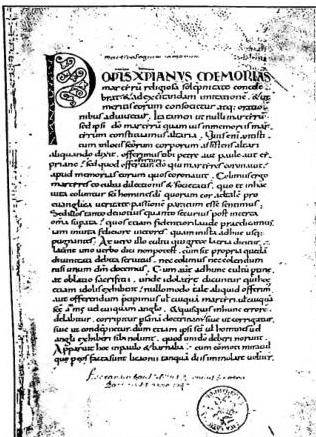
MARTYROLOGY - M. of Ado, originating from Angoulême. Vatican Library, cod. Reg. Lat. 512, f. 1° (10th-11th centuries).
of martyrs. The same occurs on 31 January, 2, 9, 17 February, 4 March, 7 May, 3 June, etc. Names are generally grouped by regions. First the East, with the generic formula "in Oriente" or with the indication of the region or city. Then the West: Africa, followed by Rome, Ravenna, Milan, and finally the cities of Gaul.
In the Bern manuscript, occasional references to passiones or historical annotations are found here and there. For example, on 27 December, St. James is given as bishop of Jerusalem and martyred during the Easter festivities. Apart from the Gallic lists, easily recognizable, the "Jeromian centon" as De Rossi calls it (Roma sotterranea, II, p. XII) exacerbates the obscurities of local or general M., due to the ignorance of copyists who often misinterpreted the model, confused the boundaries separating one day from another, introduced bizarre readings, inserted marginal notes into the text, and, finally, due to the lack of discernment on the part of the redactor himself in utilizing the sources.
IV. HISTORICAL MARTYROLOGIES
When the Hieronymian entered liturgical use, its skeletal list of names no longer satisfied, and the laterculi were clothed with hagiographic details drawn from various ecclesiastical literary sources, but especially from the passiones, which served as a link between the Hieronymian and the so-called historical martyrologies. These can be divided into: 1. The English group; 2. The Lyonnais group; 3. Usuard’s Martyrology.1. The English Group. - The oldest representative is the Martyrology of Bede (d. 735). The manuscripts are divided into two families. The first, represented by manuscript St. Gall 451, presents no additions to the archetype; the second already contains several interpolations introduced to fill empty days. The historical notices number 114, in addition to a fair number of brief notices (especially in the second family), which reduce the empty days to 187. Bede’s sources are of three kinds: hagiographic, such as lives, passions, miracles; literary, especially Eusebius, St. Jerome, St. Gregory of Tours, the Liber Pontificalis; and the Hieronymian Martyrology, in the recension of the Epternacensis. In all, about fifty passions and a dozen ecclesiastical writers. The dates assigned to the saints are fixed with prudent discernment; they generally align with the Hieronymian, the Greek Synaxarion, and liturgical books. A summary of the Martyrology of Bede is the so-called Martyrology of d’Achéry. This is a poetic composition on a certain number of saints, published by Luc d’Achéry (d. 1685 [PL 94, 603-606]). The work is certainly of English origin; indeed, for a time it was attributed to Bede himself. It dates from the first half of the 8th century (744) and appears to be a simple obituary calendar of the Church of York or the monastery of Ripon. Two other martyrologies of lesser interest derive from the Martyrology of Bede: the Martyrology of Rabanus Maurus (d. 856: PL 110, 1122-88) and the Pseudo-Florus (PL 94, 799-1148).
2. The Lyonnais Group. - Far greater is the importance of the Lyonnais Martyrology (Bibliothèque nationale de Paris, 3879), first noted by H. Quentin. It dates from the 9th century and was used in the Velay. Essentially, it is the Martyrology of Bede, with additions and developments that reduced the empty days to 129. A significant number of Spanish saints initially suggested that it was a manuscript of Bede that had passed through Spain. A more careful examination of the documents led to the more plausible hypothesis that the redactor had before him a Spanish "passionary."
The sources are the same as those of Bede and the Hieronymian. The assignment of dates is less precise than in Bede but not arbitrary. In general, the author follows the Hieronymian and the Passiones. That the homeland of the martyrology is Lyon is evidenced by the notices of French saints, two-thirds of whom belong to that city. The composition must be placed before 866.
An important martyrology was authored by Florus (d. ca. 860), deacon of Lyon. His information is more abundant than that of his predecessors, to whose sources must be added Eusebius’ Historia ecclesiastica continued by Rufinus, St. Jerome’s De viris illustribus, Bede’s Chronica, St. Cyprian, and Cassiodorus. The recourse to sources is striking. One senses a hand skilled in ecclesiastical literature. The dates naturally depend on the sources, and when these are silent, the redactor attempts to establish them as best he can. Of the nine manuscripts containing it, six are from Lyon and date between 866 and 857. Ado (d. 875) used Florus’ martyrology to compile his own, which is preserved in many manuscripts and has had several editions (PL 123, 143-438). The notices are often very lengthy and present extensive passages taken from literary sources.
The manuscripts are divided into two large families (cf. Quentin, op. cit., pp. 466-68). The first, followed by L. Lippomano (1554), Mosander (1581 and 1586), and E. Rosweyde (1613), presents the following order: Ado’s preface, the Parum Romanum (rarely), a second preface by St. Augustine (Contra Faustum, 20, 21: PL, 42, 384), the hymn Aeterna Christi munera (not always), the first part of the martyrology (beginning with the vigil of Christmas), an extract of a prefatory poem by Florus, notes on the popes concerning the Constitutions attributed to them by the Liber Pontificalis; finally, in some manuscripts, a series of additions dedicated to bishops and saints of Vienne. The second family is simpler, consisting of St. Augustine’s preface and the text of the martyrology with additions of saints from Auxerre and Usuard’s martyrology.
From a critical standpoint, Ado’s martyrology is the most vulnerable of all historical martyrologies. For the same notice, Ado sometimes uses several sources, often adding arbitrary details. The notices taken from the New Testament, especially the Acts, are manipulated with great freedom. Concordance with the Synaxarion and the Hieronymian is no longer present; new names appear, dates are shifted, and there is a great abundance of topographical indications. In the preface, Ado claims to have also used a venerabile perantiquum martyrologium, sent from Rome to a bishop of Aquileia. This document, published in 1613 by Heribert Rosweyde (d. 1629) and called by him Parum (instead of vetus Romanum [PL 123, 143-178]), has been the subject of discussions and varying appraisals by critics. Du Sollier (Acta SS. Iunii, VI, Paris ed. 1867, pp. xviii-xxxv) and de Buck (Recherches sur les calendriers ecclésiast., Brussels 1877, p. 12) assign it to 740. De Rossi (Roma sotterranea, II, XXVII) and Achelis (Die Martyrologien, p. 112) consider it contemporary with Bede. Dufourcq (Étude sur les gesta martyrum romains, p. 372) places it in the first half of the 7th century (608-58). Duchesne dates it between the end of the 8th and the beginning of the 9th century (Lib. Pont., I, p. CXXVI). Quentin considers it a composition posterior to 848 (Les martyrologes historiques, p. 410). The Parum Romanum contains 525 laterculi, of which 120 are original, and the rest derived from Florus. Of these, the redactor of the Parum shifted 51, most often to fill empty days.
The author draws on the literary sources of his predecessors but clearly aims to push back the dates when dealing with Roman saints and to avoid saints who are too recent or of local character, so as not to detract from the ancient and Roman appearance of the martyrology. Finally, Quentin (op. cit., pp. 654-63) has demonstrated that the Parum is an Adonian composition, passed off by the author as ancient, probably to lend greater credibility to the assertions of his major work and to overshadow all competitors. One need only compare the narratives of the passiones, the manner of using ecclesiastical writers, and the changes of date in the two documents. The Parum is therefore "false," and Ado’s work loses value; his martyrology is nothing more than an expanded reworking of Florus’ martyrology, composed in Lyon (as evidenced by the numerous references to that city) in the decade 850-859. From Ado derive the martyrologies of Usuard and Notker Balbulus, monk of St. Gall (d. 912), the Farfa Martyrology (11th century, edited by A. I. Schuster, in Revue bénédictine, 36 [1909], p. 433 ff.), Hermannus Contractus (d. 1054), and the Adonian recension used by Mabillon and Giorgi (1745).
BIBL.:
H. Quentin, Les martyrologes historiques du Moyen Âge, Paris 1908; L. Duchesne, Origines du culte chrétien, Paris 1909; H. Delehaye, Commentarius perpetuus in Martyrologium Hieronymianum, Bruxelles 1931; J. Dubois, Les martyrologes du Moyen Âge latin, Turnhout 1978; V. ADONE; V. BEDA; V. FLORO; V. USUARDO.
A. Amore
3. Martyrology of Usuard. - In a letter to Emperor Charles the Bald (875-77), Usuard, a Benedictine of Saint-Germain-des-Prés (d. 877), states that he was induced to compile his Martyrology to correct what he found imperfect in others; the redaction therefore dates to around 875, that is, shortly after Ado’s work. With him, the historical Martyrology reaches its perfection: it no longer has empty days, as in Bede and Florus, nor prolixity, as in Ado; the number of saints rises from 800 (Ado) to 1,170, of whom 300 are simply mentioned, the rest with reduced notices. Usuard claims to have taken all his information from the Martyrologium Hieronymianum, from Bede, and from Florus. The latter has raised difficulties because, in fact, Usuard refers to Ado’s Martyrology, not to Florus’s. Quentin believes that the expression should be understood in the sense that Usuard abridges and completes the text of Ado’s edition, in some way returning to Florus’s edition, from which Ado depends.
The Martyrology of Usuard enjoyed wide and rapid diffusion, which increased with the invention of printing. In 1475, the great edition of Lübeck appeared, followed five years later (1480) by that of Utrecht. The Martyrologium secundum morem Romanae curiae, printed in Paris (1521) by the Augustinian Belino of Padua, was nothing more than a corrected Usuardian Martyrology. By the end of the 16th century, it was adopted in almost all churches, including the Roman basilicas. In 1568, the splendid edition by Jean Molanus appeared in Louvain under the title: Usuardi martyrologium quo Romana ecclesia ac permultae aliae utuntur. The Martyrology of Usuard revised by Francesco of Messina (d. 1575), widely circulated in the 16th century, was instead prohibited for public and private reading due to arbitrary alterations of the text (G. Mercati, Lettera del card. Santoro). The Martyrologium sanctae Romanae ecclesiae usui in singulos anni dies accomodatum auctore Galesino (Milan 1578) was riddled with errors.
V. « MARTYROLOGIUM ROMANUM ». - In 1580, Gregory XIII entrusted Cardinal Guglielmo Sirleto (1514-85) with the task of preparing an edition of the Roman Martyrology. The specially appointed commission included Silvio Antoniano (d. 1603), Cesare Baronio (d. 1607), who played the principal role, Lodovico de Torres, Luigi Giglio (Lilius), who composed the tabella temporaria, the explicatio... ad pronuntiationem lunae, and the table of letters at the head of each day, Pietro Chacón (d. 1581), a Toledan and former member of the commission for the reform of the calendar, Gerardus Vossius, a Belgian known for his edition of the Opera s. Gregorii Thaumaturgi (Mainz 1604), the humanist Latino Latini (d. 1593), Curzio Franco (or de’ Franchi), a Vatican canon and secretary of the commission, Antonio Geronio of Tarragona, and the Theatine Antonio Agellio (d. 1608, Bishop of Acerno). It seems that the Franciscan Giovanni Salon (cf. Pastor, IX, p. 202) was also added to these, and more probably Giambattista Bandini (cf. G. Mercati, Giambattista Bandini e le correzioni del M., art. cit. in bibl.). On the entire question of the commission’s members, cf. Lämmer (op. cit. in bibl., p. 15 sgg.) and Paschini (art. cit. in bibl., p. 199).
The basis for the work was: a) the Martyrology of Usuard, by then adopted almost everywhere, the Martyrology of St. Cyriacus at the Baths (ms. F. 85 of the Vallicelliana Library), and the Martyrologies of Bede, Florus, and Ado; b) the Greek menologia translated into Latin by Sirleto; c) the Dialogi of St. Gregory, from which all the persons mentioned therein were taken; d) various calendars of particular churches, especially Italian ones. The work was carried out with great energy and was published in Rome in 1583: Martyrologium Romanum ad novam Kalendarii rationem et ecclesiasticae historiae veritatem restitutum, Gregorii XIII Pont. Max iussu editum, 1583. After a second edition, the official edition for reading in choro, furnished with the apostolic constitution Emendato of 14 January 1584 (cf. the text at the beginning of the current typical edition of the Martyrology), finally appeared in 1584, by which Gregory XIII omni alio Martyrologio preferred and prescribed it for the universal Church. As for the results, from a critical standpoint, it must be noted that the editors did not have at their disposal the critical apparatus of modern scholars.
The interest aroused by the new Martyrology was great, and a world of questions captivated ecclesiastics and scholars. Cardinal Sirleto had foreseen this and, the year before, had already entrusted Baronio with the publication of the "fontes" and the documentation. The work, encouraged by St. Philip Neri, Cardinal F. Peretti (later Sixtus V), and Cardinal A. Caraffa, was completed by mid-1585. At Baronio’s own request, Guglielmo Lindano (d. 1588), Bishop of Roermond, passing through Rome, was entrusted by the Pope with the rev-
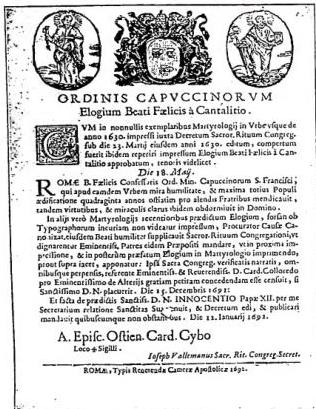
MARTYROLOGY - Decree for the insertion into the Roman M. of Blessed Felice da Cantalice, lay Capuchin (12 January 1692). Vatican City, Archive of the S. Congregation of Rites.
revision, completed, with ample praise and approval of the work, on 22 August. At the end of 1586, the volume was published under the title: Martyrologium Romanum cum notationibus Baronii, dedicated to Sixtus V. Although the notationes were a personal work, Sixtus V authorized Baronio to make slight corrections ("perrero") to the text of the M. based on them, though he wished the name of Gregory XIII to remain attached to II. At the beginning of the 1586 edition, the pope had Baronio’s Tractatio de Martyrologio Romano printed, which still appears in its place.
Benedict XIV did not limit himself to a revision or update. He personally studied several hagiographic questions in detail, such as the cases of Clement of Alexandria, Sulpicius Severus, Theodore, and Siricius, presenting his findings in the apostolic letter to Joannes V, King of Portugal and the Algarves, dated 1 July 1748, which he prefaced to the text of the M., where it still appears today. Another edition, ceteris emendator et locupletior, is that of Gregory XVI (1845), in which the M. of the four great religious Orders were included in an appendix, though they were removed in the subsequent edition of Pius IX (1873). Pius X also published a new edition of the M. in 1913. The most recent, published under the name of Benedict XV in 1922, was prepared by Fr. Brugnani but criticized and repudiated by hagiographers (H. Quentin, La correction du Martyrologe romain, in Anal. boll., 42 [1924], pp. 387–406). It is the one currently in liturgical use. The editions of the M. from the first typical edition of 1584 have been numerous. The Bollandists have listed 129 up to 1912 alone (Propylaeum, p. xiv–xv). It has also been translated into the principal spoken languages.
VI. INSERTION OF NEW ELOGIA IN THE MARTYROLOGY
Gregory XIII, in the apostolic constitution Emendato, prohibits any addition or alteration to the text of the Martyrology, except for the inscription, separately, of the saints of particular churches. The Martyrology, like all other liturgical books intended for worship, is a living book. Indeed, from Gregory XIII onward, the Martyrology has always been updated with the addition of saints as they were canonized.The insertion of a saint into the Martyrology is governed by precise norms, enshrined in documents and usage. A decree of the Sacred Congregation of Rites dated 30 July 1616, confirmed by another on 31 August 1680 (Decr. auth., n. 1651), limits inscription in the Martyrology to canonized saints only, excluding the blessed. This norm, steadfastly upheld and defended by Benedict XIV (op. cit., p. 575), remains the foundation of the practice of the Sacred Congregation of Rites today. Exceptions, in particular cases and by special concessions of the Supreme Pontiffs, are not numerous, as in 1731 for the blessed Vincenzo de' Paoli, canonized six years later (1737), and recently for the blessed Giovanni Leonardi (now a saint), particularly meritorious in the foundation of Propaganda Fide, and on this account inscribed in the Martyrology (and in the Missal) in 1893, while still blessed. The elogium with which a saint enters the Martyrology was once composed by a cardinal attached to the Sacred Congregation of Rites; now it is generally compiled by the Postulation of the cause or by officials of the same Sacred Congregation, approved in congresso, and then by the Supreme Pontiff. It follows, as with the official documents of the Holy See, publication in the Acta Apostolicae Sedis. According to Benedict XIV (op. cit., p. 575), the elogium must obey two rules: that it be taken from probati auctores, tradition, or canonical processes; and that it be concise. In general, the elogium highlights sanctity, a particular virtue, a miracle, doctrine, or apostolic activity; one or more of these elements. There are also announcements of feasts of conversions (as for St. Paul and St. Augustine), episcopal ordinations, inventions, and translations of notable relics.
In short, according to the best tradition, the elements that might enter an "elogium" should be reduced to the following: the name of the place where the saint died, the name of the saint and his liturgical title, an indication of the character of the feast (translatio, passio, depositio...). If the saint is a founder, emphasis on the family he instituted is indispensable. In recent elogia, the name of the pope who canonized the saint is almost always found. Some "historical" elements may be added, but with extreme sobriety. The Martyrology is not in itself a book of edifying reading, but the simple catalogus sanctorum, venerated day by day in the Church.
The Rubricae Martyrologii (typical edition 1922, n. 18) have also sought to establish the criteria governing the hierarchical insertion of elogia. According to these norms: a) with equal rank, the feasts of saints of the universal Church precede those of particular Churches in this order: martyrs, confessors, virgins, non-virgins; b) in the absence of such equality, the nobler feasts precede those of lesser dignity; c) men precede women; d) ecclesiastics precede laity; e) among ecclesiastics, the order of dignity is followed; f) among women, virgins precede; g) among men and women, saints who died in Rome or whose notable relics are preserved in Rome take precedence. In the sixteenth and seventeenth centuries, it was debated whether the insertion of a saint in the Martyrology signified an official recognition of cult or was merely a gestorum memoria. The second opinion prevails, vigorously supported by Benedict XIV (op. cit., pp. 579-80; cf. also card. G. Tomasi, Opuscoli inediti, ed. G. Mercati [*Studi e testi], Roma 1905, pp. 46-53). Saints are prima et per se inserted in the Martyrology to commemorate their feast and their cult, and such insertion, being a "simple product of historians, has nothing to do with the infallibility of the Church or the Pope" (H. Grisar, art. cit., p. 293; cf. also Quentin, op. cit., pp. 678-88). Indeed, the various phases of the Martyrology's composition over the centuries, before the Holy See imposed an official edition, exposed it, more than any other liturgical book, to inaccuracies, errors, and incongruities from a historical-critical perspective, due to the state of hagiographic-historical science of the times that labored over II. Consequently, even today, in light of recent hagiographic studies, the Martyrology requires a careful and judicious revision (cf. A. Bugnini, Verso una riforma del « Martyrologium Romanum », in Ephem. lit.*, 61 [1947], pp. 91-99).
BIBL.:
H. Quentin, Les martyrologes historiques du Moyen Âge, Paris 1908; H. Delehaye, Les origines du culte des martyrs, Bruxelles 1912; Id., Commentarius perpetuus in Martyrologium Hieronymianum, Bruxelles 1931; A. Dufourcq, Gesta martyrum romains, Paris 1900-1910; P. Peeters, L'œuvre des Bollandistes, Bruxelles 1942; G. Mercati, Note di letteratura biblica e cristiana antica, Roma 1901; Id., Opere minori, III, Città del Vaticano 1937; G. Calenzio, La vita e gli scritti del card. Cesare Baronio, Roma 1907; P. Paschini, La riforma gregoriana del M. romano, in La Scuola cattolica, 51 (1923), pp. 198-210, 274-84; A. Bugnini, Verso una riforma del « Martyrologium Romanum », in Ephemerides liturgicae, 61 (1947), pp. 91-99.
A. Amore
VII. LITURGICAL USE
In liturgical offices (in choro), the Martyrologium is read at the hour of Prime, after the psalms and before the versicle Pretiosa. This usage appears to be ancient, at least in monasteries (E. Martène, De ant. monachorum rit., l. I, c. 5, Lyon 1690, pp. 54-68). It is attested by the Regula of St. Chrodegang (d. 766): « Post lectionem recitantur aetas mensis et lunae, et nomina sanctorum, quorum festa crastinum excipiat dies » (PL 89, 1067). The Council of Aix-la-Chapelle in 817 (can. 69) also mentions it: « Ad capitulum primum martyrologium legatur » (Mansi, XIV, 398). Several churches adopted the practice. Gregory XIII sanctioned it and wished the Martyrologium to be read also in the private recitation of the Office.Among religious not bound to choir and in colleges, seminaries, etc., the Martyrologium is read at the end of the midday meal. Each day, the saints of the following day are announced. Exceptions are made on Easter Day and on 2 November, the Commemoration of All the Faithful Departed, when the saints of the current day are announced; on Holy Thursday, Good Friday, and Holy Saturday, the reading of the Martyrologium is entirely omitted. The day is announced according to the Roman computation of calends, nones, and ides, with the addition of the lunar phase. In the Middle Ages, the reader first asked for the superior’s blessing, which was given with the formula: In vitam mandatorum... Usuard, in compiling his Martyrologium, found an average of three hundred saints’ feasts for each day and, unable to include them all, supplemented the daily reading with the formula: Et alibi aliorum plurimorum sanctorum martyrum et confessorum atque sanctarum virginum, a formula still in use today. After the response « Deo gratias » from those present, the one presiding over the Office adds a brief prayer for all the saints. Formerly, it was: « Ipsi et omnes sancti intercedant ». Today, instead, the invocation is: « Sancta Maria » (the Virgin) « et sancti ». The reading of the Martyrologium on certain feasts was conducted with particular solemnity. Thus, at Christmas, when the reader announced the birth of the Redeemer with the words: « Nativitas Domini nostri Jesu Christi secundum carnem », all prostrated themselves humbly with their foreheads to the ground. Even today, those words are chanted in a higher tone to emphasize their meaning. A similar practice existed for the announcement of the Lord’s death and Resurrection on Holy Thursday and Holy Saturday.
The rules to be observed for the reading or chanting of the Martyrologium in the canonical Office are minutely set forth in the Rubricae prefixed by Gregory XIII to the first typical edition of 1548, later considerably expanded in subsequent editions. The Martyrologium is one of the liturgical books for which the Holy See has reserved the right of publication (AAS, 38 [1946], p. 371; documentation in Ephem. lit. [para altera, Ius et Praxis], 61 [1947], pp. 19-21). - Vedi tav. XX.