
GIROLAMO, saint. — One of the four great Doctors of the Latin Church.
SUMMARY:
I. Life
II. Works
III. Doctrine
IV. Law
V. Iconography
VI. Society of S. G.I. LIFE
Son of Eusebius, he was born at Stridon, a fortress destroyed by the Goths, on the borders of Dalmatia and Pannonia. The holy Doctor himself transmitted these details among his autobiographical notices in chap. 135 of the De viris, written in 392. Those lines concern the family, the date of birth, and the place of origin of St G., as well as many problems often discussed, most of which, for lack of the necessary documents, cannot receive an entirely satisfactory solution. His parents were Catholics, and he received a Catholic education. The name of his mother is unknown; only that of a maternal aunt, Castorina, is known, with whom he later had difficulties. He retained a tender memory of his grandmother’s affection; but he left no memory of his mother. The family enjoyed a certain prosperity, and, despite the destructions wrought by the Goths, the family property was still in sufficiently good condition that, in 398, G. could hope to derive some profit from its sale. He had a sister who, for some time, caused him anxiety and whom he commended to the clergy of Aquileia; and a younger brother, Paoliniano, who was later to join him at Bethlehem and practise monastic life there with him. The date of St G.’s birth is fixed by the Chronicle of Prosper; but it does not agree with the numerous details that St G. himself gives concerning his early years. It seems rather that his birth should be dated to about 347, a date with which all his notices concerning his early education and his life in Rome agree. As for the exact location of Stridon, it is impossible to determine it: no document, apart from the notice given by St G., mentions this locality. Thus the most divergent and improbable conjectures have been formulated on the subject. One of these, which had won over scholars such as G. Morin and F. Bulić, placed Stridon at Grahovopolje in Bosnia, not far from Glamoč, near the frontier of present-day Dalmatia, on the basis of an inscription mentioning the Stridonians; it had to be abandoned because it rested on a serious forgery, acknowledged by the author himself. Following D. Vallarsi, A. Vaccari and F. Cavallera thought that ancient Stridon should rather be sought in the vicinity of Aquileia and Haemona, toward which the evidence of St G.’s correspondence with his relatives and friends points. Morin had accepted this hypothesis but, in the issue of June 1941, changed his mind once again and, in an article in Nova et Vetera, vigorously argued that this solution was unfounded, proposing that Stridon be sought much farther east, along the line where the itineraries mark two ad fines, and more probably where Qrin is now located. Vaccari seems to have abandoned his former opinion; Cavallera, however, without discussing the new hypothesis, attempted to demonstrate in a recent article that the arguments for the vicinity of Aquileia retained all their force (La patrie de st Jérôme, in Bulletin de littérature ecclésiastique, 47 [1946], pp. 60-64).Whatever the case may be, G. first received, in his father’s house, a very careful education, in connection with which he recalls the severity of his teacher, a new Orbilius, and the games played in the great family home.
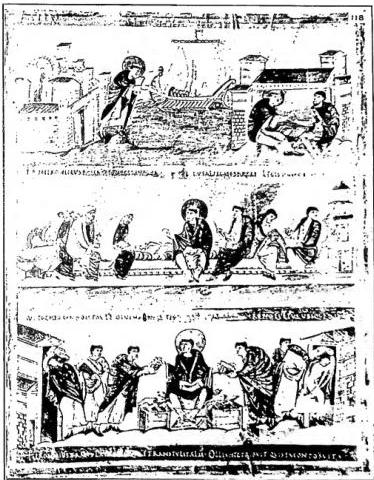
When the time came to complete his education and encourage his tastes for liberal culture, G. was sent to Rome to study under the most prominent grammarians and rhetoricians; he was a regular pupil of Donatus. A serious student, he took a profound interest in literature and in all branches of knowledge cultivated at that time, including law and philosophy. Although he did not pursue the study of Greek in depth, he nevertheless took care from that time onward to assemble a select library. He studied with young men who had come from the same regions as he, such as Bonosus and Rufinus, or who were of Roman origin, such as Pammachius, the future senator and son-in-law of Paula.
According to some testimonies, G. is said at that time to have led a highly dissipated and frivolous life with the young Romans. But even more strongly, he experienced the attraction that Christianity exercised upon the city, which had witnessed the martyrdom of St Peter and St Paul. On Sundays he visited the catacombs with some friends who shared his Christian convictions, and he soon decided to receive Baptism, which, according to the custom of the time, he had until then postponed.
Having completed the normal course of his studies, he left Rome with a childhood friend, Bonosus, to go to Trier: his correspondence with Rufinus shows him engaged in transcribing manuscripts of Christian authors for himself and his friends. At the same time he felt the first impulse toward the monastic vocation.
The reasons for this journey to Trier and the duration of his stay are unknown. He had returned to Italy by 373, and is found at Aquileia in a circle of fervent young men gathered around Bishop Valerian in order to lead there, in G.’s expression, a heavenly life. But the group dispersed a few months later, for reasons that are not well known. G. took advantage of this to depart for the East. Passing through Illyricum, Thrace, Pontus, Cappadocia, Bithynia, and Galatia, he arrived in Antioch in 374. He left some recollections of this journey, particularly of his passage through Athens.
At Antioch he was first the guest of Evagrius, whom he had recently met in Italy and who, during a long and serious illness, tended him with great devotion. It was then that he had the dream in which he was severely punished for his attachment to profane literature, and he swore never again to take an interest in II. As soon as he was able, abandoning his plan of visiting Jerusalem, he went into the desert east of Antioch, among other monks who set him this example and devoted themselves to exercises of penance and prayer, though he was at times troubled by memories of his Roman youth. During this period he also began the study of Hebrew, in order better to understand Sacred Scripture, despite the great difficulties he encountered in II. He lived in that desert for almost two years, apparently happy and determined to persevere, when the demon of discord began to blow through the desert. The cause was the question of the schism of Antioch, which was then tearing the entire Eastern Church apart. The monks immediately took sides, and each person was asked to declare his preferences and his Creed. G. at first fought as well, but then, weary of the struggle, wrote to Pope Damasus to ask with whom he ought to be in communion. Receiving no reply, he abruptly decided to leave the desert. Evagrius again received him, and since he himself had sided with Paulinus against Meletius, he had little difficulty in persuading G. to take the same side. Paulinus immediately understood the importance of this adherence and, in order to strengthen it, persuaded him to receive the priesthood from his own hands. G. stipulated that he be allowed to continue practicing the monastic life: this was what he wished to safeguard above all else. At the same time, continuing his scriptural studies, he had the opportunity to hear several lectures by Apollinaris and to visit the Nazarenes of Beroea, where he was able to see their copy of the Hebrew Gospel, and he made his first attempts at composition. Until then he had been content to write, with great care and some affectation, a number of letters to his friends in East and West. He also attempted a short commentary on Obadiah and perhaps his Altercatio Luciferiani et Orthodoxi. Nevertheless, the great capital of the East, which Theodosius had restored to free Nicene orthodoxy and in which Gregory of Nazianzus exercised such a fruitful and luminous apostolate, attracted him. He went there, it seems, in 379 and became Gregory’s devoted disciple, living near him through the stormy days of the Council of 381; this also gave him the opportunity to meet St. Gregory of Nyssa and St. Amphilochius. At their school G. perfected his knowledge of Greek and above all learned to esteem Origen, whose homilies on Jeremiah, Ezekiel, and Isaiah he began to translate. Ecclesiastical history also interested him. At the request of his friends Vincent and Gallicanus, he translated Eusebius’ Chronicle and continued it up to his own time, while awaiting the opportunity to carry out—a project he never fulfilled—his plan to write a Historia of his own age.
It is not known under what circumstances G. came to know St. Epiphanius, bishop of Salamis. In 382 Paulinus of Antioch and the latter, wishing to go to Rome, took him with them. G. then again felt the spell of the eternal city and allowed the two friends to depart alone in the spring of 383. He had in fact won the full confidence of Pope Damasus, who readily employed his services for his official correspondence and also for the study of Sacred Scripture, in which G. was already proving himself an undisputed master.
During this Roman sojourn G. devoted himself with an ardor that difficulties would only intensify to a twofold task, pursued tirelessly: the propagation of the monastic life, especially in the female circles of the Roman aristocracy, and the study of Sacred Scripture in the original Hebrew text. Among the tasks imposed upon him by the trusting friendship of the aged Pope Damasus, one must also note the revision of the Latin text of the Gospels: G. himself collated the Hebrew text of the Bible with that supplied by certain manuscripts used by the Jews of Rome. Above all, he had organized in Marcella’s house on the Aventine a kind of conference, where he taught the noble lady and her daughters to understand the original text of the psalms, which they thus sang with greater understanding and devotion; and he answered, orally or in writing, the difficulties they encountered in reading the sacred text.
This twofold apostolate, especially that in favor of the monastic life, soon aroused strong opposition, to which G. replied with scathing responses directed at the lax life of too many Christians, and especially of clerics or monks and virgins who were insufficiently faithful to their ideal. His letters from that period bear witness to this, particularly the famous Letter XXII to Eustochium, daughter of Paula, one of his most distinguished and faithful followers. Other letters in the form of funeral eulogies—on Blesilla, another daughter of Paula, and on the widow Lea, whose blessed fate he contrasted with that of Praetextatus, to whom the widow, after his death, had rendered empty honors in paganism—allowed him, through his criticisms, to renew his replies to the continual attacks to which he was subjected, as well as his vigorous advocacy of Christian perfection and scriptural studies. As long as Damasus lived, the Pope’s favor sufficed to defend him. Indeed, some were already considering him as a possible successor. But when Damasus died on 11 December 384, Siricius was elected pope, and since he did not appear to show G. any particular esteem, the enmity against him was given free rein: infamous accusations were brought against him, to which he replied victoriously but which inspired in him an insurmountable disgust for residence in that unworthy Babylon. In August 385, venting all his bitterness in a farewell letter to Asella, he definitively embarked for the East, which he was never again to leave.
He would leave it only for a few brief journeys within Palestine itself, as, for example, to consult at Caesarea the sole copy of the Hexapla compiled by Origen’s own hand, or to flee persecution
(courtesy of Dr. D. Degenhart)
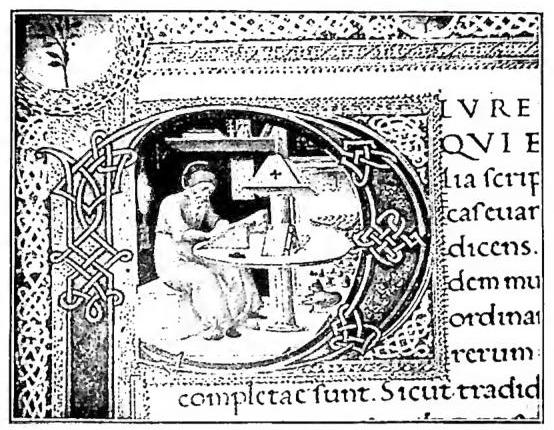
GIROLAMO, santo - St. G. at his worktable. Miniature from cod. Vat. Urb. lat. 10, containing the Four Gospels with the prologues, by Franco de’ Russi (1475–82).
Pelagian in the spring of 416. But although G. had physically left the West, no one was better informed than he of what was happening there. Numerous were the pilgrims who, on their journey toward the Holy Places, made a longer or shorter stop at Bethlehem. More numerous still were the letters that G. received from all the regions of the West, often accompanied by subsidies enabling him to meet the considerable expenses required for his labors and for this continual correspondence. A life outwardly singularly monotonous, but abundantly filled with prayer, work, and the practice of charity. The years passed, all resembling one another and differing only in the variety of the subjects to which he applied his activity, the enemies of the Faith whom he had to combat, and the bereavements that successively afflicted him. G. remained at his post to the very end, fighting and continuing to urge others, especially s. Agostino, to resist the enemies of God, when he himself no longer had the strength required to continue fighting. In this field of battle, in the midst of the struggle against Pelagianism, in 419–20, God came to take him away and grant him his eternal reward.
II. WORKS
First among his works stands the correspondence, undoubtedly, together with the Vulgate, the most widely read of all Jerome’s works. At all times it has been preferred by scholars and is a precious source not only for the life and activity of St. G., but also for the history of his age. Increased in 1910 by a few brief letters, it comprises 154 in the notable critical edition published by I. Hilberg in the CSEL. It also contains twenty letters from other correspondents. Most of them concern not only scriptural difficulties, but also the other controversies of the period, the concern for Christian formation or education, and also obituary notices.His revision of the Gospels is the oldest work of this kind, undertaken, as we have seen, at the request of Pope Damasus. Its value is unanimously recognized, whereas, for the rest of the New Testament, the Latin text leaves much to be desired. Some dispute its authenticity, which is nevertheless generally accepted. What creates difficulty is precisely the negligence with which this work is said to have been carried out, and the fact that G. vigorously criticizes certain readings preserved in that text (critical ed. by I. Wordsworth and H. G. White, minor, Oxford 1911; maior in fascicles; Gospels, ibid. 1889-98; Epistulae Paulinae, ibid. 1913-1941).
The revision of the ancient Latin version of the Septuagint, and in particular of the Psalter. - G. corrected the Latin text of the Psalter twice, chiefly in order to add the diacritical marks. While everyone agrees in attributing the Psalterium Gallicanum to him, the authenticity of the Psalterium Romanum is still debated. As for the rest of the Old Testament, G. states that he translated it in its entirety but that it was stolen from him. What remains of the work is the revision of Job and what constitutes the Septuagint text in his commentary on the major and minor prophets.
Vulgate. - Soon after settling permanently in Bethlehem, G., while continuing to perfect his knowledge of Hebrew, decided to translate the sacred books from the original text. He began this work in 389 and pursued it tenaciously, amid various occupations, until 405, when he considered it finished, leaving aside Maccabees, Ecclesiasticus, Wisdom, Baruch, and various other parts whose canonicity seemed doubtful to him. It is a work full of merit and, in general, very accurate, which provided the Latin world with a version of the Bible far superior not only to the one it already possessed, but also to all the other versions taken together, with the exception of that of the Septuagint. Despite certain shortcomings, G. succeeded in combining concern for elegance with fidelity to the text. His work earned him unfailing encouragement as well as opposition, of which certainly the lesser was not that of St. Augustine himself, deeply attached to the ancient Vulgate because of his exaggerated pastoral concerns. The work, long debated, eventually imposed itself unanimously from the seventh century onward and received from the Council of Trent the great honor of becoming the official (authentic) Latin translation. Nevertheless, out of respect for the habits of the Christian people, the translation of the psalms did not replace the Psalterium Gallicanum, which, moreover, was also corrected by G. The Benedictines of the monastery of S. Girolamo in Rome, entrusted by the Holy See with publishing the critical edition of the Vulgate, printed in 1948, together with the Liber Verborum dierum, the seventh volume of their edition.
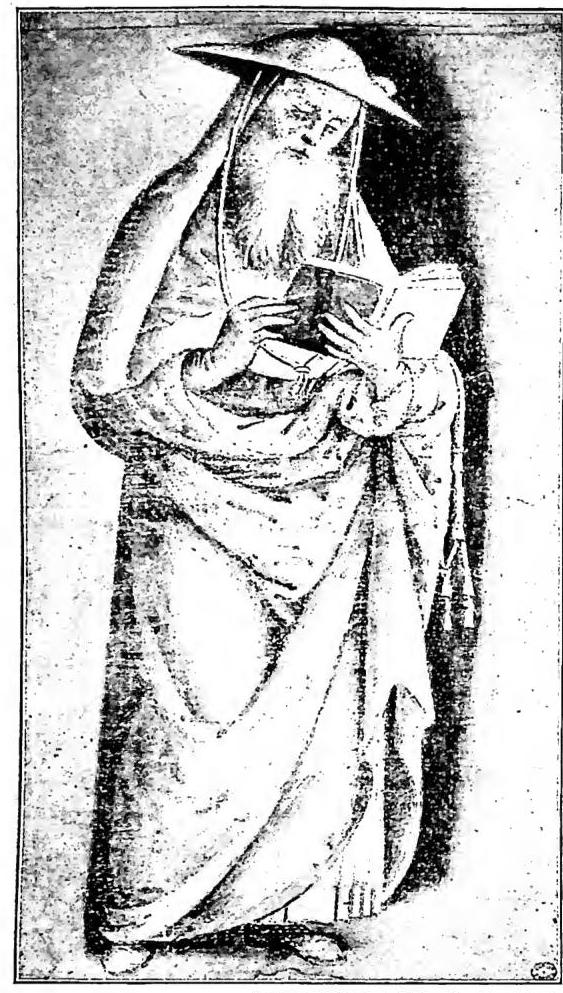
GIROLAMO, santo - S. G. legends. Drawing by Pinturicchio (15th century) - Leipzig, Boener collection.
sinners. Moral applications also have a place in them; but they do not possess the same interest as the analogous works of Origene, who is unquestionably the model followed.
To these studies must be added some less noteworthy but useful works for introduction to scriptural studies: the Liber interpretationis nominum Hebraicorum, an etymological list of Jewish proper names that is a source for the development of «spiritual exegesis», in the same way as etymologies involving numbers. The customary editions of the Bible until recent times reproduced a list of this kind, a testimony to the importance attributed to it in certain circles. Much more useful is the adaptation G. made, adding material of his own, of Eusebius’s Palestinian geography known under the name of Onomasticon or Liber de situ et nominibus locorum Hebraicorum, «a fundamental work of geography for the fourth century, still of great help today for knowledge of Palestine in biblical times» (Abel).
These works referring directly or indirectly to Sacred Scripture do not, however, constitute the whole of G.’s literary output. To them must be added the numerous works dictated by the need to defend the Faith and by controversy. These include the treatise Contra Luciferianos, apparently the earliest work of its kind, whose occasion remains unknown; the Liber de perpetua virginitate
Beatae Mariae (384), against Helvidius, in which he victoriously refutes the objections drawn from the Gospel against Mary’s virginity and in which he is the first to affirm the virginity of St. Joseph. The books Contra Iovinianum date from 393; they constitute the most brilliant work of Jerome’s polemics, though often influenced by Tertullian and marked by excessive harshness of language and exaggerated severity toward marriage. Pammachius invited him to provide some reassuring explanation on the subject, which G. did most willingly (letters 48–50); but this did not prevent St. Augustine, in 400–401, from believing it his duty to offer a clarification on the matter in De bono coniugali. In 396, G. wrote a letter of reproach to Vigilantius, and in 406 an even harsher treatise against him. By the latter date, however, the lively controversy provoked by anti-Origenism had already unfolded; and, not content with fighting Rufinus on his own account, he had also become, through his translations and his activity, the tireless auxiliary of Theophilus of Alexandria and St. Epiphanius. In addition to numerous letters, he composed the treatise against John of Jerusalem, the response to Rufinus’s attacks under the title Apologia, and even, at the invitation of Pammachius and Marcella, an excessively literal translation of Origen’s Periarchón, unfortunately now lost. Then came the Pelagian controversy, in which G. had the merit of being among the first to intervene, first with Letter 133 to Tesiphontus, and then with the Dialogus adversus Pelagianos, where, in his own manner, he refutes his opponents chiefly with the aid of scriptural texts.
G. felt equally at home in the field of hagiography, in which he intervened on several occasions and to which the obituaries he composed during his Roman sojourn are quite logically connected: the funeral eulogies of Nepotianus, Paula, Fabiola, and others. He also composed the legendary life of St. Paul of Thebes, that of St. Hilarion, and added to them the charming account of the solitary Malchus. His taste for monastic life also led him to translate several documents of Egyptian origin, of which Boon has recently provided a critical edition under the title Pachomiana latina (Rules of St. Pachomius and St. Theodore). To these may be added the remarkable sermons discovered and recently published by Morin in volume III of the Anecdota Maredolana: familiar sermons addressed to his monks on the duties of monastic life, which vividly reveal the transformation undergone by texts when they were intended for a broad public.
This body of work, without entering into greater detail, is sufficient to give a broad idea of the formidable labor G. carried out over the course of his long career, of that capacity for work which enabled him, amid his immense and daily correspondence, to pursue studies so diverse that they demanded truly dogged effort.
III. DOCTRINE
S. G. occupies a wholly particular place in the history of dogma. He never attempted to produce a synthesis of Christianity or to set forth points of view that were particularly his own in matters of dogma. What characterizes him best is, it seems, the expression, already dear to Origen and which he willingly makes his own, vir ecclesiasticus, one whose sole concern is to remain faithful to the teaching of the Church. He readily exercises his freedom in the realm of free opinions and, with a touch of pedantry, often makes a display of his erudition in this regard as well, minutely setting forth the bizarre or unusual opinions that he encounters along the way, without normally making them his own. But in the realm of revelation he is content to be an echo: he coins admirable formulas to express it, but generally goes no further. He does not seek to enhance it through personal reasoning, but prefers to let the scriptural texts speak or to find, in his extensive sacred and profane learning, complementary testimonies that will lend the weight of their venerable authority to his statements.Thus, it is much easier to gather in him, as C. Schulting did in his Confessio Hieronymiana (4 vols.,
Cologne 1645), abundant material for a very rich and thoroughly orthodox anthology than to identify somewhat extended demonstrations and detailed expositions of a speculative nature, even in the scriptural subjects that were the object of his ordinary concerns. On the other hand, since he wrote hastily and most often by dictation, he was frequently carried, under the influence of his immense learning and his memories, to use formulas and to mention, without the necessary reservations, opinions that left something to be desired. One would risk distorting his true thought if one attributed to these oddities an importance that confessional polemic has often exaggerated. Nevertheless, he is very often an excellent interpreter of common belief, for example, concerning the authority of Scripture, its divine origin, the unity of the Church and papal primacy, the virginity of Mary, the legitimacy of the veneration of the saints and of the customary expressions of piety, and the excellence of virginity. On the other hand, his thought has often given rise, in every century, to interminable discussions, not only concerning the canon of Scripture, where he was in conflict with St. Augustine and the doctrine defined at Trent, but also concerning the eternal fate of Catholics who died in sin, the origins of the episcopate, and the power of the keys. On the whole, his works remain an inexhaustible source of information of every kind, both for the theologian and for the scholar; above all, G. left everyone the incomparable example of a life wholly sanctified by prayer and assiduous work, which neither frequent illnesses nor the most bitter opposition ever succeeded in interrupting. The harshnesses of a difficult character, yet one sensitive to the charm of friendship, are little beside these fundamental qualities and the extraordinary services that, through his biblical works, and especially through his translation from the Hebrew, G. rendered to the Church.
Recent studies: G. Grützmacher, Hieronymus, 3 vols., Berlin 1901, 1906, 1908; F. Cavallera, St Jérôme, sa vie et son œuvre, part 1, 2 vols., Louvain 1922; A. Penna, S. G., Turin 1949. For the other excellent publications, V. BARDENHEWER, OTTO, III, pp. 605-54; Schanz, IV, pp. 439-99; P. Vaccari, S. G., studi e schizzi, Rome 1921. Among the various studies and monographs, besides the Miscellanea Geronimiana, Rome 1921, V. Sanders, Etudes sur st Jérôme, Brussels 1903; T. Tracinski, Die dogmatischen Schriften des hl. H., Posen 1917; D. Gorce, La «lectio divina», st Jérôme et la lecture sacrée, Paris 1925; J. Forget, s. V. in DThC, VIII, 1 (1924), cols. 894-983; F. Cavallera, s. V. in DBs, IV (1949), cols. 889-97; J. P. O'Connell, The eschatology of st. Jerome, Mundelein 1948; A. Penna, Principi e carattere dell'exegi di s. G., Rome 1959.
Ferdinando Cavallera
IV. LAW
In G.’s work there are numerous passages of juridical content. Indeed, it is thought that they find their justification in his intention to pursue a political career. For these same reasons, some writers had attributed to him the Collatio legum Mosaicarum et Romanarum.In his writings, he touches upon every field of law, from private law to criminal and procedural law.
The most interesting observations, however, concern the law of persons and family law. Thus slavery is discussed, with a particular inquiry into the well-known question of the servus fugitivus (PL 26, 638 ff.); in connection with Matrimony and in opposition both to Roman and Jewish legislation, the favor pudicitiae is exalted; likewise, one finds the assertion that Matrimony is contracted by initial consent and is dissolved only by the death of one of the spouses (PL 22, 1048–49); certain passages deal with the Pauline privilege and the impediment of disparity of worship (PL 22, 233–34).
Equally important statements, however, are found on other subjects: thus, in the matter of property, the assertion that goods are given for the use of all human beings and that he is unjust who does not give fratribus ad intendum quod a Deo pro omnibus est creatum (PL 22, 1019). Special duties of clerics in the use of temporal goods are affirmed, and severe statements such as the following are found: Negotiatorem clericum et ex inope divitem... quasi quandam pestem fuge (PL 22, 531).
Of particular interest, moreover, are the references to the duty of remaining faithful even to simple promises, in contrast to the Roman principle: Nuda pactio obligationem non parit. It has nevertheless been astutely observed that, in comparison with the large number of passages of juridical content, references to Roman law—which G. nevertheless knew well and which constitutes the framework of his legal culture—are not very abundant; this scarcity of direct references provides an interesting further confirmation of the phenomenon known as the autonomy of patristic thought.
V. ICONOGRAPHY
Depicted for the first time on the diptych of Boethius at Brescia (after 602), s. G. was endowed, from the end of the thirteenth century, with the cardinal’s hat, and already in a fresco by Tommaso da Modena (1352) also with the garments of a cardinal, under which guise he subsequently became one of the saints most frequently represented, appearing, very often with the lion of the legend as his individual attribute, alone or in a chair, in “sacred conversations,” or associated with the other doctors of the Church.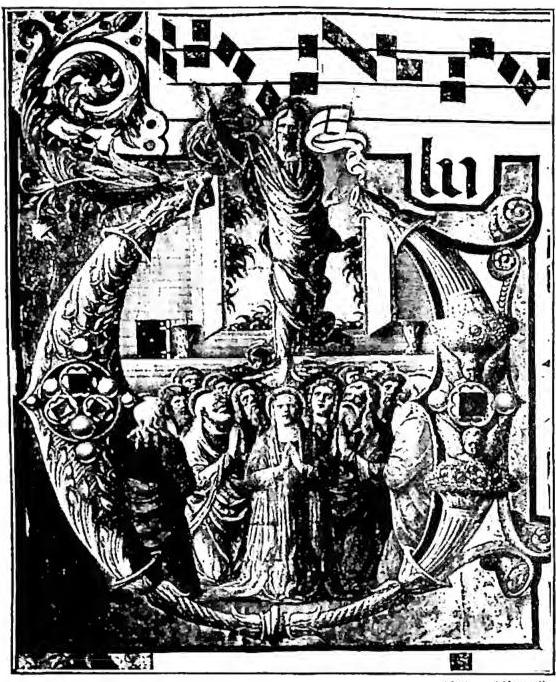
(phot. Alinari)
GIROLAMO da CREMONA - Ascension. Miniature by G. da C. in a choir book - Siena, Cathedral, Piccolomini Library.
Charles the Bald (Paris) and in those of the so-called Bible of Charles the Fat (Rome, S. Paolo fuori le mura), which presuppose common models; among the most important later examples should be recalled the paintings by Carpaccio in the Scuola degli Schiavoni in Venice, the reliefs by Mino da Fiesole in the Museo artistico-industriale in Rome, and the frescoes by Domenichino in the atrium of S. Onofrio in Rome (where the celebrated “anti-Ciceronian vision,” rarely represented elsewhere, is also found). Among individual episodes, finally, mention deserves to be made of the last Communion of s. G. (Pinacoteca Vaticana, 1614), a masterpiece by Domenichino himself inspired by a composition by A. Carracci.
It also published the separate Gospels of Matteo and Luca. To the Gospels were added the Acts of the Apostles and a prayer book with illustrations. By 30 Nov. 1902 it had already distributed 119,702 copies. The latest reprint, the 516th, dates from 1944 and is sold out. Among the various proposals was that of extending the version to the whole New Testament, paraphrasing the Old Testament, and publishing a life of Jesus. The Society has no commercial purposes, but distributes its publications at prices accessible to all. The supreme pontiffs, especially Pio X and Benedetto XV, encouraged and assisted II. Pio XII expressed his satisfaction in a letter to card. F. Tedeschini, protector of the Society of s. G. (AAS, 42 [1950], p. 552). - Vedi tav. XLVIII.