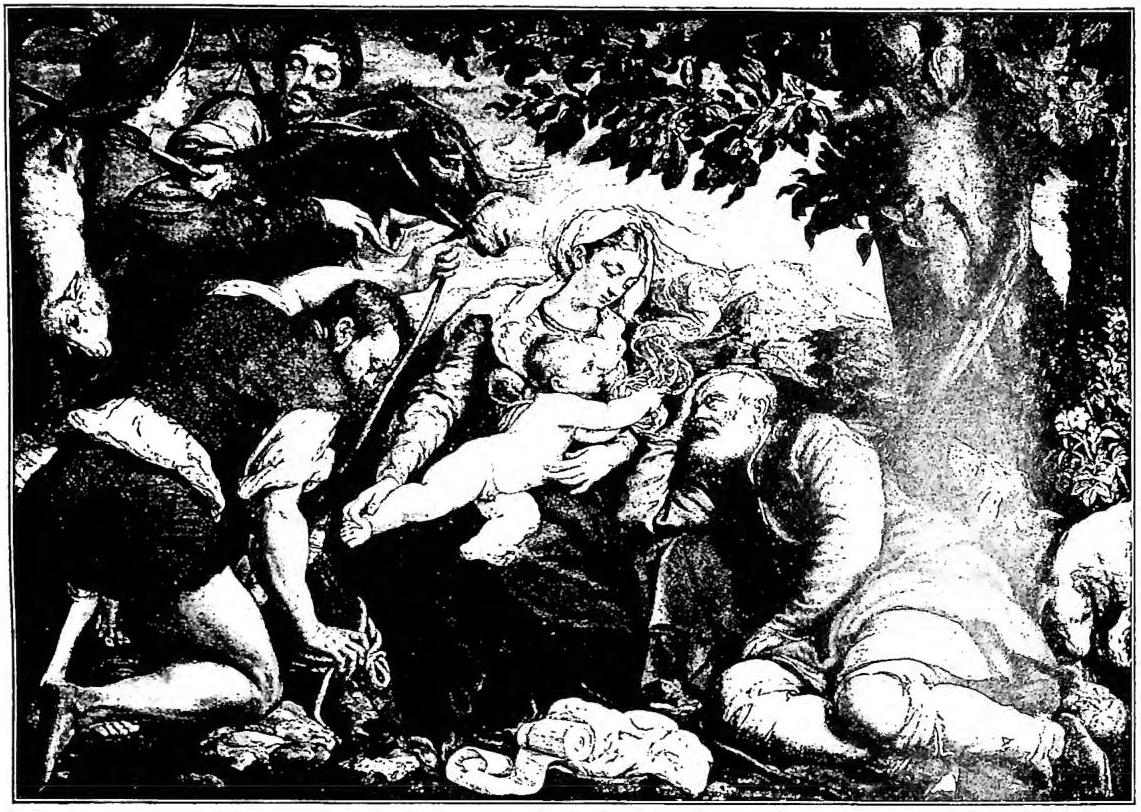
BASSANO (DA PONTE). — Family of painters commonly designated by the name of the city of the same name, rather than by the surname Da Ponte, active from the end of the 1400s to the first decades of the 1600s.
FRANCESCO IL VECCHIO (b. in Bassano in 1470, d. in 1540 or ’41), began the Bassano school, whose characteristic product was a painting of popular character that reduced sacred histories almost to genre scenes, or in any case inserted them into the ordinary life of its own time. He was influenced by the Veronese school and by Montagna. In Bassano there are by him the Madonna enthroned between Sts. Bartolomeo and Giovanni Battista and the Virgin between Sts. Pietro and Paolo.
IACOPO, his son (b. in Bassano in 1515 or ’16, d. in Venice on 13 February 1592), is the most celebrated member of the family. We know nothing of his early artistic education; from observation of his works we infer paternal instruction and may presume, with sufficient certainty, that he received a Venetian training. It is not always easy to distinguish his autograph works from those produced collaboratively, because of the continual presence of assistants, which gives much of his production the character of a workshop. But this predominance of the workshop should not lead one to undervalue his art, as though classifying it as commercial art; nor should Iacopo be appreciated merely as the conventional painter of fairs, shepherds, flocks, and coppersmiths whom many like to represent him as. Rather, it is legitimate to affirm that, in sixteenth-century Venetian painting, he occupies a distinct place on account of the distinctive qualities of spirituality and popular simplicity that he felicitously united.
A savory rustic art and a genuine rural fragrance are found in his early works, such as the Flight into Egypt (Bassano, museum), the Supper at Emmaus (Cittadella, parish church), Christ and the Adulteress (Bassano, museum), Nebuchadnezzar and the Three Young Men (ibid.).
The Madonna enthroned with Matteo Soranzo (Bassano, museum) is likewise executed with ingenuous popular frankness; in it, the last figure on the left is an effective portrait; and a beautiful “piece of painting” may be seen in the little girl seated at the foot of the staircase, playing with a dog, lively and true in her little dress of green stripes on faded red. The Last Supper in the Borghese Gallery brings to mind the young Velasquez. The Earthly Paradise in the Doria Gallery has rightly been considered an anticipation of Paolo Brill or of Bruegel de' Velluti, but in it there is, in addition, a greater sense of vitality in the animals and greater expressiveness even in inanimate things. In St. Rocco in the Brera Gallery, Iacopo already employs a touch-based manner of painting, which he subsequently continues in St. Jerome in the Gallery of Venice. In St. Valentino Baptizing Lucilla in the museum