BAROCCI, FEDERICO

BAROCCI, FEDERICO. - Pittore, n. a Urbino, se- condo il Bellori nel 1528 (secondo altre fonti nel 1535),

Article illustration
BAROQUE ART — Incense burner in silver and enamels (17th century).Orvieto, Museo dell’Opera del Duomo.

It no longer performs the function of a stage set, yet it is so closely bound up with the forms that it loses its individual value. The canvases of S. Luigi dei Francesi, of S. Maria del Popolo, and that depicting the Mo

\frac{\partial \rho}{\partial t} + \nabla \cdot (\rho \mathbf{v}) = 0,
\frac{\partial \mathbf{v}}{\partial t} + \nabla \cdot (\rho \mathbf{v} \otimes \mathbf{v}) - \nabla p = \mathbf{f},
\frac{\partial \mathbf{p}}{\partial t} + \nabla \cdot (\rho \mathbf{v} \otimes \mathbf{v} + \mathbf{p} \mathbf{I}) = \mathbf{g},
\frac{\partial \mathbf{T}}{\partial t} + \nabla \cdot (\rho \mathbf{v} \otimes \mathbf{T}) = \mathbf{h},
\frac{\partial \mathbf{S}}{\partial t} + \nabla \cdot (\rho \mathbf{v} \otimes \mathbf{S}) = \mathbf{i},
\frac{\partial \mathbf{R}}{\partial t} + \nabla \cdot (\rho \mathbf{v} \otimes \mathbf{R}) = \mathbf{j},
\frac{\partial \mathbf{Q}}{\partial t} + \nabla \cdot (\rho \mathbf{v} \otimes \mathbf{Q}) = \mathbf{k},
\frac{\partial \mathbf{U}}{\partial t} + \nabla \cdot (\rho \mathbf{v} \otimes \mathbf{U}) = \mathbf{l},
\frac{\partial \mathbf{V}}{\partial t} + \nabla \cdot (\rho \mathbf{v} \otimes \mathbf{V}) = \mathbf{m},
\frac{\partial \mathbf{W}}{\partial t} + \nabla \cdot (\rho \mathbf{v} \otimes \mathbf{W}) = \mathbf{n},
\frac{\partial \mathbf{X}}{\partial t} + \nabla \cdot (\rho \mathbf{v} \otimes \mathbf{X}) = \mathbf{o},
\frac{\partial \mathbf{Y}}{\partial t} + \nabla \cdot (\rho \mathbf{v} \otimes \mathbf{Y}) = \mathbf{p},
\frac{\partial \mathbf{Z}}{\partial t} + \nabla \cdot (\rho \mathbf{v} \otimes \mathbf{Z}) = \mathbf{q},
\frac{\partial \mathbf{A}}{\partial t} + \nabla \cdot (\rho \mathbf{v} \otimes \mathbf{A}) = \mathbf{r},
\frac{\partial \mathbf{B}}{\partial t} + \nabla \cdot (\rho \mathbf{v} \otimes \mathbf{B}) = \mathbf{s},
\frac{\partial \mathbf{C}}{\partial t} + \nabla \cdot (\rho \mathbf{v} \otimes \mathbf{C}) = \mathbf{t},
\frac{\partial \mathbf{D}}{\partial t} + \nabla \cdot (\rho \mathbf{v} \otimes \mathbf{D}) = \mathbf{u},
\frac{\partial \mathbf{E}}{\partial t} + \nabla \cdot (\rho \mathbf{v} \otimes \mathbf{E}) = \mathbf{v},
\frac{\partial \mathbf{F}}{\partial t} + \nabla \cdot (\rho \mathbf{v} \otimes \mathbf{F}) = \mathbf{w},
\frac{\partial \mathbf{G}}{\partial t} + \nabla \cdot (\rho \mathbf{v} \otimes \mathbf{G}) = \mathbf{x},
\frac{\partial \mathbf{H}}{\partial t} + \nabla \cdot (\rho \mathbf{v} \otimes \mathbf{H}) = \mathbf{y},
\frac{\partial \mathbf{I}}{\partial t} + \nabla \cdot (\rho \mathbf{v} \otimes \mathbf{I}) = \mathbf{z},
\frac{\partial \mathbf{J}}{\partial t} + \nabla \cdot (\rho \mathbf{v} \otimes \mathbf{J}) = \mathbf{a},
\frac{\partial \mathbf{K}}{\partial t} + \nabla \cdot (\rho \mathbf{v} \otimes \mathbf{K}) = \mathbf{b},
\frac{\partial \mathbf{L}}{\partial t} + \nabla \cdot (\rho \mathbf{v} \otimes \mathbf{L}) = \mathbf{c},
\frac{\partial \mathbf{M}}{\partial t} + \nabla \cdot (\rho \mathbf{v} \otimes \mathbf{M}) = \mathbf{d},
\frac{\partial \mathbf{N}}{\partial t} + \nabla \cdot (\rho \mathbf{v} \otimes \mathbf{N}) = \mathbf{e},
\frac{\partial \mathbf{O}}{\partial t} + \nabla \cdot (\rho \mathbf{v} \otimes \mathbf{O}) = \mathbf{f},
\frac{\partial \mathbf{P}}{\partial t} + \nabla \cdot (\\frac{\partial \mathbf{B}}{\partial t} + \nabla \cdot (\rho \mathbf{v} \otimes \mathbf{B}) = \mathbf{s} \\
\displaystyle \frac{\partial \mathbf{C}}{\partial t} + \nabla \cdot (\rho \mathbf{v} \otimes \mathbf{C}) = \mathbf{t} \\
\displaystyle \frac{\partial \mathbf{D}}{\partial t} + \nabla \cdot (\rho \mathbf{v} \otimes \mathbf{D}) = \mathbf{u} \\
\displaystyle \frac{\partial \mathbf{E}}{\partial t} + \nabla \cdot (\rho \mathbf{v} \otimes \mathbf{E}) = \mathbf{v} \\
\displaystyle \frac{\partial \mathbf{F}}{\partial t} + \nabla \cdot (\rho \mathbf{v} \otimes \mathbf{F}) = \mathbf{w} \\
\displaystyle \frac{\partial \mathbf{G}}{\partial t} + \nabla \cdot (\rho \mathbf{v} \otimes \mathbf{G}) = \mathbf{x} \\
\displaystyle \frac{\partial \mathbf{H}}{\partial t} + \nabla \cdot (\rho \mathbf{v} \otimes \mathbf{H}) = \mathbf{y} \\
\displaystyle \frac{\partial \mathbf{I}}{\partial t} + \nabla \cdot (\rho \mathbf{v} \otimes \mathbf{I}) = \mathbf{z} \\
\displaystyle \frac{\partial \mathbf{J}}{\partial t} + \nabla \cdot (\rho \mathbf{v} \otimes \mathbf{J}) = \mathbf{a} \\
\displaystyle \frac{\partial \mathbf{K}}{\partial t} + \nabla \cdot (\rho \mathbf{v} \otimes \mathbf{K}) = \mathbf{b} \\
\displaystyle \frac{\partial \mathbf{L}}{\partial t} + \nabla \cdot (\rho \mathbf{v} \otimes \mathbf{L}) = \mathbf{c} \\
\displaystyle \frac{\partial \mathbf{M}}{\partial t} + \nabla \cdot (\rho \mathbf{v} \otimes \mathbf{M}) = \mathbf{d} \\
\displaystyle \frac{\partial \mathbf{N}}{\partial t} + \nabla \cdot (\rho \mathbf{v} \otimes \mathbf{N}) = \mathbf{e} \\
\displaystyle \frac{\partial \mathbf{O}}{\partial t} + \nabla \cdot (\rho \mathbf{v} \otimes \mathbf{O}) = \mathbf{f} \\
\displaystyle \frac{\partial \mathbf{P}}{\partial t} + \nabla \cdot (\rho \mathbf{v} \otimes \mathbf{P}) = \mathbf{g} \\
\displaystyle \frac{\partial \mathbf{Q}}{\partial t} + \nabla \cdot (\rho \mathbf{v} \otimes \mathbf{Q}) = \mathbf{h} \\
\displaystyle \frac{\partial \mathbf{R}}{\partial t} + \nabla \cdot (\rho \mathbf{v} \otimes \mathbf{R}) = \mathbf{i} \\
\displaystyle \frac{\partial \mathbf{S}}{\partial t} + \nabla \cdot (\rho \mathbf{v} \otimes \mathbf{S}) = \mathbf{j} \\
\displaystyle \frac{\partial \mathbf{T}}{\partial t} + \nabla \cdot (\rho \mathbf{v} \otimes \mathbf{T}) = \mathbf{k} \\
\displaystyle \frac{\partial \mathbf{U}}{\partial t} + \nabla \cdot (\rho \mathbf{v} \otimes \mathbf{U}) = \mathbf{l} \\
\displaystyle \frac{\partial \mathbf{V}}{\partial t} + \nabla \cdot (\rho \mathbf{v} \otimes \mathbf{V}) = \mathbf{m} \\
\displaystyle \frac{\partial \mathbf{W}}{\partial t} + \nabla \cdot (\rho \mathbf{v} \otimes \mathbf{W}) = \mathbf{n} \\
\displaystyle \frac{\partial \mathbf{X}}{\partial t} + \nabla \cdot (\rho \mathbf{v} \otimes \mathbf{X}) = \mathbf{o} \\
\displaystyle \frac{\partial \mathbf{Y}}{\partial t} + \nabla \cdot (\rho \mathbf{v} \otimes \mathbf{Y}) = \mathbf{p} \\
\displaystyle \frac{\partial \mathbf{Z}}{\partial t} + \nabla \cdot (\rho \mathbf{v} \otimes \mathbf{Z}) = \mathbf{q} \\
\displaystyle \frac{\partial \mathbf{A}}{\partial t} + \nabla \cdot (\rho \mathbf{v} \otimes \mathbf{A}) = \mathbf{r}\frac{\partial \mathbf{Q}}{\partial t} + \nabla \cdot (\rho \mathbf{v} \otimes \mathbf{Q}) = \mathbf{h},\\
\frac{\partial \mathbf{R}}{\partial t} + \nabla \cdot (\rho \mathbf{v} \otimes \mathbf{R}) = \mathbf{i},\\
\frac{\partial \mathbf{S}}{\partial t} + \nabla \cdot (\rho \mathbf{v} \otimes \mathbf{S}) = \mathbf{j},\\
\frac{\partial \mathbf{T}}{\partial t} + \nabla \cdot (\rho \mathbf{v} \otimes \mathbf{T}) = \mathbf{k},\\
\frac{\partial \mathbf{U}}{\partial t} + \nabla \cdot (\rho \mathbf{v} \otimes \mathbf{U}) = \mathbf{l},\\
\frac{\partial \mathbf{V}}{\partial t} + \nabla \cdot (\rho \mathbf{v} \otimes \mathbf{V}) = \mathbf{m},\\
\frac{\partial \mathbf{W}}{\partial t} + \nabla \cdot (\rho \mathbf{v} \otimes \mathbf{W}) = \mathbf{n},\\
\frac{\partial \mathbf{X}}{\partial t} + \nabla \cdot (\rho \mathbf{v} \otimes \mathbf{X}) = \mathbf{o},\\
\frac{\partial \mathbf{Y}}{\partial t} + \nabla \cdot (\rho \mathbf{v} \otimes \mathbf{Y}) = \mathbf{p},\\
\frac{\partial \mathbf{Z}}{\partial t} + \nabla \cdot (\rho \mathbf{v} \otimes \mathbf{Z}) = \mathbf{q},\\
\frac{\partial \mathbf{A}}{\partial t} + \nabla \cdot (\rho \mathbf{v} \otimes \mathbf{A}) = \mathbf{r},\\
\frac{\partial \mathbf{B}}{\partial t} + \nabla \cdot (\rho \mathbf{v} \otimes \mathbf{B}) = \mathbf{s},\\
\frac{\partial \mathbf{C}}{\partial t} + \nabla \cdot (\rho \mathbf{v} \otimes \mathbf{C}) = \mathbf{t},\\
\frac{\partial \mathbf{D}}{\partial t} + \nabla \cdot (\rho \mathbf{v} \otimes \mathbf{D}) = \mathbf{u},\\
\frac{\partial \mathbf{E}}{\partial t} + \nabla \cdot (\rho \mathbf{v} \otimes \mathbf{E}) = \mathbf{v},\\
\frac{\partial \mathbf{F}}{\partial t} + \nabla \cdotial t} + \nabla \cdot (\rho \mathbf{v} \otimes \mathbf{B}) = \mathbf{s},\\
\displaystyle \frac{\partial \mathbf{C}}{\partial t} + \nabla \cdot (\rho \mathbf{v} \otimes \mathbf{C}) = \mathbf{t},\\
\displaystyle \frac{\partial \mathbf{D}}{\partial t} + \nabla \cdot (\rho \mathbf{v} \otimes \mathbf{D}) = \mathbf{u},\\
\displaystyle \frac{\partial \mathbf{E}}{\partial t} + \nabla \cdot (\rho \mathbf{v} \otimes \mathbf{E}) = \mathbf{v},\\
\displaystyle \frac{\partial \mathbf{F}}{\partial t} + \nabla \cdot (\rho \mathbf{v} \otimes \mathbf{F}) = \mathbf{w},\\
\displaystyle \frac{\partial \mathbf{G}}{\partial t} + \nabla \cdot (\rho \mathbf{v} \otimes \mathbf{G}) = \mathbf{x},\\
\displaystyle \frac{\partial \mathbf{H}}{\partial t} + \nabla \cdot (\rho \mathbf{v} \otimes \mathbf{H}) = \mathbf{y},\\
\displaystyle \frac{\partial \mathbf{I}}{\partial t} + \nabla \cdot (\rho \mathbf{v} \otimes \mathbf{I}) = \mathbf{z},\\
\displaystyle \frac{\partial \mathbf{J}}{\partial t} + \nabla \cdot (\rho \mathbf{v} \otimes \mathbf{J}) = \mathbf{a},\\
\displaystyle \frac{\partial \mathbf{K}}{\partial t} + \nabla \cdot (\rho \mathbf{v} \otimes \mathbf{K}) = \mathbf{b},\\
\displaystyle \frac{\partial \mathbf{L}}{\partial t} + \nabla \cdot (\rho \mathbf{v} \otimes \mathbf{L}) = \mathbf{c},\\
\displaystyle \frac{\partial \mathbf{M}}{\partial t} + \nabla \cdot (\rho \mathbf{v} \otimes \mathbf{M}) = \mathbf{d},\\
\displaystyle \frac{\partial \mathbf{N}}{\partial t} + \nabla \cdot (\rho \mathbf{v} \otimes \mathbf{N}) = \mathbf{e},\\
\displaystyle \frac{\partial \mathbf{O}}{\partial t} + \nabla \cdot (\rho \mathbf{v} \otimes \mathbf{O}) = \mathbf{f},\\
\displaystyle \frac{\partial \mathbf{P}}{\partial t} + \nabla \cdot (\rho \mathbf{v} \otimes \mathbf{P}) = \mathbf{g},\\
\displaystyle \frac{\partial \mathbf{Q}}{\partial t} + \nabla \cdot (\rho \mathbf{v} \otimes \mathbf{Q}) = \mathbf{h},\\
\displaystyle \frac{\partial \mathbf{R}}{\partial t} + \nabla \cdot (\rho \mathbf{v} \otimes \mathbf{R}) = \mathbf{i},\\
\displaystyle \frac{\partial \mathbf{S}}{\partial t} + \nabla \cdot (\rho \mathbf{v} \otimes \mathbf{S}) = \mathbf{j},\\
\displaystyle \frac{\partial \mathbf{T}}{\partial t} + \nabla \cdot (\rho \\frac{\partial \mathbf{U}}{\partial t} + \nabla \cdot (\rho \mathbf{v} \otimes \mathbf{U}) = \mathbf{l},\\
\frac{\partial \mathbf{V}}{\partial t} + \nabla \cdot (\rho \mathbf{v} \otimes \mathbf{V}) = \mathbf{m},\\
\frac{\partial \mathbf{W}}{\partial t} + \nabla \cdot (\rho \mathbf{v} \otimes \mathbf{W}) = \mathbf{n},\\
\frac{\partial \mathbf{X}}{\partial t} + \nabla \cdot (\rho \mathbf{v} \otimes \mathbf{X}) = \mathbf{o},\\
\frac{\partial \mathbf{Y}}{\partial t} + \nabla \cdot (\rho \mathbf{v} \otimes \mathbf{Y}) = \mathbf{p},\\
\frac{\partial \mathbf{Z}}{\partial t} + \nabla \cdot (\rho \mathbf{v} \otimes \mathbf{Z}) = \mathbf{q},\\
\frac{\partial \mathbf{A}}{\partial t} + \nabla \cdot (\rho \mathbf{v} \otimes \mathbf{A}) = \mathbf{r},\\
\frac{\partial \mathbf{B}}{\partial t} + \nabla \cdot (\rho \mathbf{v} \otimes \mathbf{B}) = \mathbf{s},\\
\frac{\partial \mathbf{C}}{\partial t} + \nabla \cdot (\rho \mathbf{v} \otimes \mathbf{C}) = \mathbf{t},\\
\frac{\partial \mathbf{D}}{\partial t} + \nabla \cdot (\rho \mathbf{v} \otimes \mathbf{D}) = \mathbf{u},\\
\frac{\partial \mathbf{E}}{\partial t} + \nabla \cdot (\rho \mathbf{v} \otimes \mathbf{E}) = \mathbf{v},\\
\frac{\partial \mathbf{F}}{\partial t} + \nabla \cdot (\rho \mathbf{v} \otimes \mathbf{F}) = \mathbf{w},\\
\frac{\partial \mathbf{G}}{\partial t} + \nabla \cdot (\rho \mathbf{v} \otimes \mathbf{G}) = \mathbf{x},\\
\frac{\partial \mathbf{H}}{\partial t} + \nabla \

d. there on 30 Sept. 1612. His great-great-grandfather was Ambrogio B., a Milanese sculptor who took up residence in Urbino under Federico da Montefeltro. Directed toward drawing by his father, he worked with Giambattista Franco, the Venetian painter summoned by Duke Guidobaldo to fresco the vault of the episcopal choir, who urged B. to study the antique intensively. He then moved to Pesaro, where he was in the company of the painter and architect Bartolomeo Genga. At twenty, spurred by the example of his great rival Raphael, he went to Rome, where he earned praise from Giovanni da Udine and Michelangelo. He then returned to Urbino and remained there for several years; at that time, a painter arrived with some sheets of cartoon and pastel heads by Correggio, and he was entirely captivated by that style, which so corresponded to his own inclination. Returning to Rome in 1560, he worked there on his best-known pieces, beginning with the decorations in the Casina of Pius IV in the Vatican gardens.

B. almost always painted sacred subjects: in Rome, the Last Supper in S. Maria sopra Minerva, the Presentation of Mary and the Visitation in the Chiesa Nuova, the Annunciation (formerly at Loreto), the Rest in Egypt (formerly at Perugia), the Blessed Michelina (formerly at Pesaro) in the Vatican Pinacoteca; at Perugia, the Deposition from the Cross in the cathedral; at Florence, the Madonna of the People in the Uffizi Gallery, where there is also a Self-Portrait and a Portrait of Francesco Maria II della Rovere; at Milan, the Martyrdom of St. Vitalis at Bern (formerly at Ravenna); at Urbino, the Last Supper and St. Sebastian in the cathedral. Among his few profane works, besides the series of portraits, the Flight of Æneas from Troy in the Borghese Gallery, painted for Rudolph II and replicated for Cardinal della Rovere, deserves mention.

According to Schmarsow, B. is the founder of the Baroque,

Article illustration
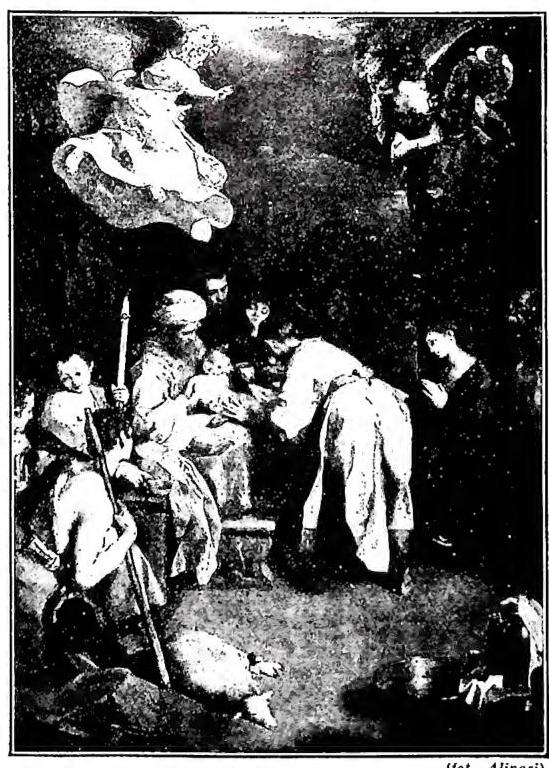
(fol. Alinari)
Barocci, Federico – The Circumcision – Paris, Musée du Louvre.

and, more precisely, a painter essentially in the manner of Correggio, who, like Correggio, anticipated various aspects and characteristic movements of the Baroque. From Correggio he also derived, carrying it to the point of over-refinement, a love for grace and delicacy of form. He was a great lover and observer of nature, hence the large number of his drawings. For his figures he used wax models on which he studied drapery. He took great care in the harmony of colors, to the point of calling painting “music.” Often, to achieve subtle shading, he used his thumb instead of a brush and altered hues with cinnabar and blues in his cartoons, arriving at excessive sfumato.

B.’s art influenced Rubens, Van Dyck, and Murillo.

BIBL.: G. P. Bellori, Le vite ecc. Rome 1672, pp. 169–166; R. Soprintendenza alle Gallerie e Musei della Toscana, Mostra dei cartoni e disegni di F. B. (Catalogo, with notes to the Vita of Bellori), Bergamo 1913; C. Ricci, s. V. ENOCH. Ital., VI, pp. 216–18 (with the preceding bibliography); G. Gronau, Documenti artistici urbinati, Florence n.d. (see index); H. R. Weihrauch, Einige unbekannte italienische Handzeichnungen in der Graphischen Sammlung zu München, in Münchner Jahrbuch der bildenden Kunst, 12 (1937–38, II); A. Petrucci, I fondi perduti del B., in Prima, 4 (1943, VII), pp. 135–36; W. R. Valentiner, Two Child Portraits by F. B., in Bulletin of the Detroit Institutes of Art, 24 (1944–45, II).