
BARTOLOMEO (Βαρθολομαίος, Bartholomaeus), APOSTOLO, SANTO. -
I. SACRA SCRITTURA
Uno dei dodici apostoli nel Nuovo Testamento nominato soltanto negli elenchi dei Sinottici (Mt. 10, 3; Mc. 3, 18; Lc. 6, 14), ove è unito a Filippo, e di Act. 1, 13. Il nome è un patronimico il cui doppio elemento è aramaico: Bar-Talmaj « figlio di Talmaj ». Talmaj ricorre nella Bibbia come nome di non ebrei (Ios. 15, 14; II Sam. 3, 3 e 13, 37 re di Gēšūr), i Settanta lo rendono Θολμί e Θολμαί (Volgata: Tholmai e Tholomai) e Fl. Giuseppe Θολμαίος (Ant. Iud., XIV, 8, 1; XX, 1, 1; Bell. Iud., I, 9, 3; trattasi di personaggi siri) forse per assonanza con Πολομαίος. I testi siriaci trascrivono Bar Talmaj.Benché la tradizione patriatica sia muta al riguardo, B. Nathanael (v.) di cui parla solo il IV Vangelo ponendolo tra gli Apostoli (Io. 1, 45-51: vocazione dopo Andrea, Simone, Filippo; 21, 2: elencato dopo Pietro e Tommaso, prima dei « figli di Zebedeo »). Primi a proporre questa identità, ma in forma dubitativa, furono, tra i siri Išō'dād di Merw (sec. IX), tra i latini Ruperto di Deutz (m. nel 1129; PL 169, 273); più tardi l'ipotesi fu appoggiata da C. Giansenio di Gand, A. Salmeron, Corn, a Lapide, A. Calmet, sostenuta di proposito da due gesuiti: J. Roberti (1620) e il bollandista Joh. Stilling (Acta SS. Augusti, V, Anversa 1741, pp. 1-34), e oggi è comunemente ammessa (J. Knabenbauer, J. Belser, E. Le Camus, M.-J. Lagrange, F.-M. Braun, U. Holzmeister, Th. Zahn, F. Prat, Th. Innitzer, ecc.).
Nathanael (« diede Dio », senso identico a Mattaj e Mattijāh) doveva essere il nome personale, mentre B. era il cognome (come per Simone Barjōnā'). Era galileo di Cana (Io. 21, 2; cf. 2, 1), ove oggi una chiesa è dedicata a s. B. Dal racconto giovannoso della sua vocazione all'apostolato, appare d'indole riservata e pensosa. Condotto da Filippo, è lodato da Gesù (2, 47 « ecco veramente un Israelita in cui non è dolo ») che gli rivela i suoi segreti; onde esce entusiasta in una professione di fede che prelude a quella di Pietro (Mt. 16, 16): « Tu sei il figlio di Dio, tu sei il re d'Israele » (Io. 2, 49). È poi presente all'apparizione del Risorto sul lago (Io. 21, 2). Con il collegio apostolico B. riceve lo Spirito alla Pentecoste (Act. 1, 13).
L'apostolato successivo di B. dev'essere stato attivissimo, poiché la tradizione posteriore gli attribuisce lunghi viaggi missionari; ma nulla di preciso si può stabilire.
Eusebio (Hist. Eccl., V, 10, 3; PG 20,456) narra che Panteno (verso l'anno 200) trovò in India il Vangelo di Matteo in ebraico (aramaico) e si sentì dire che vi era stato portato da B.; ciò ripete s. Girolamo (De vir. ill., 36; PL 23,651); ma non si sa se l'India « designi le regioni prossime
(fot. Anderson)
la figlia, fu martirizzato: crocifisso, secondo la tradizione diffusa in Oriente; decapitato secondo i Martirologi di Rabano Mauro, Adone, Usuardo (PL 110, 1164; 123, 185; 124, 394); la decorazione di s. B. è affermata da s. Isidoro di Siviglia e dal Martirologio di Beda (PL 83, 1291; 94, 1016) ed è comunemente ammessa presso i Latini dalla fine del medioevo (ma J. de Ribera [1588-1652] di pinge 12 volte [K. Künste, p. 117] la crocifissione di s. B.). Le sue spoglie furono trasportate a Martyropolis o Majāfārgin dal vescovo Mārūtā (ca. 410), poi a Darae in Mesopotamia (o Anastasiopoli in Frigia?) dall'imperatore Anastasio I (ca. 507; Teodoro Lettore, 2, 57; PG 86, 211); Vittore di Capua nel cod. Fuldense le dice in Frigia (ca. 546), poi appaiono a Lipari (ca. 580), a Benevento (ca. 838); oggi sono venerate a Roma, a S. Bartolomeo all'Isola, ove sarebbero state portate da Ottone III (983). S. Gregorio di Tours narra la traslazione miracolosa del corpo di s. B. a Lipari (De gloria mart., 33; PL 71, 734); Teodoro Studita (PG 99, 800 sg.) e Niceta Paflagone (PG 105, 213-17) dall'Armenia a Lipari e a Benevento; Niceta è riprodotto nell'Encomio di s. B. del monaco Giuseppe (Cod. vat. gr. 984; palinsesto del sec. IX-X, ff. 90-95, 265-71). La festa di s. B. è celebrata dai Bizantini l'11 giugno, dai Latini (almeno dal sec. VIII) il 24 ag., dagli Armeni l'8 dic. e 25 febbr., dai Copti e Etiopi il 18 giugno e 20 nov.
I. Lévy (contraddetto da J. Halévy) e B. Heller fanno dipendere dalla tradizione cristiana su B. la leggenda talmudica (Mē'ilāh, 17b) del demonio Ben-Temalion, e ricollegano entrambe a fonti indiane.
Antonino Romeo
II. ICONOGRAPHY
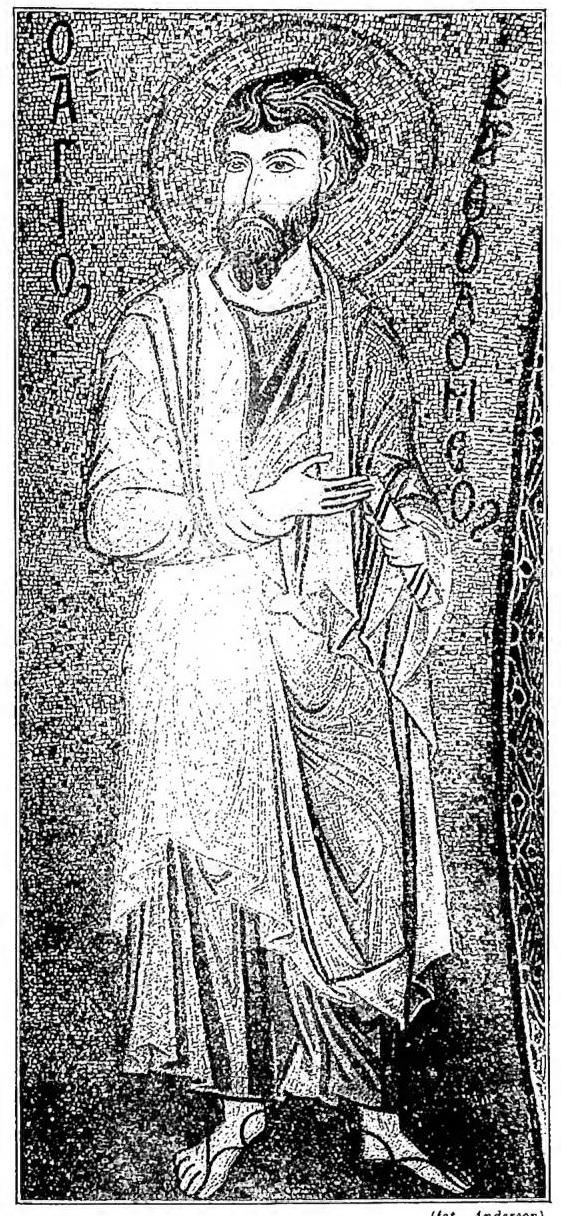
He originally carries a book or a scroll, the symbol of his apostolate; from the 13th century onwards, a knife, the instrument of his torture, and his own skin. The oldest representations of the saint are found in some mosaic medallions in Ravenna (5th and 6th centuries) and in a fresco in S. Maria Antiqua in Rome (ca. 705); later iconographic documents consist of a relief in the church of the same name in Rome (12th century), a statue in Mainz (ca. 1250), another by Michelozzo in Montepulciano, and the veristic statue by Marco d'Agrate (1562) in the Duomo of Milan, as well as the famous figure in Michelangelo's Last Judgment in the Sistine Chapel, featuring the painter's self-portrait in the skin hanging from the saint's left hand. Aside from individual episodes, traceable as early as the 9th century, "stories" from the legend of B. are represented in a 14th-century stained-glass window in S. Francesco in Assisi. The suggestion of the cruelty of his martyrdom meant that most of the artists who illustrated the scene belong to the late German Gothic period (Strigel, Holbein the Elder); the theme was also dear to artists of the Baroque era (Mattia Preti, Salvator Rosa, and Ribera, who treated it no fewer than twelve times), both for effects of refined painful expression and for the opportunities the subject offered to display a knowledge of anatomy.IV. PASSION (MARTYRDOM) OF B
A writing (5th or 6th century) that recounts the mission and martyrdom (scourging, then decapitation) of the Apostle St. B. in India, sometimes called Acts of B. Two different recensions remain, one Greek (Μαργύριον Βαρθολομαίου), the other Latin (Passio Bartholomaei); perhaps the original was Syriac. R. A. Lipsius detected traces of Nestorianism in II. Against Lipsius, M. Bonnet demonstrates that the Latin text (in numerous manuscripts of the 8th-15th centuries) is original with respect to the Greek (a single manuscript of the 13th century).V. VANGELO DI B
Apocryphon, composed in the Egyptian Gnostic milieu (3rd century), belonging to the group of those esoteric pseudepigrapha with an apocalyptic background in which the risen Jesus reveals a mysterious point of Gnostic doctrine to an apostle. It is mentioned by St. Jerome (Comm. in Matth., prol.: PL 26, 17), by the Gelasian Decree (E. V. Dobschütz [*Texte u. Untersuch., 38, IV], Leipzig 1912, pp. 11 and 51), and by St. Bede (Comm. in Lucam., I, 1: PL 92, 307); in the East, by Ps. Areopagite (Myst. Theol., I, 3: PG 3, 1000) and by the monk Epiphanius (12th century), who invokes the testimony of B. for the testament of Mary (De vita SS. Deiparae, 25: PG 120, 213). But all trace of it had been lost, and scholars used to identify the Gospel of B. with the Hebrew Matthew brought to India by B. and found there by Pantaenus, according to Eusebius (Hist. Eccl.*, V, 10). The Gospel of B. was substantially reconstructed between 1863 and 1913; a standard redaction is known (important fragments in Greek, Slavic, Latin), alongside a divergent recension in Coptic. The apostle B. questions the risen Jesus on various mysteries, especially on the descent into hell (narrated at length), or asks Mary for details about the Incarnation. Finally, the final struggles between Christ and his adversary are foretold. According to J. Kroll, the « Questions of B. » contain the earliest mentions of Jesus' descent-struggle into hell. The original work appears to have been
composed in Greek in the 3rd century (according to J. Kroll in the 2nd century), within a Christian sect detached from the Church of Alexandria.
A. Wilmart and E. Tisserant published (1913) the (fragmentary) Greek text from ms. 13 of St. Sabas (now in Jerusalem), dating from ca. 1000. The Slavic text (« Questions of the holy apostle B. ») was edited by Tichonravov (1863), and Vassiliev published a parallel Greek text (1893); N. Bonvetsch utilized (1897) an analogous text in the Serbo-Slavic dialect. The primitive Greek text can be largely reconstructed with the help of the two Slavic texts.
Discovered by Card. A. Mai (1854), Latin fragments (in Cod. Vat. Regimen, 1050) were published by A. Wilmart and E. Tisserant. U. Moriceca published a new Latin text (ms. 1880, 11th century, from the Casanatense Library): Interrogatio beati B. apostoli, vel aliorum apostolorum cum Domino Jesu Christo.
Of a different content are the Coptic (Sahidic) fragments, which appear to constitute five or more derivations from a common text of the 5th or 6th century, composed on Greek sources. Sometimes they are called Apocalypse of B. They were published by E. Dulaurier (1835), by A. Harnack and Schmidt (1891), by P. Lacau (1904), by E. Révillout (PO 2, 2, 123-98, and Revue Biblique, new series, I [1904], pp. 167-87, 321-55), by R. de Rustafjaell (1909), and by E. A. Wallis Budge (1913).