
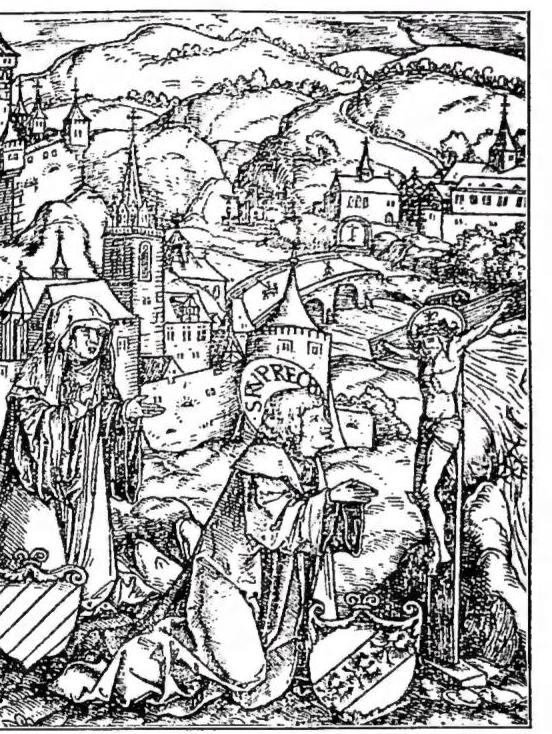
RUPERTO di DEUTZ (Rupertus Tuitiensis). — Theologian and Benedictine abbot, born in Liège around 1075, died at Deutz in 1130. A monk at S. Lorenzo di Liegi, he was ordained a priest in 1110 and in 1115 moved to the monastery of S. Michele di Sieburg (Cologne). Elected abbot of S. Eriberto di Deutz (1120), he had the misfortune of witnessing the burning of his monastery (1128).
A writer of astonishing fertility, he dealt predominantly with exegetical and theological subjects. After some youthful works (hymns and a chronicle of S. Lorenzo di Liegi), in 1111 he composed his first major work, De divinis officiis (PL 170, 11–332), a strongly symbolistic explanation of the Divine Office (I, I), the Mass (I, II), and the liturgical year (II, III–XII). The De voluntate Dei (ibid. 437–54) and the De omnipotentia Dei (ibid. 453–78) concern his
RUNE — Stele of Sanda, with a runic inscription (ca. A.D. 1000). In the upper part, the arrival of a warrior in Valholl is probably represented. On the right, Odino; on the left, Frigg. In the lower scene, three men can be seen who appear to be carrying the symbols of the Odinic triad: the spear of Odino, the hammer of Thor, and the sickle of Freyr — Sanda (Gotland).
The De S.ma Trinitate et eius operibus in 42 books (PL 167), written in 1114-17, is a prolix exegesis of the first books of the Old Testament, of the Major Prophets, and of the first chapters of the Gospels, in which R. dwells on the passages that best serve his purpose. The final 9 books deal with the works and gifts of the Holy Spirit. The following commentaries were then written: In Job (PL 168, 963-1196): a compendium of the Moralia of S. Gregorio Magno; In Prophetas minores (ibid. 9-836): a mystical interpretation; In Canticum Canticorum (ibid. 939-62): applied to the Incarnation and the Virgin; In Librum Ecclesiastes (ibid. 1195-1306); In Apocalipsism (PL 169, 827-1215): interpreted—with some regard for the literal sense—as a prophecy concerning the concrete life of the Church in its historical development; it is perhaps R.’s finest exegetical work. The De victoria Verbi Dei in 13 books (ibid. 1215-1502), written at the request of Abbot Cunone (ca. 1118), is an outline of a theology of history, from the fall of the Angels to Christ’s victory over the Antichrist. The work is completed by the De gloria Filii hominis super Matthaeum in 13 books (PL 168, 1307-1634), in which the adoptionism (v.) of the 12th century is combated. The De glorioso rege David in 14 books (lost) was a commentary on the Books of Kings, in which R. exalted the reign of Christ prefigured by that of David. At the request of Cunone, by then bishop of Ratisbona, R. wrote two works of anti-Jewish polemic: Annulus seu
dialogus christiani et iudaei in 3 books (PL 170, 559-610) and De glorificatione Trinitatis et processione Spiritus Sancti (PL 169, 9-202); in the latter he seeks to demonstrate that the Old Testament contains in semine the Christian doctrine concerning the Trinitarian Mystery. The De incendio oppidi Tuitii (PL 170, 333-50; MGH, Scriptores, XII, pp. 629-37) is of historical importance; the Super quaedam capita regulae divi Benedicti abatis (ibid., 477-538), written after his visit to Montecassino (1124-25), is instead an essay offering a personal interpretation of Benedictine life. R. brought his laborious existence to a close with the De meditatione mortis (ibid., 357-90), a dialogue between the author and his own soul.
An extreme allegorist in exegesis and an avowed opponent of dialectic in theology, R. di D. was possessed of feverish and undisciplined activity; although he displayed broad learning, lively stylistic vigor, and sincere piety, he failed to produce a truly constructive work. None of his works has imposed itself upon the consideration of posterity. He is remembered less for his numerous and ingenious insights—which might be further developed—than for his Eucharistic views, which from the outset provoked suspicions and accusations (cf. Guglielmo di Saint-Thierry, Ep. ad quemdam monachum: PL 180, 342), and which even later benevolent interpreters have been unable to demonstrate as wholly unfounded. Indeed, he began with a decidedly dyophysite conception of the Mystery of the altar—a kind of Eucharistic Nestorianism, which entered history under the name of “impanation”: he asserted the simultaneous presence of the two natures (the humanity of Christ and the unchanged substance of the bread), united in the person of the Word: « Verbum immudum caro factum, panis visibilis fit, non mutatum in panem, sed assumendo et in unitatem personae suae transferendo panem » (In Io. 6: PL 169, 181). Nor was he any more successful in the terminology concerning the Eucharistic species and the mode of Christ’s bodily presence; nevertheless, in his mature works he softened the harshness of some expressions.