
ANTICRISTO. – Adversary of Christ who, at the end of time, will seduce many Christians by satanic marvels and cunning, and will finally be parousia (v.). The term ἀντίφωνος (“anti-Messiah”), which occurs four times in the New Testament, implies the twofold sense of the prefix ἀντί: supplanting (as in Philo ἀντίθεος, “impious”; whereas in Homer ἀντίθεος has a laudatory sense: “almost divine, like God”), and opposition (as in ἀντίθεος, ἀντίθιος). The A. is Christ’s arch-enemy, whose dignity and dominion he usurps, or attempts to usurp.
The concept, developed more precisely in the Pauline and Johannine writings, exists only in embryo in the Old Testament. From the very “proto-gospel” (Gen. 3:15), the religious struggle is outlined between the Messiah at the head of the righteous and Satan with his satellites.
The Prophets point out the hostility of the Gentiles, whose kings represent peoples rather than individuals (cf. Is. 34): “Pharaoh” is the first enemy king defeated by Yahweh; he is followed by the king of Babylon (Is. 14:4-17; 21:1-10), Sennacherib, Nebuchadnezzar, Antiochus IV Epiphanes, and Pompey. These powerful enemies of Yahweh, whom the Messiah-King will crush (Ps. 2 and 109), become, when transposed onto the eschatological plane, types of the A. From the time of the exile onward, the prophetic descriptions of the “end of time” are dominated by the aggression and defeat of the enemy of God, whose notion becomes increasingly defined as opposition to Israel’s theocracy, conceived as the Kingdom of God. Ezekiel already traces the features of the A. in the oracles against Tyre (28:2, 9) and against the various uncircumcised kings (32), and in the allegory of Gog, the ferocious assailant who is annihilated with his forces on the mountains of Israel (38–39), provides the first “personification of the A.” (E. Tobac, Les prophètes d’Israël, II, Malines [1921], p. 417). Joel (3) and Zach. (1:7-14; 5:5-11; 12; 14:1-19) reinforce the antithesis between the two kingdoms, the divine and the satanic: victory over the enemy fills the great “day of Yahweh”; but they do not name a leader of the coalition of the powers of evil.
Daniel presents Antiochus IV Epiphanes as a typical monster of iniquity (7:8; 8:9-14, 23-26; [9:27]; 11:21-45), who by flatteries and violence brings about the summit of wickedness foretold for the end of time. J. Knabenhauer (Comment. in Dan. proph., Paris 1897, pp. 192, 267), invoking the authority of many Fathers, maintains that Dan. 7:8 and 9:27 speak of the A.; on the contrary, S. R. Driver (The Book of Daniel, Cambridge 1912, p. xcvii) and J. A. Montgomery (The Book of Daniel, Edinburgh 1927, p. 83) assert that it is entirely inaccurate to speak of a Danielic A. In reality, Dan. typologically foretells the A. in Antiochus IV (J. Götzberger, Das Buch Daniel, Bonn 1929, p. 93; J. B. Pelt, Histoire de l’A. T., II, 7th ed., Paris 1925, pp. 357-83). From this point onward, the picture of the eschatological opposition to the Kingdom of God and of the future enemy-king of God will be modeled on the Danielic pattern: the enemy of Israel increasingly emerges as the enemy of God, until in the New Testament God and the anti-God (the Messiah and the anti-Messiah) remain alone on the field.
In the Jewish “apocalypses,” meanwhile, the political aspect of the enemy of God remains: he is the enemy of the Jews, namely Rome, with which the pagan world is by now identified. The Roman oppressor (Pompey) in the Psalms of Solomon 2 and 17 is par excellence “the sinner,” “the impious one,” indeed the “dragon.” In IV Esd. 5:6, “he will reign whom the inhabitant of the earth does not expect”: this undesirable figure seems to be the A. (B. Violet, Die Apokalypsen des Esra und des Baruch, Leipzig 1924, p. 26); cf. Apoc. Baruch str., 36 and 40. In the Testaments of the XII Patriarchs (Lexi 18:12) and the Assumption of Moses 8, the anti-Messianic struggle is launched by Beliar; in III Sibyll. 63-76, Beliar brings back Nero. The revived Nero (cf. Tacitus, Hist., I, 2; II, 8; Suetonius, Nero, 40, 57) appears in IV Sibyll. 109-14, 137-45; V Sibyll. 1-51, 215-246, 361 ff.; VIII Sibyll. 146-58; in the Ascension of Isaiah 4:2-18, Beliar is incarnate in a king (Nero). From these writings R. H. Charles infers that around A.D. 90 the myths of Beliar and of Nero “reversurus” were fused.
It is therefore certain that ancient “Jewish literature knows no personal A.” (J. Bonsirven), nor any properly human A. The thesis of W. Bousset, according to which the A. is a Jewish legend accepted by Christians, consequently lacks foundation. In the apocrypha, Beliar (who is not an eschatological entity) and other incarnations of evil do not appear in direct anti-Messianic struggle; rather, at the appearance of the Messiah and his Kingdom, they disappear. A kind of A. is Armilius (already in Torgum Jonathan 2 Is. 11:4, where it seems to be interpolated), which, however, belongs to the Gaonic literature of the eighth century A.D. (D. Castelli, Il Messia secondo gli Ebrei, Florence 1871, p. 239 ff.). Cf. H. L. Strack-P. Billerbek, Komm. zum N. T. aus Talmud und Midrasch, III, Munich 1926, pp. 637-40. The eschatology of the Christian apocrypha, on the other hand, gives great prominence to the A., whom Jesus’ parousia will annihilate (Apocalypse of Elijah, second or third century).
In the New Testament, the nationalistic perspective that identifies the “enemy of God” with the Gentiles disappears. Anti-Messianism instead becomes a sad characteristic of Judaism (Act. 4:24-32; I Thess. 2:14-16; 4th Gospel; Apoc. 2:9; 3:9). The Gospels do not mention an individual A. Jesus foretells many pseudo-Christs (cf. Deut. 18:20) and false prophets (Mt. 24:11, 25; Mc. 13:22; Io. 5:43 b), whose doctrines and deceptive marvels will lead many astray: these stand in relation to the A. as the 2nd Beast of Apoc. 13 stands in relation to the 1st Beast. But in I Io. the false prophet (4:1-3) is identified with the A. (2:22: identical characteristics); cf. Apoc. 16:13; 19:20; 20:10. The Fathers directly apply Io. 5:43 b to the A.; for example, Origen (Tractatus de libris ss. Scripturarum, ed. Batiffol, Paris 1900, p. 116).
The A. appears explicitly in II Thess. 2 (ca. A.D. 52) as “the man of sin”: vv. 3-5 describe him as anti-God, vv. 6-12 as anti-Christ. The adversary (ὁ ἀντικείμενος) of God is “the son of perdition, who exalts himself above everything that is called God or receives divine worship, to the point of seating himself in the temple of God and displaying himself as God” (v. 4). For the present he is restrained by a living and rational force (τὸ κατέχον) (ὁ κατέχων), and therefore carries out his wicked work secretly (τὸ μυστήριον τῆς ἀνομίας); when the obstacle is removed (at the end of time), “the apostasy” will occur: the lawless one (ὁ ἀνόμος) “will appear in every power through the operation of Satan, with deceptive marvels and every kind of sinful seduction, for the perdition of those who will have believed the lie and not the truth” (vv. 9-12); but Jesus will appear and annihilate the lawless one (v. 8): the two opposing “parousies” are set against each other. Here, as Ps.-Barnabas, Justin (C. Tryph., 32, 110), Irenaeus (Adv. Haer., V, 25, 4; 28, 2), and Hippolytus already understood, the subject is the A. (“Significari Antichristum nullus ambigit”: St. Augustine, De Civ. Dei, 20, 19), whom the Apostle describes with the features of Antiochus IV expressed by Dan. 9:35-45; 11:21–12:1 (J. B. Orchard). Paul distinguishes two periods: the A. already exists and operates secretly; at the end, however, he will have complete freedom of action (cf. Apoc. 17:8; 20:3 b, 7), but after a brief triumph he will be defeated by Jesus (cf. Apoc. 20:3 [“modico tempore”], 8-9).
Similarly, Giovanni, the only hagiographer who uses the term ἀντίχριστος (four times in the first two epistles), distinguishes the two periods; but for his parenetic purpose he insists on the present, whereas Paolo had to explain to the Thessalonians “the apostasy” as a sign of the end. In the epistles Giovanni states that the A. “is already in the world,” indeed that there are already many of them (I, 2, 18, 22; 4, 3; II, 7). He alludes to the eschatological expectation (I, 2, 18; 4, 3), adding that the present existence of a multitude of deniers of Christ is a sign that we have reached the end of time (I, 2, 18); the impostors who deny Christ are moved by “the spirit of the A.” (I, 4, 3), that is, by Satan. The A. is like an ideal type; in reality he manifests himself in a plurality of opponents of Christ, architects of the final “apostasy” (cf. I Tim. 4, 1-2; II Tim. 3, 1-5; 4, 3-4; Tertulliano, De praescriptione, 4, 33). Policarpo (Ad Phil., 7, 2) echoes his teacher Giovanni.
The Apoc. is the prophetic tableau of the struggle between Christ and the A., as St. Ireneo observes (Adv. Haereses, V, 30, 3; PG 7, 1207; and in Eusebio, Hist. eccl., III, 18), or rather between the two collectivities (the Church and the unbelieving world) that rally around them.
The Beast from the sea (13, 1-8), derived from Daniel, blasphemous and fighting against and conquering the saints of God, upon which Babylon sits, chapter 17, is the political A., that is, the worldly power and civilization then centered in Rome. The Beast from the earth (13, 11-17) is subordinate to it as its “prophet” (16, 13; 19, 20; 20, 10): it is a pseudo-lamb (pseudo-Christ) and, as the “high priest of the A.” (Ippolito), by means of prodigies seduces the peoples into worshipping the first Beast. The two Beasts represent the perpetual A. under its two aspects, political and intellectual (dominion and propaganda, power and seduction). The enemy who arouses and directs the entire anti-Christian struggle is Satan (the Dragon), who nevertheless does not intervene openly (2, 24). Having been unable to devour Christ (12, 4-5), and cast down to earth, he persecutes the “other children” of the Woman and launches two earthly lieutenants against humanity (the two Beasts), just as Christ has his two witnesses (11, 1-13), who are one single reality (the Church). According to a constant rhythm, the opposition between Christ and the A. is depicted in symmetrical antithesis: both are kings of the earth (1, 5 and 2, 7; 13, 2, 7); Christ is lion and lamb (5, 5-6), while the A. is a hybrid beast (13, 2); the Lamb (Christ) has seven horns and seven eyes (5, 6: “the seven spirits of God”; 4, 5), while the Beast has seven heads and seven horns (17, 9: “the seven emperors”); Christ and the A. are enthroned (14; 13, 4, 12). The A. is therefore a caricature of Christ, and the kingdom of sin is the sacrilegious counterfeit of the kingdom of God. To the features of Antioco IV already adopted in describing the A., the Apoc. discreetly adds those of Nerone (13, 18; 17, 8-12). The Apoc. too distinguishes the two periods: the struggle against the anti-Christian forces of persecution and persuasion is already now most fierce, attested in heaven by confessors and martyrs (2, 10-11; 7, 14; 14, 9-11; 14, 12-13; 20, 4), but it will culminate at the end of time with the unleashing of the satanic powers, which will finally be defeated forever (16, 13-16; 20, 7-10). The Apoc. of Elia and nearly all exegetes (except Ticonio) up to the seventeenth century saw in 11, 3-13 the struggle of the A. against Enoch and Elia.
The Didaché 16, 3-4 announces that in “the last days” pseudoprophets and corrupters will multiply, among whom will emerge the deceiver of the world, passing himself off as the Son of God (φανέρεται ὁ κοσμοπλάνης ὡς υἱὸς θεοῦ); he will perform prodigies and rule the earth. The Epist. Barnabae announces the imminent final apostasy (4, 3: τὸ τέλειον σκάνδαλον ἤγγικεν), “as Enoch says” (Enoch etiop. 89, 61-64; 90, 17) and Daniel (Dan. 7, 7 ff. 24), and recommends that one “resist” (as in I Pt. 5, 9) during the period of impiety (ἐν τῷ ἀνόμῳ καιρῷ), so that “the Black One” may not stealthily enter (4, 9: ὁ Μέλας), that is, the A.
The Fathers regard the A. as a false Messiah, an instrument of Satan; the Messiah awaited by Judaism is, for Christians, the A. (E. A. Sophokles, Greek Lexikon of the Roman a. Byzantine Periods, Nuova York 1900, p. 192): “Antispistum pro Xpisto recepturi sunt” (Origene, op. cit., p. 31). They generally consider him a Jew from the tribe of Dan (Ireneo, V, 3; Ippolito, De Antichristo; Girolamo, In Danieleum, XI; Ambrogio, De benedictionibus Patriarcharum 7; Agostino, Quaestio 22 in Josue; Teodoreto; Andrea di Cesarea; Gregorio Magno, Isidoro, Beda; this was admitted as probable up to St. Antonino in the fifteenth century), or “a king of the Jews” (Primasio). Dan’s grim privilege is deduced from Gen. 49, 17 and from the omission of his name in Apoc. 7, 5-8. At times Nerone redivivus is regarded as the A. (Cirillo Gerosol.), under the title of “king of the Jews” (Vittorino di Pettau), or as the precursor of the Jew from Dan (Commodiano, Lattanzio). Later Jews would make the “man of sin” a son of Satan and of a woman (Simeon ben Johai; Apoc. of Daniele). In modern times J. Mariana, Scholia in V. ac N.T., Madrid 1619, returned to the legend, disseminated around the year 300 by Vittorino (Comm. in Apoc., 17, 9-16) and Commodiano (Carmen. apolog., 825; Instructiones, I, 41, 7), who identified the A. with Nerone redivivus; E. Renan transformed it into an axiom that he placed at the foundation of his interpretation of the Apoc. (L'Antéchrist, Parigi 1873). For Renan, as for the other rationalists, the A. is a popular legend; W. Bousset vindicates its historical-religious, psychological, and folkloric importance.
It would seem that the crystallization of the concept of the A. as a single person occurred in late Jewish apocalyptic literature (first century), from which it passed to the Christians. From the second century to the present, the near unanimity of Catholics, along with distinguished Protestant exegetes (Th. Zahn, G. Wohlenberg), has accepted the A. as an individual person; F. Suárez (De mysteriis vitae Christi, disp. 54, sect. I, n. 7) declares this to be “res certissima et de fide,” and more recently B. Rigaux has extensively defended the thesis of an individual A., concluding (p. 397): “In the New as in the Old Testament, the final opposition to the kingdom of God, although collective, takes concrete form in an individual.”
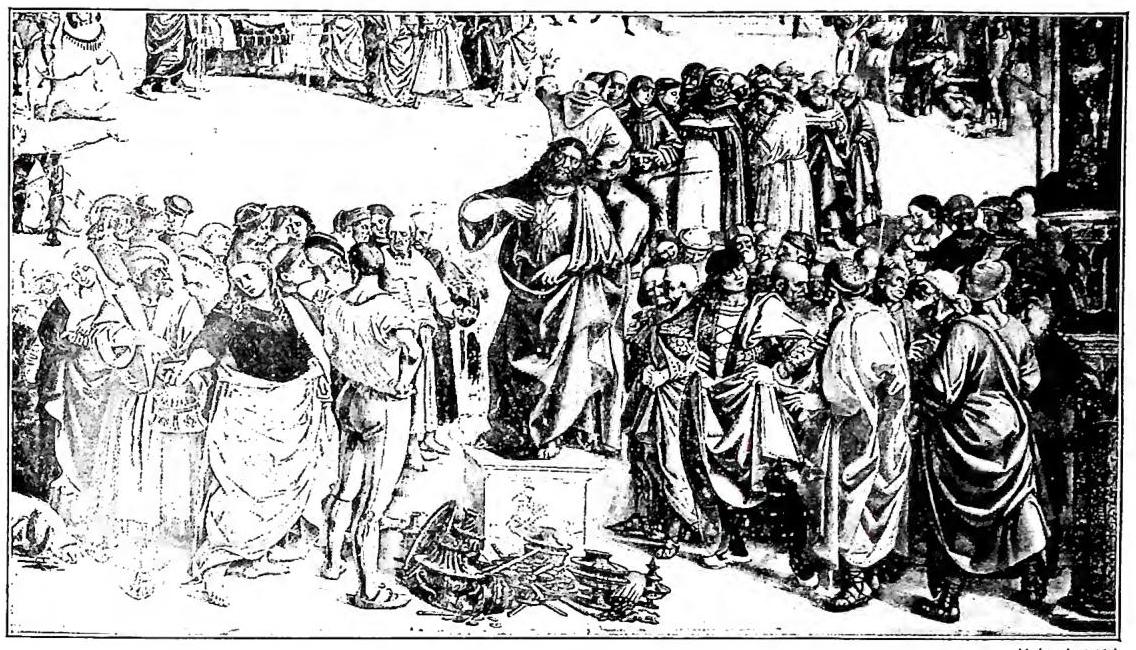
(phot. Annar)
The individual A. does not seem to figure in the biblical writings. In the New Testament, “the man of sin” of II Thess., the A. of the Johannine epistles, the two Beasts of the Apoc., the false Christs and false prophets (with the “abomination of desolation,” v.) of the Synoptic apocalypse, are various descriptions of the same opposition to God and to Christ (B. Rigaux, p. 386). Now, this impious opposition always appears as collective. The only passage cited in favor of an individual A. is II Thess. 2:3-12 (B. Rigaux, pp. 275-87). But the whole context forbids understanding “the man of sin” here
as a single man who will be born and live at the end of time, since he already exists (vv. 4-7), insofar as “the mystery of iniquity is already at work” (v. 7); at the end there will occur his full manifestation or parousia, which for now is held back by the “obstacle” (τὸ κατέχον). The “obstacle,” which seems to be—as St. Thomas observes, followed by B. Allo and D. Buzy—the true preaching of the Gospel (the convergence of II Thess. 2:3-12 with Mt. 23:11 ff., 24; I Tim. 4:1-2, where “apostasy” is connected with false preaching; Apoc. 11:6-7), operating as the “power of God” (I Cor. 1:18; Rom. 1:16), is a present and enduring reality that prevents the “lawless one” from revealing himself in all the “activity of Satan,” not from being born. Since the “obstacle” is simultaneous with and opposed to “the man of sin,” the nature of the latter must be established consistently with that of the “obstacle,” which is universally regarded as a collective power that will continue until the last generation. The sign of Christ’s parousia is not the existence of the A., but his triumphant appearance in Satan’s lying power. Employing the personification disseminated chiefly by Daniel (Antiochus IV Epiphanes: V. 8, τῇ ἐπιφανείᾳ), Paul gives a personal aspect to the collective and perpetuating power of evil, thereby imparting dramatic movement to the antithesis (cf. I Cor. 4:6). “The man of sin” can be called individual only insofar as he embodies a type. It may also be admitted, as a hypothesis, that the power of evil will ultimately be put into operation “by a future man who will know all the forces of iniquity” (B. Allo, p. cxiv). But ever since the apostolic age, we have been living in the “end of time” (I Cor. 10:11), and Jesus’ victorious campaign against his enemy is under way (Io. 16:33; Apoc. 2:27; Eph. 1:21-22); Jesus’ parousia will mark the decisive clash, the epilogue to eternal triumph, after the monster’s final convulsion.
This collective interpretation of the A., introduced today among Catholics by P. Pierini and B. Allo, and incisively advocated by D. Buzy, followed by J. Bonsirven (Epitres de s. Jean, Paris 1935, p. 135) and F. Amiot (L'enseignement de s. Paul, II, 4th ed., Paris 1946, pp. 211-14), corresponds to the New Testament conception of the kingdom of evil opposed to the Kingdom of God realized by Christ. The A. is implicit in the Pauline passages concerning the dark power that governs this world, a kingdom opposed to the Kingdom of Christ (Eph. 6:12; Col. 1:13; cf. Lc. 22:53), because it is ruled by Satan, the “prince of this world” (Io. 12:31; 14:30; 16:11). The A. is characterized by the proud splendor of universal dominion and by imposture. The A. asserts itself throughout the centuries until it brings about the “apostasy”: it is a political-economic power that rules the seas and controls all commerce (Apoc. 13:17; 18:11-19); master of every means, it irresistibly subjugates and fascinates human beings through disguised violence and seductive promises, and through interest and pleasures alienates them from the heavenly Kingdom (Apoc. 13:3-17; 17:3-4, 17-18; 18:9-24); rather than directly combating God, it replaces him (ἀντίθεος) in human hearts, since this is the only way to annihilate his Kingdom. The A. is an eschatological being, since eschatological time begins with Christ’s first coming, around which the struggle and human drama unfold (death or life, perdition or salvation), and extends to his final parousia: therefore, from the presence of the A. it must be deduced that we are at the world’s final stage (1 Io. 2:18). But only the parousia of the A., with the consequent “apostasy,” will be a sign of the imminent end (II Thess. 2:3-12).
The mythical theory that identifies the A. with Satan is entirely unfounded. Already mentioned by Celsus (Origen, C. Celsum, 6:42), it is today upheld by H. Gunkel and chiefly by W. Bouset (A. Satan incarnate), followed by many non-Catholics, such as M. Friedländer and, in part, R. H. Charles. The sacred texts clearly distinguish Satan from the A., which is a vast human force working to expel God and his Christ, moved and guided by Satan.
The identifications of the A. with individuals or institutions have been innumerable; W. Bornemann presents the principal ones with erudition. From Caligula and Nero to Napoleon and Stalin, the A. was discerned in many politicians and heresiarchs. In the Middle Ages, the fearful expectation of the A. grew stronger, beginning with St. Norbert and St. Bernard; Uguccione da Lodi (13th century) and the Ludus de Antichristo popularized it; “Spirituals” such as Ubertino da Casale branded certain popes as A.; Guglielmo di Saint-Amour, Giacomino da Verona, Giovanni di Parigi, and Nicola de Clémanges treated of the A. for purposes of “reformist” polemic. The term is often used in a broad, practical sense; for example, St. Caterina da Siena designates the antipope Clement as “A., a member of the demon” (letter 306). The nearness of the A. was foretold by Fluentino da Firenze (condemned in 1105), Goffredo da Viterbo (1120-91), Arnaldo da Villanova (condemned in 1311) and many Joachimites, Bartolomeo Jassovesio (condemned by Urban VI), the Bohemian Milic (for the year 1365-67), St. Vincenzo Ferreri (De fine mundi et Antichristo, 1412), Manfredo di Vercelli, and the Sienese Sigismondo Tizio (d. 1528), in connection with the expected end of the world. The Fifth Lateran Council (Session XI, Constitution Supernas maiestatis, 19 December 1516; Mansi, XXII, pp. 945-47) had to prohibit preachers from announcing the imminent A. Yet the ven. B. Holzhauser (d. 1658) still preached that the A. would be born in the middle of the year 1855 and killed in the year 1911!
Launched by J. Wicleff, the identification of the A. with the pope pro tempore was advocated by Luther (as early as 1520) (H. Grisar, Luthers Kampfbilder, fasc. 1–4, Freiburg im Breisgau 1921–23). This became a Protestant commonplace which, although refuted by Bellarmine (De Romano Pontifice, III) and by J. A. Eudaemon (De Antichristo II, 3 adversus Rob. Abbotum Oxoniensem, Ingolstadt 1609), was advocated by many Englishmen, Germans, and Frenchmen of the various sects. The scholars J. Napier (A plainic Discovery of the whole Revelation of St. John, chap. 7, Edinburgh 1593) and I. Newton (Observations upon the Profecies of Daniel and the Apocalypse of St. John, London 1733, posthumous) took the trouble to vent such antipapalism in entire treatises. Only H. Grotius rejected this exegesis of hatred (Annotationes ad Nov. Test., Amsterdam 1641), and was therefore covered with insults. Most of these anti-Roman exegetes saw the pope-A. in the 2nd Beast of the Apocalypse, others in the 1st Beast or in both. From the eighteenth century, observing that the A. is an eschatological being and that the end of the world was not coming, some abandoned this theory, which, however, was still so widespread eighty years ago that Cardinal Newman, confessing that until the age of forty-two his imagination had been “soiled” by the Protestant hallucination that sees Rome as the capital of the A., had to refute it extensively (The Protestant Idea of Antichrist, in Essays Critical and Historical, II, London 1897; The Patristic Idea of Antichrist, in Discussions and Arguments on Various Subjects, London 1899).
In the face of the progressive apostasy of the modern world, reaction has sought to recognize the A. in modern materialistic, mechanical, centralizing “progress” (D. Mereškovskij throughout almost all his writings, e.g. Gesù sconosciuto, Italian translation, Florence 1933, pp. 256–61), Selma Lagerlöf in socialism (Die Wunder des Antichrist, 1897), and many today in Bolshevism (N. Berdjajev; F. Ossendovski, L'ombra dell'Oriente tenebroso, Italian translation, Milan 1928, pp. 188–92, 220; L. Cappuccio, U.R.S.S. Reges dell'A., Milan 1933). Outside the realm of literature, G. Combs, Le retour offensif du paganisme, Paris 1938, observes that in Freemasonry and Bolshevism there appears “the very presence of Satan” (p. 197), in accordance with the encyclical Humanum genus (20 April 1884), which denounces the occult forces promoting “apostasy” through the “implacable hatred of Jesus Christ that burns in Satan’s heart.” Leo XIII often denounced this growing apostasy, deploring “the abomination of desolation in the holy place” (Allocus. Consistory of 30 June 1889), the “struggle against religion” (Consistory of 30 December 1889), the “continual and most immediate danger of apostatizing from the faith” (Letter to the Italian people, 8 December 1892), “the advent of apostasy” (Letter to Cardinal Rampolla, 2 October 1895), the “fierce war against Catholicism” (Consistory of 15 August 1901; Letter to the Superiors General, 29 June 1901), “legal subversion” and “pagan naturalism” (Allocus. to the Sacred College, 23 December 1902). In his first encyclical (E apressi apostolatus cathedra, 4 October 1903), Pius X recognized the A. in atheistic and pagan society, in which he saw II Thess. 2:2–3 being fulfilled; he repeated this in the encyclical to the Bishops of Italy on Catholic Action (1 June 1905); in the encyclical Notre charge (25 August 1910), he condemned those Catholics “now forming a miserable tributary of the great movement of apostasy organized in every country to establish a universal Church without dogmas or hierarchy ... which, under the pretext of freedom and human dignity, would restore to the world the legal reign of cunning and force.” Pius XII now makes the tragic observation (Allocus. 7 April 1947): “Today the spirit of evil has been unleashed against the Church and against every human order, indeed against God himself and against Jesus Christ, with such fury as to foreshadow an imminent final resolution, were it not known that the struggle will last as long as the world and will be resolved only in God’s victory ... But meanwhile, how many victims!”
Impressive is the thesis of R. H. Benson’s masterpiece, The Lord of the World, London 1907 (Italian translation, Il dominatore del mondo, Florence 1900): the A. is humanitarian naturalism, which preaches moderation and peace and, by legal means, empties Catholicism of its substance; with persuasive simplicity it brings about secular leveling and the union of human beings in earthly enjoyment, receiving universal approval, “and it seems, at least from what we see, that the way has been opened to the most secret recesses of the human heart” (Italian translation, p. 154). The opinion of L. Billot (De Verbo Incarnato, Rome 1892, pp. 437–38; 6th ed., 1922, p. 618) and J. Meinvielle (De Lamennais à Maritain, Buenos Aires 1945, pp. 363–73) is no different.
Studi moderni. - W. Bornemann, Die Thessalonicherbriefe (in Kritisch-vergetischer Kommentar über das N. T. di H. A. W. Meyer), Gottinga 1894, pp. 348-75, 400-59, 556-706; W. Bousset, Der Antichrist in der Überlieferung des Judentums, des Neuen Testaments und der alten Kirche, Ein Beitrag zur Änderung der Apokalypse, Gottinga 1895 (con largo apparato «religionsgeschichtlich»); id., s. V. BENE. of Rel. and Ethics di J. Hastings, I (1908), pp. 578-81; id., Die Religion des Judentums im späthellenistischen Zeitalter (3ª ed. di H. Gressmann), Tubinga 1926, p. 254 seg., 316 seg.; R. H. Charles, The Ascension of Isaiah, Londra 1900, pp. LIII-LVII; id., The Revelation of st. John, II, Edimburgo 1920, pp. 89-90; M. Friedlander, Der Antichrist in den varchristlichen jüdischen Quellen, Gottinga 1901; C. Chauvin, Histoire de l'Antichrist d'après la Bible et les Saints Pères, Parigi 1903; G. Wohlenberg, Der erste und zweite Thessalonicherbrief (in Kommentar zum N. T. di Th. Zahn), Lipsia 1903, 2ª ed. 1900, pp. 141-58, 177-223; A. Lémann, L'Antichrist: choses certaines, choses probables, choses indicties, choses fantasistes, Lione 1905 (trad. II. di B. Neri, Torino 1908, 2ª ed. 1910); P. Pierini, De Antichristo, Perugia 1906; A. Lemonnier, in DFC, I, coll. 146-50; J.-M. Vosté, Comment. in Ep. ad Thessalon., Roma-Parigi 1917, pp. 194-221, 263-88; I. L. Ratton, Antichrist: An historical Review, Londra 1917; B. Allo, L'Apocalypse, Parigi 1921, pp. CXV-CXXI, 182-86, 198-214, 277-79; F. Prat, La Théologie de s. Paul, I, 12ª ed., Parigi 1924, pp. 94-99; D. Buzy, in DBL, fasc. I-II (1926), coll. 297-302; id., L'adversaire et l'obstacle (II Thess. 2, 3-12), in Recherches de Science religieuse, 24 (1934), pp. 402-31 (confuta B. Rigaux); J. Sickenberger, Die Johannesphilosophie und Rom, in Biblische Zeitschrift, 17 (1926), pp. 270-82 (sull'Anticristo-Papato dei protestanti); J. Kaufmann, s.V. Antichrist, in Encycl. Judaica, II, coll. 906-10; B. Rigaux, L'Antichrist et l'opposition au royaume messianique dans l'Auc. et le Nouv. Testament, Gembloux-Parigi 1932 (si il più ampio studio cattolico recente); F. Alcañiz, Ecclesia Patriotica et millenarius, Granata 1933, pp. 11-22, 27, 40-42, 99; J. Bonsirven, Le Judaïsme palestinien au temps de J.-C., I, Parigi 1934, pp. 464-65; L. G. Randal, The Mystery of iniquity and his historical experts, in Biblioth. Sacra, 91 (1934), pp. 354-68; G. Ritter, Das Judentum und die Schatten des Antichrist, 3ª ed., Graz 1938; J. Kroon, De Antichrist, in Studiën, 70 (1938, 1), pp. 204-12; J. M. Bover, El principio de autoridad, obstetalo a la aparición del Anticristo: un texto misterioso de s. Pablo (II Thess. 2, 3-8), in Razón y Fé, 118 (1939), pp. 94-103; J. Holzner, L'Apostolo Paolo (trad. it.), Brescia 1939, pp. 284-95; J. B. Orchard, St. Paul and the Book of Daniel, in Biblica, 20 (1939), pp. 172-79; E. Lohmeyer, s. V. in Reallexikon f. Antike und Christentum, I, Lipsia 1942, pp. 450-57; A. Arrighini, L'A., Torino 1945; P. H. Furfey, The Mystery of Lawlessness, in Cath. Bibl. Quarterly, 8 (1946), pp. 179-91.
Sull'A. nella concezione popolare e nella letteratura medievale: E. Wadstein, Die eschatologische Ideengruppe: Antichrist, Weltabbat, Weltende und Weltgericht, Lipsia 1896; H. Preuss, Die Vorstellungen vom Antichrist im späteren Mittelalter, Lipsia 1906; E. Bernheim, Mittelalterliche Zeitanschauungen in ihrem Einfluss auf Politik und Geschichtsbreitung, I, Tubinga 1918, p. 70 seg.; G. Hasenkamp, Das Spiel vom Antichrist, Münster 1933; L. U. Lucken, Antichrist and the Prophets of Antichrist in the Chester Cycle, Washington (Univ. Cattolica) 1940. Antonino Romeo