
CATERINA da SIENA, saint. — Dominican, born in Siena in 1347 (25 March according to tradition), died in Rome on 29 April 1380. Her father Jacopo Benincasa, a leather dyer in the Fontebranda district, had no fewer than twenty-five children by Lapa Piagenti, C. being the penultimate. Among her brothers are recorded: Benincasa, the eldest; Bartolo (who was married to Lisa Colombini); and Stefano. Her sisters included: Nicoluccia, Bonaventura, Lisa, Nera, Giovanna, C.’s twin, and Vanna. The deeply religious family environment influenced the little Eufrosina, as she was called in the neighborhood, who was precociously drawn toward the spiritual life. At six she had her first vision; at seven she vowed virginity, imitating the anchorites and wishing to become a missionary like the friars of S. Domenico di Camporeggi. At twelve her parents were already thinking of a husband for her; she rebelled, insisting on a life of penance and exceptional asceticism. To overcome her family’s resistance, she cut her hair on the advice of the Dominican Tommaso della Fonte, provoking a persecution that her father Jacopo brought to an end.
In 1363, after much insistence, she entered the Mantellate of S. Domenico, devoted to piety and works of mercy. Until 1370 C.’s life unfolded in continual asceticism, as she purified her soul and rose toward the perfection of charity.
The mortifications, penitential practices, and prolonged fasts, while making her complete mistress of her inner life, provoked in Siena’s religious circles a violent campaign of denigration and opposition. She responded by devoting herself still more to the sick of the Scala hospital, to the lepers of S. Lazzaro, and to caring for her sick sisters, who often repaid her with atrocious calumnies.
What influence did Urban V’s return have on C.?
(18 Oct. 1367). The biographers tell us nothing, being intent on collecting prayers and miracles. They also ignore Urban’s return to Avignon (5 Sept. 1370), amid the desolation of the Italians, who saw Italy once again fall into political anarchy; they ignore C.’s suffering over such a calamity.
While Urban V was leaving Italy, C., in Fontebranda, received in an extraordinary vision the mandate to leave contemplation and devote herself to the apostolate. First of all she formed a spiritual family, chosen from among ecclesiastics, men of government, men of letters and artists, men and women. Nor did she merely pour her intense spiritual experience into her disciples; she also absorbed from them the theological and mystical thought of the schools to which they belonged: Benedictines, Augustinians, Dominicans, Franciscans, and Jesuates.
C.’s reputation for holiness made Fontebranda a center of irradiation and attraction.
The collection of letters thus arose from the need, duty, and charity she felt toward the many who came asking for advice, a word of goodness. Uneducated herself, she dictated letters for scholars, great men, and men of letters.
In the Middle Ages politics and religion were so fused and interpenetrated that they could not be separated, and C. engaged in politics—not, however, in the modern sense. The Avignon Curia, which kept watch over the separatist movements of the Fraticelli, became afraid, as did the Dominican Order; consequently C. was summoned to Florence at Pentecost in 1374 before the general chapter of her Order to undergo a genuine trial. She prevailed. To defend her against further attacks, the Order guaranteed her orthodoxy by assigning her as director Brother Raimondo delle Vigne of Capua, a descendant of Pietro, chancellor of Frederick II. Gregory XI, Urban’s successor, prepared the Crusade and entrusted its promotion also to C., who went to Pisa, a maritime center, and made it her headquarters (1375). While writing to kings and military commanders, organizing and urging them on, she received, on 1 April, in the church of S. Cristina on the Lungarno, the Stigmata.
At that time Florence, for various reasons, pursued an anti-papal policy, placing itself at the head of all those discontented with the Patrimony of S. Peter, with the ambitious dream of attacking and destroying temporal power. It therefore sought to unite the Tuscan republics in a league, and these, willingly or unwillingly, fell into the net. C. restrained the Gambacorti of Pisa, and at Lucca begged the Elders not to join; she insisted with her own people in Siena, but achieved little. In June 1375 she attended the execution of Niccolò di Toldo, a Perugian, and afterward dictated the remarkable letter.
Events in Florence moved rapidly; war with the Pontiff seemed inevitable, despite the efforts of the Guelf party and the Italian republics to avert the scandal. While the Eight of War, sarcastically called the Eight Saints, pressed for a break, efforts were made to calm the three Avignonese, whose actions aroused fear of excommunication and interdict. And when, in March 1376, excommunication and interdict were imposed on Florence, C. was sent as the Florentines’ ambassador to Avignon. She was received benevolently and induced Gregory XI to show clemency; meanwhile, however, the war party gained the upper hand in Florence, and the ambassadors sent to Avignon no longer recognized C. In a letter to Bonaccorso di Lapo, she sharply reproached the rulers for their bad faith. C.’s presence in Avignon at the crucial moment of the papacy’s return to Rome was decisive, revealing to the Pontiff the vow he had made on the day of his election.
The documentation is complete, but the disciples’ reticence in attesting to the fact is significant. The Western Schism, which followed the return, gave rise to accusations against the Saint as the cause of so great a calamity, jeopardizing her canonization; the disciples therefore sought to reduce the importance of her work.
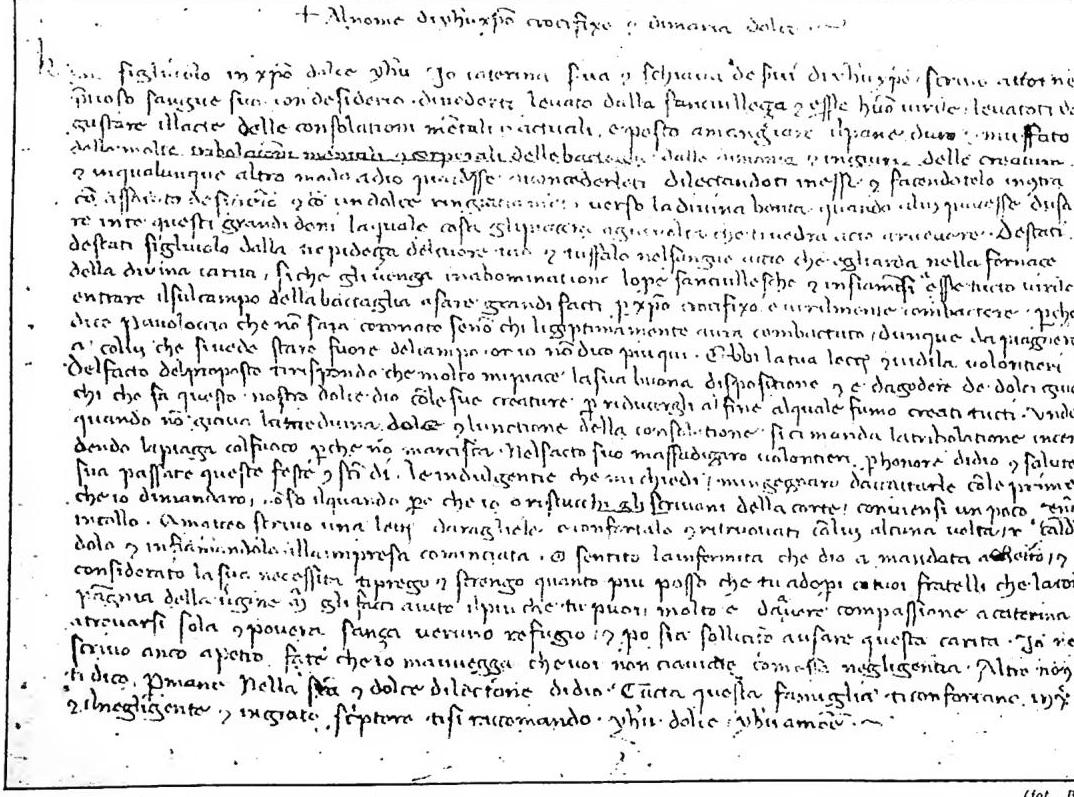
After years of delay, Gregory XI finally departed on 16 Sept. 1376. C. and her companions left the following day, and she encouraged the Pontiff when, at Genoa, pressed once more by the cardinals, he was reconsidering a return to Avignon. Back in Siena, she traveled through Val d’Orcia to reconcile the Salimbeni and catechize those populations. But her heart was always in Florence, in conflict with the Pontiff, who ordered her to return to the turbulent city to work for peace. It was a difficult mission amid the passions and factional struggles that in 1378 erupted in the riot of the « ammoniti », which placed C.’s very life in danger, and in the even graver revolt of the Ciompi. Meanwhile, in March 1378 Gregory XI died, and the peace negotiations, including the congress at Sarzana intended to resolve a matter of European concern, failed. The new pontiff, Urban VI, hastened the resolution of the problem, and finally, on 18 July, the olive branch of peace was hung at the Palazzo Vecchio amid the city’s rejoicing. C. returned to Siena as the horizon darkened, to continue her dialogue with the Eternal One, dictating the marvelous Dialogue of Divine Providence, the fruit of her continual instruction through her letters and of all her mystical experiences; the Dialogue is C.’s true « book ».
Meanwhile, the new pontiff Urbanus VI, an Italian, after seven French popes, had, with his harsh character, offended the sensibilities of the cardinals and of the Curia, which was almost entirely French. The opposition became so animated that it broke out into open revolt, resulting in the election of a new pontiff: Clement VII, elected at Fondi on 20 September 1378. Thus began the schism that tore the Church apart for forty years, causing every idea of a crusade or internal reform to founder. As early as 1375 C. had foreseen the coming schism; nevertheless, she worked for the Pope’s return to Rome, because Rome, not Avignon, is the seat of the papacy and of its bishop. In November 1378 she came to Rome, summoned there by Urbanus VI, and spoke in Consistory, reviving the Sacred College; she organized a veritable new Crusade, calling the most spiritual men to Rome, and established her chancery to send messages and letters to rulers and the Italian Republics, binding them to Rome by adhering to the true Pontiff. C. intervened to calm the Pope’s violence, worked for the capitulation of Castel S. Angelo, still in the hands of the French (1379), and urged the condottiero Alberico da Barbiano to drive out the foreigner, defeated at Marino on 30 April 1379. In a revolt organized by French emissaries, through her authority she secured peace between the people and the Pope (February 1380), while never ceasing to press Giovanna of Naples, who adhered to Avignon, to induce her to recognize Urbanus VI, though in vain.
Overcome by the immense labor, which she had endured with enthusiasm, she died on 29 April 1380 in a house near the Minerva (today Piazza S. Chiara). She had three solemn funerals, or rather three triumphs: one ordered by the Pontiff, another by the senator Giovanni Cenci, and the third by the Dominican Order. Miracles blossomed at her tomb, thus giving rise to a cult that grew in intensity in Rome and in the Church, which canonized her in 1461 under the pontificate of Pius II, Piccolomini. Pius IX declared her co-patroness of Rome, and Pius XII principal patroness of Italy together with s. Francesco d’Assisi (1939). Art has made her the subject of its manifestations, as have poetry and literature. Feast day: 30 April.
She is buried in Rome in the Church of the Minerva beneath the high altar. The sarcophagus is attributed to Isaia da Pisa (1430). The head of the Saint, however, is in Siena, in S. Domenico, in the chapel frescoed by Sodoma.
The critical problem. — The principal hagiographical source is the biography written by her confessor, b. Raimondo da Capua, in 1393, published by the Bollandists, for which, however, there is still no critical edition. It came to be called the Legenda maior to distinguish it from the minor or abridged versions written by fra' Tommaso Caffarini, fra' Massimino da Salerno, etc. Caffarini also composed a Supplementum, in which he gathered material that had escaped fra' Raimondo, especially the Miracula, which were notebooks in which the Saint’s first confessors, fra' Tommaso della Fonte and fra' Bartolomeo Dominici, transcribed the miracles, visions, and prayers. Other disciples, such as fra' Guglielmo d'Inghilterra, an Augustinian, Giovanni delle Celle (v.) Vallombrosan, published discourses in her praise. Thus there is an account
of her passing by Barduccio Canigiani; and from an anonymous Florentine there is an important document, the Miracoli, written in 1374 during her stay in Florence. Other disciples, such as Pagliaresi, Iacopo del Pecora, and Anastasio da Montalcino, left us chapters in verse in her honor, published in an appendix to the Dialogo. Some of this entire body of material has been published in the Fonti cateriniane, issued under the direction of the University of Siena, and some in the old editions.
Some good critical essays on her life and letters had been published by Lazzareschi, Motzo, and others, but a complete critical study of the Caterinian hagiographical sources was undertaken by Roberto Fawtier of the French School of Rome, who in 1921 published vol. I, in which he examined all the hagiographical material, reaching entirely negative conclusions. Except in certain minor writings, he maintained, the principal biographers, fra' Raimondo di Capua and fra' Tommaso Caffarini, had consciously disfigured the true C. This verdict, so radical, caused a scandal among scholars of Caterinian studies, but ultimately it proved beneficial, encouraging many foreign and Italian scholars to re-examine the sources and arrive at less radical, more just and objective conclusions.
Fawtier published vol. II, on C.’s works, in 1930; there he corrected many assertions contained in vol. I, proceeding with greater maturity and deliberation.
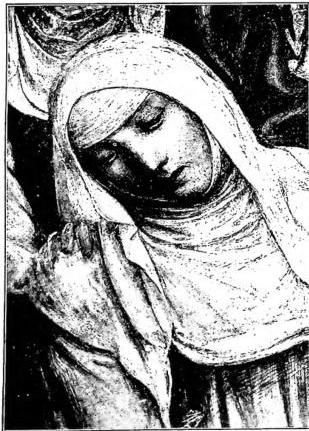
(phot. Alinari)
CATERINA DA SIENA, santa - Segnimento di s. C. Detail of the fresco by Sodoma (1526) - Siena, church of S. Domenico.
It was necessary, however, to make the rich Caterinian material available to scholars through critical editions, and this has been accomplished to a considerable extent by the University of Siena for the hagiographical sources and, for the letters, by the Italian Historical Institute for the Middle Ages.
The first edition of the Lettere, numbering 37, is the Bolognese edition of 1492; it was followed by the first edition of 1500 by Aldo Manuzio, with 350 letters, reprinted several times during the sixteenth century. Girolamo Gigli produced a more complete and accurate edition, enriched with erudite notes by the Jesuit Burlamacchi; it was then reprinted many times in the eighteenth and nineteenth centuries, until Niccolò Tommaseo produced a new edition in 1860 according to chronological and philological criteria. This was reprinted by Misciattelli in 1913–20 and later by Ferretti, with good notes and the addition of the unpublished letters discovered in the meantime, as well as those of the disciples already published by Grattanelli in 1868. Fedele commissioned E. Dupré Theseider to undertake the critical edition of the correspondence for the Italian Historical Institute for the Middle Ages; in 1940 vol. I appeared, containing 98 datable letters, preceded by a thorough critical introduction. Dupré Theseider had the rare good fortune to discover the autograph of Pagliaresi, the Saint’s secretary, in the Palatine Library of Vienna, a manuscript that resolved many problems that had seemed insoluble.
For the prayers (numbering 26), vedi the recent critical edition by p. Taurisano (2nd ed., Rome 1932).
II. di Grottanelli, Legenda minore, Bologna 1868); il Processo Castellano, a cura di M
H. Laurent (Fontes Vitae a Catherinea Senen. Historici, IX), Milano 1942. Biografie recenti: A. Capecelatro, Storia di s. C. da S. e del papato del suo tempo, Napoli 1856; A. T. Drane, The History of s. C. of S., Londra 1887; C. Gardner, S. C. of S., ivi 1907; G. Joergensen, S. C. de S., Parigi 1919; R. Fawtier, S. C. de S. et la critique des sources, I: Sources hagiographiques, Parigi 1921; II: Les oeuvres de s. C. de S., ivi 1930; S. Leclercq, La Mystique de l'apostolat: C. de S., Parigi-Bruxelles 1922-27; P. Chimimelli, S. C., Roma 1941; Fr. Valli, La mentalità agiografica del p. Raimondo da Capua, in La Diana, 8 (1933), fasc. III e IV; id., Scrittori religiosi del Trecento, Urbino 1947, pp. 69-239; M. Gallet, La mission de s. C. de S., Parigi 1946; S. Attal, L'angelo della pace: s. C. da S., Lanciano 1946; A. Levasti, S. C. da S., Torino 1947; R. Fawtier, La double expérience de Catherine Benincasa, Parigi 1948; I. Taurisano, S. C. da S., patrona d'Italia, Roma 1948. Innocenzo TaurisanoICONOGRAPHY. - Caterinian iconography is abundant; this is due chiefly to the fact that the city which gave birth to the Saint and which in every century paid her filial devotion was, as is well known, a fervent centre of art: indeed, Caterinian iconography was almost exclusively Sienese up to and including the fifteenth century.
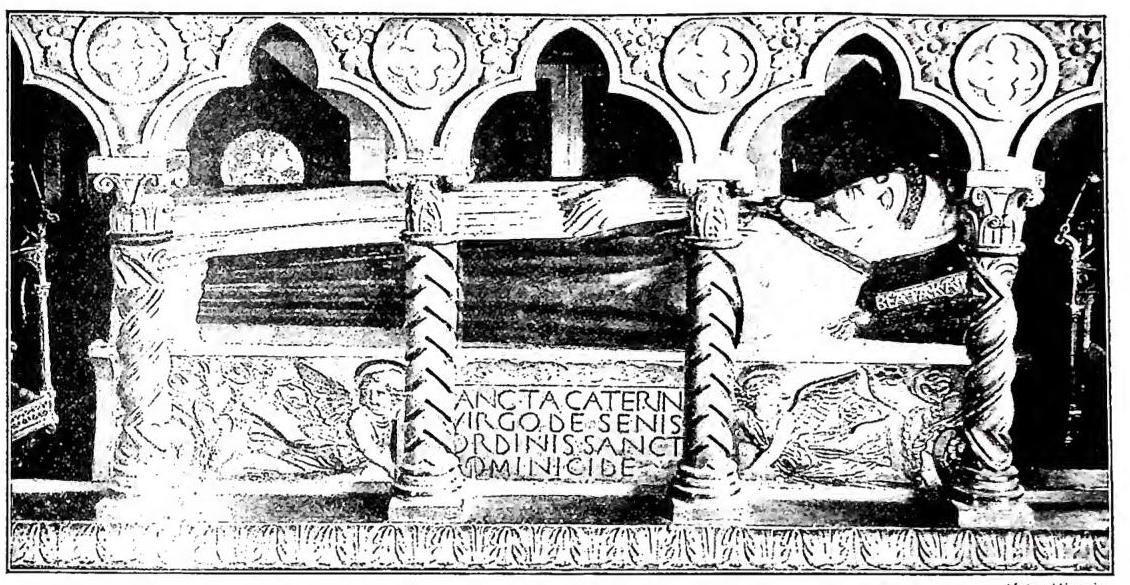
Alinari photograph
CATERINA DA SIENA, saint - Sarcophagus of s. C., work of Isaia di Pisa (1430) - Rome, church of S. Maria sopra Minerva.
quiera already in the sacristy of the hospital of S. Maria della Scala (1445; now in the Siena picture gallery, no. 204), the triptych in the cathedral of Pienza (1461), and in isolation, as in the fine fresco (1461) in the Hall of the World Map of the Palazzo Pubblico. A recently attributed original terracotta statue in which s. C. is depicted sleeping has also been assigned to Vecchietta: this statue is found in a small room belonging to the Confraternity of s. Caterina beneath the Völte of the Hospital, where tradition holds that the Saint used to take refuge for a brief rest when assisting the sick. The best-known statue of the Saint is the polychrome wooden one, attributed to Nereccio di Bartolomeo (second half of the fifteenth century), venerated on the high altar of the church of S. Caterina in Fontebranda, in the Oca district.
There are various pictorial cycles in which the principal events of Benincasa’s life were intended to be illustrated in an organized manner. The oldest and most important consisted of a series of small panels surrounding the large altarpiece with the Presentation at the Temple, commissioned in 1447 from Giovanni di Paolo by the University of the pizzicali of Siena for the church of S. Maria della Scala: the large central panel is now in the Siena picture gallery (no. 211), while of the Caterinian little stories, which began with the Gift of the Cloak to the Beggar and ended with the Saint’s Funeral, one is lost and the others have been dispersed among the Stoclet collections in Brussels, the Lehman collection, the Metropolitan Museum of New York, and the Institute of Arts of Minneapolis. Although they constitute the most valuable figurative commentary on the Saint’s life, they are nevertheless much less well known than the frescoes by Sodoma (1526) and Francesco Vanni (1593), painted on the walls of the chapel of S. Caterina in the basilica of S. Domenico in Siena: in particular, the two scenes of the Ecstasy and the Fainting, owing to their dramatic and sentimental character, have achieved wide popularity. Other cycles are those adorning the various oratories of the Caterinian sanctuary; in the so-called «oratory of the Kitchen», the narrative unfolds in thirteen paintings, plus the altarpiece with the Stigmata by Bernardino Fungai, executed by various painters between the end of the sixteenth century and the beginning of the seventeenth: A. Salimbeni, P. Sorri, C. Roncalli known as il Pomarancio, L. Bonastri, A. Casolani, F. Vanni, and R. Manetti; in the church of S. Caterina below, or «oratory of the district», some Miracles of the Saint are instead illustrated by frescoes by G. del Pacchia and V. Salimbeni; finally, another mediocre cycle of seven scenes frescoed by Alessandro Franchi (1896) is found in the so-called «oratory of the chamber». The ensemble of the panel and predella (the latter unfortunately mutilated) in which D. Beccafumi illustrated the Supernatural Events (Stigmata, Mystical Marriage, Communion, and Miraculous Clothing) of the Saint’s life may also be considered an organized cycle: this work (datable to around 1515), originating from the destroyed monastery of Monteoliveto at Porta Tufi, is now preserved in the Siena picture gallery (nos. 417, 418, 419, and 420). It is one of the highest Caterinian iconographic interpretations and ranks among the masterpieces of the great Sienese sixteenth-century painter.
A subject that from 1500 onward continually lent itself to free and imaginative interpretations is the Mystical Marriage (v. Salimbeni). In comparison with the great popularity of these subjects, in which the mystical and supernatural element clearly predominates, the illustration of the historical events in which the Saint was the protagonist appears rather scant; the Sienese recalled in particular the Canonization of the Saint, represented several times by Pinturicchio in the Piccolomini Library, by F. Vanni, and by Mattia Preti in a large canvas in the chapel of the Völte. Finally, it should be noted that, on the occasion of a national competition for a painting on a Caterinian subject held during the sixth centenary of the Saint’s birth, the sensibility of modern artists, unlike that of the ancient ones, decisively turned toward highly animated or dramatic subjects, such as the Torment of Niccolò di Tuldo, the Burial of the Leprous Tecca, the Healing of the Possessed Woman, and the Assistance Given to the Mantellata Andrea. - Vedi Tav. LXIV.