
CRISTINA, saint. — Her name occurs in the Hieronymian Martyrology on 24 July, with the topographical designation: « in civitate Tyro », repeated in not a few versions of the Latin Passio and in the Martyrology of Rabano Mauro. On the other hand, the excavations carried out at Bolsena in 1880–81, in the ancient cemetery of S. Cristina, established that there, in the 4th century, the tomb of a martyr of the same name was venerated (v. BOLSENA). This veneration must not have been unknown to Adon (9th century), who in his Martyrology believed he could reconcile both traditions, of Tyre and Bolsena, by locating Tyre near Lake Bolsena: Eodem die (24 luglio) apud Italiam in Tyro, quae est circa lacum Vulsinium, natale s. Christinae virginis in lacum Vulsinium iactatae. Adon’s ingenuous solution, the fruit of topographical ignorance, did not resolve the question.
Were there two martyrs named C., one venerated at Tyre in Phoenicia and the other at Bolsena in Italy, or was there only one? The discovery made by L. Cammelli in 1911 of the Oxyrhynchus papyrus, datable to the 5th century, containing a brief fragment of the Greek Passio, has shed no more light on the matter than that provided by the evidence allowing the Latin Passio to be regarded as a translation of the Greek.
Various considerations, but chiefly the monumental remains found at Bolsena, led G. B. De Rossi to believe that there was a single C., martyred and venerated at Bolsena since the 4th century, but born at Tyre in Phoenicia. There is no reason to think of a translation of the martyr’s body from Tyre to Bolsena, as the Bollandists proposed, but De Rossi’s view of C.’s Eastern origin is not very convincing either. P. Paschini believed that she was born in Italy, probably at Bolsena, whereas the Passio was written in Egypt during the 5th century, when C.’s cult had already crossed the borders of her homeland. It is not impossible that the Egyptian hagiographer, in his work, had before his eyes the account by Eusebius (De martyribus Palaestinae, 6) concerning Theodosia, the virgin of Tyre, a martyr of the final persecution; but it cannot be ruled out that the information about C.’s birth at Tyre was the product of the author’s imagination. It is right to note the great similarity between C.’s Passio and that of s. BARBARI (v.). After the 11th century, some versions of the Latin Passio place C.’s birth, martyrdom, and tomb at Bolsena, just as the authors of the Translationes of her body to Belgium and Westphalia suppose that the sacred relics were removed from Bolsena. The most credible hypothesis is that C. was born and martyred at Bolsena, where her tomb is still preserved.
C. appears in the wall mosaic of S. Apollinare Nuovo in Ravenna among the martyrs Sabina (Roman) and Anatolia and Vittoria (of the Sabina), which Archbishop Agnellus had executed in the 6th century. At Bolsena, her cult probably supplanted the most solemn amphitheatrical games that, until the 4th century, were celebrated every year at Bolsena with the participation of the populations of Tuscany and Umbria. The so-called « mysteries », animated representations of C.’s martyrdom, used during the procession on the martyr’s feast day (24 July), are a remembrance of those idolatrous institutions.
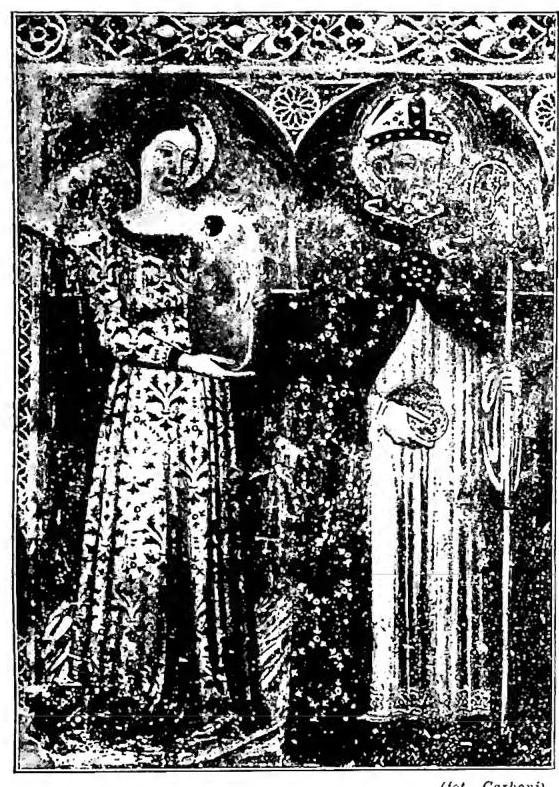
(photo Carboni)