
SABINA (SAVINA), Saint. — In early Christian hagiography the Bollandists have noted three feast days: 30 January, S. of Lodi, a widow; 29 August, S. a widow and martyr of Vindena; 27 October, S. a martyr in Avila. Moreover, confusion between the masculine and feminine forms of the name has given rise to a sister of St Savinian, celebrated on 29 January. A St S. appears in the mosaic procession of the martyrs in S. Apollinare Nuovo in Ravenna. In Rome the titulus Sabinae dates to its present form from the early 5th century, but the name and liturgical use of the building seem to predate the basilica.
In the Regio XII and probably near the basilica, the Notitia regionum urbis Romae records the presence of the privata Hadriani, from which a domus Sabinae may have originated. The identification of this person with a venerated martyr is documented in the history of the titulus by the lid of the sarcophagus in which Pope Eugenius II (823) gathered with his own bones those of the martyrs of Nomentum; the person mentioned there is known from a legendary Passio of the 6th century and forms part of the S.-Serafia group, the first commemorated on 29 August and the second on 29 July. The Passio presents Serafia as coming from Antioch (Syria), lodged by a S., widow of Valentinus, an illustrissimus vir and daughter of Herod surnamed Metallarius who, under the reign of Vespasian (69–79), had given the Romans games three times. Both lived at Vindena. Serafia converted S. and was condemned to beheading by the magistrate Berillus; she suffered martyrdom on 29 July. S., in turn, summoned before the prefect Elpidius, was condemned and beheaded on 29 August and buried by the Christians of Vindena “at the arch of Faustinus in the monument of her own where she had reverently placed her mistress in the faith, the virgin Xii Serapiam.” The city of Vindena, now disappeared, was near Terni, probably at Rocca S. Zenone. The hypothesis of G. P. Kirsch concerning a colony of Vindenates on the Aventine lacks sufficient support in the textual criticism of the Passio. It is better to admit a translation of the bodies of Serafia and S. to Rome between the time of the construction of the basilica and the beginning of the 9th century.
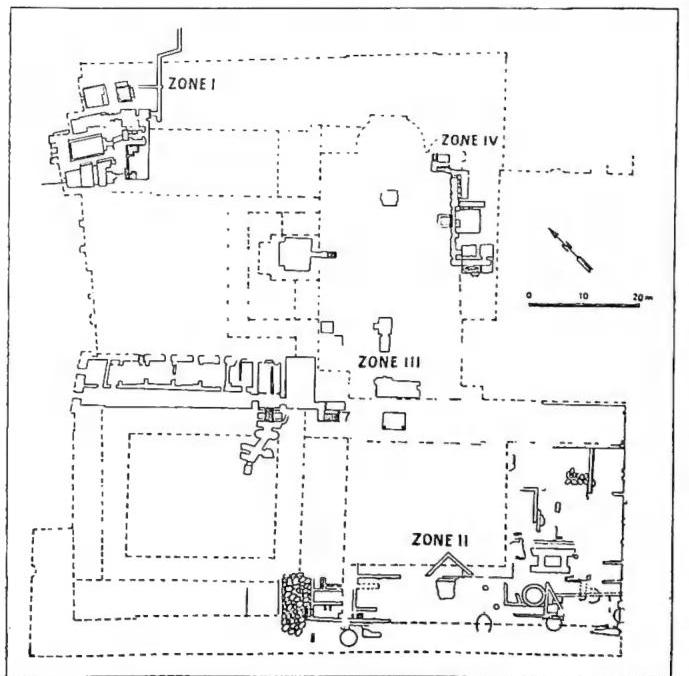
Excavations carried out repeatedly and especially during the restorations of A. Muñoz (1914–19 and 1936–39) have revealed: 1) the layout of a street which from the 2nd to the 11th century was one of the main roads of the Aventine and which borders the paleochristian constructions to the northwest; 2) the existence of a quadriporticus transverse to the longitudinal axis of the 5th-century basilica; 3) the presence of a 4th-century thermal building beneath the quadriporticus. The excavations of 1914, at the entrance to the central nave, revealed at 1.76 m below the present floor the existence of a large hall with a podium at its centre; those of 1936–37 another part of the same hall of considerable size. The research, still partial, has not permitted the complete plan of this structure to be reconstructed, which very probably already served Christian worship in the 4th century.
4) In the right nave, toward the apse, the 5th-century construction reused a 4th-century wall with building elements from the 2nd century. From 1936 to 1939 structures intended for the cult of a divinity were uncovered, confirming the likelihood of the temple of Juno Regina.
Incorporated into the medieval fortifications of the northwest plateau of the Aventine in the 10th and 13th centuries, the basilica was granted by Honorius III to the Order of Preachers who still officiate there today.