
SABINA AND POGGIO MIRTETO, DIOCESE OF — Suburbicarian diocese in the province of Rieti. It has 88,193 inhabitants, of whom 88,000 are Catholics, distributed among 72 parishes served by 82 diocesan and 25 religious priests; it has one seminary, 6 male and 40 female religious communities (Ann. Pont. 1952, p. 344).
The present territory of the diocese of P. M. also contains the three small ancient bishoprics of Cures (Passo Corese), Forum Novum (the present Vescovio), and Nomento (today Mentana). The first, 22 miles from the Via Salaria, had its cathedral dedicated to S. Antimo, mentioned in the Martyrologium Hieronymianum on 11 May (Martyr. Hieronymianum, pp. 246–47). M. Boldetti saw the ruins of the small basilica with an adjoining small cemetery (Osservazioni sopra i cimiteri, etc., Rome 1720, p. 577; E. Stevenson, in Bull. arch. crist., 5 [1880], pp. 106 ff.; id., in Real-Encyclopädie der christlichen Alterthümer, II, pp. 124–25). According to L. Duchesne, the territory of the diocese of Cures also included Trebula Mutuesca (today Monteleone), to which the martyrs Anatolia and Vittoria belonged, commemorated in the Martyrologium Hieronymianum on 9 and 10 July and 19 December (Martyr. Hie-
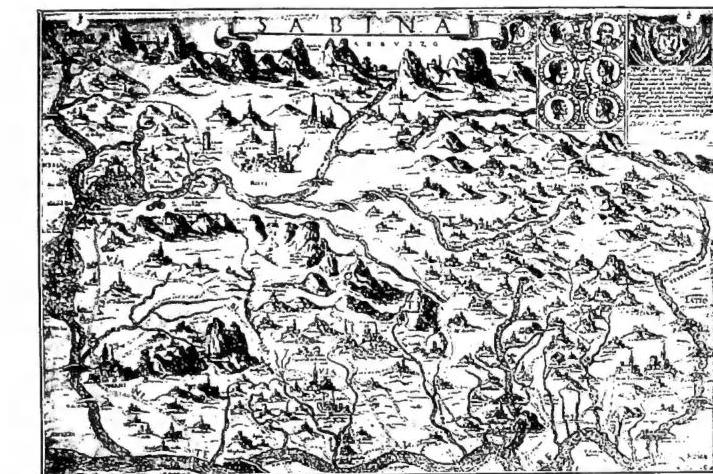
(from G. Tomasetti, G. Busotti, La diocesi di S., Rome 1980, plate after the title page)
SABINA AND POGGIO MIRTETO, diocese of — Map of the diocese, printed in 1617.
ronymianum, pp. 360–62, 364, 653); they appear in the procession of martyrs in S. Apollinare in Ravenna (P. Paschini, La Passio delle martiri sabine, Vittoria e Anatolia, Rome 1919; H. Delehaye, Les origines du culte des martyrs, 2nd ed., Brussels 1933, pp. 314, 327).
The known bishops of Cures are: Tiberius in 465, Felicissimus in 487, Dulcitius in 501, and Bono in 558–601, from a letter of Pelagius I; in 593 Gregory I united the see of Cures with that of Nomentum, whose bishop was Gratiosus (Gregorii Registr., I, 3, ep. 20).
Nomentum (today Mentana), at the fifteenth milestone of the Via Nomentana, is known for its bishops from the beginning of the fifth century onward, because of the controversy between Bishop Ursus and the bishop of Tivoli. Ursus dedicated the altar over the tomb of two martyrs buried at the seventh milestone of the Via Nomentana (G. Belvederi, La Basilica e il cimitero di S. Alessandro al VII miglio della Via Nomentana, in Riv. arch. crist., 14 [1937], pp. 200, 221 and fig. 19), and in another inscription there he is called Christi signifer (id., ibid., 15 [1938], p. 243 and fig. 68). The bishops Servusdei (465), Cyprian (487), Serenus at the end of the fifth century, Romanus, Felix (531), Romulus (551), Redemptus (553), Gratiosus (593), and Constantius (600) are also known. From the same cemetery come the inscriptions of a bishop Adeodatus, undated, and of a bishop who died in 569. The city was destroyed by the Lombards (v. ALESSANDRO, EVENZIO e TEODULO).
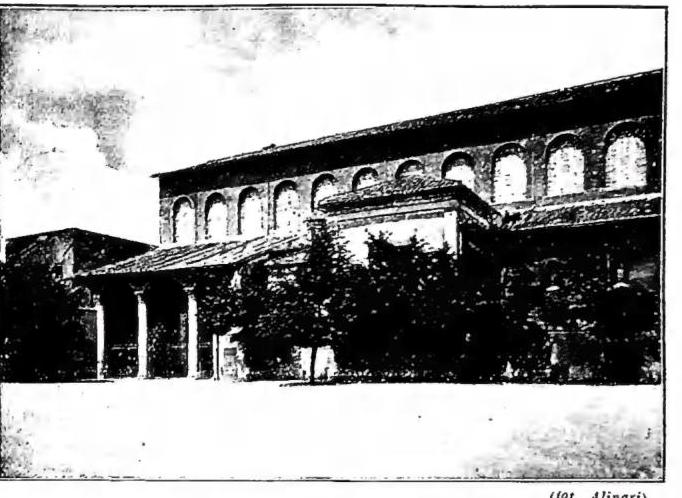
In the Hieronymianum on 27 and 29 May and 11 June (Martyr. Hieronymianum, pp. 276–77; 280–81; 314–15), a S. Restitutus is indicated at the sixteenth milestone of the Via Nomentana, as in the Passio (BHL, 7197). A. Bosio saw in his day, at the fifteenth milestone of the Via Nomentana, the ruins of a small basilica that he believed had been built over PRIMA (v.) and Feliciano (Roma sotterranea, Rome 1632, p. 416). The « castrum Nomentanum », by a bull of Innocent II dated 3 April 1139, came under the jurisdiction of the monastery of S. Paolo fuori le mura. Forum Novum (today Vescovio), in the municipality of Torri (ancient Gabii), had S. Eutimio as its cathedral, later S. Maria di Vescovio. The church that has come down to us is that of the ninth century, with a single nave, raised presbytery, and apse with a semi-annular crypt; it was later enlarged and contains remains of twelfth-century paintings. Only the transept seems to be a century earlier, with surviving pictorial panels bearing stylized textile patterns. The presbytery has an enclosure with small pillars and plutei. The two walls of the nave still contain considerable remains of the iconographic cycle of the Old and New Testaments, while the interior entrance wall contained, as in ancient Roman churches, a representation of the Last Judgment (twelfth century). The bell tower was subsequently superimposed on the façade; A. Serafini dates it to the end of the tenth or the beginning of the eleventh century (Torri campanarie di Roma e del Lazio, Rome 1927, p. 142). A Christian sarcophagus has on its lid the busts of the two spouses with two children and the inscription of an « Aurelius Ursacius ».
A S. Getulius, not far from Torri, was venerated in the ninth century; E. Stevenson believed he recognized at the thirtieth milestone the remains of a cemetery (Bull. arch. crist., 5 [1880], p. 108), whose relics were transferred to Farfa (I. Schuster, L'imperiale abbazia di Farfa, Rome 1921, p. 98). Pope Landon (913–14), who restored the destroyed cathedral of Forum Novum, originated in the S. In 1341 the cathedral was almost out of use, also because of a lack of clergy; it was in complete desolation in 1452 because of the abandonment of the population. On 14 October 1495, Pope Alexander VI transferred the episcopal see to Magliano. Because of the disputes that arose, Pope Julius II gave the church of S. Maria di Vescovio the title antiqua, while the church of S. Liberatore received the title of « nova cathedralis Sabinorum », which was confirmed by Leo X on 21 June 1521. The canonical visitation of 1572 found only a Franciscan friar as custodian at S. Maria di Vescovio; the church had been granted to that Order at the end of the fourteenth century. From 1633 to 1674 it was held by the Conventuals; then by the Mercedarians until 1751. From that time, the canons of the cathedral of Magliano were obliged to perform official duties at S. Maria di Vescovio twice a year. Pope Gregory XVI, by the apostolic letter Studium quo impense officimur of 23 November 1841, detached from the suburbicarian diocese of S. the part of the territory farthest from Rome, creating the diocese of P. M. and incorporating into it the parishes formerly subject to the ancient abbey of S. Salvatore Maggiore. The bishop of S. received the title of perpetual abbot of Farfa.
Few of the ancient bishops of Forum Novum are known; among them are Paul in 465, Asterius in 487, and Projectus in 499. The bishop of S. is first mentioned in the letter of Pelagius I (558–60) to Bishop Bono. John VIII (872–82) wrote a letter to the bishop of S., Leo (Jaffé-Wattenbach, 2276); in May 944 Marinus II confirmed to Bishop John the episcopate of S. (ibid., 2779); a dispute between Bishop John and the abbot of Farfa was brought before Leo IX in 1051. Anastasius IV determined the boundaries of the diocese in 1153–1154; Lucius III (1181–85) assigned to the diocese Mount Tancia, occupied by the monastery of Farfa.
Among the cardinals of S. are remembered Corrado (1153), later Pope Anastasius IV; Goffredo Castiglione (1239–41), later Pope Celestine IV; Guido Fulcodi (1261–65), later Pope Clement IV; Bessarione in 1449; Giuliano della Rovere (1479–83), later Julius II; Alessandro Farnese (1523–1524), later Paul III; Giovanni Pietro Carafa (1546–50), later Paul IV; Scipione Borghese (1629–33); Francesco Barberini (1645–52); Pietro Ottoboni (1681–83), later Alexander VIII; Annibale Albani (1730–43); and Gaetano De Lai (1917–28), who restored the cathedral and the seminary. Pope Pius XI, by the apostolic constitution Suburbicariae Sabinae dioecesis of 3 June 1925, suppressed the diocese of P. M., retaining the name of the diocese (Mandelen) with its cathedral Chapter and establishing that from then on the suburbicarian bishop of S. should also be called bishop of P. M.; on the same date, by the apostolic constitution In altis Sabinae montibus, he united with the diocese of Rieti the parishes of Pratoiani, Vaccareccia, Longone, Valle Cupola, Rocco Vittiana, Poggio Vittiano, and Varco Sabino, which, together with the cenobium and church of S. Salvatore Maggiore, were united to the diocese of Rieti (AAS, 18 [1926], pp. 34–37).
Al XXX miglio della Via Salaria il Martyr. Hieronymianum, pp. 497-98, indica al 9 sett. il martire Giacinto di cui non si conosce la Passio e che potrebbe essere lo stesso deposto sulla Salaria vetus, che si trova venerato anche a Rieti; forse solo reliquie (non il corpo) furono accolte in quella basilica in Sabinis che ricevette in dono da Leone III una « pulcherrima » stoffa (Lib. Pont., II, p. 13; Lanzoni, I, p. 354; H. Delehaye, Les origines... cit., p. 314).