
BESSARIONE. — Periodical of Oriental studies published in Rome from 1896 to 1923, founded by Msgr., later Cardinal, Niccolò Marini (1843–1923). Taking its inspiration from pontifical documents, B. set itself a twofold program: to make Western Catholics acquainted with the history, liturgical, dogmatic, artistic, etc. heritage of the Eastern Christian communities, and to promote the union of the Churches. In order to achieve this aim more effectively, a Greek edition of the publication was also planned, but the project did not materialize. From 1919 to August 1922, B. became the official organ of the new Pontifical Institute for Oriental Studies.
BESSARIONE. - Greek cardinal, metropolitan of Nicaea, born in the territory of Trebizond on 2 January 1402, to parents of humble condition, baptized with the name of Basilio (?). Destined for the ecclesiastical state, he was entrusted, while still very young, to the metropolitan of Trebizond, Dositeo, who took him to Constantinople where he was initiated into letters, philosophy, and the ascetic life by Ignazio (Giovanni) Cortasmeno, archbishop of Selimbria. At the school of the rhetorician Crisococca, he was a fellow student of Francesco Filelfo and perhaps of Giorgio Scolario. He took the monastic habit on 30 January 1423, with the name that became famous.
His first writing is precisely the encomium of his new patron (unpublished in cod. Marc. Gr. 533). He distinguished himself with a monodia (funeral oration) for Emperor Manuel II (d. 25 July 1425); he was sent to the court of Trebizond (1426?), wrote an oration in honor of Emperor Alexios IV and three monodiae on Empress Theodora Kantakouzene Komnene (d. 17 November 1426). Deacon in 1426, priest in 1431, he went to the Peloponnese where he gained the favor of Despot Theodore II and was a student of Giorgio Gemisto Pletone, with whom he always maintained the best relations.
He wrote an epitaph and a monodia on Cleoppa Malatesta, wife of Despot Theodore (d. 1433); an epitaph for Theodora Tocco, wife of Constantine Palaiologos (who later became the last emperor of Byzantium); verses to be placed beneath a portrait of Manuel II and his consort. From that stay date twelve letters, including a long one to Giovanni Lascari Leondari with an exposition of Christian morality; a defense of his protector Dositeo (who had moved to the see of Monemvasia); an encomium of his native Trebizond; and a homily (unpublished in cod. Marc. Gr. 533).
Having helped to settle a dispute that arose in 1436 between Emperor John VIII and his brother Theodore, he was recalled to the capital and placed in charge of the monastery of St. Basil. Elected metropolitan of Nicaea (1437), he sailed with the emperor for Italy (24 November 1437).
At the Council of Ferrara-Florence, he was, with Marco Eugenio, the principal Greek orator and contributed effectively to the act of union on 6 June 1439 (speeches of 9 October and 1 November 1438 in Ferrara; major dogmatic discourse on the equivalence of the formulas «διὰ τοῦ Υἱοῦ» and «ex Filio» in Florence, 13 and 14 April 1439). After the union, Eugene IV assigned him an annual pension of 300 florins, which could be increased to 600 if he were to establish himself in the Curia (11 August 1439). Bessarione returned to Constantinople with the emperor and the apostolic nuncio Cristoforo Garatoni (1 February 1440). He wrote three Consolations for Emperor John VIII, who had lost his wife Maria (17 December 1439), conducted research on the Fathers in the libraries of the capital, took part in the election of Patriarch Metrophanes II (1 May 1440), and probably worked on his refutations of Gregory Palamas and Maximus Planudes regarding the procession of the Holy Spirit. Created cardinal with the title of SS. Apostoli (18 December 1439), he returned to Florence, where the Curia still resided (10 December 1440). He studied Italian and Latin, seeking to acquire in the latter language the perfection and elegance demanded by the humanist current, into which he resolutely entered, becoming one of its luminaries. He was granted the archbishopric of Thebes in the duchy of Athens (1440-49?) and the Benedictine abbey of S. Giuliano in Rimini (?-1449). On 5 February 1442, he signed the decree of union with the Jacobites; in the same year, he consecrated, according to the Latin rite, the Franciscan church of S. Croce in Florence. He arrived in Rome with the Curia on 28 September 1443 and settled near his titular church, which he actively oversaw.
From his Florentine sojourn or the early days of his Roman one date the letter to Alexios Lascaris Philanthropenos, in which he defends his actions and those of the union council; the preface to the Latin translation of St. Basil’s Against Eunomius (done at his request by George of Trebizond); and the translation of the same saint’s homily on the Nativity, dedicated to Tommaso da Sarzana, the future Nicholas V. His interest in all matters concerning his homeland is reflected in the letter to Despot Constantine (1444), full of suggestions for reviving in Greece the arts of peace and war. In 1444, Bessarione dedicated to Giuliano Cesarini, cardinal bishop of Tusculum, his translation of Xenophon’s Memorabilia. The correction of the medieval translation of Aristotle’s Metaphysics, dedicated to his friend Alfonso, king of Naples (d. 1458), may also date from this period.
As commendatory abbot of S. Giovanni Evangelista in Ravenna, he ceded to the Observant Friars Minor the priory of S. Mamante (1444). He also held in commendam the abbey of S. Cristoforo in Castel Durante (Urbania; 1445-68) and that of S. Stefano in Pinis in Spalato, from which, in 1450, he ceded a priory (S. Maria della Palude) to the Observant Friars Minor. As protector of the Order of St. Basil, he presided, in November 1446, over a general chapter in the basilica of the Twelve Apostles with the abbots of Apulia, Calabria, and Sicily, approved by Eugene IV (14 December 1446). For the Basilians, he composed an epitome of the rules of St. Basil. His right of visitation over the Greek monasteries of Italy was confirmed by Nicholas V on 22 June 1451, which perhaps gave him the opportunity to discover, in the monastery of S. Nicola di Casole in the land of Otranto, the codices of Quintus Smyrnaeus and Colluthus. In the states of Alfonso of Aragon, Bessarione held in commendam the archbishopric of Manfredonia (1447-49) and the Basilian monasteries of S. Angelo di Brolo (1447-64), S. Filippo Grande (1449-64), SS. Pietro e Paolo di Forza d’Agrò (1450-1452), and S. Giovanni a Piro (?-1468). In 1447, he was entrusted with the recognition of the relics of St. Lawrence the Martyr, and in 1449, with the canonization of St. Bernardino of Siena. Bishop of Sabina (5 March 1449), he retained in commendam until his death the basilica of the Twelve Apostles, in which he replaced the secular chapter with a convent of Friars Minor (30 June—
BESSARIONE - Loggia of the villa of Cardinal B. (15th century) - Rome.
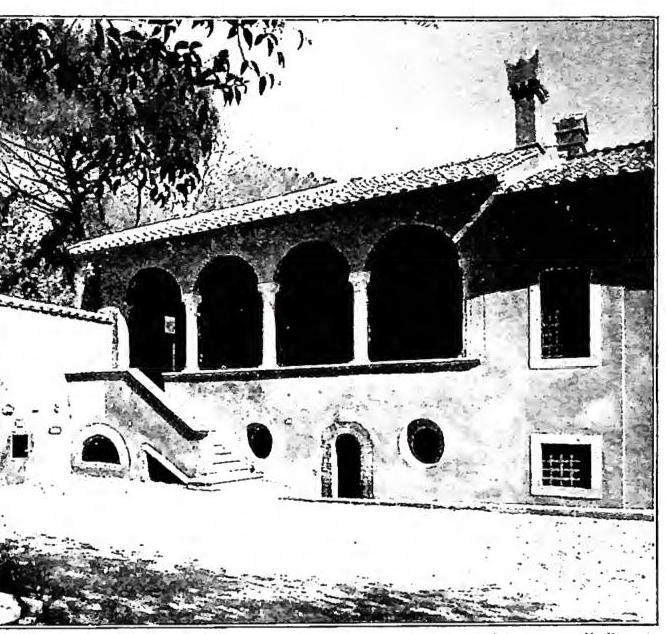
In the final years of his Roman sojourn, B. encouraged Valla when, for the first time, he applied new philological methods to biblical studies in his Annotationes in Novum Testamentum. B.’s own treatise In illud « Sic eum volo manere » also belongs to this field of study. The origins of what was later called the academy of B. date to the same period. His correspondence with Pletho, circa 1447, reveals the continued interest he maintained in philosophy.
On 10 September 1449, Nicholas V appointed B. legatus a latere for the peace negotiations between Venice and Milan and between Francesco Sforza and the Ambrosian Republic, though without success. From 1450 to 1455, the legation in Bologna kept B. away from the Roman humanists. In that government, B. relied on the emerging lordship of the Bentivoglio; but he devoted particular care to the declining University, where, among other things, he had his Perotti teach. Meanwhile, Constantinople had fallen to the Turks, and a new element entered the life of the Greek Cardinal: he ransomed his compatriots reduced to slavery, provided for those wandering the world, and exhorted princes to war against the invader. Above all, he conceived and began to realize the project of a library in which to gather the treasures of Greek literature, threatened, as he believed, with loss, since its people no longer had any center of study. This noble concern emerges from his correspondence with Michele Apostolis (1453-55). In the Conclave of 1455, from which B. seemed for a time likely to emerge as Pope, Callistus III was elected instead, bringing to the Chair of Peter the spirit of the Spanish reconquista. This orientation pleased the Greek Cardinal, who, taking advantage of a cure in Pozzuoli and a reception given in his honor by King Alfonso in Naples (5 June 1457), urged him toward the holy war. But it was a private attempt, for the pontificate of Callistus III marked for B. a time of lesser political activity and, in compensation, a gain for his studies. Thus, when in 1455 George of Trebizond, in his Comparaciones, attacked Plato, B. defended the great philosopher in the four books In Calumniatorem Platonis, his principal work. The refutation of the Syllogisms of Mark Eugenicus likely dates to the time of his Bolognese legation. The commendam of the Camaldolese abbey of S. Croce di Fonte Avellana (1456-72) gave him the opportunity to strengthen his relations with the house of the bibliophile Count Federico III of Montefeltro and Urbino. He became (1456-57) coadjutor, then archimandrite, of the Basilian monastery of S. Salvatore in Messina. From 1458 to 1462, he was bishop of Pamplona. Of Pius II, a humanist like Nicholas V and as zealous for the crusade as Callistus III, B. soon became a close friend, though in the Conclave of 1458 he had not initially given him his vote. The new Pope appointed B. protector of the Franciscan Order (10 September 1448) and entrusted him with the canonization of Catherine of Siena (1459).
At the Congress of Mantua (autumn 1459), the Pope and the Greek Cardinal worked in vain to secure the princes’ adherence to an offensive league
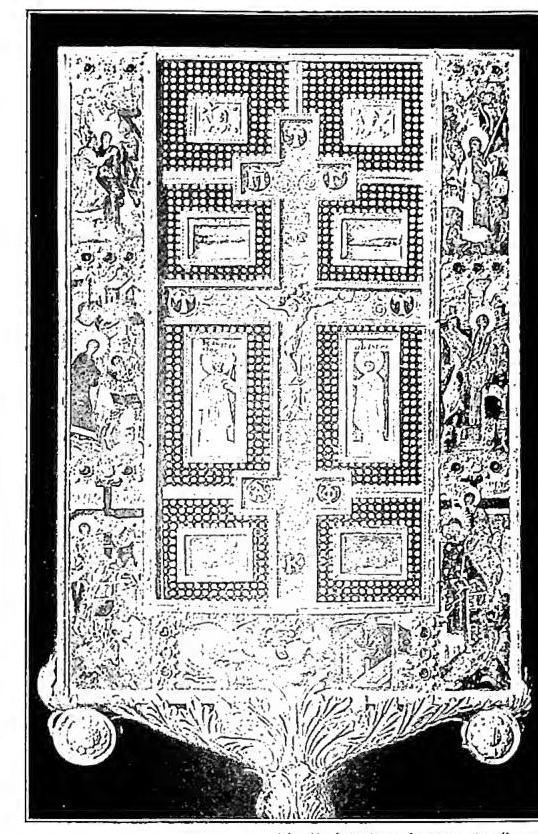
(from G. Popolari, La teca dei B. e la Croce di S. Teodoro di Venezia, in Defula, April 1577)
BESSARIONE - Staurotheca of Cardinal B., work of the late 14th century. Venice, Scuola della Carità.
In 1463, the capture of Argo and the conquest of Bosnia gave rise to a new Crusade project. Pius II sent Bessarione to Venice as legatus a latere, where he contributed to the triumph of the war cause in the councils of the Serenissima. However, when Bessarione arrived in Ancona with the Venetian fleet led by the Doge, where the army was gathering, he found the Pope on his deathbed: with the death of the animator, the enterprise faded. After the Conclave of 1464, the newly elected Paul II declared that he was not bound to observe the sworn "capitoli" that limited the exercise of pontifical power, giving rise to a misunderstanding between him and Bessarione, who then devoted himself more intensely to his studies. It was likely at this time that he composed the De natura et arte and translated his theological-polemical writings into Latin. In 1465, the children of the despoiled Thomas Palaiologos arrived in Italy, of whom he became protector: we have three letters in vernacular Greek in which he outlines rules of conduct for the tutors of the exiled princes. In 1466, he restored the baths known as those of King Pepin in Viterbo (where, since 1462, he had been undergoing treatments). He served as camerlengo of the Sacred College for 1467-68. That year, he made his will and donated his library—the richest in Greek codices at the time—to the Republic of Venice (14 May 1468). The trial against the academics of Pomponio Leto (1468), some of whom were part of Bessarione’s circle, gave him the opportunity to intervene once more on behalf of the humanists, particularly for Platina, who the following year repaid his benefactor by writing a panegyric in his honor. Here and in other documents, we see Bessarione reconciled with Paul II, who placed his trust in him. On 4 July 1468, he received a pension from the revenues of the Benedictine abbey of San Pietro di Villanova near Lusiana, in the diocese of Vicenza. We also find him, at his death (though it is unknown since when), as commendatory abbot of the Cluniac priory of San Giacomo di Pontida in Bergamo. On 14 October 1468, he moved from the Tusculan see to that of Sabina. In August 1469, the Latin translation of the In calumniatorem Platonis was published, prompting an exchange of letters with many scholars, including Marsilio Ficino. The usual controversies did not fail to arise, one with Giovanni Argiropulo, conducted courteously, and another, vehement, with George of Trebizond. The Turkish conquest of Euboea (1470) moved Bessarione to write an oration to the Christian princes, which his friend Guillaume Fichet, rector of the University of Paris, promptly disseminated in print, while in Rome a cardinalitial commission, convened in Bessarione’s home, addressed the Turkish threat. Sixtus IV, a friend of Bessarione, succeeding Paul II, appointed him legatus a latere to France, Burgundy, and England (22 December 1471) in support of the Crusade. However, the legation was soon limited to resolving pending issues between the Holy See and France; nevertheless, Bessarione allowed himself to be persuaded by friends (especially Fichet and Jacopo Ammannati) and by a personal invitation from King Louis XI to undertake this difficult task. If he secretly hoped to draw that powerful monarch into the holy war, he was disappointed, and overall, his French legation proved no more successful than his German one. Broken by illness and the hardships of the journey, Bessarione returned to Italy and died piously in Ravenna on 18 November 1472. His remains were taken to Rome, where on 3 December, in the Basilica of the Twelve Apostles, his funeral was held in the presence of the Pope. Niccolò Capranica, Bishop of Fermo, delivered his funeral oration in Latin, while in Crete his faithful Apostoli wrote another in Greek. The cardinal rests in the tomb he had prepared for himself (1466) in the same Basilica. There, one can see his effigy in bas-relief and his coat of arms: two arms
(int. Alinari)
BIBL.:
L. Mohler, Kardinal Bessarion als Theologe, Humanist und Staatsmann, I-III, Paderborn 1923-42; G. Hofmann, Bessarione e la sua biblioteca, in Orientalia Christiana Periodica, 1935; V. Laurent, La correspondance de Bessarion avec les moines de Grottaferrata, in Revue des Études Byzantines, 1946; V. Zabughin, Giulio Pomponio Leto, I-II, Roma 1909-12; G. Mercati, Codici latini Pico Grimani Pio e di altra biblioteca ignota del secolo XVI esistenti nell'Ottoboniana, Città del Vaticano 1938; A. Pertusi, La scoperta di Euripide nel primo Umanesimo, in Italia Medioevale e Umanistica, 1958; V. anche le voci: FICINO, PLATINA, PIO II, PAOLO II, SISTO IV.
L. M.
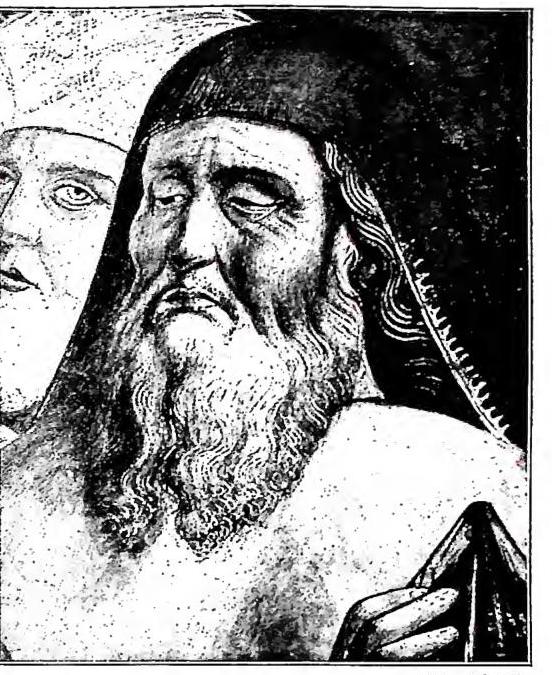
BESSARIONE - Ritratto del card. B. Particolare del Passaggio del Mar Rosso di Piero di Cosimo - Vaticano, cappella Sistina.
(raffiguranti le chiese latina e greca) sorreggono la croce: emblema della causa cui dedicò la vita e della quale egli stesso è rimasto il simbolo.