
BENTIVOGLIO. – Bolognese family recorded since the beginning of the thirteenth century; already toward the end of that century and at the beginning of the following one, some of its members, more or less connected with the Popoli and belonging to the Guelph party, were involved in the various factions and vicissitudes of the city. In 1354 they opposed the lordship of Giovanni di Oleggio and were forced into exile. They returned to Bologna with Cardinal Albornoz in 1360. In February 1401 GIOVANNI I proclaimed himself lord of the city, but was murdered the following year and his party forced into exile. In 1420 we find his son ANTON GALEAZZO once again lord, remaining so until 1435, when he was put to death by the papal legate. His son ANNIBALE revived the family’s fortunes in 1443, but was treacherously murdered in 1445 by the Canetoli. In 1446, however, SANTE, his relative, became lord, and in 1447, in the name of Bologna, concluded with Nicolò V that agreement with the Holy See which lasted until the Napoleonic invasion. Under him began the building renewal that attained particular splendor under GIOVANNI II, Annibale’s son, who succeeded Sante in 1462. Without officially assuming the lordship, Giovanni governed Bologna for many years with great magnificence and prestige, and was held in high regard by the rulers of Italy. Having subsequently lost the affection of the citizens through several acts of cruelty, Giovanni found himself isolated in the face of the armies of Luigi XII and Pope Giulio II, so that in 1506 he had to leave his city with his family and died excommunicated at Milan in 1508. The family made several unsuccessful attempts to return to Bologna and settled in Ferrara.
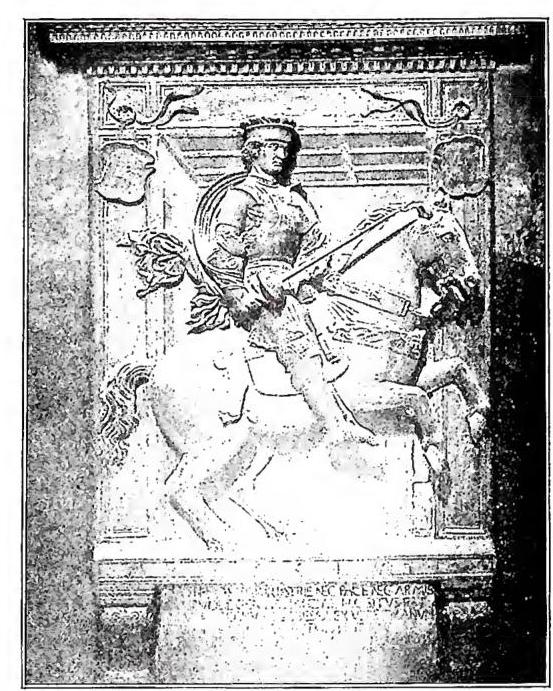
BENTIVOGLIO - Monument to Annibale II B., erected in 1458, with the inscription recalling his killing in 1445. Work of a fifteenth-century Lombard sculptor - Bologna, church of S. Giacomo Maggiore.
Returning from there in 1615, he moved to the nunciature of Paris the following year and did not leave it until 1621, when he was created cardinal. He enjoyed considerable influence in the Curia as protector of the kingdom of France and head of the Inquisition, until he died on 7 September 1644 during the Conclave convened after the death of Urban VIII. Particularly inclined toward historical studies, he wrote, in 24 books, the history Della guerra di Fiandra from 1559 to 1607 (Cologne 1632–36) and the Relazioni in tempo delle sue nunziature (Antwerp 1629); finally, in 1642, those Memorie of his, a vivid portrayal of the curial life of his time and rich in information documenting its events. For these writings, which were reprinted several times, B. is numbered among the finest writers of his age.
Under the pseudonym Selvaggio Porpora, he published in Rome in 1729 his translation into unrhymed verse of Statius’s Thebaid, which is the third Italian poetic translation from Latin, after those of Caro and Marchetti. All the critics of the eighteenth century agreed in declaring that
Statius, in the translation by B., had become, to use Zeno’s words, “sublime without bombast, great without disproportion, gentle without softness.” And indeed B.’s Thebaid is an eighteenth-century Thebaid; “reworked,” writes Calcaterra, “according to the tastes of the early eighteenth century, by a poet who had relived it through his literary love for Tasso and Ariosto, and who wished to continue the epic tradition of his Ferrara.” It is a legend that Cardinal B. had bought this work from Frugoni and published it as his own: Frugoni himself repeatedly declared to his first biographer that he had had no part whatsoever in the translation of the Thebaid.