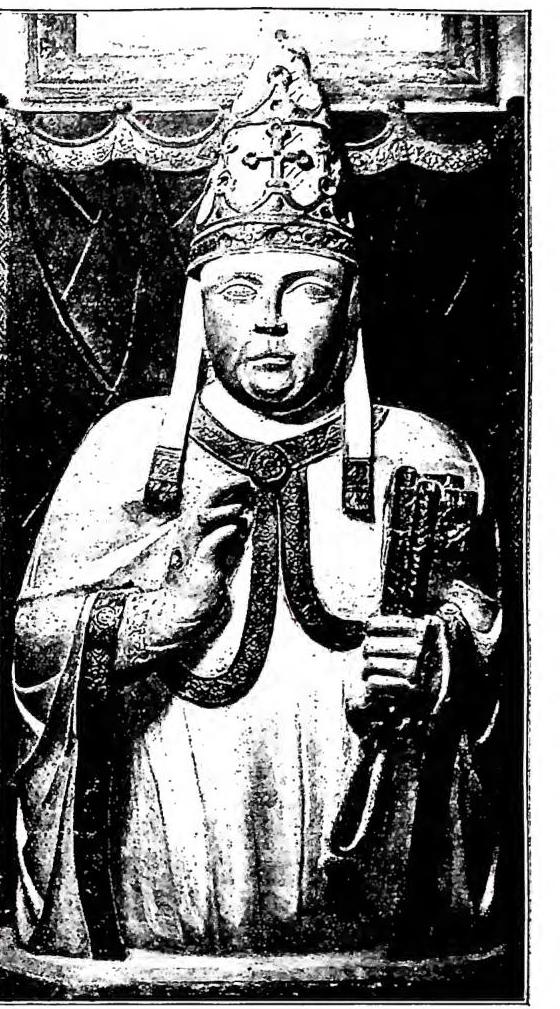
BENEDETTO XII, POPE. — He was the third Avignonese pope, succeeding Giovanni XXII (d. 4 Dec. 1334) on 20 Dec.; he was crowned on the following 8 Jan. by Cardinal Orsini in the Dominican church at Avignon. Giacomo Fournier (also called Novelli), born of humble parents at Saverdun in the diocese of Pamiers, entered the Cistercian abbey of Boulbonne at a very young age; he then moved to that of Fontfroide, where his uncle was abbot; he studied theology at Paris and there became a doctor. Abbot of Fontfroide in 1311, he was appointed bishop of Pamiers on 19 March 1317, and from there transferred to Mirepoix on 3 March 1326. In the governance of the two dioceses he displayed great zeal against heresy, supporting the work of the Inquisition; consequently, on 18 Dec. 1327, he was created cardinal of S. Prisca. Elected pope, he hastened to conclude the discussions concerning the beatific vision, which had become heated during the final years of his predecessor; with the constitution Benedictus Deus of 20 Jan. 1336, condemning what had been Giovanni XXII’s personal error, he defined that the souls of baptized children and the souls of the just who had no further fault to expiate were admitted immediately to the “intuitive and also facial vision” of the divine essence, and that for them the exercise of the acts of faith and hope ceased (Denz-U, 530). He immediately set about correcting the “innumerable abuses” that afflicted the Church, beginning with the malversations of the court, obliging prelates entrusted with the care of souls to observe residence (15 Jan. 1335), and prescribing stricter constitutions against the laxity of the Benedictines and Cistercians. He wished to eliminate the scourge of wandering religious, condemned the Fraticelli, and regulated the activity of the Franciscans and Dominicans, striving to overcome every opposition. As for the Curia, he intended to eliminate the abuse of commendam and expectations, and regulated the registration of petitions to be presented to the Pope. After an initial intention of returning to Rome, Pope B. resolved not to leave Avignon, where he began the construction of the papal palace. The subjugation of Bologna was a success for him. He attempted an understanding with the excommunicated emperor Lodovico il Bavaro; but the interference of Filippo VI of France and the sovereign’s lack of stability rendered his efforts fruitless. B. maintained peaceful relations with the other princes of Europe. He was praised for his scrupulous conduct toward his relatives, to whom he showed no particular favor; he married his only niece off quite modestly; only to his nephew Giovanni di Cardone, a respected person, did he confer the archbishopric of Arles in Oct. 1341. He died in Avignon on 25 Apr. 1342 and was buried in the Cathedral. The Cistercians venerate him as blessed.