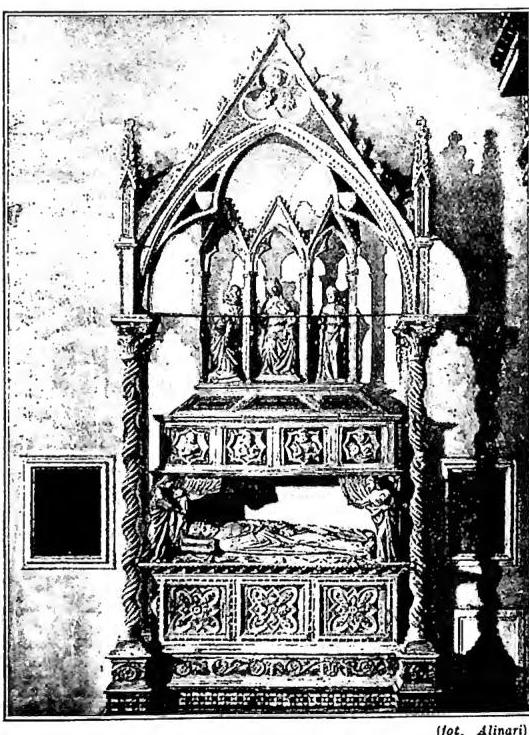
BENEDETTO XI, PAPA, blessed. — Niccolò Boccasini, born at Treviso in 1240 to a notary, entered the Dominican Order in 1254; he subsequently became lector, prior, provincial of Lombardy, and master general (1296). Created cardinal in 1298, he carried out various legations in Hungary, Poland, Austria, and other countries. Bishop of Ostia and Velletri in 1300, he stood beside Boniface VIII when the latter was attacked by the emissaries of the king of France at Anagni. After Boniface’s death, and once the novendials had passed, in accordance with the constitution of Gregory X, he was elected pope after only one day of conclave (22 Oct. 1303) and took the name of B. XI.
Of a mild and conciliatory character, he sought to restore peace with the king of France, mitigating the bull Clericis laicos. Following a letter of submission from Philip the Fair, B. absolved him and his accomplices from the censures and restored to France the privileges of which the deceased Pontiff had deprived II. This pacification was the most notable act of his pontificate. He nevertheless condemned Nogaret, Sciarra Colonna, and the other aggressors at Anagni, who were excommunicated by a bull of 7 June 1304. He also absolved cardd. Pietro and Giacomo Colonna, without, however, restoring all the privileges of their rank to them.
Tuscany was troubled by the Guelf and Ghibelline factions, by the Whites and the Blacks; to restore peace there, he sent to Florence as his legate card. Niccolò Albertini da Prato. The effort to pacify Italy proved of little avail. Even in Rome the disturbances continued, so that B. deemed it advisable to transfer his residence to Montefiascone, to Viterbo, and finally to Perugia, where he ended his brief pontificate on 6 July 1304, not without suspicion that he had been poisoned through the agency of Nogaret (cf. Villani, Cronaca, VIII, cap. 80; Dino Compagni, Cronaca, III and following). He was buried in the church of S. Domenico in Perugia. Clement XII confirmed his cult on 24 Apr. 1736 and granted its official recognition to the Dominican Order and the diocese of Treviso; Benedict XIV extended it to the whole Venetian territory and inserted B.’s name in his edition of the Martirologio (1748), under 7 July. As evidence of his intellectual stature, his Sermoni e Commentari on portions of the Gospel of St. Matthew, the Psalms, the Book of Job, and the Apocalypse are recalled. He created only three cardinals, chosen from the Order of Preachers.
Great hopes had been entertained for B.’s pontificate, so much so that some commentators on Dante even wished to see in him the Veltro, savior of Italy and the Church (cf. G. M. Cornoldi, Commento alla Divina Commedia, Roma 1888, p. 11). In Perugia he received the ambassadors of James II, king of Aragon, who declared that they recognized the kingdoms of Sardinia and Corsica as papal fiefs, having been granted by the Holy See to the Aragonese in 1297. The ambassadors of Federico, king of Sicily, made a similar declaration on 1 May 1304, on the occasion of the payment of the annual tribute. B. ardently aspired to launch a crusade for the liberation of the Holy Land.
A controversy was being debated between the secular and regular clergy: namely, whether a member of the faithful who had confessed to a religious should repeat the confession to his own parish priest in order to satisfy the Easter precept. B. resolved it by an apostolic constitution, declaring that it was not necessary to repeat the confession before the parish priest (cf. O. Raynaldi-C. Baronio, Annales eccl., an. 1304). He approved the celebration of the feast of the Stigmata of s. Francesco d’Assisi (cf. L. Wadding, Annales Minor., VI, an. 1304) and showed great favor toward the mendicant Orders, removing the restrictions imposed upon them by his predecessor; his concessions were, however, revoked by his successor Clement V because of the disagreements that had arisen between the regular and secular clergy.