
APOCALYPSE. - Prophetic book that concludes the New Testament.
The title is taken from the first Greek word of the text (Ἀποκάλυψις Ἱησοῦ Χριστοῦ), which does not recur thereafter. The usual form in the codices is Ἀποκάλυψις Ἰωάννου, with various additions in the minuscules and versions (Vulgata Clementina: Apocalypsis sancti Ioannis apostoli). The term ἀποκάλυψις (17 times elsewhere in the New Testament: Lk. 2, 32, and 13 times in St. Paul; 3 times in I Pt.; ἀποκάλυψις: 26 times in the New Testament) means the "unveiling" of a hidden reality (mystery) and often has an eschatological sense; here it signifies: "manifestation of Jesus Christ as sovereign and judge" (cf. I Cor. 1, 7; II Thess. 1, 7; I Pt. 1, 7-13; the same sense of the verb: Lk. 17, 30).
SUMMARY:
1. Theme and analysis
2. Authenticity and canonicity
3. Literary character, language, text
4. Place and time of composition; recipients
5. Interpretation
6. The Apocalypse in art.6. THEME AND ANALYSIS
The general subject is formulated at the sound of the 7th trumpet (11, 15-18): "The kingdom of the world has become the kingdom of our Lord and of his Christ, and he shall reign for ever and ever"; and in vv. 17-18 this "mystery of God" (10, 7) is explained, equivalent to that revealed by St. Paul in I Cor. 15, 24-28. This thematic proclamation, around which the entire complex symbolic drama unfolds, echoes throughout the book (1, 5-8; 4, 8-11; 5, 9-13; 7, 9-12; 12, 10; 14, 3-5; 15, 3-4; 17, 14; 19, 6-8, 12-16; 21, 22-27). The central idea is an antithesis between the two kingdoms (Church and world), between Christ and Antichrist (v. ANTICRISTO), between the elect and the reprobate; and this antithesis is periodically highlighted (B. Allo, p. LXXVI ff.). The synthesis in which this antithesis is resolved is the Judgment (understood in the double biblical sense of dominion and the restoration of order through just retribution) that God exercises through Jesus, Lord and Judge.The formal structure of the book is quite clear. Beyond the prologue (1, 1-8) and the epilogue (22, 6-21), the Apocalypse is divided into three parts: the 1st concerning the present, the 2nd prophetic-eschatological, and the 3rd synthetic-anagogical.
1ST PART: Letters to the seven churches of Asia. In an introductory vision to the entire book, the "Son of Man" appears in glory among 7 golden lampstands (1, 9-20). He dictates letters to the 7 churches (of Ephesus, Smyrna, Pergamum, Thyatira, Sardis, Philadelphia, Laodicea), in which he exhorts them to spiritual fervor and repentance (2-3).
2ND PART (4, 1-21, 8): Symbolic visions concerning the struggles and triumph of the Church in the world. It is divided into two sections, the 2nd of which resumes and develops the 1st, both concluding with the general judgment.
The 1st Section (4-11) opens with the principal vision, which serves as the supreme backdrop until the conclusion (21, 8). In heaven, the throne of God appears, borne by 4 living creatures (Cherubim) and surrounded by 24 elders acclaiming; the Lamb (Jesus Christ) appears on the throne, to whom God entrusts the scroll sealed with 7 seals (4-5). The Lamb opens the first six seals (6): the unsealings reveal the salient lines of the divine decrees; at the opening of the first seal, a crowned rider on a white horse rushes to victory (Jesus Christ will be victorious); at the 2nd, 3rd, and 4th, riders emerge representing calamities (war, famine, pestilence) that will be instruments of Christ's justice, destroying a fourth of the living; at the 5th, the martyrs invoke divine justice, which will be fulfilled at the end; at the 6th, a universal upheaval is unleashed that must precede the end. Meanwhile, four angels mark the foreheads of the 144,000 elect from the 12 tribes of Israel, then an innumerable multitude from every nation appears, clad in white robes and with palms; having overcome tribulations, they will be rewarded (7). When the 7th seal is opened, there is silence in heaven for half an hour (8, 1). The 7 trumpets (8-11) mark the execution of the secrets of the book with the 7 seals. While an angel ministers incense on the heavenly altar,
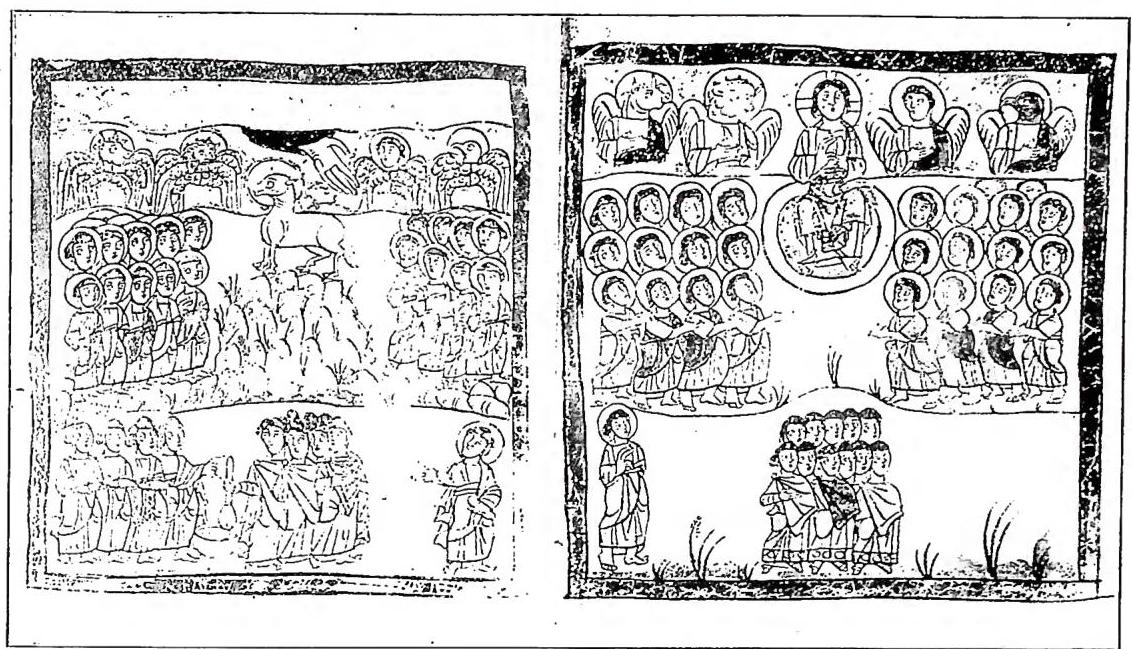
APOCALYPSE - The triumph of the Lamb and Christ in majesty among 24 elders and 4 symbolic animals. (Apoc. 4:3 - 5:10).
Illuminated miniature (late 8th-9th century), based on a 5th-century prototype - Trier, Stadtbibliothek, cod. 31, foll. 43°, 61'.
from which he pours fire upon the earth, 7 angels receive 7 trumpets. At the sound of the first four trumpets, cataclysms destroy a third of creation on land, sea, and springs, and the stars. An eagle cries three "woes!". At the sound of the 5th trumpet (1st "woe!") a star, falling to earth, opens the abyss, from which emerge countless monstrous locusts, Abaddon (v.), which torment men for 5 months. At the 6th trumpet, immense hosts of horsemen kill a third of mankind; yet the survivors remain impenitent (2nd "woe!").
Consoling interlude (10-11). A radiant angel, after 7 thunders, swears that the "mystery of God" will be fulfilled at the sound of the 7th trumpet and makes the seer eat a small open book containing the many prophecies he must proclaim (10). John is ordered to measure the temple and the altar, but not the outer court, which the Gentiles will trample for 42 months (3½ years) during the great persecution, in which two witnesses will prophesy, be killed in "Sodom" by the Beast of the abyss, and after 3½ days rise again and ascend to heaven, while a tenth of "Sodom" is destroyed by an earthquake in which 7,000 men perish; the survivors glorify God (11:1-13). At the 7th trumpet, the proclamation of the eternal Kingdom of God and of his Christ erupts (11:14-18). This 3rd "woe!" is not described: it will be in the 2nd section. The final victory of God (11:18) includes the parousia and the final judgment.
2nd Section (11:19-21:8). The ark of the covenant appears (11:19), followed by visions that illustrate with greater precision the fate (proclaimed in 10:15-18) of the Kingdom of God (Church) until the end of the world. A radiant woman (the heavenly Jerusalem of chaps. 21-22, but in her earthly state) appears in heaven; a red Dragon (or Serpent) with 7 crowned heads and 10 horns (= Satan) seeks to destroy her with the newborn (Messiah) who will rule all peoples; but the Dragon is defeated and cast down to earth by Michael and his angels. The newborn is taken up to the throne of God, and the woman flees into a desert for 3½ years, escaping the Dragon’s persecution, which turns to wage war against "the rest of her offspring."
The alignment of forces ready for battle is described in a diptych vision (13:1-14:5). The Dragon
raises up two instruments: a) the Beast from the sea (which rises "from the sea") with 7 heads and 10 crowned horns (political Antichrist: pagan Rome and subsequent powers), whose mortally wounded head heals, and all the earth worships the Dragon; the latter enthrones the Beast, which dominates the peoples for 42 months, blaspheming and persecuting the saints; b) the Beast from the earth (which rises "from the land" of Asia), with a less fierce appearance, has two horns like a lamb but speaks like the Dragon (doctrinal Antichrist) and, seducing with wonders, induces all to worship the Beast from the sea and its image, on which it imprints the mark or number (= name) that is 666 (probably: Heb. Nron Qsr, Nero Caesar). But on Zion stands the Lamb with his escort of 144,000 virgin men marked with his name and the Father’s, singing the new song.
Preparatory vision for the battle (analogous to the "seals" of chap. 6): three angels announce the triple judgment of God (14:6-20). The first, bearing the "eternal Gospel," proclaims the imminent judgment; the second foretells the fall of Babylon (pagan Rome); the third condemns the worshippers of the Beast to eternal fire. Anticipated vision of the judgment that will crown the struggle: the Son of Man on the cloud presides over the harvest of the elect and the vintage of the reprobate.
Divine victory over the beasts and Babylon (15-19). After the thematic proclamation (15:1-4), from the heavenly temple emerge 7 angels who pour from the 7 bowls of God’s wrath (analogous to the 7 trumpets) the 7 last plagues upon the empire of the Beast (15:5 - 16:21): at the 1st bowl, an ulcer strikes the worshippers of the Beast; at the 2nd and 3rd, the waters of the sea and rivers turn to blood; at the 4th, the sun scorches men, and at the 5th, darkness invades the kingdom of the Beast, yet men remain impenitent; at the 6th, three demons gather all the kings of the earth against God in Armageddon (v.), where they will be defeated (Christ the Judge is announced: 16:15); at the 7th, a terrible earthquake and hail convulse the earth, but men remain impenitent: God decrees the destruction of Babylon.
This destruction is described in 17:1-19:10. One of the 7 angels of the bowls shows great Babylon as a lavish harlot seated on the Beast from the sea; all kings fornicate with her, who is drunk with the blood of the saints. He explains the "mystery": the Beast is Rome ("7 mountains")
with its 7 emperors (from Nero to Domitian, it seems), the Beast itself is one of the 7 and will be the 8th (continuator of the series, reproducing Nero); the 10 horns are 10 kingdoms dependent on the Beast, with which they will fight the Lamb, but will be defeated by him and will destroy the harlot Babylon. Another angel announces the fall of Babylon for its iniquities; another describes the laments of kings, merchants, and sailors (18:9-20; cf. Ez. 26-27), to which the celestial hymn of jubilation responds: alleluia! (19:1-8). Epilogue: the revealing angel forbids the seer to worship him (19:9-10).
The two Beasts are then defeated (19:11-21): the white horse reappears, ridden by the Word of God crowned and with a bloodstained robe, followed by the heavenly armies; the kings gathered with their armies (cf. 6th bowl) are exterminated by the sword that proceeds from the mouth of the Word, and the two Beasts are cast into the "lake of fire."
Satan is finally vanquished (20:1-10): he is first imprisoned for a thousand years (a long and indeterminate duration) while Christ reigns with his martyrs and saints (14:1-5): this is the "first resurrection" (spiritual). Then Satan, released, launches against the city of the saints Gog and Magog (Ez. 38), but "fire from heaven" consumes these last enemies, and Satan is cast into the "lake of fire" forever.
After the resurrection of the dead, the universal judgment takes place ("the books," 20:12-15) before the throne of God: the wicked are cast into the "lake of fire" ("second death"), and the saints rejoice with God in the new Jerusalem (20:11-21:8).
3rd PART (21:9 - 22:5): The holy Jerusalem is described (shown by one of the 7 angels of the bowls), the city of God and bride of the Lamb, opposed to the harlot Babylon; it is a transcendent image of the Church in its glorious aspect, whereas in chap. 12 it is in its militant phase. It descends from heaven, splendid and immense; God and the Lamb are its temple and light; men in earthly life find therein the means of grace (river and trees of life), and in the future life full beatitude in the divine vision.
In the epilogue (22:6-21), Jesus promises his imminent coming (22:12, 20).
After the parenetic introduction of chaps. 2-3, A. depicts in allegorical form the future or eschatological history, but in close connection with the present (a "synthetic" eschatology), in accordance with the canon of true prophecy; he teaches that the Kingdom of God and of Christ is already in act, and that these are "the last times" in which God and Christ overcome the final violent resistances and aggressions of the defeated Enemy: the judgment of the perverse world is already being executed, preluding the final judgment, and from now on the faithful rise spiritually to the "holy Jerusalem" in expectation of reigning there eternally, free from every temptation and sorrow, with God and the Lamb. He describes the messianic age, in which persecutions and tribulations provide the occasion for faithful "testimony" following the example of Jesus (1:5), until the human tribunals are succeeded by the judgment of God (cf. Jn. 3:14-21; 5:20-29; 8:34-36; 15:18-27; 16:16-33; 17:9-23).
BIBL.:
For the general interpretation and structure of the book: P. Ketter, Das letzte Buch der Hl. Schrift, Freiburg 1936; A. Wikenhauser, Die Offenbarung des Johannes, Regensburg 1947; E.-B. Allo, Saint Jean. L'Apocalypse, Paris 1933; R. H. Charles, A Critical and Exegetical Commentary on the Revelation of St. John, Edinburgh 1920; J. Michl, Die Offenbarung des Johannes, Bonn 1939; L. Cerfaux - J. Cambier, Apocalypse de S. Jean, in Dictionnaire de la Bible. Supplément, I, Paris 1928, coll. 517-586; A. Feuillet, L'Apocalypse, Paris 1963.
For the historical context: E. Peterson, Der Monotheismus als politisches Problem, Leipzig 1935; H. Kraft, Die Offenbarung des Johannes, Tübingen 1974; G. R. Beasley-Murray, The Book of Revelation, London 1974.
For the theology of the Apocalypse: P. Prigent, Apocalypse et liturgie de l'espérance, Paris 1980; U. Vanni, L'Apocalisse. Ermeneutica, esegesi, teologia, Bologna 1988; J. Comblin, Le Christ dans l'Apocalypse, Paris 1965.
For the iconography: L. Réau, Iconographie de l'art chrétien, II, Paris 1957, pp. 587-620; W. Neuss, Die Apokalypse des hl. Johannes in der altspanischen und altchristlichen Bibel-Illustration, Münster 1931.
A. Vaccari
The theology of the Apocalypse resolves into a Christological-soteriological poem. The arduous and contested redemption of humanity is outlined in seven aspects or salient scenes: God on the throne with His ministering angels, the Lamb (Jesus) and His followers, Satan with his monsters, earthly powers with their pomp, the struggle, the judgment, the glory. The Lamb (v. AGNELLO), immolated and glorious, is the fulcrum of the narrative; to Him earth and heaven look (cf. O. Kuss, Die Theologie des N. T., 2nd ed., Ratisbon 1937, pp. 361-81). The Apocalypse, transposing the symbolism and prophecy of the Old Testament onto the eternal plane, is the conclusive synthesis of the ideas and hopes of the New Testament, and at the same time, the new prophecy of the new and final age.
7. AUTHENTICITY AND CANONICITY
The author calls himself Giovanni (1:1, 4, 9; 22:8) and presents himself with the prestige of an undisputed teacher to the churches of Asia; his language reveals him to be a Jew. From the 2nd century onward, writers and Fathers identify him, therefore, without hesitation, with the apostle Giovanni. Justin (C. Tryph. 81, 4) is explicit in this regard, and the importance of his testimony will be noted by Eusebius (Hist. eccl., IV, 18) and by St. Jerome (De viris ill., 9). The Muratorian Canon (line 57) sanctions the Johannine authorship of the Apocalypse, which St. Irenaeus cites 22 times, often naming Giovanni as the author. This is further attested by Clement of Alexandria and especially by Origen, St. Hippolytus (De Antichristo), and St. Cyprian. With the exception of the presbyter Gaius (v. ALOCI), who dared to attribute it to Cerinthus—since, in opposing Montanism, he combated all Johannine writings—the Latins never had any doubts on the matter: Jerome affirms it, adding with much exaggeration: «Graecorum ecclesiae Apocalypsim Joannis... non suscipiunt» (Ep. 129 ad Dardanum, 3).In the East, however, doubts first arise with Dionysius of Alexandria (d. 265), who, to refute the millenarianism (v.) of Nepos, bishop of Arsinoe, sought to attribute the book—not to the apostle but to another Giovanni—based on internal criticism (divergences between the Apocalypse and the Fourth Gospel). And in the 4th-5th centuries, it seems that the Antiochene school denies the authenticity and canonicity of the Apocalypse: St. Cyril of Jerusalem omits it from his canon; St. John Chrysostom and Theodoret, St. Aphraates and the Peshitta seem to ignore II. Hence the strange conclusion of Eusebius (Hist. eccl., III, 25) that the Apocalypse is to be placed either among the undisputed canonical books (homologoumenoi) or among the spurious (since the discussion hinged on authenticity) «according to opinions», and he opines that the author of the Apocalypse could be «Giovanni the Presbyter.»
On the other hand, the Alexandrians—St. Athanasius, Didymus, St. Cyril—along with St. Methodius of Olympus and St. Epiphanius, affirm the authenticity and canonicity of the Apocalypse. Among the Cappadocians, St. Gregory Nazianzen and St. Amphilochius do not dare to include it in the canon; but St. Basil and St. Gregory of Nyssa, without hesitation, side with the Alexandrians (N. B. Stonehouse, The Apocalypse in the Ancient Church, Goes 1929).
The uncertainties in the East lasted little more than a century, and well before the Trullan Synod (692), the apostolicity and canonicity of Giovanni’s Apocalypse were admitted by all Greeks and Syrians, so that today the Apocalypse is in the canon of all Eastern heretical or dissident churches.
In the 16th century, Erasmus renewed the doubts; Luther rejected the Apocalypse, though other Protestants retained II. But in the 18th century, liberal Protestants rejected the traditional thesis, denying Giovanni the apostle and evangelist the authorship of the Apocalypse. After the critics of Tübingen (O. Pfeiderer), many defined the Apocalypse as a Judeo-Christian work written around 50 or 60 by an unknown or by the apostle Giovanni (distinct from the evangelist): thus J. Weiss, O. Holtzmann, A. Jülicher; R. H. Charles distinguishes Giovanni «the seer» from both «the presbyter» and the apostle. But A. Harnack supports the «critical heresy» that assigns the Fourth Gospel and the Apocalypse to the same author, identifying him, however, with Giovanni «the presbyter.» More eccentric, J. Behm (in his commentary, as in the 8th ed. of P. Feine, Einleitung in das N. T., Leipzig 1936) maintains that the author of the entire Apocalypse, as of the Fourth Gospel, is «the apostle Giovanni, son of Zebedee.»
(photo: Broji)
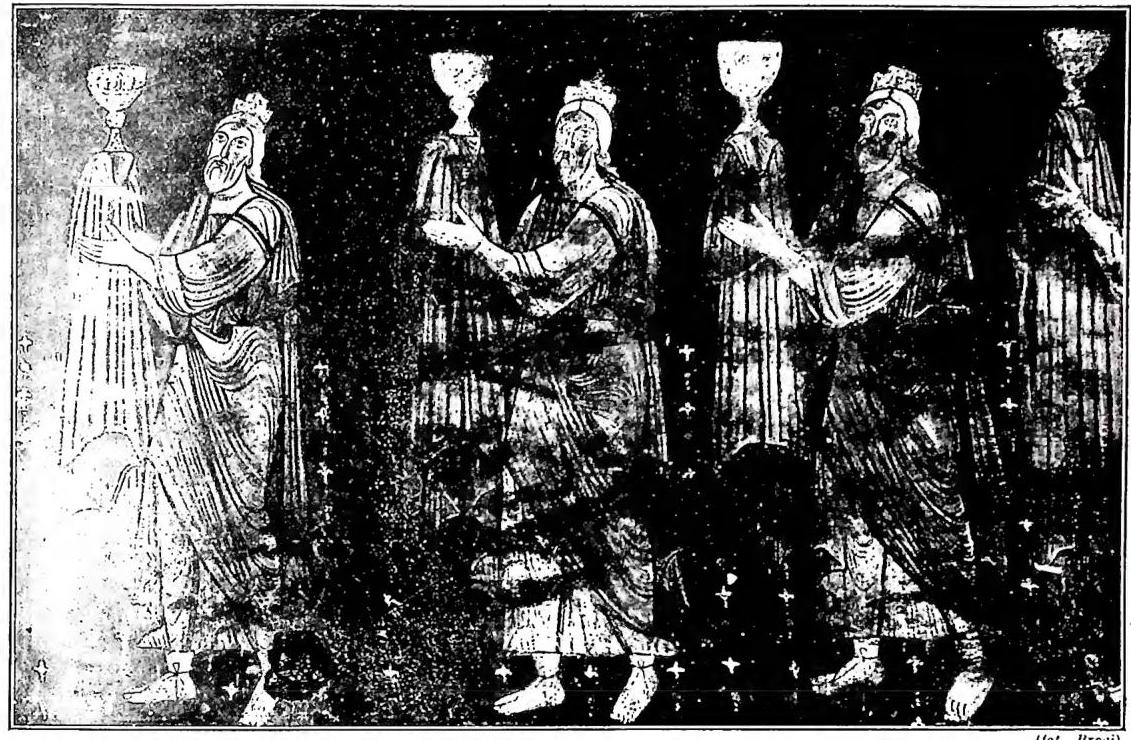
APOCALYPSE – The Elders of the Apocalypse. Fresco by the Roman school of the 12th century – Castel S. Elia, Church of S. Elia.
The elders of the A. The fresco by the Roman school of the 12th century in the Church of S. Elia at Castel S. Elia.
The tendency to fragment the A. into multiple sources has, however, now declined among critics. W. Bousset, R. H. Charles, A. Loisy, E. Lohmeyer, as well as the Catholic scholars Th. Calmes and A. Lemonnyer, oppose the proponents of such fragmentation (E. Lohmeyer, Die Offenbarung des Joh., pp. 181-91), though they acknowledge that the author of the A. may have incorporated fragments of earlier writings.
Indeed, an internal examination of the A. leaves no doubt as to its unity. The architectural unity of the book is evident, in which each part is bound by the law of concatenation (Allo, pp. LXXIII-LXXV) and articulated through numerical symbolism (the entire work is structured in septenaries, each divided into two series of three and four members: Allo, pp. LXXXI, XCIII), and marked by the recurrence of dominant symbols (the "Lamb" from ch. 5 to ch. 22, the "Beast" from ch. 11 to ch. 20, etc.). Each part is inseparable from the whole, constructed without any gaps (despite 3:22; 11:19; 15:1). Unlike the chaotic compilations of apocryphal apocalypses, the A. presents a coherent and homogeneous doctrine. The style, with its peculiar anomalies, remains consistent from beginning to end; the lexicon exhibits the same characteristic terms throughout (e.g., παντοκράτωρ and θρόνος from the first to the last chapter, etc.). Singular thematic expressions link the introduction to the conclusion (1:1 and 22:6; 1:3 and 22:7-10; 1:8 and 22:13; 2:11 and 20:6; 3:12 and 21:2) and the other sections among themselves (1:6 and 5:10; 3:3 and 16:15; 12:9 and 20:2; etc.). Cf. Th. Zahn, Ein letztes Wort über die Einheitlichkeit und Echtheit der johanneischen Apokal., in Neue kirchliche Zeitschrift, 37 (1926), pp. 749-68;
Ph. Carrington, The Meaning of the Revelation, London 1931: Some overly systematic exegetes rigidify this literary unity into a constant rhythmic structure, such as A. Olivier, who discovers at the foundation of the entire composition of the A. the numerical devices 888 and 666. Slightly less arithmetical is R. [J.] Loenertz, who, after rightly illustrating how the entire work is divided into 7 septenaries, argues that each septenary is subdivided into 8 minor sections and finds everywhere the literary device of intercalation (expressed by the formula A-B-A).
The internal difficulties adduced by modern "critics" to deny the identity of authorship between the Fourth Gospel (with the Johannine epistles) and the A. are the same as those produced in the 3rd century by Dionysius of Alexandria: differences in composition, ideas, and style. The disparity is certainly notable, but it is largely explained by the difference in literary genre and subject matter. Instead, affinities of thought and form appear between the two works. The doctrine of both culminates in a transcendent eschatology, revolving around the foundational ideas of life (eternal), light, Lamb and Shepherd, Word of God (only Jn 1:1-14 and 1 Jn 1:1 and Apoc. 19:13), divine judgment, and two opposing kingdoms (God and Satan, heaven and world). The nature and perspective of the author are shared, as are the dramatic and spiritual conception, the literary technique of progressive parallelism and concatenation between parts, and various "Johannine" terms (ζωή, ἀλήθεια, ἐντολή, μαρτυρεῖν and μαρτυρία, νικῆν, etc.). Thus, critics such as A. Harnack and W. Bousset recognize that the Fourth Gospel and the A. originate from the same "Johannine school of style." Historical testimonies and internal evidence therefore concur in declaring the Apostle John as the author of the A.
3. LITERARY NATURE, LANGUAGE, AND TEXT – In its allegorical-symbolic form as well as in its general theme ("the age to come": hā-'ōlām hab-bā'), the A. connects to apocalyptic literature (v. APOCALITTICA). Yet within this literature, it constitutes a unique case: it is, in fact, true prophecy; thus, pseudonymity is excluded, as are any deceptive artifices or slavish imitation. The A. arose from a genuine vision and from a divine command to recount that vision (K. Schneider, Die Erlebnisschheit der Apok. des Johannes, Leipzig 1930).
Though it presents itself as a single vision unfolding in multiple acts and many scenes (the frequent formula being: "and I saw," "after this I saw"), it may be held that John experienced various visions at different times. According to St. Thomas, the visions of the A. are of the imaginative type (Sum. Theol., 2a-2ae, q. 175, a. 3, ad 4), and St. Teresa rightly observes (Vita, ch. 28) that imaginative and intellectual visions almost always occur together (cf. St. Thomas, op. cit., 2a-2ae, q. 173, a. 2, ad 2). Many images give the impression of being purely intellectual due to their notable complexity; they are "contemplated thoughts" (W. Förster, in Neutestamentliche Forschungen, 104 [1932], pp. 279-310). Yet overall, the vast symbolic drama lacks neither plastic realism nor coherence. It is a celestial liturgy (J. Peschek), modeled on the Sunday synaxis of the time (J. C. Hedley, The Holy Eucharist, ch. 10), into which is woven God’s judgment upon opposing powers and the triumph of the Lamb with His faithful (B. Brinkmann, De visione liturgica in A. s. Ioannis, in Verbum Domini, 11 [1931], pp. 335-42). John wrote what he saw and heard (22:8): the voice he hears is sometimes that of Jesus (1:10-13; 4:1; 21:5-8; 22:12-16), but more often (consistent with apocalyptic usage) it is that of an angel (15 times, from 5:2 to 22:6-11). The seer weeps (5:4), is astonished (17:6) or overwhelmed (1:17), and above all, he adores and prays (22:8-9, 17, 20).
All is seen in unity sub specie aeternitatis. As a vast allegorical drama of God’s victorious Kingdom, the A. presents in a transcendent degree the triple unity of action, time, and place. Against the two-tiered scenic backdrop (heaven and earth), the plot unfolds in swift, total contrasts, culminating in catastrophe and final triumph, foreseen from the outset. Earthly time, merging with celestial eternity, is concentrated into the "last times" (1:1, 19; 22:6, 10, 20). Amid the shifting scenery, there is an unchanging focal point: the celestial City-Sanctuary with the throne of God, and at its center the Redeeming Lamb, who is the temple and the lamp of heaven (21:22-23). The drama is almost entirely visual, consisting of the succession of scenes with few but powerful lines: the political art of Van Eyck (The Mystic Lamb) in Saint Bavo’s Cathedral in Ghent corresponds to the pictorial character of the A. Yet dialogue is absent, supplanted by frequent choruses and mysterious music (5:9-11; 14:2-3).
The symbolic images, transcending the inadequacy of human language, highlight the spirituality of the "revelation." The seer draws them not from Jewish apocalypses, which are foreign to him in tone, spirit, and doctrine, but from the sacred books of the Old Testament (J. Freundorfer and J. Michl, contra R. H. Charles). In 405 verses, the A. contains 219 references to the Old Testament; only in about twenty passages can some connection with apocryphal apocalypses be discerned. Its primary models are the later Prophets: Ezekiel (the background vision is in Ez 1:4-28; cf. Is 6:1-4; 24:23) and Daniel (Dan 7-12), followed by Zechariah and Joel; it also frequently refers to the Mosaic books and the Psalms.
From the New Testament, it employs the "synoptic apocalypse" (Mt 24; Mk 13; A. Wikenhauser, Der Sinn der Apok., pp. 5-15), and in Christology, it recalls St. Paul (1:5: Col 1:18). Yet while continuing the tradition of the Prophets and the Gospel, the A. possesses pure originality in its overall composition and in adapting earlier symbols to its lofty Christian theme, completing and transforming the prophetic symbols; it is a new and higher prophecy. A. Wikenhauser exaggerates in calling the A. the "Book of Daniel of the New Testament."
G. RICCIOTTI
The biblical coloration and originality must be asserted above all against those who make the Apocalypse a derivative of Hellenistic syncretism through cosmogonic influences (H. Gunkel, Schöpfung und Chaos in Urzeit und Endzeit, Göttingen 1895, reprint 1921) or astrological ones (F. Boll, Aus der Offenbarung Johannis, Leipzig-Berlin 1914; id., Sternglaube und Sterndeutung, ibid. 1918, 2nd ed. 1926): J. Freundorfer has learnedly refuted such theories.
The style is unmistakable. Extremely simple, it is solemn and majestic, often also pathetic; monotony alternates with emphasis, as the soul oscillates between adoration and terror; the chant periodically transforms from invocation into paean. Sentences are juxtaposed (parataxis); the period is based on parallelism, which often gives it a rhythmic appearance. But the theory of R. H. Charles, that the Apocalypse is largely a poetic composition arranged in strophes, is unfounded. In the succession of symbolic scenes, parallelism gives way to a characteristic "spiral" progression (Allo): the description, first sketched, is taken up again to be integrated. There is a constant, as in the Fourth Gospel, the procedure of syncrisis, an antithesis of "contrapasso," spontaneous elsewhere where the divine Judgment is described.
The language, from a grammatical standpoint, is the most singular known among Greek literary writings. It disconcerts due to frequent case disagreements (e.g., 1, 4. 5. 15; 2, 20) and strange constructions. The solecisms of the Apocalypse pose a problem, which today is generally resolved by attributing them to the Semitic character of the seer, inexperienced in Greek, whose grammatical structures he could not master in translating thoughts he mentally expressed in Aramaic formulas. The Apocalypse ignores, for example, the genitive absolute and the narrative hoin frequent in the Fourth Gospel (cf. G. Sacco, La hoinè del Nuovo Testamento e la trasmissione del sacro Testo, Rome 1928, pp. 100-14). But the language of the Apocalypse has also been excessively condemned. Case disagreements are explained by the frequent parentheses that break the period, giving rise to "pendent nominatives." Anacolutha abound, but they are always explained by a Semitic conceptual substratum.
The lexicon of the Apocalypse presents no difficulties: of its 913 words (108 of which are foreign to other books of the New Testament), only 6 are not found in other Greek texts (hapax legomena). Singular is only the almost absolute absence of the most commonly used particles, and the semantic modification of various terms under the influence of the Semitic vocabulary. Attempts to reconstruct a Hebrew original have been in vain (M. Mieses, Hebräische Fragmente aus dem jüdischen Urtext der Apok. des hl. Johannes, in Monatschrift für Gesch. u. Wissenschaft des Judentums, 74 [1930], pp. 345-62).
The text has come down to us in 252 Greek manuscripts, of which only 8 are uncials (some of which are lacunose) and about ten cursives are prior to the 11th century; among the complete ones, the oldest is the Sinaitic (4th century), but the most faithful (less revised) is the Alexandrian (codex A, 5th century). The Chester Beatty papyrus (edited by F. G. Kenyon, London 1934) from the 3rd century contains Apocalypse 9, 10-17, 2, and confirms the primacy of codex A (M.-J. Lagrange, in Revue Biblique, 43 [1934], pp. 488-92). The textual criticism of the Apocalypse is today the most precise available for any biblical book, thanks to the gigantic works of H. C. Hoskier, Concerning the text of the Apocalypse, 2 vols., London 1929. Cf. H. A. Sanders, The Beatty Papyrus of Revelation and Hoskier's Edition, in Journal of Biblical Liter., 53 (1934), pp. 371-80.
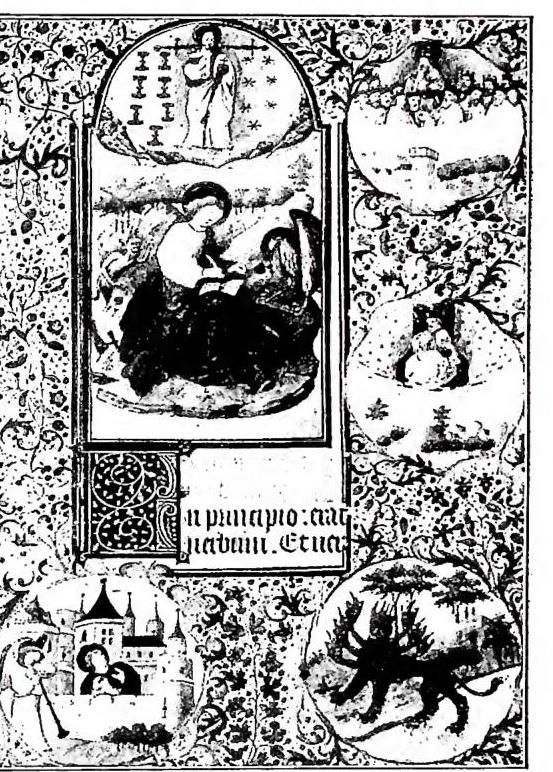
John declares that he had his vision on Patmos, an island in the Aegean, where he was exiled for having preached Christ (1, 9), and this indication (which directly refers to the vision, not the redaction of the work) provides the orientation for establishing the date.
Many "critics," following F. C. Baur, place the persecution mentioned (1, 9) and thus the composition of the Apocalypse at the end of Nero's reign (between 65 and 68), based on three clues: Jerusalem and the Temple are still depicted as standing (11, 1-2), the Beast clearly alludes to Nero (13, 18 and 17, 10), and the language of the Apocalypse presupposes several decades of distance from that, much more advanced, of the Fourth Gospel (so A. Hilgenfeld, J. B. Lightfoot, F. J. A. Hort, J. J. Scott).
But historical tradition places the composition of the Apocalypse at the end of Domitian's reign, around 95, and if, for once, the "critics" strive to antedate it, it is only to detach the Apocalypse from the Fourth Gospel. No proof can be established on the symbols of the Temple (Church) and Nero (Antichrist). Clearly, however, St. Irenaeus attests (Adv. Haer., V, 30, 3): "The vision (of the Apocalypse) occurred not long ago, but almost in our time, at the end of Domitian's empire," and so do Clement of Alexandria, Origen, Victorinus of Pettau (In Ap., 10, 11; 13, 10), Eusebius (in the Chronicon he places the Apocalypse in the 14th year of Domitian: A.D. 95), and St. Jerome (De viris ill., 9: A.D. 95). Some late conjectures, advanced by St. Epiphanius and Apringius (under Claudius) or by apocryphal Acts of John and Theophylact (under Nero), do not undermine the ancient and constant tradition (cf. R. Schütz, Die Offenbarung des Johannes und Kaiser Domitian, Göttingen 1933).
The letters to the seven churches (chapters 2-3) presuppose the conditions prevailing at the end of the 1st century: the Asian churches appear organized and flourishing, having overcome persecutions, and partly declined from their primitive fervor; a generation seems to have passed since the time of the Pauline epistles.
Since, therefore, the Apocalypse precedes the Fourth Gospel by barely a five-year period, the difference in language between the two works must be explained, because if John had not well assimilated Greek until old age, it does not seem he could have become a good master of the language four or five years later. Some seek the solution in the harsh conditions of exile on Patmos, where the Apostle did not have sufficient time and leisure to supervise his style, while later in Ephesus he wrote the Gospel calmly, refining its diction. Most (H. B. Swete, J. H. Moulton, E. Jacquier, L. Radermacher, M. Meinertz, P. Gächter) believe that the Apocalypse presents John's language in its raw state, while the form of the Fourth Gospel would have been refined or revised by a secretary or reviser employed by the Apostle; and this can well be reconciled with the first explanation (A. T. Robertson).
The Apocalypse is a letter to the Christians of proconsular Asia represented by the seven churches (1, 11). John names the seven churches (a symbolic number, expressing totality) with which he is in closest relation, omitting some important ones (Miletus, Hierapolis, Magnesia) while including some secondary ones (Thyatira, Philadelphia). The hypothesis that the names of the seven churches were chosen based on their geographical location, as W. Ramsay proposes (The Letters to the seven Churches of Asia, London 1904), is unlikely.
John's prophetic-epistolary message aims to strengthen faith and comfort hope; it seeks to fortify the faithful, inclined toward laxity, against the persecution that announces itself as ever more violent, describing the struggles and triumph of the Kingdom of God: it is an exhortation to perseverance and "martyrdom" amid earthly tribulations, a proclamation of certainty and eternity. The seer's gaze extends beyond the Domitianic persecution and embraces
(from Trésors des bibliothèques de France, 1938, pl. 6).
BIBL.:
H. Gunkel, Schöpfung und Chaos in Urzeit und Endzeit, Göttingen 1895; F. Boll, Aus der Offenbarung Johannis, Leipzig-Berlin 1914; id., Sternglaube und Sterndeutung, ibid. 1918; J. Freundorfer, Die Apokalypse des hl. Johannes und die hellenistische Kosmologie und Astrologie, Paderborn 1929; R. H. Charles, A Critical and Exegetical Commentary on the Revelation of St. John, 2 voll., Edinburgh 1920; G. Sacco, La hoinè del Nuovo Testamento e la trasmissione del sacro Testo, Roma 1928; H. C. Hoskier, Concerning the text of the Apocalypse, 2 voll., London 1929; F. G. Kenyon, The Chester Beatty Biblical Papyri, London 1934; M.-J. Lagrange, in Revue Biblique, 43 (1934), pp. 488-92; H. A. Sanders, in Journal of Biblical Liter., 53 (1934), pp. 371-80; R. Schütz, Die Offenbarung des Johannes und Kaiser Domitian, Göttingen 1933; W. Ramsay, The Letters to the seven Churches of Asia, London 1904.
A. Vaccari
APOCALYPSE - St. John at Patmos. Miniature from a book of hours according to the use of Paris: ms. lat. 1176, fol. 14 (15th century), from the Bibliothèque Nationale de Paris.
the immense conflict of all times between the mystical Christ and the world of Satan: «Persecutio quam sancta Ecclesia toto terrarum orbe patietur, universa scilicet civitas Christi ab universa diaboli civitate» (Augustine, De civitate Dei, XX, 11). Only one thing matters here below: to conquer (2, 7.26; 3, 12.21; 21, 7); woe, therefore, to the lukewarm and the cowardly (3, 15.16; 21, 8). But the anxious vigil, the anguished waiting, the bloody struggle, will be transformed into joy and glory (cf. Io. 16, 16-22); to the groaning prayer will follow the epinicion. The dazzling «revelation» of the Apocalypse is, today as yesterday, of burning actuality (E. Riggenbach, Die Bedeutung der Offenbarung Johannis für die Gegenwart, Basel 1926; Dieu Vivant, fasc. 1 [1946], pp. 5-9).
8. INTERPRETATION
The obscurity of the Apocalypse, inseparable from prophecy and even more so from the allegorical-symbolic genre, perceived moreover by the seer himself (13, 18; 17, 9; «book with the 7 seals»), creates innumerable difficulties for exegesis (St. Jerome, Ep. 53 ad Paulinum: «Apocalypsis Ioannis tot habet sacramenta quot verba»). The enigmas were fewer for the recipients and the first readers, who were aware of various allusions to events and situations of the time, familiarized with certain symbolisms. However, no exegetical tradition has been preserved except in a fragmentary state. Already from the 2nd century, systems of interpretation arose that were more influenced by Jewish apocalyptic ideas than conscious of the guiding lines of prophetic representation and spiritual symbolism. The many systems into which Catholic exegesis of the Apocalypse has been divided can be reduced to four, which still have proponents today.1) The eschatological (endgeschichtlich) is the oldest and still the most widespread: the Apocalypse (from chapter 4 to the end) predicts the future events of the end of the world (persecutions and calamities, apostasies, Antichrist, final judgment).
The earliest writers «Judaized» (Jerome, In Isaiam, introduction to ch. XVIII) by falling into literal millenarianism (Papia, St. Irenaeus, St. Justin, St. Hippolytus, Tertullian, etc.), up to the first commentator included (the commentaries of Melito and Hippolytus are lost) Victorinus of Pettau, who nevertheless inaugurates the theory of recapitulation. Eschatological, but without millenarianism, are the Greek commentaries of Andrew of Caesarea, Ecumenius (text discovered in Messina in 1901 by F. Dickamp: cod. S. Salvatore 99, edited by H. C. Hoskier, Ann Arbor 1928), Arethas; among the Latins, most of them, from Apringius, St. Gregory the Great, St. Bede, Alcuin, St. Beatus of Liébana, Haimo (d. 853), up to St. Albert the Great (i.e., Hugh of St. Cher: J.-M. Vosté, in Angelicum, 9 [1932], pp. 328-35) and Denis the Carthusian; in the 16th and 17th centuries, F. de Ribera, B. Pereira, B. Viegas, St. R. Bellarmine, C. a Lapide, J. Mariana, G. S. Menochio, A. Escobar y Mendoza, J. de Sylveira; in our days, A. Bisping, F. Kaulen, R. Cornely, J. Corluy, L. C. Fillion, M. Sales, J. Sickenberger, S. Rosadini, A. van der Heeren, among Protestants J. C. K. Hofmann and Th. Zahn. Cf. H. Rongy, in Revue ecclés. de Liège, 23 (1931), pp. 92-95, 158-65.
2) The ancient historical (zeitgeschichtlich) is almost the opposite of the previous one: the Apocalypse symbolically describes the struggle of Judaism and paganism against the Church, ending with the triumph of the Church and the fall of pagan Rome; the prophetic cycle of the Apocalypse would be completed by the 4th and 5th centuries. Proposed by J. Henten (1574), then by A. Salmeron (d. 1585), it was emphasized and popularized by L. de Alcázar (v.). It was adhered to by J. B. Bossuet, A. Calmet, De Vuilleret, M. Aberle, F. Allioli, L. Bacuez, J. Schäfer-M. Meinertz, L. Billot.
Very different is the modern rationalist «zeitgeschichtlich» school (to which the Catholics P. Touilleux and A. Gelin partly adhere), which sees in the Apocalypse only allusions to contemporary history (Nero): E. Renan (L'Antéchrist, Paris 1871), O. Pfeiderer, F. Spitta, E. Vischer, D. Völter, W. Beyschlag, H. J. Holtzmann, C. Erbes, A. Loisy. On their hypotheses cf. L. Brun, Die römischen Kaiser in der Apok., in Zeitsch. für neutest. Wissenschaft, 26 (1927), pp. 128-51.
3) The universal historical (kirchengeschichtlich) holds that the Apocalypse encompasses all times. Berengaudus (9th century), Rupert of Deutz (12th century), and Alexander of Bremen (13th century) find in it the various ages of the world since creation. Joachim of Fiore inaugurates the theory of the (seven) epochs of the Church with the culmination of a spiritual millenarianism (cf. W. Kamlah, Apokalypse und Geschichtstheologie: Die mittelalterliche Auslegung der Apok. vor Joachim von Fiore, Berlin 1935); many follow him, from the movement of the «Spirituals» to various recent Protestant sects.
Preceded by the Franciscans Alexander of Bremen (d. 1271) and Peter Auriole (d. 1322), Nicholas of Lyra (1329) sees in the Apocalypse the chronological exposition (in seven epochs) of the entire history of the Church. This interpretation became very popular, having been launched by Luther (1534) among Protestants and by B. Holzhauser (d. 1658) among Catholics (among the more recent: Lafont de Sentenac, P. Drach, F. Tiefenthal, M. A. Gallois, F. Gutjahr). This superficial system becomes highly arbitrary when it breaks down prophecy into news items, according to a method that still seduces many improvised exegetes (S. Sansi, Il Regno di Cristo... secondo l'Apoc., 2 vols., Rome 1899; J. Chevalier, L'Apoc. et les temps présent, Rome 1907; etc.; P. Clangor, La grande guerra, massoneria, bolscevismo e l'avvenire del mondo nelle visioni profetiche dell'A., Brescia 1937; W. Muller-Jurgens, «Apokalypse», Die Geheime Offenbarung des Johannes, Bern-Leipzig 1938; Fortunato della Valletta, Apocalypse de St Jean, Ottawa 1939; J. du Plessis, Le sens de l'histoire, II, Paris 1939; L. Moreno Mora, La Iglesia Católica a través del Apocalipsis, Quito 1939; etc.).
4) The recapitulative is hinted at or implicit among the best Latin representatives of the first system (e.g., Bede, Alcuin); it is the only one, along with the eschatological, that can be called traditional. The Apocalypse does not present future events in a continuous progressive series but describes some supreme events of the struggle between Christ and Satan, repeating the same realities in different symbols until their maturation and final outcome: it is the Kingdom of God militant and finally triumphant. Hinted at by Victorinus of Pettau, the recapitulatio is formulated and applied by the Donatist Tyconius (ca. 380), admitted and explained by St. Augustine (De Civ. Dei, XX, 8), who establishes sure exegetical principles: the Apocalypse predicts the spiritual history of humanity from the Incarnation to the end of the world, without lingering over particular external contingencies: the economy of the New Testament unfolds in its salient lines of harsh conflict ultimately victorious between «the two cities», as presented in the Gospel (Mt. 10, 16-39; Lc. 10, 1-24; 17, 20-37; 18, 7-8; cf. Io. 15-17). Augustine adds: «Sic eadem multis modis repetit, ut alia atque alia dicere videatur, cum aliter haec ipsa dicere vestigatur» (ibid., XX, 17).
This theory, still represented by Primasius, Cassiodorus, and Ambrose Autpert, later received an artificial application from Abbot Joachim, aggravated further by the Protestants N. Collado (1581) and J. Cocceius (1668). Today it is restored in its pure and traditional form by B. Allo (1921), who well demonstrates how chapters 12-20 are a parallel development of chapters 4-11, and by A. Merk, Compendium introductionis in S. Scripturae libros (by Cornely, 9th ed.), Paris 1927, pp. 794-798, and De compositione A., in Verbum Domini, 8 (1928), pp. 211-17; cf. H. Höpfl-B. Gut, Introductio specialis in Novum Testamentum, Rome 1938, pp. 521-22. It is adhered to by conservative Protestants: E. Lohmeyer; H. E. Hill, Mystical studies in the A., London 1932.
BIBL.:
Per l'interpretazione: J. Behm, Die Offenbarung des Johannes (in Lietzmann, Handbuch zum N. T., 16), Tubinga 1924; E.-B. Allo, Saint Jean. L'Apocalypse (Études bibliques), Parigi 1921; A. Wikenhauser, Die Offenbarung des Johannes (Regensburger N. T., 9), Ratisbona 1947; H. B. Swete, The Apocalypse of St. John, Londra 1906; R. H. Charles, A critical and exegetical commentary on the Revelation of St. John (Intern. Crit. Comm.), 2 voll., Edimburgo 1920; J. M. Vosté, De Apocalypsi S. Ioannis, Roma 1938; A. Feuillet, L'Apocalypse. État de la question, Bruges 1963; inoltre V. APOCALITTICA; ESCHATOLOGIA; MILLENARISMO; PROFEZIA.
A. Vaccari.
Questo sistema, che meglio salvaguarda il carattere profetico (spirituale) e unitario dell'A., deve accogliere il nucleo di vero dei tre primi. La A. è escatologica, non già una predizione dettagliata della storia universale; ma gli «ultimi tempi» debbono essere intesi nel senso profetico e apostolico: sono l'età messianica, era religiosa definitiva. La maggior parte dei simboli si riferiscono anzitutto alle persecuzioni dell'Impero romano, e, come ogni profezia, l'A. era uno scritto d'attualità; ma la lotta tra Roma pagana e la Chiesa raffigura e predice le successive fasi della perpetua
lotta tra le potenze sataniche e Cristo, che in ultimo trionferà nella sua Chiesa (Ticonio, Liber regularum, IV: «Dum speciem narrat in genus transit»), V. ABADDON; ALFA E OMEGA; ANTICRISTO; ARMAGEDDON; DRAGONE; NERONE; TESTIMONI, I DUE.
BIBLI: L'A. ha avuto innumeri commentatori dal sec. VIII a oggi; i più notevoli sono stati nominati sopra. B. Allo, St. Jean: L'A., Parigi 1921, passa in rassegna (pp. CCXVIII-CCXLVII) i commenti anteriori al 1920. Il miglior commento cattolico moderno è questo di Allo (3ª ed. 1933), di cui C. Laverne ha dato un compendio (Parigi 1930). Altri commenti cattolici (dopo il 1920): I. Rohr, Die geheime Offenbarung des hl. Johannes (1915), 4ª ed. Bonn 1932; C. Martindale, The A. of st. John, Londra 1922; J. Schäfer, Die Apokalypse des hl. Joh., Steyl 1926; O. Cohaus, Säberliche auf Patmos, München-Gladbach 1927, 2ª ed. Klosterneuburg 1938; R. Eaton, The A. of st. John, Londra 1930; C. Bonavia, L'A. di Giovanni, Bari 1933; J. Trepat, A. de s. Jean, Barcellona 1936; A. Van Delft, A. van den H. Joannes, Nimega 1936; D. S. Sebastiano, Die geheime Offenbarung des hl. Johannes, Città d. Vaticano 1936; A. Gelin, L'A., in L. Pirot, La Sainte Bible, XII, Parigi 1938; O. Karrer, Die geheime Offenbarung, Einsiedeln 1938; J. Stahelin, Die A., San Gallo 1939; J. Sickenberger, Erklärung der Johannesapokalypse, Bonn 1940 (2ª ed. 1942); A. Van der Heeren, L'A., Parigi 1941; K. Rösch, Die Offenbarung des hl. Johannes, Paderborn 1941; P. Ketter, Die Apokalypse, Friburgo in Br. 1942; H. M. Féret, L'Apoc. de s. Jean. Vision chrétienne de l'histoire, Parigi 1946; J. [R.] Loenertz, The Apocalypse of st. John (trad. di H. J. Carpenter, dal francese inedito), Londra 1947.
Principali commenti cattolici recenti: H. B. Swete, The A. of st. John, Londra 1906 (3ª ed. 1917); R. H. Charles, A critical and exegetical Commentary on the Revelation of st. John, 2 voll., Edimburgo 1920; id., Lectures on the A., Londra 1922; A. Loisy, L'A. de Jean, Parigi 1923; Th. Zahn, Die Offenbarung des Johannes, 2 voll., Lipsia 1924-26; H. L. Strack - P. Billerbeck, Kommentar zum N. T. aus Talmud u. Midrasch, III, Monaco 1926, pp. 788-857; E. Lohmeyer, Die Offenbarung des Joh., Tuhinga 1926; id., Die Offenb. des Joh. 1920-34, in Theologische Rundschau, 6 (1934), pp. 204-314 (rassegna completa degli studi del quindicennio); J. Behm, Die Offenb. des Joh. (Das N. T. deutsch, III, 3), Gottinga 1935 (3ª ed. 1937); C. Clemen, Visionen und Bilder in der Offenb. Joh., in Theol. Studien und Krit., 107 (1936), pp. 236-65; id., Dunkle Stellen in der Offenb. Joh. religionsschichtlich erklärt, Bonn 1937; M. Kiddle e M. K. Ross, The Revelation of st. John, Londra 1940.
Principali studi recenti di cattolici: L. Billot, La Parousie, Parigi 1920, pp. 267-303; E. Jacquier, Histoire des livres du N. T., IV, 3ª ed., Parigi 1921, pp. 311-420; J. Sickenberger, Die Johannesapokalypse und Rom (nega che la Bestia dal mare sia Roma), in Bibliche Zeitschrift, 18 (1926), pp. 270-82; id., Die Deutung der sieben apokalyptischen Gemeinden, in Römische Quartalschrift, 35 (1927), pp. 135-49; E. Tobac, L'A. de s. Jean, in Collationes Mechlin., 17 (1928), pp. 137-57; J. Peschek, Geheime Offenbarung und Tengeldienst, Paderborn 1929; J. Freundorfer, Die A. des Ap. Johannes und die hellenistische Kosmologie und Astrologie, Münster 1929; A. Wikenhauser, Der Sinn der A. mit einer Darstellung ihres Inhalts und literarischen Aufbaus, Münster 1931; id., Das Problem des taureuführigen Reiches in der Johannes-A., in Römische Quartalschrift, 40 (1932),
pp. 13-25; A. Médebielle, Expiation (dans l'A.), in DBs, III (1934), coll. 234-42; N. Žuvić, De A. taupum prophetico libro, in Bogoslovská Smotná, 22 (1934), pp. 330-46; id., Explicatio A. s. Johannis, ibid., 23 (1935), pp. 17-46; P. Touilleux, L'A. et les cultes de Domitien et de Cybèle, Parigi 1935; D. Haugg, Die zwei Zeugen (Apoc. 11, 13), Münster 1936; J. Schmid, Der Apokalypsetext des Ch. Benty-Papyrus, in Neugriech-Byzant. Jahrbuch, 11 (1934), pp. 65-108; id., Untersuchungen zur Geschichte des griechischen Apokalypsetextes, in Biblica, 17 (1936), pp. 11-44, 167-201, 273-93, 429-60; J. Michl, Die Engelvorstellungen in der A. des hl. Johannes, I: Die Engel um Gott, Monaco 1937; E. Peterson, Zenze der Wahrheit, Lipsia 1937; A. Charue, Le message de l'A., in Collationes Namurcenes, 31 (1937), pp. 417-31; 32 (1938), 85-100, 245-65; A. Olivier, La clé de l'A., Parigi 1938; id., La strophe sacrée en s. Jean,
ivi 1939; A. Škrinjar, A. de Regna Christi, in Verbum Domini, 14 (1934), pp. 289-95; id., A. de martyris, ibid., 20 (1940), pp. 210-18, 234-40, 278-86; id., Antiquitas christiana de angelis 7 ecclesiarum, ibid., 22 (1942), pp. 18-24, 51-56; id., Dignitates et officia Ecclesiae Apocalypticae, ibid., 23 (1943), pp. 22-29, 47-54, 77-88 (e altri notevoli studi dello stesso in Verbum Domini); A. Vitti, Ultimi studi sul l'A., in Biblica, 21 (1940), pp. 64-78; R. Loenertz, Plan et division de l'A., in Angelicum, 18 (1941), pp. 336-56; P. Ketter, Der römische Staat in der A., in Trierer theologische Studien, 1941, pp. 70-93; H. M. Féret, A., histoire et eschatologie chrétienne, in Dieu vivant, fasc. II (1946), pp. 115-34; J. Huby, A. et histoire, in Construire, 15 (1944), pp. 80-100.
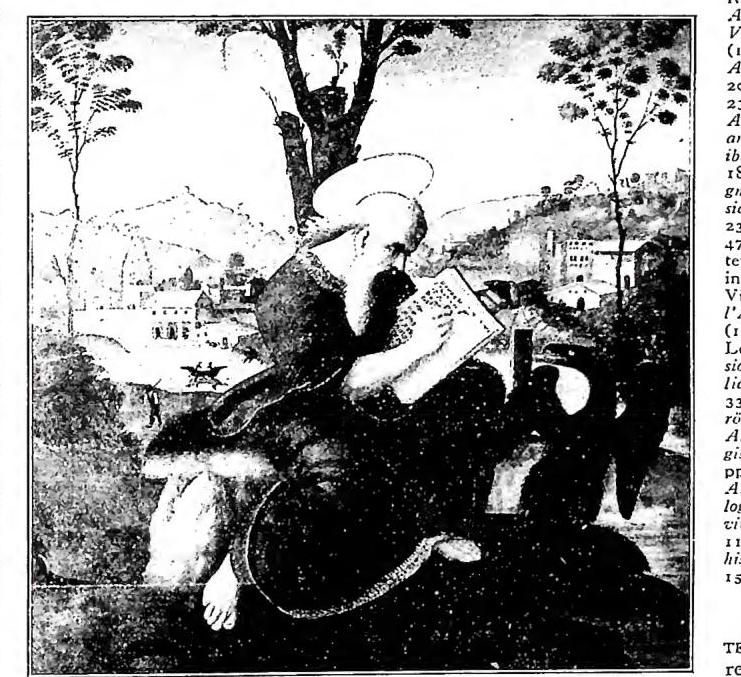
Dipinto di Berto di Giovanni (sec. XV) - Perugia, Pinacoteca.
Nella miniatura le illustrazioni dell'A. hanno particolare sviluppo dopo l'VIII sec., specie nella Spagna grazie al commentario di Beato di Lièbana (v); mentre un gruppo a parte è costituito dai codici di Treviri, Cambrai, Valenciennes, Bamberga (secc. VIII-XI). Il terzo gruppo, l'anglo-normanno, che più d'ogni altro si diffuse tra gli ar-
tisti gotici oltremontani, ispirò ancora, sebbene parzialmente, l'eccezionale figurazione del Dürer, la cui enorme influenza s'estese fino ai conventi del monte Athos.
In the Middle Ages, while such illustrations initially follow the apocalyptic text even in its most fanciful details, in mural decorations the great variety of scenes is reduced to the most common and widespread motifs: for example, Christ between A and Ω (Palatine Chapel in Aachen); the twelve lambs emerging from the two holy cities (Ravenna, S. Apollinare in Classe); this also occurs in more complex cycles, such as those of the abbey of Civate al Monte and the crypt of the cathedral of Anagni.
From the 15th century onward, apocalyptic motifs are interpreted with the utmost freedom, as demonstrated by the frescoes of Signorelli in Orvieto, the adoration of the lamb by the van Eycks, the woman of the A. by Rubens, and in some scenes of tapestries from Flemish manufactories, etc. For the 18th–19th centuries, we cite the fresco by Scheffler in the church of S. Paolino in Trier and the cartoons for a cycle of frescoes by Cornelius, in the National Gallery of Berlin. Apocalyptic subjects, however, become increasingly rare due to the naturalistic approach of the Renaissance vision and are generally ignored in the iconography of the Counter-Reformation. Contemporary art includes the representations of the A. by Giorgio De Chirico and the great encaustic cycle by Ferruccio Ferrazzi. - Vedi Tav. CXXIV.