
SERPENT, IN ANCIENT RELIGIONS. — The cult of the serpent is widespread in ancient religions and among primitive peoples, where it sometimes represents the supreme being possessing nature’s creative and destructive power (Africa, Australia), above all insofar as it can grant or withhold rain; at other times, it is concealed or transformed beneath serpentine forms (e.g., Zeus Ctesios and Philios in Greece; Isis and Osiris in Egypt), or ultimately recedes entirely into the background, becoming an attribute of the god (e.g., Asclepius).
First of all, the serpent has a cosmic significance in myth, since the deity who creates or fashions the world must, at the beginning of time, fight against a serpentine monster, always associated with the waters, in order to bring the cosmos forth from chaos, which is guarded by, or even identified with, that serpent: such is the case of the Sumero-Babylonian Tiamat, split in two by Marduk (Euima elii); of the Egyptian serpent Apophis and the Hittite Illujankas, killed by the storm god Innaras; of the Vedic Vrtra (nicknamed Ahi = the enfolder), defeated by Indra, who was thus able to free the waters hidden by him (Ryveda I, 32); and of the “serpent of the world” of the northern peoples (Edda, Volospa, 197 ff.), symbol of the Ocean surrounding the Earth (Homer), and at the same time of the serpentine monster Typhon defeated by Zeus. These myths reveal a twofold characteristic of the serpent: as guardian of chaos or, at a more archaic stage, as chaos itself; and from both these concepts derive the other religious aspects of the serpent in these ancient religions.
Thus, first of all, its eternity, or at least immortality (a concept widespread in ethnology, perhaps arising from observation of its annual shedding of skin), which it does not allow man to possess as well: such is the meaning of the Sumerian myth of Gilgames, who, having found the herb of immortality after many hardships, is robbed of it by a serpent (Epic of Gilgamesh, tablet 13, 304). Moreover, it is the repository of prophetic knowledge, and is therefore employed as an oracular instrument: at Delphi, in the most ancient oracle of Gaia, guarded by the serpent Python, later killed by Apollo; in the numerous medical oracles of Asclepius, and similarly at Rome with Aesculapius (cf. Pliny, VIII, 153); at Lanuvium, in the temple of Juno, a serpent was used to determine the virginity of maidens (Propertius, V, 8, 3); in the Edda, the hero Sigurdh understands the language of birds after eating the heart of the serpent Fafnir (Fafnismal, 148 ff.), etc. Medical science too is one of its characteristics: in Greece and Rome the already re-

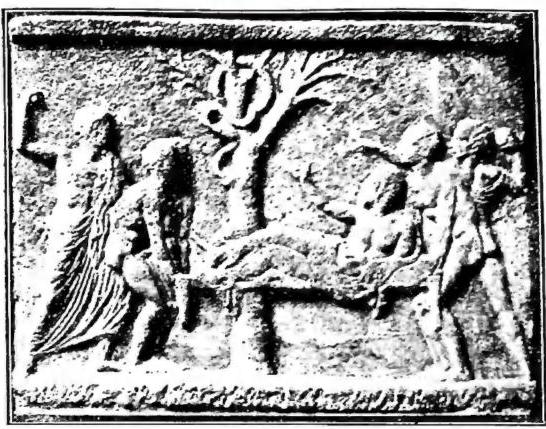
Finally, the other important aspect of the serpent as genius loci should be recalled: the serpent, in the archaic age the guardian of chaos, preserves this characteristic attachment to a place in order to guard and protect it («Angues apud gentiles locorum erant pro genius habiti semper»: Isidore, Orig., 12, 4, 1); thus it is very frequently found guarding springs, altars, oracles, and even cities (for example, the Acropolis of Athens was guarded by Athena’s serpent); above all, however, being connected with the underworld, it is the guardian of tombs in general and of the domestic hearth in particular, to such an extent that it symbolizes the souls of the dead (Lares) and is even worshipped and raised in every household, not only among primitive peoples but also in India, Greece, Rome, and among the Slavs and Balts.