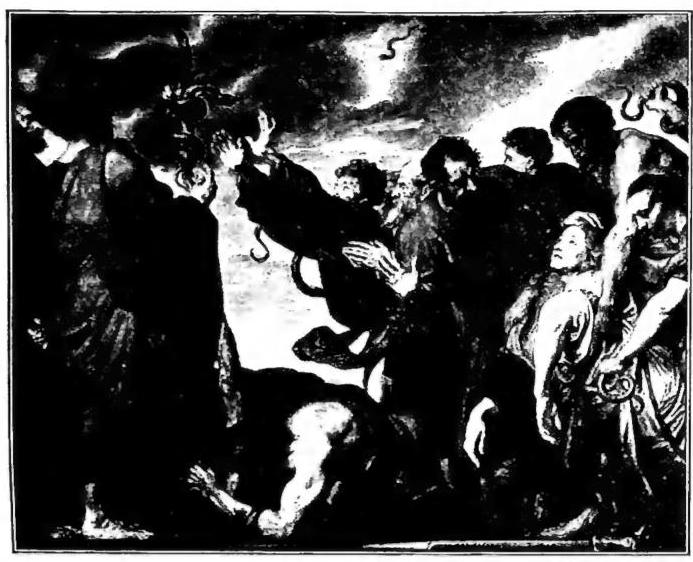
SERPENTE DI BRONZO

Image from page 251
Image from page 251
Image from page 251
Image from page 251

Serpent of Bronze

In the march of several months that brought the Israelites of Moses to the Arnon, in view of the "steppes of Moab," the people once again manifested their weariness from the hardships of the desert journey and the insufficiency and monotony of their diet of manna. Their complaints were "against the Lord" as well as against Moses. Then God sent them the punishment of "fiery serpents," whose bite was deadly.

It is not clear what species of serpents these were; perhaps the term "fiery," or "burning," Heb. *sáraph*, alludes to the inflammation or fever that the bite provoked. Once the people had repented, God, through the intercession of Moses, indicated the remedy in a serpent of bronze, which was to be erected on a pole: whoever had been bitten and looked upon it would be healed; and so it happened (Num. 21:4-9). The symbolism is not difficult to grasp: it is chosen in harmony with the setting. Suspended from the pole, the serpent was rendered harmless; the sight of the image recalled the punishment deserved; the act of trust, which the gaze was meant to evoke and signify, merited healing from God (Wis. 16:6-8). The object was preserved, but in popular Israelite tradition it became associated with a cult: it is found under the name of *Nohestan* (Nehustán) among the idolatrous objects that Hezekiah had destroyed (2 Kgs. 18:4). The meaning of the bronze serpent found at Gezer is unclear (ancient—

---

SERPENTE DI BRONZO — SERPOTTA GIACOMO

Giacomo Serpotta (1656–1732), Sicilian stucco artist.

In 1681 he executed the equestrian monument to Charles II in Messina, destroyed in 1848 (sketch in the Sieri Pepoli Museum in Trapani). In 1682 he created the statues of SS. Peter and Paul in the church of S. Maria del Carmine Maggiore; in 1685 he began one of his most famous works: the stuccoes of the oratory of S. Cita, completed over various periods. In 1690 he modeled the statue of the Virgin for the Jesuit College; in 1691 the stuccoes for the chapel of S. Stefano in S. Sebastiano alla Marina and that of the Annunciation in S. Onofrio. In 1694 he moved to Agrigento to execute the remarkable stuccoes of the church of S. Spirito; later in Alcamo, where he left four of his finest Allegories, while it is uncertain whether he traveled to other centers of the island that claim works by him without secure documentation. In 1696 Serpotta undertook the decoration of the church of S. Orsola, later restored by his son Procopio, also a stucco artist, and prepared wax models for the mysteries of the Rosary in the convent of S. Cita, later carved by Vitagliano. In 1698 he adorned the small chapel of the priests’ hospital, and in 1699, surrounding Caravaggio’s paintings, he executed the stuccoes of the oratory of S. Lorenzo, which, together with those of the oratory of the Rosary in S. Domenico, slightly later, are among the master’s greatest works. In 1707 the Princess of Roccaforzata had herself portrayed in a stucco medallion by Serpotta. The following year he adorned the church of the Pietà, and in 1711 that of S. Agostino. Shortly afterward he decorated the church of S. Tommaso dei Greci. From 1720 to 1728 the artist modeled the statues for the church of S. Agostino, where Berninian reminiscences are evident, and completed the oratory of S. Francesco ai Candelari, seat of the Confraternity of the Forensi, his last work.

Serpotta, one of the greatest sculptors of his time, had a remarkable sense of environmental decoration, modulating in his vivid representations an infinite series of motifs. These achieve unity through the magical interplay of shadows that lend and receive value from the precious whiteness of the luminous material used by the artist.

BIBL.: S. Bottari, *Artisti siciliani*, Messina 1931, pp. 47-66; F. Meli, *Studi e conferenze per il 2° centenario serpottiano*, Palermo 1934; id., *G. S.* (with bibl.), ibid. 1934; N. Basile, *Serpotiana*, ibid. 1935; S. Bottari, *Il baldacchino del duomo di Messina*.