
EVA. – Progenitress of the human race. E. was created so that man might have “a help suitable for him” (Gen. 2:18–20). Adam (v.) called her E. (Heb. Ḥawmāh), from the verb ḥājāh, “to live”: hence “mother of the living” (Gen. 3:20).
So that man might become aware of his superiority over all other beings, God ordered the animals of paradise to approach Adam, who gave each of them a name corresponding to its nature, and realized that no animal species was like man; feeling himself alone, he desired a help suitable for him, or almost his own image, and God, to whose creative work he turned, granted his request. “Then the Lord God cast a deep sleep upon Adam” (Gen. 2:21; Heb. tardīnah), during which Adam was to perceive God’s intention: He formed the woman from one of his ribs or from the flesh of his side (ṣilāʾ). The anthropomorphic account means that God, by his omnipotent will, formed the woman from a part of man. The sacred writer, as the very form of the account in a historical book suggests and s. Paul confirms (I Cor., 11:6), intends to relate a real event. Metaphysically, it signifies the moral and social relations of the two sexes: man will love woman as a part of himself, and woman will lean upon her husband as upon her head, whom she loves and on whom she depends.
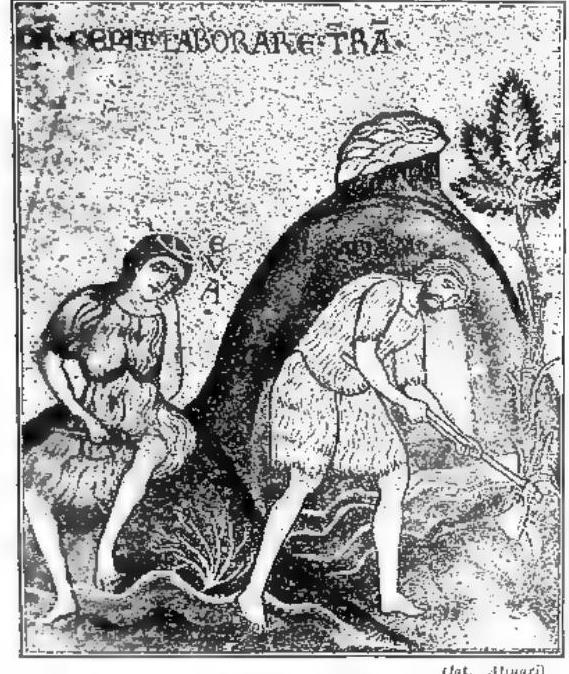
(Int. Almarè)
EVA – The Work of Adam and E. (late 12th century) – Monreale, Cathedral.
The reality of the historical event is also demanded by Adam’s words (Gen. 2:23); in the Hebrew text the name “woman” (ʿīfāh) is the feminine form of the name “man” (ʿīf), which the Vulgate rendered: “haec vocabitur virago quia de viro sumpta est”. Enlightened once again by God, Adam probably reveals the indissoluble and total bond of the spouses (Gen. 2:24; cf. Mt. 19:4–6).
To these considerations the Apostles and the Fathers add other reasons, such as: 1) so that man might be the origin of the entire human race and the unity of origin and species might be preserved (Mt. 19:4; Act. 17:26; cf. Gen. 3:20; 5:1–2); 2) so that the dignity and authority of man might be evident (I Cor. 11:7–9; I Tim. 2:13–14); 3) so that the union of Christ and the Church might be prefigured (Eph. 5:23–32; Io. 19:34).
After the original sin, of which E. was the initiator, God pronounced sentence against E.: “I will greatly multiply your toil and your pregnancy ... and yet you will feel drawn toward your husband, and he will rule over you” (Gen. 3:16); the punishment corresponds to pride and sensuality, essential elements of the fault. The condition of woman as wife has not changed, but as a natural consequence of sin, woman’s subjection will be harsh and painful (s. Tommaso, Sum. Theol., 2ᵃ-2ᵃᵉ, q. 164, a. 2, ad 1). In his goodness, God deigned to grant the first parents consolation by announcing the Redeemer, or new Adam, and also the co-redemptrix, or new E., as the Fathers have called Mary Most Holy (cf. s. Giustino, C. Tryph.: PG 6, 710; s. Ireneo, Adv. Haer., III, 22, 4: PG 5, 19, etc.).
VANGELO di III – An apocryphal work in use among the Nicolaitans, heretics of the apostolic period, according to s. Epifanio (Haer., 26, 2, 3, 5: PG 41, 334–35, 339). From the two brief citations that Epifanio makes of it, it appears that this apocryphon was Gnostic in character, composed in the literary form of an apocalypse. From a statement by Ippolito concerning E. (Philosoph., 5, 16), Harnack concludes that the Gospel of E. was also used by the Peratae.