
DOCTORS OF THE CHURCH. — I. THEOLOGY
They are illustrious men of the Catholic Church who, on account of their holiness, orthodoxy in faith, and above all their eminent learning in sacred matters, attested especially by their writings, have been awarded this title by a special decree of the Church.
As with the « Fathers of the Church », so too the D. must possess holiness, orthodoxy, learning, and ecclesiastical recognition; but the difference is this: 1) for the Fathers of the Church, antiquity is necessary; that is, they must belong to the first centuries of the Church, so that it may be said that they almost gave it birth, whereas this is not required for the D.; 2) for the Fathers, explicit ecclesiastical approval is not required, practical consensus being sufficient, whereas for the D. proclamation by an official decree either of a council or of the supreme pontiff is necessary; 3) for the Fathers, it is not necessary that their learning be exceptional, whereas for the D. learning must be the special characteristic. The Fathers, therefore, are characterized by « antiquity », while the D. are characterized by « learning ». This, however, does not prevent the same person from possessing both qualities and thus being at once a Father and a D. of the C. This is in fact the case with various persons, among whom are the four greatest Fathers of the Latin Church: s. Agostino, s. Ambrogio, s. Gerolamo and s. Gregorio Magno, and the four foremost Fathers of the Greek Church: s. Atanasio, s. Basilio, s. Gregorio Nazianzeno and s. Giovanni Crisostomo; these are also regarded as the « great D. » of the C.
These concepts, now so clearly distinguished, were not so in the past: since « doctor » means teacher, in the first centuries of the Church those who possessed doctrine to an eminent degree and had the gift of teaching it easily and fruitfully were called d. s. Paolo also mentions this when he says that Jesus « appointed some as apostles, others as prophets, others as evangelists, others as pastors and d. » (Eph. 4, 11; cf. II Cor. 12, 28; Act. 13, 1).
With time, the doctorate became an increasingly specific title, but at first it was commonly attributed only to the Fathers of the Church, and precisely to those who stood out most for their learning.
Thus there arose the dual title « Father and D. of the C. ». The D., therefore, at that time also possessed the characteristic of antiquity. The first to provide a list in this sense of the commonly recognized Fathers and D. of the C. was Beda il Venerabile, in the 8th century (Beda, Epist. resp. ad Accam Ep. : PL 92, 304). He gives the names of s. Ambrogio, s. Agostino, s. Girolamo and s. Gregorio Magno. The name of a martyr, as can be seen, does not appear here, nor will it appear later, even if the martyr, such as, for example, s. Cipriano, is eminent in doctrine, because whoever has given his life for Christ bears the title of « martyr », which takes precedence over every other title.
In the 16th century, the exclusive criterion of antiquity was abandoned; that is, figures from more recent periods also began to be proclaimed D. The first proclamation without this criterion was made by Pio V in 1567, for s. Tommaso d'Aquino (v. sotto). From then on, further proclamations followed, culminating in that of s. Alfonso de' Liguori (d. in 1787), who, among the D. of the C., lived closest to our own times.
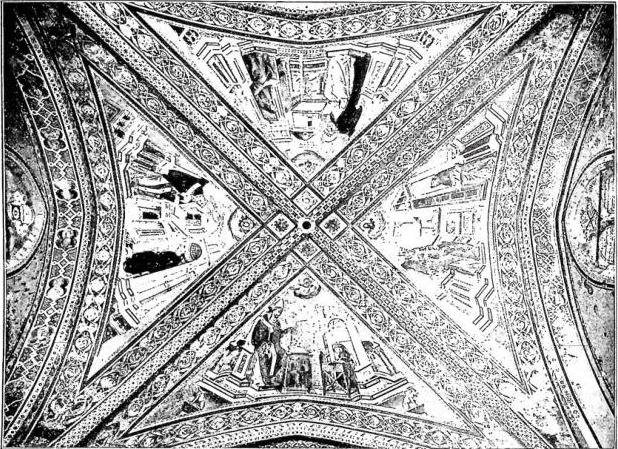
DOTTORI DELLA CHIESA - The four great D. of the Latin C.: Gregorio, Agostino, Girolamo, Ambrogio, fresco by Cimabue and collaborators (late 13th century) - Assisi, upper church of S. Francesco.
(Alinari photograph)
The service that the D. render to the Church is well symbolized by the four statues that, in 1667, at the command of Alessandro VII, Bernini placed in the apse of the Vatican basilica: they depict s. Atanasio and s. Giovanni Crisostomo, of the Eastern Church, and s. Ambrogio and s. Agostino, of the Western Church, supporting the Chair of S. Pietro.
II. LITURGY
1. The liturgical prerogatives of the Doctors of the Church
The feasts of the Doctors of the Church have the double rite, must be celebrated by the whole Church, and have their own formulary for Mass: In medio Ecclesiae; Gospel: Vos estis sol terrae; the Creed. In the Office they follow that of Confessors who are pontiffs or non-pontiffs, but have certain proper parts, especially the antiphon at Vespers: O doctor optime; a proper «oremus»; the proper eighth responsory: In medio Ecclesiae; and proper lessons at the Second and Third Nocturns.The formulary In medio Ecclesiae is derived from the Introit of the Mass of s. Giovanni Evangelista, the «theologian» among the Apostles and Evangelists. As for the antiphon O doctor optime, it is not yet known when it was first introduced, but it is certain that it was already in use in the thirteenth century. The Creed at Mass, according to Gavanti, was prescribed by Gregorio XI and Urbano VI, but he cites no source (B. Gavanti-C. M. Merati, Thesaurus sacr. rituum, I, Venezia 1762, p. 62 ff.). The double rite was introduced by Bonifacio VIII in the letter «Gloriosus Deus» (Anagni, 24 September 1294), addressed to the archbishop of Reims and his suffragans, and later incorporated into his Decretals (l. III, tit. XXIII, dated Roma 1298); but to regard, as is often done, this provision of Bonifacio VIII as the formal institution of the Doctors of the Church is not accurate. He conferred upon the four great lights of the Church, already so designated and venerated since the eighth century, a liturgical prerogative that had become appropriate, since the double rite had been assigned to other saints of lesser importance for the universal Church. In any case, the decretal of Bonifacio VIII did not come into force everywhere; even in the sixteenth century there are liturgical books in which the four Doctors have the semidouble rite. Uniformity throughout the Church was established only with the liturgical reform of s. Pio V (Breviary, 1568; Missal, 1570). He extended the liturgical honors due to the four Doctors of the Latin Church equally to those of the Greek Church, ss. Basilio Magno, Gregorio Nazianzeno, Giovanni Crisostomo and Atanasio.
2. The two great medieval Doctors: s. Tommaso and s. Bonaventura. - The entire Middle Ages would never have conceived the idea of conferring the title of Doctor of the Church on anyone other than the four universally renowned great theologians. Now, the extraordinary flourishing of medieval theology produced a new type of theologian, the «magister» or «doctor theologiae». Some, though not always the greatest, soon also acquired a distinctive epithet, sometimes during their lifetime (Doctor subtilis, solemnis, profundus, etc.). Among the «masters» and «doctors», one soon came to surpass all the others: the «doctor communis», Tommaso d'Aquino,