
SYMBOLS OF THE FAITH. — Formulas that express the truths of the faith in summary form.
I. NOTION
The word « s. », if derived from the Greek σύμβολον, means token, sign of recognition; if instead derived from συμβολή, it means contribution. The Fathers, however, preferred the first derivation, especially after Rufinus and s. Agostino, when explaining why this term designates the rule or profession of faith required for admission to Baptism.The name s. is already routinely applied to this profession by s. Cipriano (Ep., 69, 7), whereas the more ancient Fathers used the expressions regula veritatis
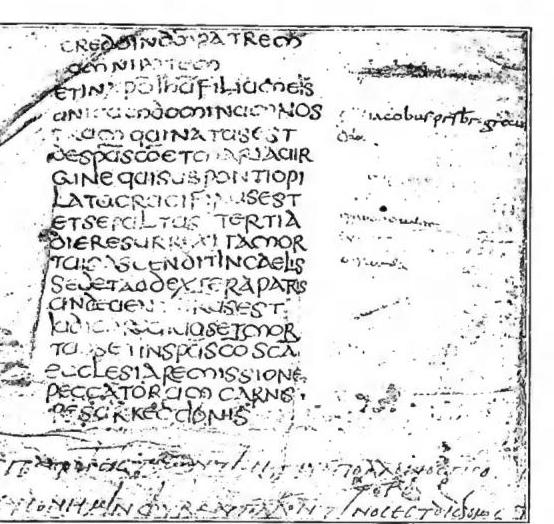
SIMBOLI DELLA FEDE - The Apostles’ Creed. Text of Roman origin, preserved in a manuscript of the sixth or seventh century — Oxford, Bodleian Library, cod. Laudianus 35, f. 226v.
(κανών τῆς ἀληθείας), regula o doctrina fidei, tessera, sacramentum (cf. s. Ireneo, Adv. haeres., III, cap. 9, n. 4; Tertulliano, De praescript., cap. 6). Some recent authors (G. C. Van Noort, Tractatus de fontibus revelationis, 3rd ed., Amsterdam 1920, p. 113) distinguish the symbols from professions of faith, regarding the former as abbreviated formulas of faith and professions of faith, on the other hand, as more developed formulas; but for the most part the two designations are used interchangeably (Denz-U, 26 and lo Hahn, Bibliothek der Symbole und Glaubensregel der alten Kirche, 3rd ed., Breslavia 1897).
II. ORIGIN
The S. d. f. trace their origin to the internal needs of the primitive Christian communities. Already in the mission entrusted by Jesus to the Apostles (Mt. 23:19–20), it was implicit that the teachings to be imparted had to have a well-defined formula. Moreover, the baptismal formula prescribed by Christ himself is a profession of faith in the Holy Trinity. Apart, then, from the question concerning the origins of the « apostolic creed » (v. below), it is not surprising that, from the earliest times, brief, accessible, precise doctrinal formulas arose in the Church, later called s., which were to serve both to maintain the uniformity of the faith and to ascertain the faith of those who were to be admitted into the Church.As these formulas gradually developed, they became, consciously or unconsciously, also the basis of polemics or apologies (cf. the Dialogue with Trypho of s. Justin and the Adversus haereses of s. Irenaeus), while the need to combat heresies suggested, from time to time, the addition or emphasis of one thought or another. These clarifications multiplied over the centuries, and against the denials of the heretics the Church always opposed the professions of faith of its s.
The S. d. f., therefore, far from constituting a collection of empty, arid, lifeless formulas, should rather be regarded as a tangible manifestation of the Church’s very vitality. The fact that the Church prescribes their frequent use in her liturgy itself shows how much they serve to strengthen the bonds uniting the followers of Christ in the unus Dominus, una fides, unum baptismum (Eph. 4:5). The principal ones are presented here.
III. THE APOSTLES’ CREED
An ancient profession of faith of the Roman Church. It appears in two substantially different forms: the text used in the liturgy and a shorter but more ancient text (cf. Denz-U, 226).1. Origin
The Apostles’ Creed is the result of an evolution determined by the internal needs of the Christian communities, and particularly by the creative impulseof the liturgy. From apostolic times, in fact, an explicit profession of faith was required for admission to Baptism; hence the need to summarize for the faithful the principal Christian truths in a brief, precise, and easily comprehensible formula, which would also serve to distinguish true doctrine from false doctrine in the face of tenacious heretical propaganda. The oldest known formula is that used by the eunuch of the Queen of Ethiopia: «I believe that Jesus Christ is the Son of God» (Act. 8, 37). From apostolic times, however, other more widespread formulas were known that contained the most important truths of the Redemption, such as that in I Cor. 15, 3-4: «For I delivered unto you first of all, that which I also received: how that Christ died for our sins, according to the Scriptures, and that he was buried, and that he rose again the third day, according to the Scriptures». Similar confessions of a Christological character are encountered later, toward the end of the first century, in s. Ignatius of Antioch (Eph., 18, 2; Smirn., 1, 1). Alongside the Christological formulas, there are also formulas of a Trinitarian character, whose emergence was determined by Jesus’ command: «Go and teach all nations, baptizing them in the name of the Father and of the Son and of the Holy Spirit» (Mt. 18, 19). A characteristic example of a somewhat expanded profession of faith of a Trinitarian type is found in the apocryphal Epistula Apostolorum, recently discovered and published, whose origin is placed around 180: «Credo in Patrem omnipotentem; et in Jesum Christum, Salvatorem nostrum, in Spiritum Sanctum Paraclitum; in Sanctam Ecclesiam, et in remissionem peccatorum» (Denz-U., 1). Analogous formulas are found in s. Irenaeus (Adv. Haer., I, 10, n. 48) and in the liturgy of the Der Balyzech papyrus. Perhaps as early as the middle of the second century, the need was felt to add new elements of a Christological character. In this regard, the fact was important that the thanksgiving (Preface) of the Eucharistic liturgy had from its origins included an extensive confession of Christ (cf. Justin, I Apol., 61, 3, 10, 13; Irenaeus, Adv. Haer., I, 10).
Thus, in Rome, a type of Creed was drawn up that contained an expanded clause concerning Christ, and therefore in a certain sense disturbed the symmetrical balance of the primitive Creed of a Trinitarian character. This formula, which subsequently crystallized into the form comprising approximately 12 articles, is known toward the end of the fourth century under the precise designation of the Creed of the Apostles, or Apostles’ Creed. This designation, attributed to the baptismal profession of faith of the Roman Church, is encountered for the first time in the letter, certainly drafted by s. Ambrose, sent by the Milanese Synod (393) to Pope Siricius (PL. 16, 1126).
2. The Primitive Apostles’ Creed
The primitive Apostles’ Creed in its complete text was transmitted for the first time in Greek by Marcellus of Ancyra, in a letter to Pope Julius (ca. 340), and in Latin by s. Nicetas of Remesiana and Rufinus of Aquileia (both ca. 400); to the latter belongs the first assertion of a strictly apostolic origin for the Roman Creed with all its articles. The Apostles, Rufinus relates, before separating to preach the Gospel, are said to have jointly compiled this summary of their future preaching, which they called the Creed and established as a rule of truth to be handed on to new believers (Comm. in Symbolum apostol., 2: PL. 21, 337). Rufinus says that he learned these details from his elders (tradunt maiores nostri), and his account enjoyed currency in the West throughout the Middle Ages; and since there were 12 articles, in the sixth century it was claimed that each of these was to be attributed to one of the Apostles (PL. 39, 2189-90). The Latin Fathers at the Council of Ferrara in 1438 were therefore greatly surprised when, having invoked the authority of the Apostles’ Creed against the Greeks, they heard Mark Eugenicus, archbishop of Ephesus, reply that the Greek Church had never known a Creed of the Apostles. There is no need to insist on the legendary character of the Rufinian tradition.Nevertheless, although the Apostles’ Creed is not strictly an apostolic work, it does date back to a very ancient period. It is found almost in its entirety in Tertullian (De virgin. velandis, 1; Adversus Praxeam, 2; De praescript. haeret., 13 and 36);
and certain elements of it are found in s. Hippolytus (cf. B. Capelle, Le Symbole romain au second siècle, in Revue bénéd., 39 [1927], p. 33 ff.), in s. Irenaeus (Adv. haer., I, 10), in s. Justin (Diol. cum Tryph., 76, 85, 116; I Apol., 61), and perhaps also in s. Ignatius (Ad Trall., 9). Hence the opinion of Battifol (Littérature grecque, Paris 1898, p. 70) and Burn (The Apostles Creed, London 1906, p. 30), who date it to around 100–120, is highly probable. Vacant (DThC, I, cols. 1675-76) traces at least the essential part of our Creed, as a baptismal institution, back to the Apostles, specifically to the founders of the Roman Church; that is, the explicit profession of faith in the Father, the Son, and the Holy Spirit. The other secondary elements would derive from later additions that completed its various articles.
According to the more recent Catholic critics, the Roman Creed could be regarded as the result of the fusion of two formulas, both apostolic, one Trinitarian and the other Christological; it could be said that this Creed is a summary of the essential features of the primitive catechesis concerning the two great mysteries of Christianity. These formulas, initially used separately, would have been united, within the framework of the Trinitarian formula, at the beginning of the third century in order to combat the emerging monarchianism more effectively (cf. P. Lebreton, La formation du Symbole des Apôtres, in Rech. de sc. rel., 13 [1923], pp. 349-53). It is certain that the ancient formula of the Apostles’ Creed was the basis of all the other Western baptismal creeds; conversely, it cannot be demonstrated that it was also the basis of the Eastern creeds.
3. Present Text
The current textus receptus differs substantially from that of Rufinus of Aquileia. The latter, in fact, consisting of 12 articles (whereas the textus receptus consists of 14), lacks the following clauses: «Creator of heaven and earth», «was conceived», «suffered», «died», «descended into hell», «almighty», «catholic», «the communion of saints», «eternal life». The earliest attestation of the current formula is found in the Expositio vel tra-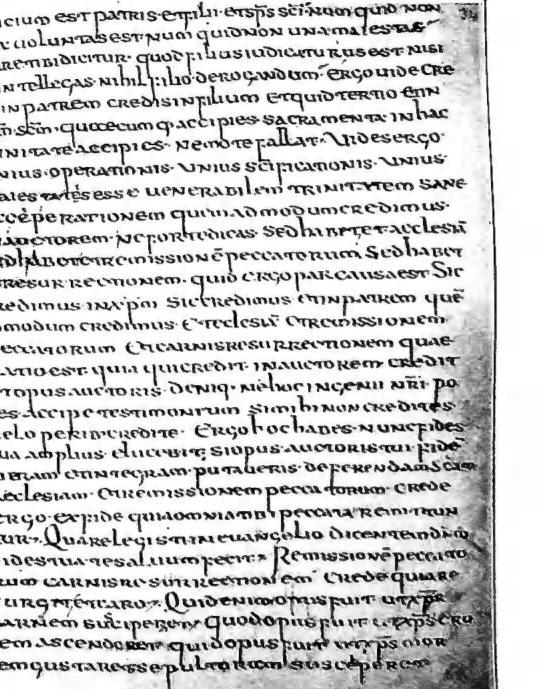
SIMBOLI DELLA FEDE - Commentario di s. Massimo di Torino sul S. degli Apostoli - S. Gallo, Biblioteca abbaziale, cod. 188, f. 343 (sec. VII).
ditio Symboli, contenuta nel Missale gallicanum vetus: poiché in tale Expositio si manifesta in modo evidente la mano di s. Cesareo (m. nel 543), il textus receptus era già in uso nella Gallia meridionale a tale data.
Non si sa bene per opera di chi e in quali circostanze siano confluite in esso le varianti sopra riferite, le quali prima del sec. vi si trovano già sparse or in uno, or in un altro dei s. in uso presso alcune grandi Chiese. Oscuro è pure il luogo dove questa elaborazione sia stata compiuta. Il Vacandard pensa nella Gallia, l'Hahn in una Chiesa dell'alta Italia, il Burn nella Chiesa di Roma o forse in un monastero influente come quello di Bobbio; tutti però sono d'accordo nell'affermare che la diffusione del testo attuale nell'Occidente, qualunque ne sia la provenienza, poté avvenire solo per il prestigio della Chiesa romana.
4. Autorità del S. apostolico. - Il S. apostolico ritenne sempre nella liturgia battesimale quel posto d'onore che vi ebbe fin dai primi secoli. Inoltre, la conoscenza del medesimo si ritenne sempre come un elemento fondamentale della vita cristiana. Per questo i sinodi medievali raccomandano ai sacerdoti di insegnarlo e commentarlo ai fedeli e di farlo loro recitare ad alta voce nelle chiese parrocchiali (cf. M. Righetti, Manuale di storia liturgica, I, Milano 1945, pp. 173-74). Esso fu considerato di particolare efficacia contro le tentazioni diaboliche (s. Ambrogio, De virg., 3, 5; s. Atanasio, Vita s. Antonii, 25); il Rituale ne prescrive tuttora la recita durante gli esorcismi. Ben presto fu introdotto nell'Ufficio divino; lo si trova in tutti i salteri dei secc. VIII e IX (S. Bäumer, Hist. du Brésiaire, I, Parigi 1905, p. 377).
IV. IL S. NICENO-COSTANTINOPOLITANO: V. NICEA, I. Primo Concilio di.
V. S. CALCEDONESE: V. CALCEDONIA.
VI. IL S. ATANASIANO: V. QUICUMQUE VULT.
VII. OTHER SYMBOLS
The four most important ones cited above are followed by: 1) the Toledo Symbol (Denz-U, 26, 275), the profession of TOLEMAIDE (v.) of 675; 2) the Symbol of Leo XI (Denz-U, nos. 343-49). It is found in the letter Congratulatur vehementer, of 13 April 1053, addressed to Pietro, patriarch of Antioch. This profession of faith is more or less the one pronounced, in the form of questions and answers, at the consecration of bishops; 3) the Professio fidei Waldensibus praescripta (Denz-U, 26, 420, 7) of Pope Innocent III (1198-1216), which sets forth, among other things, faith in the Church’s sacramental doctrine and in the individual Sacraments; 4) the Symbol of Leo IX is expanded in the Symbolum Lateranense (Denz-U, 428 ff.), composed at the Fourth Lateran Council in 1215, under Innocent III. The expansion concerns principally the doctrine of the Holy Eucharist; 5) a further development of the Symbol of Leo IX is found in the Professio fidei Michaelis Paleologi (Denz-U, 461 ff.), prescribed by Pope Clement IV in 1267 for the emperor Michele Paleologo, who deposited it at the Second Coun-cil of Lyon (1274) before Pope Gregory X. It concerns particularly the doctrines of the Sacraments, the primacy of the Roman Church, and the Last Things. On 1 August 1385 it was prescribed by Urban VI for all those who passed from the dissenting Church to the Catholic Church. 6) The last of the great symbols is the Professio fidei Tridentina (Denz-U, 494 ff.), which briefly and clearly summarizes the content of the Council of Trent. This profession was expanded by additions from the First Vatican Council and, in this final form, under the title Professio fidei Catholicae, stands at the beginning of the CIC. It is required for admission to almost all ecclesiastical offices and for every change of office or benefice, as well as for clerics before the subdiaconate and for confessors and preachers before receiving authorization to exercise these functions (CIC, can. 1406). In these circumstances there was added the Iusiorandum contra errores modernismi, promulgated by Pius X in the motu proprio Sacrorum Antistitum of 1 September 1920 (Denz-U, 2145-47).
VIII. DOGMATIC VALUE
Here we speak only of the official symbols, such as those listed above, and not of the professions of faith so frequently encountered among ancient writers. The latter are undoubtedly venerable formulas, but their importance concerns solely the history of dogmas.There can be no doubt about the dogmatic value of the oldest symbols—the Apostolic, Nicene, Nicene-Constantinopolitan, Chalcedonian, and Athanasian. Apart from the formal recognitions of the Popes and Councils, the mere fact that they have become an integral part of the liturgy (in Baptism, in the Breviary, in priestly Ordination and in the ordinary prayers, and in the Holy Mass) already reveals an official consecration on the part of the Church’s authentic magisterium, according to the well-known saying: lex orandi, lex credendi.
All the other symbols or professions of faith have the formal approval of the Pope; therefore, like the preceding ones, they merit the designation of official documents of the Catholic faith. Certain reservations, however, are expressed regarding the anti-Modernist oath, not all of whose parts seem uniform in their doctrinal value. Since it presupposes, in fact, earlier doctrinal documents, its individual affirmations must be analyzed in themselves, and their doctrinal value depends on the value of the documents to which they refer (v. SILLABO). Finally, it should be noted that the dogmatic value of the symbols of faith concerns only what constitutes the direct teaching of the symbols themselves, and not what is merely an explanation or an incidental assertion; consequently, it is in this latter sense that the comparison between body and soul, which the Athanasian Symbol uses to explain the substantial unity of Christ, must be understood.