
GALLIA. – This is what the ancients called the land bounded by the Mediterranean, the Alps, the Rhine, the Ocean, and the Pyrenees, which they divided into G. Narbonensis, Aquitania, Lugdunessis, Belgica.
I. EVANGELIZATION
The region, entirely pacified and organized by Augustus, had soon attained a notable degree of civilization and tranquillity; relations, both commercial and political-administrative, with Italy and Rome had continued, the roads were numerous and well maintained, and the waterways widely used. The Provençal coast must have been much frequented by Greeks and Orientals by ancient tradition: there, from approximately 600 B.C., the Phocaeans of Asia Minor had founded and brought to active and prosperous life their colony of Μασαλλία (Marseilles), and controlled the excellent route of penetration inland offered by the Rhône. It is highly probable that some Christian report reached the Massaliot region at a very early date, and the fact would find a parallel in Puteoli, another place with close connections to the East, where St. Paul found in A.D. 60 a Christian community of some importance. The late-origin traditions concerning the arrival in Provence of Lazarus, the man raised from the dead at Bethany, and of his sisters Martha and Magdalene, however, do not seem worthy of consideration.In II Tim. IV, 10, St. Paul laments that he is almost alone, and among the names of the disciples who are far away he mentions a Crescens εἰς Γαλλίαν. Not all the codices, however, have Γαλλίαν; others have Γαλατίαν, and the earliest interpreters, Eusebius and Theodoret, did not even raise the question whether G. might be intended, but referred the passage to Galatia. In any case, no further information is available concerning this mission of Crescens.
There is also the question whether St. Paul went to Spain. That he intended to do so is certain; he himself states it clearly in Rom. 15:24, and an affirmative answer would seem to be supported by a passage in the Epistle of St. Clement to the Corinthians (V, 7), where it is said that the Apostle reached the crown of martyrdom only after touching the farthest West. If St. Paul went to Spain, it is more than probable that he chose the sea route rather than attempting to cross the Alps; in that case, given the ancient navigators’ custom of following the coast, there must have been a stop at Massilia, which the Saint would certainly not have failed to put to good use. In any event, Battifol has asked why St. Paul spoke of Spain and not of G. and Africa. Might it not have been because someone else had already gone to those provinces? One should recall what the Apostle says about his reluctance to go and work in a field already sown by another (Rom. 15:20).
In any case, one remains in the realm of possibility here, just as the attribution to the second century of certain epigraphic texts and sarcophagi found in G. has an entirely hypothetical value, since they are considered to belong to that period solely on the basis of doubtful palaeographic or historical-artistic criteria. To find the first reliable documentation of the presence of Christians in G., one must descend to A.D. 177. A letter concerning the events of that year was written by the Christians of Lugdunum (Lyons) to their brethren in Asia and Phrygia, to recount to them the glorious end of a group of Christians killed with barbarous tortures because of their faith. The tragic event at Lugdunum was almost certainly the first case of anti-Christian persecution in G., as Sulpicius Severus acknowledges: «sub Aurelio deinde, Antonini filio, persecutio... agitata, ac tunc primum inter Gallia martyris visa, serius trans Alpes Dei religione suscepta» (Chron., II, 32).
At the head of the Church of Lugdunum, having been made its bishop after the storm had passed, remained the presbyter Irenaeus. A native of Asia, where in his youth he had listened to St. Polycarp of Smyrna, he is one of the greatest figures of second-century Christianity. It is not known when or why he came to G.; certainly, he carried out there a fervent and enlightened ministry, both as bishop and as a learned writer and defender of the Christian Faith, enjoying great prestige. Indeed, he was able to intervene with wise counsels of moderation in the dispute between the Church of Rome and the Churches of Asia concerning the date of the celebration of Easter, succeeding in persuading Pope Victor I not to separate the Churches of Asia from the mystical body of the universal Church over a matter of no vital importance.
Only Lugdunum has episcopal lists that go back to before the third century (L. Duchesne, Faites épiscopaux de l'ancienne Gaule, Paris 1907–19); this does not mean that the existence of other episcopal sees must be categorically excluded, since many were the sees unable to produce complete and orderly lists of their bishops. In any event, it is certain that the farther back one goes in time, the more one will find episcopal sees restricted to the major cities alone.
Gregory of Tours says that in A.D. 230 «septem viri episcopi ordinari ad praedicandum in Gallia missi sunt» (Hist. Franc., I, 30), but scholars do not place much confidence in this report. More credible is the information contained in a letter of St. Cyprian from the years 251–255, according to which the bishop of Lugdunum and other «episcopi in eadem provincia constituti» denounced to Pope Stephen I their colleague Marcian, bishop of Arles, whose conduct in the matter of the Novatian schism did not appear irreproachable. Christianity therefore continued to spread, and other episcopates were established. Among the most singular and noteworthy Christian monuments is a Greek inscription found at Autun (Augustodunum), with complicated and obscure formulas that somewhat resemble the mysterious language of the Gnostics. There is no agreement among the many scholars who have studied it concerning the date to be assigned to it, which has been placed anywhere from the second to the sixth century A.D. (cf. H. Leclercq, Autun, in DACL, I (1924), cols. 3188–3216).
A long silence follows concerning the Christian affairs of G. until the time of Diocletian. To this period may be assigned some predominantly funerary Christian inscriptions of unknown persons, and several martyrs are attributed to it, but only in late narratives that do not merit credence. The final persecution, that of Diocletian, was also supposed to take place in G.; however, the Caesar responsible for the region, Constantius Chlorus, applied the provisions of that edict only very rarely and partially. Moreover, the abdication of Diocletian and Maximian, the succession shortly afterward of Constantine, and the decrees of toleration issued by Galerius and by Constantine and Licinius (the so-called Edict of Milan of 313) freed the Churches of G. and of the whole Empire from every fear of persecution. Not long afterward, the Christian religion, first placed on an equal footing with the others, became the favored religion, and the public worship of the old Greco-Roman religion was subsequently proscribed. Yet every difficulty was not removed, for certain heresies arose and spread tenaciously, two of which particularly concern G.: Donatism and Arianism. The former, though it arose in Africa, found in G., at a council convened by Constantine at Arles, judgment and condemnation. For some time Arianism also enjoyed the favor of the imperial court, for example, that of the emperors Constantius II and Valens and of the empress Justina, mother and guardian of the young Valentinian II. A great bishop of G., Hilary of Poitiers, also fought Arianism energetically; the emperor Constantius punished him with exile in Phrygia.
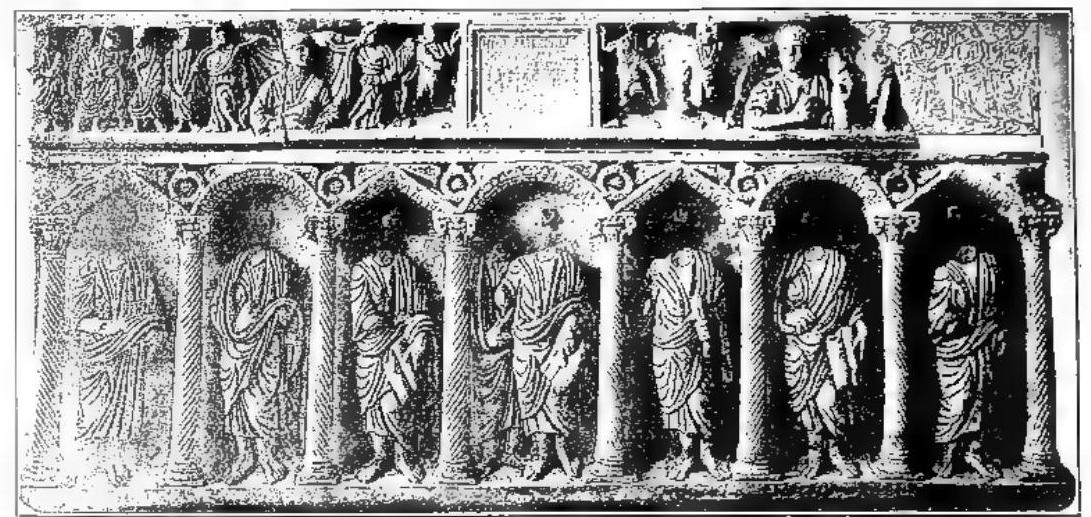
GALLIA - Front of the sarcophagus of Hydria Tertulla (4th century) - Arles, Museum.
who had the good fortune to baptize the king of the Franks Clovis (in the year 496), the first of the barbarian rulers to be converted to the Catholic faith without having passed through the Arian heresy.
BIBLI: C. Boissier, La fin du paganisme, Paris 1891; L. Duchesne, Les fuites épiscopales de l'ancienne Gaule, 3 vols., there 1894 (2nd ed. 1907), 1900 and 1915; O. Hirschfeld, Zur Geschichte des Christentums in Lughmann vor Kantantin, in Sitzungsber. der Presse. Akad. d. Wiss., 1895, p. 381; L. Duchesne, Histoire ancienne de l'Eglise, 3 vols., Paris 1906–10; Fliche-Martin-Frutos, I–III, Turin 1938–42.
II. PALEOCHRISTIAN SCULPTURE
As the Empire declined, the West lost its cult of form, but the art of Christian funerary relief kept alive the tradition of Greco-Roman sculpture from the Constantinian age until the time of the barbarian invasions. Its gradual decline can be followed from Arles and Narbonne, where the workshops were fully active in the mid-fourth century, to Marseille, where, at the end of the Theodosian period, a workshop arose near the abbey of S. Vittore, founded in 415, and to Aquitaine, where funerary relief disappeared shortly thereafter, to be replaced by barbarian decoration.Arles was the city that Constantine had chosen as the capital of his Empire. In 395 it became the seat of the praetorian prefecture of Gaul; its funerary sculpture was essentially Roman. Its workshops disappeared along with the collapse of the Empire, at the time of the upheavals that marked the Empire of Honorius (410–20), whereas in Marseille, a city that, after the Roman conquest, had remained on the margins of the Empire, sarcophagus workshops arose later and followed the artistic development of the fifth century, which linked them both to the art of Ravenna and to that of Visigothic Aquitaine.
Since the sarcophagi found in northern Gaul were export products from the south, the chronology of funerary art in Gaul is limited to the southern provinces; it reveals a succession of workshops extending from Constantine to the Frankish conquest. The two artistic centres were Arles and Narbonne; the former ceased production at the beginning of the fifth century, while Marseille was fully active during the first half of that century. In Languedoc and Aquitaine, Visigothic rule, granted by Honorius (413), was established at Toulouse; until the victory of the Franks at Vouillé (507), it extended over the Gévaudan, the Rouergue, the Velay, and Languedoc. This rule witnessed, and perhaps encouraged, the survival of the Narbonne workshop, which was by then linked to the art of Toulouse, as well as the emergence of workshops in the valley of the Garonne that preserved the traditions of Greco-Roman sculpture, though profoundly transforming them until the early years of the sixth century.
The sarcophagus of Arles took its architectural forms from the continuous frieze, the small arches with columns or trees, and the strigils, following the Roman type, which itself represented a fusion of the Greek-Asian sarcophagus of the Sidamara type with relief in the pagan tradition. As in previous centuries, it may be held that a certain number of sarcophagi in the “beautiful style,” with highly pronounced reliefs and drill work on the colonnettes, heads, and limbs projecting from the ground, in which the contrast of shadows and lights is observed as a result of the excessive use of the drill, according to Anatolian technique, were imported from Asia Minor and especially from Italy. The sarcophagi were generally made of Pentelic marble from Asia Minor or of Proconnesian marble from the Propontis, which lent greater translucency and a warm colour to the modelling. Such are the Constantinian and Theodosian sarcophagi representing Christ’s farewell to the disciples prostrate and weeping at his feet (the Florence replica), those of Hydria Tertulla and of Concordius, bishop of Arles (d. 375–80), and, generally, the high-relief sarcophagi with continuous friezes.
Nevertheless, in the second half of the fourth century, the existence of an Arles school may be asserted on the basis of the identical workmanship of the Carrara-marble sarcophagi and those of St-Bêat, which were not exported to Italy and were therefore worked locally. The local type of sarcophagus, conceived in imitation of Roman models, with the same borrowings from pagan funerary art in its decoration, was generally divided by small arches and panels of strigils that simplified the composition: scenes of the Nativity, the Orans, Christ holding the cross, surrounded by two worshippers in the central panel. The Arles school, however, also initiated continuous-frieze compositions, especially the Crossing of the Red Sea, of which seven or eight examples are known (Arles Museum, S. Trofimo, Nimes, the castle of Candiac at Bellegarde, Moustiers-Ste-Marie, the tomb of Ludovicus Pius in the Museum of Metz). The reliefs are not very high, the folds broad and rectilinear, and the use of the drill is moderate in the hair, the junction of the lips, the nostrils, etc.; the eye is incised at the centre and not at the inner corner, as was customary in Roman high reliefs.
The sarcophagus of Geminius of Cologne, administrator of the five Provinces, who died at Arles in the first decade of the fifth century and is preserved at S. Trofimo, may be regarded as the last product of this workshop; it possesses all the characteristics of the school of Marseille, which succeeded that of Arles.
The sarcophagi of Marseille, with small arches supported by columns or trees, following the Arles type, in fact have an entirely different style that links them with the sarcophagi of Ravenna and Aquitaine. The technique of drilling becomes increasingly rare and, reduced to a series of holes made to remove the material without initially deepening the crown of the hair, eventually disappears altogether. The composition is simplified; scenes with several figures, employing perspective and representing the great biblical events or the miracles of the Lord, are replaced by scenes of isolated Apostles in shallow small arches or in rectangular niches, according to the practice of Toulouse. The folds of the garments become flat and the figures’ attitudes animated and declamatory; the dynamism of movement compensates for the figures’ plastic force. There appears the symbolism of sheep or lambs and of deer drinking at the spring, allegories almost unknown to the art of Arles and evocative of the art of the reliefs and mosaics of Ravenna.
These are the characteristics found in the sarcophagi of Narbonne, Clermont in Auvergne, Rodez, Toulouse, Castelnau-de-Guers, Mas-St-Antonin, and elsewhere. They assign an increasingly reduced place to the figures, isolated in small arches, sometimes adorned with half-open draperies, after the fashion of the porticoes in the mosaic of S. Vitale at Ravenna. Subjects drawn from ancient themes, such as the Good Shepherd, Daniel among the lions, the Nativity, Adam and Eve, and the Dioscuri, still appear sporadically in the central panel of sarcophagi and on terracotta plaques originating from the decoration of churches in the West. Floral ornamentation, however, tends increasingly to invade the field and replace the human representation, which in turn tends to disappear with the Frankish conquest. The expressionist modelling of the figures, according to a process more pictorial than sculptural, marks the end of Greco-Roman art; the dissolution of the Empire, beginning in 410, is reflected in the new decorative tendencies that reveal the predominance of the art of the Empire’s peripheral provinces—the art of Ravenna and that of the Visigoths—over the classicism of Rome. Thus, beginning with Arles and Narbonne, the chronological continuity is established of a sculpture heir to those Greco-Roman sculpture workshops that preserved at Arles, the capital of the Roman province and the last bastion of Romanitas, the heritage of the Empire until the reign of Honorius, and at Marseille and Narbonne in Visigothic Aquitaine the last reflection of “humanism.”
BLIT.: F. Benoit, Le Musée des crypes à St-Victor de Marseille (Mémoires de l'Institut historique de Provence, 1954); id., Les cimetières suburbains d'Arles dans l'antiquité chrétienne et au moyen âge, Roma 1935; id., Le Musée lapidéte d'Arles, Parigi 1936; id., Fragments de sarcophages chrétiens datés, in Bull. Soc. nat. Antiq., 1938; id., Fragments de sarcophages inédits, in Riv. di arch. cristiana, 17 (1940), pp. 248-70; id., Marbres employés en Provence à l'époque gallo-romaine, in Bull. Soc. nat. Antiq. de France, 1934-1944; id., Nouveau sarcophage des adorants, in Riv. di arch. cristiana, 26 (1950); E. Le Blant, Etude sur les sarcophages chrétiens d'Arles, Parigi 1878; id., Les sarcophages chrétiens de la Gaule, ivi 1886; G. Rodenwaldt, Szulemarkophae, in Mitteilungen d.
deutsch. Arch. Instituts, Röm. Abt., 38-39 (1923-24), p. 1 sgg.; M. Lawrence, Citygate sarcophagi, in The Art Bulletin, 10 (1927), p. 1 sgg.; L. Coutil, L'art nérovingien et carolingien, Bordeaux 1931; M. Lawrence, Columnar sarcophagi in the Latin West, in The Art Bulletin, 14 (1932), p. 103 sgg.; G. Wilpert, Sarcofagi, M. von Schoenbeck, Die christliche Stethophosphatität unter Konstantin, in Mitteilungen d. deutsch. Arch. Instituts, Röm. Abt., 51 (1938), p. 238 sgg.; A. C. Soper, The Latin style on Christian Sarcophagi of the Fourth Century, in The Art Bulletin, 19 (1937), p. 148 sgg.; J. B. Ward Perkins, The sculpture of Visigothic Franc, Oxford, in Soc. of antiquaries of London, 1938; Fr. Gerke, Die christl. Sark. der von Konst. Zeit, Berlino 1940; M. Lawrence, The sarcophagi of Ravenna (College Art Association, 1945, Study, 2); B. Huguet, Arte paleocristiana, in
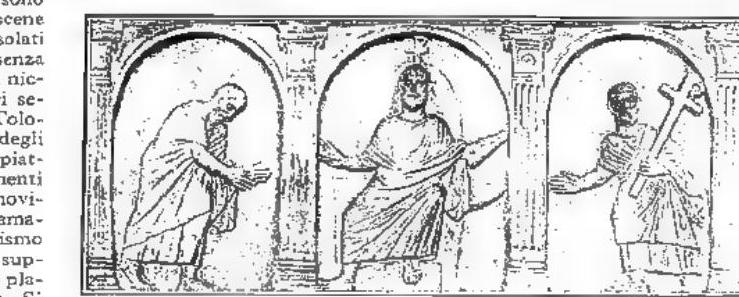
(da Wilpert, Sarcofagi, tov. XLIII, 8) GALLIA - Front of a sarcophagus serving as an altar in the church of S. Trofimo; Christ between SS. Paolo and Pietro (5th century) - Arles.