
SARCOPHAGI. – Within the body of artistic documentation from the early centuries of Christianity, the early Christian s. constitute, together with the cemetery paintings, the richest and most exceptionally valuable part, both for the history of the art of the later Empire and for the illustration of Christian thought.
The rite of burial, the only one permitted among Christians, found for most of their dead the indispensable and relatively inexpensive protection afforded by loculi, arcosolia, and fosse provided by the underground, in rock-cut tombs or, in their absence, in coffins or urns of terracotta or lead, or in tombs constructed with tiles or marble slabs. The more prosperous among them, however, never renounced the more costly means of the s., so widespread in the Greco-Roman world; and from the moment when Christians could fully develop their cemeteries sub divo, the workshops of the marble workers could count on an increasingly numerous clientele. With the exception of the distinctive features of a few provincial centers of secondary importance, the surviving monuments reveal Rome as the principal center of production, whose influence was felt in southern Italy and Africa, northern Italy, the south of Gaul, and the north of Spain;
the art of Constantinople, on the other hand, was late in developing, and it influenced centers such as Thessalonica and Ravenna. Although there are already certain indications showing how, in the various regions, local elements combined, according to the period, with influences arriving from the metropolises, much remains to be done before a clear and complete differentiation can be achieved. This is made difficult by the still unresolved question of the intense traffic in marble, and perhaps also in already finished s., throughout the Empire.
And it was precisely marble that served as the preferred material, since the use of porphyry remained limited to imperial tombs, while local stones, chiefly limestones, were used rather late, in cemeteries sub divo, for s. decorated with only a few figures. The marbles most frequently used were white Greek marble, that of Asia Minor, and lunense marble; but discoveries such as that made by Visconti in the ancient Marmorata on the Tiber (1868–70) reveal the full variety of their provenances. Just as happens today, we must imagine the existence of marble workers’ workshops along the principal roads near the great cemeteries (Appian, Salarian, Vatican), workshops of various grades which evidently adapted their production to demand and thus progressively became Christianized.
Although at first most s. were monolithic, the increasing scarcity of marble later led not only to the construction of marble chests from slabs held together by iron clamps, but also to the joining of marble blocks of different sizes and even of different materials. The fact of these joints must never be overlooked in stylistic or iconographic studies, because they sometimes made it necessary to choose particular scenes, to modify their traditional composition, and to distribute the individual scenes differently. Indeed, one may ask whether certain scenes were not preserved in the more developed repertoire precisely because of these joints.
As a few rare surviving examples demonstrate, many were polychrome, in some cases even before their sculpture had been completely finished. Through outlines in carmine red and cinnabar, yellow, or violet, an attempt was made to bring out the overall design more clearly; by means of surface coloring, certain parts of the composition were enlivened so as to contrast with other marble sections left in their natural state; still other parts were detailed or shaded with fine yellow or reddish-brown hatching. Gold, often applied over a purple background, was used preferably for the hair of conventional figures, for ornaments (galloons, bracelets, etc.), and on metal objects. But the coloring never followed uniform rules and underwent changes over time.
In their general form, s. are distinguished into two types: those shaped like a basin and those shaped like a chest. Roman art preferred the s. decorated only on the principal face, or at most also on the ends, although with more modest reliefs, the whole being contained between simple horizontal moldings; as a lid, a horizontal slab sometimes provided with acroteria and attic sections, into which the tablet
for the inscription was set amid various figurative compositions. Greek art, on the other hand, generally employed ornamental complexes whose rich base and frame gave them a more pronounced architectural appearance, while the reliefs covered all four sides and the lid assumed a semicylindrical form or that of a gabled roof. From one group to the other, certain interferences may be found. A special architectural type is represented by the columnar s., which spread in the fourth century, and by the s. with a background of city gates (city gates). In the former and its derivatives (s. with trees or pilasters), the columns, often richly decorated, are surmounted by architraves, arches, or pediments, which may alternate with one another; in the latter, crenellated towers are set side by side.
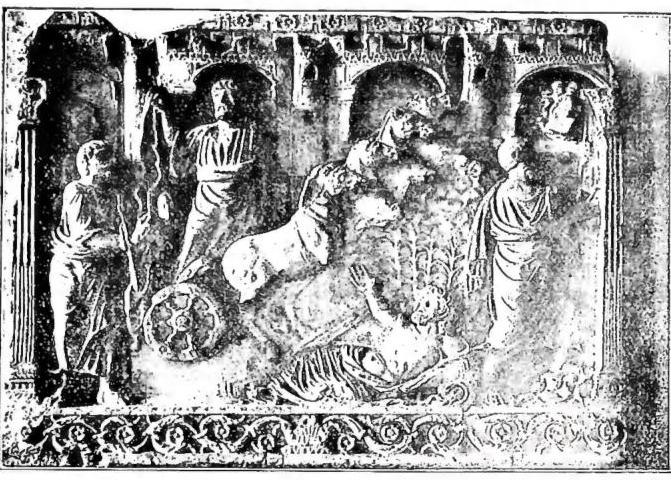
(courtesy of Prof. E. Gori)
SARCOFAGI - Left side of the 4th century, with the abduction of Elijah - Paris, Musée du Louvre.
scenes of limited development, if not indeed of isolated figures. The same speculations and repercussions of a constructive nature are noticeable in the scenes and figures adorning the attic of the lids, where the central panel is preferably framed by scenes of broad horizontal development: races of dolphins, vases among reclining personifications of the seasons, hunting scenes, banquets, the Adoration of the Magi, the Three Youths in the Furnace.
The stylistic evolutions of the sculpture of the s. followed the great curves of sculpture in general, passing, like it, from the pictorial form rich in classical reminiscences to realistic Impressionism; from the positive form to the negative; from idealism to Expressionism; and subsequently experiencing the eclecticisms of a classical revival, before passing to a conventional and stereotypical calligraphy that would lead it in a straight line toward an art strongly marked by decorative taste. These evolutions, whose succession is now largely established, also help effectively to clarify the chronology of the s. Although uncertainty still remains regarding the absolute chronology of the earliest Christian s. (late 2nd century, ca. 220 or 250), a comparison among the more advanced artistic forms suffices to establish the successive groups: Severan, Gallienic, Tetrarchic, Constantinian and post-Constantinian, Theodosian, etc.; for more detailed studies, however, account must always be taken of the inevitable exchanges between one current and another, and between one region
and another. The use or non-use of the drill, which in certain periods was employed more as a pictorial than as a sculptural instrument in order to obtain chiaroscuro effects, has still served as the principal means of investigation; but a series of stylistic criteria is also found in the manner of setting out the figures, grouping them, and in their gestures and attitudes; in the analysis of the sculptor’s conception of a given anatomical form and of the manner in which he evoked it in marble; in the way the garments were draped; and in the spatial elements and proportions of the figures and of the s. itself.
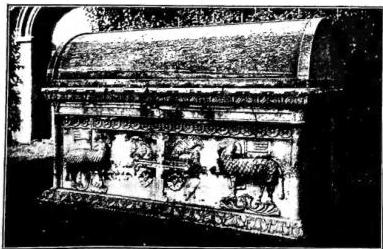
The iconographic repertory of the s. is more extensive than that of the cemetery paintings and, in the case of certain scenes, which occasionally form genuine cycles, reveals figurative traditions exclusively its own. This does not prevent the evolution of its themes from running parallel, in all other respects, to that of the other artistic genres. Never renouncing its fundamental-
(photo by Vecchi and Graziani)
SARCOFAGI — Front panel of a sarcophagus of the Ravenna type (6th century) — Ferrara, Municipal Picture Gallery.
While never renouncing its fundamentally symbolic aims—that is, its use of images to communicate more hidden and spiritual concepts or sentiments—the art of sarcophagi changed several times the general direction that would guide the choice of its figurative genres. At first, the prevailing theme was the purely symbolic one of an idyllic character, entirely intended to evoke a paradisiacal atmosphere; subsequently, the historical event became a symbol, evoked as a paradigm of eternal salvation; then, owing to new allegorical and representational tendencies, the historical person became the principal motif, transferred to otherworldly regions where the atmosphere of apotheosis reigns; finally, through further abstraction, the symbol crystallized into conventional signs serving a decorative art. More particularly, the earliest sarcophagi readily employed one of the motifs already known, at least formally, to profane art: the Good Shepherd (possibly Orpheus), the Orant, the scene of the true Doctrine, and the clipeus with the portrait of the deceased. Depending on the compositions selected, these themes could serve as the principal, if not indeed the exclusive, motif; but they could also be combined with one another and form mixed ensembles, to which new figures were also added, such as the Fisherman, the Devouring Lion, and the Genius of Death. In the second half of the 3rd century, the pastoral framework was enlarged and biblical scenes began to penetrate the existing ensembles: Jonah, Noah in the Ark, Daniel among the Lions, the Sin of the Protoparents, Baptism, and the Raising of Lazarus. Their selection, together with that of the symbolic motifs, reveals that Christian art knew, from the outset, the two paths of harmony and contrast. A brief period, spanning the turn of the 3rd and 4th centuries and documented by only a few examples (Wilpert, Sarcofagi, pls. 65,5; 220; 287, 1; 38,3), inaugurated, with broadly developed symmetrical scenes, the series of sarcophagi decorated exclusively with biblical scenes, which would enjoy their richest flowering in the Constantinian period.
This does not mean that the strigilated sarcophagus disappeared during this period; indeed, it continued until the end of the century, even preserving its old motifs. But the great majority of sarcophagi now arranged scenes from the Old and New Testaments, often in two superimposed registers and sometimes according to a carefully conceived ideological program, around new central motifs such as the Deceased Woman (not always an orant) or the Deceased Man between Two Apostles, the so-called « Denial » of St. Peter, the Multiplication of the Loaves, the Entry into Jerusalem, and the clipeus with the portraits, while at the ends of the frieze there frequently appeared the Miracle of the Fountain, the Raising of Lazarus, and the
Sacrifice of Abraham. Although in some cases the relations between the two Testaments governed the distribution of the scenes, these were usually employed rather indiscriminately. New Testament scenes, among which the Cycle of St. Peter, the Healings of the Man Born Blind and of the Paralytic, and the Miracles at Cana and of the Multiplication of the Loaves stand out, are more frequent than those from the Old Testament, in which the Sacrifice of Abraham, Daniel among the Lions, and the Sin of the Protoparents recur most often. Among those recently discovered and not yet included in the manuals must be counted the Expulsion from Paradise, the Cycle of Lot and of Joseph the Hebrew, and the Prophet Balaam Halted by the Angel.
Around 340, new paths opened with the introduction of scenes of the Passion (first of Christ, and subsequently of the apostles Peter and Paul), set in contrast with typological scenes and with themes of apotheosis, such as the allegorical ensemble of the triumph over death or Christ enthroned and borne by the allegory of Heaven. At the same time, the first examples of the Traditio legis appeared. Thus arose the idea of the glorious Christ and of the triumphant continuation of his mission within the Church.
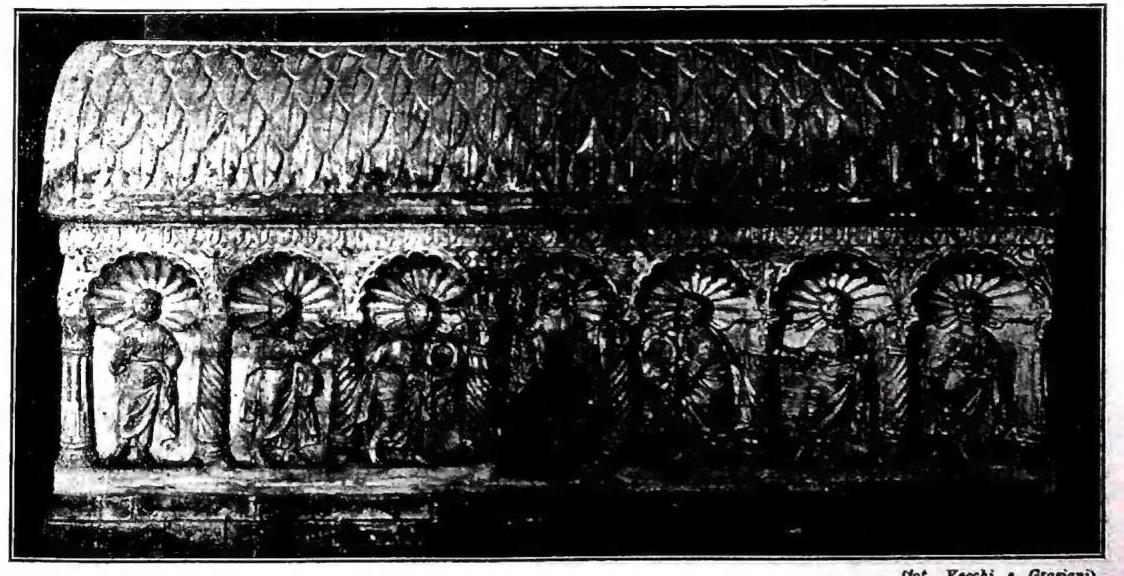
The allegorical frieze of the twelve lambs arranged around the divine Lamb on the mountain with the four rivers; the two deer framing the « signum Christi »; the chrismon or monogrammatic Cross among doves, etc., already show the direction that the subsequent development of the iconographic themes would take, documented above all in the 5th and 6th centuries by the Ravenna sarcophagi. At Ravenna, indeed, although it still seems difficult to reach agreement on the chronology of the local sarcophagi, it is clear that the ornamental motif increasingly prevailed. The figured sarcophagi are not only few in number
(phot. Vecchi and Graziani)
SARCOFAGI — Front portion of a sarcophagus of the Ravenna type (5th–6th century) — Ferrara, church of S. Francesco.
fewer in number, but the same figured scenes appearing in them are subject to the same decorative tendency, both in their symmetrical arrangement and in the repeated frontality of the isolated figure, as well as in the broad unbroken background against which the figures stand out. Apart from a few biblical scenes (such as the rhythmic Adorazione dei Magi del s. di Isacco), the themes chosen are representative ones, such as the Traditio legis, the Traditio clavium, the Cristo acclamato, etc. For the most part, however, the human figure is replaced by the symbol: the Agnello sul monte tra due pecore; the cervi alla mistica fonte; the palme del Paradiso; the Cross, the chrismon, the crown with monogram, and the letters A and Ω flanked by peacocks, etc. Indeed, at a certain point in the development, the symbol, now less well understood, tends to become pure ornament, as is shown by the uniform repetition of crosses, vases, tendrils, and birds, especially toward the end of the evolution, when the form also becomes barbaric.
This development is further confirmed by the sarcophagi of southwestern Gaul, where the ornamental motif predominates strongly: graphic and stylized, in low relief, and capricious in its composition of the vegetal volutes that cover broad surfaces, the vases from which they emerge, and the birds pecking at them. Human figures are extremely rare. The centre of the decorative arabesque is most often the Cross, or the chrismon within a crown protected by curtains, while a few stylized stars are scattered in the secondary voids. For the medieval and modern periods