
ADORATION. — Etymologically, a. (from Lat. ad os) is the gesture of bringing the hands to the lips and then turning them toward an image or any sacred object as a sign of veneration. This name is also extended to similar postures of the arms, hands, and body (kneeling, prostration [Gr. προσκόνησις], deep bows, etc.).
1. A. IN RELIGIONS IN GENERAL. — The act of a. exists in all religions because it is prompted by an intimate feeling of fear and respect toward the mi-
A. is expressed through collective or individual acts of worship. Collective acts draw the entire human group, whether small or large, toward the expression of the same religious sentiment, which may manifest itself in the lower forms of orgiastic dance, the rhythmic movements of the Quakers and Pentecostals, and the whirling turns of the shouting dervishes; and, in the higher forms, in prayers and songs modulated at the invitation of whoever presides over the gathering, and in sacrifices.
Individual acts of worship depend upon the free expression of the individual, and proceed along an ascending scale, from the simple gesture to contemplative meditation, prepared in certain religions by practical means such as control of the breath in yoga, “psychotechnical” practices in theosophy, the pursuit of silence that isolates one from contact with the outside world, and finally the complete surrender of all the powers of the soul to God. But on this point V. MISTICA.
The religious monuments that have come down to us in such abundance from antiquity and the Middle Ages enable us to distinguish various gestures of a. Used in the ancient East and even today among Muslims is complete prostration on the ground: the same posture that was used before sovereigns, who placed their foot upon the necks of subjects and conquered kings, while the inferior kissed the ground. Simpler is the attitude of sitting on one’s heels or kneeling on both knees or on one knee. But one could also adore while simply standing, in the attitude of a servant awaiting orders, with the arms hanging down or crossed over the breast, or with both arms raised. It was also frequent to adore with a gesture of greeting, with the arm raised and the palm turned forward. The humility of the various gestures could be heightened by bowing the head as a sign of reverence.
A gesture that seems to have remained isolated appears to have been in use among the Cretan-Mycenaeans: it consisted in bringing the clenched fist to the forehead, as though to shield the
eyes from the radiance emanating from the divinity. Finally, the kiss is a sign of a., though rather rare both in antiquity and in the modern age.
Paolino Mingazzini
2. IN CHRISTIAN THEOLOGY
In the broad sense in which a. has been defined, it could also refer to persons invested with civil authority. In Christian tradition, however, it generally has only a religious content and may signify either any act of worship (cf. Io. 4, 21) or, more properly, every external act of worship offered to God or to creatures, with due regard to their special relationship with God.In these latter words, the object of a. is perfectly determined: God, supremely and fully, without any relationship; and then the creature considered solely in its relations with God. And since the union of the various creatures with God may be more or less intimate, it follows that a. may have different degrees. Already s. Agostino wrote on this subject: “We honor the martyrs with that worship of love and social intimacy with which here on earth we honor other men distinguished by their holiness in serving God. It is only that we honor the martyrs with greater devotion and confidence because they have already overcome the struggle” (Contra Faustum, 20, 21: PL 32, 384). In actual fact, however, the use of the word a. has been restricted, with regard to creatures, to those alone that have an entirely special relationship with God. Thus the holy humanity of Jesus Christ in the Eucharist, the cross as the symbol of our redemption, the angels and saints whose sole occupation is to honor God, and the Mother of the divine Word, who is placed above the angels and saints, are the objects of our a., but of an a. proportionate to their excellence in relation to God. Hence there are three kinds of a., which are true acts of religion: latria, dulia, and hyperdulia. The theologians, with s. Tommaso, teach that while the a. of dulia
ADORATION - ADORATION OF THE MOST HOLY SACRAMENT
and the adoration of hyperdulia do not differ substantially from one another (it is always adoration rendered to creatures), whereas between them and the adoration of latria (which is to be rendered to God alone), the difference is substantial (cf. Sum. Theol., 2ᵃ-2ᵃᵉ, q. 103, a. 3).
Taken in this sense, adoration means the same as worship (v.), and thus authors likewise speak of the worship of latria, the worship of dulia, and the worship of hyperdulia. Generally, however, restricting the use of the word adoration to the worship due to God alone (adoration in the strict sense, adoration of latria), they call veneration (dulia means dependence, submission and therefore veneration) the worship due to the angels, the saints, and their relics and images; and special veneration that due to the Virgin, her relics, and her images. In each of these kinds of adoration or worship, authors further distinguish absolute adoration or worship from relative adoration or worship: absolute is the adoration rendered to what deserves to be adored in itself because of its own excellence; relative, on the other hand, is that rendered to what does not deserve to be honored in itself, but because of the excellence of another. Thus absolute adoration or worship of latria is directed to God, to the Most Holy Trinity, to Jesus Christ, to the Eucharist, and to the heart of Jesus; relative adoration or worship of latria to the name of Jesus, to the cross on which Jesus died, to the image of Our Lord, and to the instruments of the Passion, such as the crown of thorns, the nails, the lance, etc. By absolute adoration or worship of hyperdulia, the Madonna is honored, and by relative hyperdulia, her images. By absolute adoration or worship of dulia, we venerate the angels and the saints; by relative dulia, their relics and images.
According to the definition given above, it is clear that adoration entails a twofold act: one internal, of the intellect, which recognizes another’s excellence and one’s own subjection, and of the will, which intends to manifest externally, by some sign, this subjection of ours; the other external, namely the very act of humiliation and respect by which we outwardly manifest the internal act.
The external acts by which adoration was demonstrated in the past and is still demonstrated today, with the sole exception of sacrifice, are indifferent and can be rendered either to God or to creatures; consequently, the specific character of adoration depends and is discerned more from the internal act than from the external act. Thus, if by prostration someone intends to submit to another as to God, he renders him the worship of latria; if instead he intends to submit to him as a friend of God, he performs an act of dulia; if he intends to submit to him as a man invested with authority or otherwise powerful, he does nothing more than perform an act of civil worship. From this it is easy to explain the ecclesiastical use of genuflection to the Pope and to the diocesan bishop, of kissing the foot of the Supreme Pontiff, and of the very term adoration to designate the act of respect and veneration rendered by the cardinals to the newly elected vicar of Jesus Christ; likewise, the use of civil prostration (genuflection) and similar gestures, practiced especially in the East toward the person of the emperor, or toward ancestors and the dead in general.
When, however, these acts are demanded toward human creatures with the same intention with which they are rendered to God, we often see the believer in the true God refuse to perform them. Thus Sacred Scripture tells us that Abraham adored Ephron the Hittite (Gen. 23, 12), that Joseph was adored by his brothers (Gen. 43, 26), David by Mephibosheth, Joab, Absalom, etc. (II Reg. 9, 6 and 8; 14, 22 and 33); but it also tells us that Mordecai refused to adore Haman, who demanded such an act as though he were a god (Euth. 3, 2); that St. Peter refused the adoration of the centurion Cornelius, who wished to render it to him as to God (Act. 10, 26). Thus the first Christians refused those acts of homage toward the emperors who demanded them as though they were gods, protesting that with such an intention they could be rendered only to the one God. The theological disputes concerning the use of adoration are also well known, disputes which, from the fifth to the ninth century, disturbed East and West, at times more and at times less (v. ICONOCLASTIA). It must be acknowledged that in the two Churches the fundamental doctrine in this regard was the same: the controversy arose because they failed to understand one another concerning the words (from that time the Greeks began to reserve the word λατρεία to indicate worship given to God alone and used the word προσκύνησις in a more general sense; but the distinction became precise only gradually - η ἀληθινή λατρεία, η κατά λατρείαν προσκύνησις, distinct from η τιμητική (or ἐκ τιμῆς) προσκύνησις - whereas in the Latin language the two words were translated by the single term adoratio, which contributed neither to clarity nor to mutual understanding); and also because the Latins saw in the practices of the Greeks an expression of the absolute worship of latria, whereas the latter did not.
As for the obligation of adoration toward God, moral theologians recall that this duty is imposed both by natural law and by divine-positive law (cf. Mt. 4,10); ecclesiastical law, moreover, has determined the manner and the time in which the faithful are to fulfill this precept (cf. can. 1255 ff. of the CIC). The worship of the saints, of sacred images, and of relics is regulated by the provisions of the CIC (cann. 1276-89).
3. IN ART
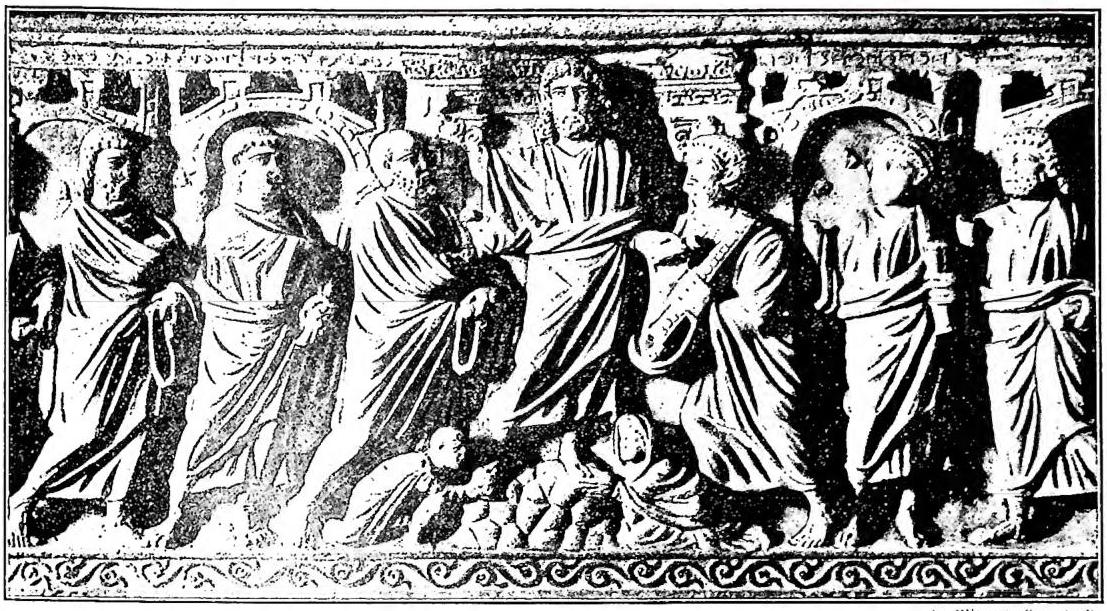
In ancient Christian art, the rite of adoratio, already used by the pagans toward the deities and later also toward the emperors, becomes a simple prostration, generally on one knee and often accompanied by a gesture of speech or greeting. This is how the saints behave when they appear before the judgment of God, and likewise the various figures (the Canaanite woman, the leper, the three Marys, etc.) whom the Gospel presents approaching Jesus in an attitude of adoration. Another form of adoration was the simple profound bow; this too occurs in ancient art, for example, in representations drawn from the Apocalypse. The kissing of the feet accompanied by profound prostration, seen on various ancient sarcophagi, combines the sentiment of adoration with that of the more general expression of profoundest respect. This has remained in the rite that is still, improperly, called the adoration of the newly elected Pope.Antonio Ferrua
ADORAZIONE: V. ORAZIONE.