
PRAYER. – Language of praise, invocation, or petition addressed by man to God.
CONTENTS:
I. Nature and definition
II. Psychology
III. Forms and degrees
IV. Necessity: moral obligation
V. Efficacy; qualities
VI. Object
VII. The prayer of the faithful (oratio fidelium)
VIII. Prayer among primitives
IX. The various types of prayer in non-Christian religions.I. NATURE AND DEFINITION
Prayer is the most spontaneous and elementary manifestation of the relationship between man and God; as A. Sabatier observes, it constitutes « the very soul of religion ». It takes on the most diverse forms, from the monosyllable to meditation, from the religious hymn to silent contemplation, from the liturgical formula to the spontaneous colloquy of the heart with God. There is no religion, however primitive, in which prayer does not occur.Some Fathers attempted to give a definition of prayer. St. Jerome (Ep. 140, ad Cyprianum: PL 22, 1168): « Oratio... pertains to prayers and supplications ». St. Gregory of Nyssa (De oratione Domini: PG 44, 1124): « Prayer is conversation and discourse with God, the overthrow of evils, the amendment of sins ». St. John Damascene: « Ascensus mentis in Deum », « petitio decentium a Deo » (De fide orth., III, 24: PG 94, 1089), the first of which emphasizes the effort the soul makes to detach itself from creatures and rise to God, the other highlights its character as a request. St. Augustine: « oratio tua locutio est ad Deum » (Enarr. in Ps. 85: PL 37, 1086), and elsewhere « Mentis ad Deum affectuosa intentio » and (Sermo 61: PL 38, 411): « oratio petitio quaedam est ». St. Gregory the Great (Moralia, 33, 23: PL 76, 701): « To pray in truth is to utter bitter groans in compunction and not to resound with contrived words ».
J. de Guibert and A. Fonck believe that among the three patristic definitions—request made to God, colloquy with God, elevation of the soul to God (pseudo-Augustine, St. John Damascene)—that of colloquy with God (St. Gregory of Nyssa; St. John Chrysostom cited by St. Thomas, Sum. Theol., 2ᵃ-2ᵃᵉ, q. 83, a. 2 ad 3ᵘᵐ) is the most closely aligned with the reality of the nature of prayer.
St. Thomas provides various definitions. In IV Sent., dist. XV, q. IV, a. 1, sol. 1: « Oratio rationis est actus applicantis desiderium voluntatis ad eum, qui non est sub potestate nostra, sed supra nos, scilicet Deus ». In Sum. Theol., 3ᵃ, q. 21, a. 1: « Oratio est quaedam explicatio proprie voluntatis apud Deum ut eam impleat »; in 2ᵃ-2ᵃᵉ, q. 83, he treats prayer extensively, making it dependent on the virtue of religion, hence « oratio proprie est religionis actus »; it is an act of practical reason: « petitio quaedam est » or also « ascensus mentis in Deum ».
Prayer may be defined, overall, with the Catechism of Pius X: « A pious elevation of the soul to God to know Him well, adore Him, thank Him, and ask Him for what we need ».
Particularly contested has been the prayer of petition as useless, with objections drawn from God’s prescience and omnipotence, which Origen (De oratione, 5-8: PG 11, 429-42) already refuted at length. Following in part the deists of the 18th century, who excluded any communication with God, modern philosophers reprove the prayer of petition, deemed by E. Kant unworthy because self-interested.
A book with a similar conception, by the Catholic O. Karrer, Gebet, Vorsehung, Wunder, was placed on the Index (18 March 1942) (AAS, 34 [1942], p. 100).
The Quietists opposed the prayer of petition « because asking is an imperfection, being an act of one’s own will and choice, and it is a desire that the divine will conform to ours rather than ours to God’s » (proposition 14 of Molinos, condemned by Innocent XI, 20 November 1687, as « temerarious, scandalous, impious... »). On 4 September 1687, an analogous proposition (the 36th) was condemned by the Holy Office (J. de Guibert, Documenta ecclesiastica christianae perfectionis studium spectantia, Roma 1931, pp. 272 sg., 291).
II. PSYCHOLOGY
F. Suárez (v. BIBLICA) poses the question: «Utrum oratio sit actus intellectus vel voluntatis?». In the Middle Ages, two schools divided the field. The voluntarists, with Ugo da S. Vittore (De modo orandi, cap. 1) and S. Bonaventura (In III Sent., q. 17, a. 1, q. 1 ad 3), considered prayer as an affective movement of the will. The intellectualists, with S. Tommaso (Sum. Theol., 2ᵃ-2ᵃᵉ, q. 83, a. 1, sed contra), saw in prayer an act of practical reason, which «est non solum apprehensiva, sed etiam causativa... sicut indicens et quodammodo disponens, et hoc modo ratio petit aliquid fieri ab his, qui ei non subjiciuntur, sive sint aequales, sive superiores».Required by the virtue of religion and falling within the duties of justice toward God are the interior acts of the two spiritual faculties: prayer, an act of the intellect, and devotio, an act of the will. After devotion, prayer holds the principal place among the acts of religion, because through it religion moves man’s intellect toward God (ibid., a. 3, ad 1ᵘᵐ).
After S. Tommaso, the meaning of prayer increasingly shifts, and prayer is understood not only as meditation (v.), affective orazione (v.), contemplation (v.). This broadening of meaning is already present in Scala claustralium sive tractatus de modo orandi, ca. 1145 (PL 184, 475-96). This occurs particularly in the 16th and 17th centuries, when meditation is incorporated into the concept of prayer under the name of mental prayer. Due to this expansion of the concept of prayer, the volitional element comes to accompany the intellective element, so that «the discrepancy between the Thomistic theory of prayer and the later one is not merely a question of terminology; there is also a difference in approach. But this does not imply a contrast in doctrinal substance» (M. Campo, Natura dell'orazione, in La p., Milano 1947, p. 22).
III. FORMS AND DEGREES
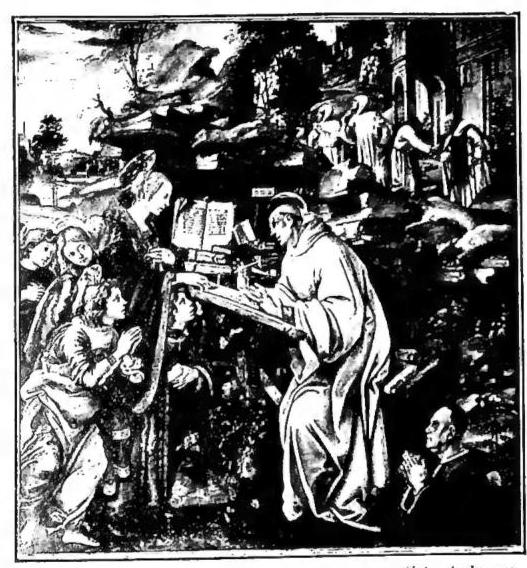
Prayer is adoration when directed to God as the supreme Lord and Governor of the world, which entails "the recognition in God of His most exalted sovereignty and in ourselves of the deepest dependence" (J.-B. Bossuet, Sermon on the Worship of God). It is also thanksgiving for the benefits received. It is a plea for divine assistance, and a plea for forgiveness for sins committed. Beyond these four classical forms of prayer, there is the prayer that is love, attraction, complacency that moves one to unite with God (N. Crou, L'école de Jésus-Christ, II, Paris 1923, p. 29: "l'amour doit être l'objet final ou même le sujet de sa prière"), and the prayer of abandonment to the divine will, which reaches its most perfect exemplar in that of Jesus on the Cross (Lk. 23, 46; cf. Iob 13, 15; I Reg. 3, 18). St. PaulPRAYER - The Virgin appears to St. Bernard. Painting by Filippino Lippi (1480) - Florence, Badia church.
Vocal prayer always presupposes an internal thought as its origin, according to the definition of Benedict XIV ("Oratio vocalis ea est quae voce exprimitur, ita tamen ut mens ori conjuncta sit"). The nobility of vocal prayer is underscored in Hebr. 13:15 ("Per Ipsum ergo offeramus hostiam laudis semper Deo, idest fructum labiorum confitentium nomini ejus"). A. Fonck endeavors to show that mental prayer is not superior to vocal prayer (DThC, XIII, col. 187 ff.). The giaculatoria (v.) is like a brief and fiery dart launched from the heart to God, and, as J. B. A. Landriot aptly notes (Instructions pastorales pour les saints temps de carême 1859-64, in Oeuvres, II, Paris 1866), it may present two forms: the aspiration or sigh directed to God from the depths of the soul without precise words, and brief formulated invocations. The best collection of giaculatorie is that of Cardinal Bona (Opuscula ascetica selecta, edited by Lehmkuhl, Freiburg i. Br. 1911, pp. 281-378; cf. L. De Grandmaison, in Revue d'ascét. et de myst., 2 [1921], pp. 132-37).
The legitimacy of vocal prayer, denied by the Enlightenment thinkers and Quietists of all ages, is proven by St. Thomas (In IV Sent., dist. XV, q. IV, a. 2; Contra Gent., III, c. 119; Sum. Theol., 2ᵃ-2ᵃᵉ, q. 83, 12; q. 91, 1): we must offer to God not only the homage of the soul but also that of the body, to stimulate our devotion and for the good example of our neighbor.
Vocal prayer can be private or public. Society as such must also pray; this applies to natural society but particularly to the supernatural society, the Church. Even the prayer of the Church recited privately, such Breviary (v.), is public; cf. AAS, 18 (1926), p. 79; 35 (1943), pp. 241 and 245. The prayer of the Church is essentially liturgical prayer, that is, "the solemn prayer of Christ, Head of the Mystical Body, together with His members who participate in the life of their Head" (E. Caronti).
IV. NECESSITY: MORAL OBLIGATION
Pelagius, at the beginning of the 5th century, denied the necessity of prayer; this was connected to the denial of the necessity of Grace: "he wants to discuss everything except prayer" (St. Augustine, De natura et Gratia, 18). His initial denial was later restricted, with the Pelagians recognizing that one may pray to have sins already committed forgiven, but not to obtain the grace not to commit them again. St. Augustine combated this doctrine throughout his life (Serm., 26, 2-3: PL 38, 171-72; De peccat. meritis et remissione, 1, 2, 2, n. 2: PL 44, 151; De perfect. iustitiae homin., 1 and 19: PL 44, 293 and 319).The necessity of prayer can be considered as a necessity of means or as a precept. Regarding the necessity of means, Suárez distinguishes between "necessitas simpliciter" and "necessitas ad melius esse," which strictly speaking is utility, "quae tamen tunc vocatur necessitas quando tanta est ut sine tali medio vix aut cum magna difficultate possit finis obtineri." Prayer is not necessary by necessity of means in the strict sense because such intrinsic necessity belongs to divine Grace alone (Suárez, op. cit., I, cap. 28, pp. 56-57). Absolutely speaking, there are other means to obtain Grace, e.g., good works, and in particular almsgiving, which have an impetratory value. It can be said to be necessary by necessity of means "ex divina lege et quasi ex pacto," writes Suárez (loc. cit., n. 2), as if God had issued a decree that man obtains the graces necessary for his salvation only through prayer? Generally, theologians answer affirmatively. St. Alphonsus M. de' Liguori (Il gran mezzo della p. [V. BIBLICA.], cap. 1) establishes that prayer is necessary for salvation by necessity of means, and adds, "the Scriptures are too clear in showing us the necessity we have to pray if we want to be saved"; he supports his assertion with Lk. 18:1; Mt. 26:41; Mt. 7:7, on the fact that without Grace we cannot do any good (Jn. 15:5) and that God grants the help of Grace, by ordinary providence, only to those who pray, on the authority of the saints, particularly Augustine and Thomas, and on the fact that "prayer is the necessary weapon to defend oneself from enemies, since... without prayer it is impossible to resist temptations and practice the commandments." L. Lessius (De iustitia, I, 2, dub. 3, n. 9) holds that "it cannot be denied, without erring in faith, that prayer is necessary for adults to be saved, as it is evident from the Scriptures that it is the only means to obtain the aids necessary for salvation."
St. Augustine (De dono persec., 16, 39: PL 45, 1017) with the assertion "Cum constet alia Deum danda etiam non orantibus sicut initium fidei, alia non nisi orantibus praeparasse, sicut usque in finem perseverantiam" establishes the limits of such necessity of means in the order of graces indispensable for salvation, which does not exclude that sometimes God may grant them even without any prayer: "quis enim hominum ostenditur orasse pro Petro, ut daret ei Deus perseverantiam, qua se negasse Dominum flevit?" (De correptione et Gratia, 5, 8: PL 44, 920). The necessity of means of prayer emerges from the necessity of Grace to observe the divine law (St. Augustine, Enarrat. in ps., 118, 27: PL 37, 1581; De Gratia et libero arbitrio, 14, 28 and 16, 32: PL 44, 898 and 900); the Augustinian principle "Vere novit recte vivere, qui recte novit orare" (Serm., 55 [in appendice], 1: PL 39, 1849) is well known. Since only through prayer does one receive the Grace required to observe the divine law (id., De Gratia et libero arbitrio, 14, 28: PL 44, 898): "Non igitur Deus impossibilia iubet sed iubendo admonet et facere quod possis et petere quod non possis" (id., De natura et Gratia, 69, 83: PL 44, 288 ff.); the same necessity is asserted by St. Augustine for overcoming temptations (Confess., II, 1-2 and VIII, 11: PL 32, 675 and 761; Serm., 20, 3: PL 38, 39), against concupiscence (Serm., 57, De oratione Dominica ad competentes, 9: PL 38, 391). Finally, Grace is particularly necessary to obtain final perseverance (De dono perseverantiae, 16, 2: PL 45, 1017).
It is therefore evident that there is a moral obligation to pray. Christ has shown man that prayer is obligatory because it is necessary (Suárez, op. cit., I, cap. 28, n. 4). Beraza (Tract. de virtutibus infusiis, Bilbao 1939, p. 724) specifies
That this positive-natural divine precept—excluding liturgical prayer—imposes no determination of time, place, or manner for private and individual prayer. The Messalians, Euchites, and Acemetae interpreted the evangelical words "oportet semper orare" as a necessity to pray constantly. Suárez (op. cit., I, ch. 30, n. 8), following St. Thomas (In IV Sent., dist. XV, q. 9, a. 1, q. 3), asserts: "praeceptum hoc... non afferre secum certam et claram temporis determinationem." He holds that prayer must be made "aliquoties in vita" and adds: "credo tamen tam necessariam esse orationem ad rectitudinem vitae, ut non sit permittenda dilatio unius anni, nec fortasse unius mensis" (n. 16). Giovanni da San Tommaso (Cursus theol. in Summam D. Thomae, VII, q. 83, disp. 21, a. 3, n. 37), and later A. Vermeersch, reject the efforts of some theologians to make the obligation of prayer at least weekly, qualifying it as a "negativum religionis praeceptum" with the tenor: "orare ne contemnas neve positive negligas." According to St. Alphonsus, the precept to pray obliges in at least three cases: when one is in mortal sin, when in grave danger of sinning, and when in grave danger of death (cf. Sum. Theol., 3°, q. 39, a. 5).
In general, theologians do not recognize a strict obligation for Christians to pray vocally, since, as St. Thomas admits, prayer can be made "et voce et sine voce," according to the convenience of the one praying (In IV Sent., dist. 15, q. 4, a. 2, sol. 1). Thus, as individual prayer, "ex vi iuris naturalis oratio vocalis non est sub praecepto" (Suárez, op. cit., I, III, ch. 6, nn. 3, 9-12). Nor does any ecclesiastical precept oblige the recitation of the Pater Noster, Ave Maria, or other vocal prayers during attendance at Sunday Mass. Regarding Lk. 18:1 "oportet semper orare et non deficere" and 1 Thess. 5:17 "sine intermissione orare," St. Thomas observes: "tamdiu homo orat quamdiu totam vitam suam in Deum ordinat" (Comment. in Rom., I, lez. 5), and St. Augustine: "Si ergo laudas, non tantum lingua canta, sed etiam assumpto bonorum operum psalterio; laudas cum agis negotium, laudas cum cibum et potum capis, laudas cum in lecto requiescis, laudas cum dormis, et quando non laudas?" (In Psalm. 146). An excellent way to transform a life of action into prayer is the practice of the presence (v. PRESENZA) of God (cf. J.-N. Grou, op. cit., lez. 35: De la prière continuelle).
V. EFFICACIA; QUALITÀ
Prayer has three wondrous effects: 1) detachment from creatures insofar as they are obstacles to our union with God, with the consequent hatred of sin and imperfections; 2) union with God, which is accomplished through all human faculties; 3) the progressive transformation into God, as God inclines toward us and communicates His Graces. Pius XII, in the encyclical De Corpore Mystico Christi, recalls "il mistero tremendo, non mai sufficientemente meditato... che la salvezza di molti dipende dalle preghiere e dalle volontarie mortificazioni a questo scopo intraprese" (AAS, 35 [1943], pp. 193-218).St. Thomas (Expositio orationis Dominicae) enumerates five qualities that prayer must possess: "secura, recta, ordinata, devota, humilis"; in the Summa Theol., 2a-2ae, q. 83, a. 15, he instead lists seven: "perfecta, humilis, continua, devota, vigilans, instans et charitativa." N. Grou (op. cit., lez. 32) requires that prayer be "attenta, umile, rispettosa, amorosa, fiduciosa, perseverante."
On perseverance as a quality of prayer, Cornelius a Lapide insists, following the teaching of St. Augustine (Serm., 61, ch. 5) and St. John Chrysostom (In Gen. hom., 30: PG 53, 273) (cf. Beraza, op. cit., p. 1425). The impetratory value of prayer is infallible if it meets the following conditions: 1) that one prays for oneself (St. Augustine, In Ioh. tract., 73 and 102: PL 35, 1824-1906; St. Thomas, 2a-2ae, q. 83, a. 15; St. Bonaventure, In II Sent., dist. 27, a. 2, q. 1); Suárez, however, considers "satis pia et probabilis" the opinion that this condition is not necessary (op. cit., I, ch. 27, n. 2), and he is followed by Cornelius a Lapide, Toledo, Habert, and St. Alphonsus (op. cit., ch. 3). A. Vermeersch notes that Scripture asserts that every prayer is effective and recommends prayer for others; therefore, efficacy also pertains to prayer made for others, provided the others do not place a positive obstacle. 2) That one asks for honest and good things; 3) that what is asked does not impede a greater good of the soul; 4) that the prayer is pious, that is, proceeds from the supernatural principle of Grace, faith, and firm hope (confidence); 5) that the prayer is persevering. It is debated whether prayer made collectively for many obtains for individuals as much as it would if made for them individually. Several theologians hold that it is less effective (cf. St. Thomas, In IV Sent., dist. 45, q. 2, a. 4, 2; Suárez, op. cit., I, ch. 27, n. 5).
BIBL.:
A. Vermeersch, Theologiae moralis principia, Roma 1944; J.-N. Grou, Manuel des âmes intérieures, Paris 1855; J. de Guibert, Theologia spiritualis ascetica et mystica, Roma 1937; A. Tanquerey, Synopsis theologiae dogmaticae, Paris 1930; A. Beraza, Tractatus de virtutibus theologicis, Bilbao 1946; F. Suárez, De oratione, in Opera omnia, Paris 1856-1861; S. Tommaso d'Aquino, Summa Theologiae, Roma 1948-1950; S. Alfonso de' Liguori, Homo apostolicus, Roma 1759.
A. M.
VI. OBJECT
The only subject capable of prayer is the intellectual creature, that is, in addition to men living on earth, also the angels and the saints reigning in heaven, who, however, cannot intercede for themselves but for men on their earthly journey (viatores) (Sum. Theol., 2a-2ae, q. 83, a. 11). The souls in purgatory can pray for themselves and probably also for the living. Among viatores, both the just and sinners can and must pray.To pray in a manner acceptable to God, the state of Grace is not absolutely necessary (Sum. Theol., 2a-2ae, q. 83, a. 16, and Quaest. disp. de potentia, q. VI, a. 9, ad 5um; cf. Suárez, op. cit., I, cap. 8, n. 9). The damned cannot pray. It is debated whether Christ, reigning in heaven according to His human nature, can pray. Some theologians affirm this, basing it on Io. 14:16; I Io. 2:1; Rom. 8:39; Hebr. 7:25.
Through prayer, one can ask God for temporal and spiritual goods. St. Thomas establishes the principle: « Nihil debemus petere in oratione nisi in ordine ad beatitudinem » (Sum. Theol., 2a-2ae, q. 83, a. 4). Thus, one should primarily ask God for union with Him (ibid., a. 1, ad 2um), spiritual goods (eternal life, sanctifying grace, the aids of actual grace, various virtues, etc.) « determinate et absolute » (Billuart, Cursus theologiae, VII, disp. II, a. 5a, col. 198). Temporal things (fortune, physical health, intellectual capacity, knowledge, etc.) may be requested « considerare non quidem principaliter sed ut necessaria » and « conditionate, scilicet si saluti expediant » (St. Thomas, ibid., a. 6). The Pater Noster (v.) perfectly encompasses every object of our prayer, so that for the Christian « non debet esse liberum alia dicere » (St. Augustine, Epist., 130, 12, 22).
One must first pray to God, but it is also licit and useful to pray to the Virgin and the saints (v.) and the angels reigning in heaven. Can the souls in purgatory be invoked and prayed to? The Church, officially, does not address any prayer to them. Theologians are divided: while St. Thomas (In IV Sent., dist. 15, q. 4, a. 5, quest. 2; Sum. Theol., 2a-2ae, q. 83, a. 4, ad 5um) and other theologians deny it, Medina (Codex de oratione, qq. IV, V), Suárez (op. cit., I, cap. 10, nn. 25-28), Bellarmine, Gotti, and especially St. Alphonsus (Il gran mezzo ecc. [V. BIBLICA.], 1) admit II. Billuart observes (op. cit., t. VII, disp. II, a. 6a) that one must pray not only for oneself but also for all other living men, none excepted. One must also pray for the souls in purgatory. One cannot pray for the glorified saints or for the damned souls. God willed man to be a social being; prayer cannot but assume a social aspect, one of transcendent sociality, insofar as the holy riches accumulated as a treasury of merits: « ad omnes pertinent » (Catechismus Rom., p. 1a, a. IX, n. 119). Indeed, every prayer made by a member of the Mystical Body of Christ is an increase of the « thesaurus Ecclesiae ». The power of impetration and satisfaction of prayer is placed at the disposal of the Church (cf. R. Gräf [V. BIBLICA.], p. 55).
VII. THE PRAYER OF THE FAITHFUL (oratio fidelium)
This is the prayer recited in common by Christians during their gatherings, after the reading of the Gospel and the sermon of the officiating bishop, and concluded with the exchange of the kiss of peace. Only the baptized, that is, the faithful, were present, with the catechumens dismissed. In it, the various categories of people and the ordinary needs of the universal Church were successively mentioned. The officiating bishop improvised or recited the prayer on behalf of those present, prefacing it with a brief invitatory formula: « Oremus pro... » and indicating the intentions to be given to the prayer; the deacon intervened only to give the faithful the order to kneel.According to the admonition of St. Paul (I Tim. 2:1), this prayer has been in use since the earliest times, perhaps already hinted at by Clement I in his letter to the Corinthians, and later described by Justin (Apol., I, 65, 1), Tertullian, Cyprian, Hippolytus of Rome, and Augustine. For the Roman Church, it is attested by Boniface I (418-22) and Celestine I (423-32); the term oratio appears for the first time in a letter of Felix II (III) in 488. In the Churches of Gaul, the same formulas as those of Rome were perhaps in use, as attested in the Capitula of St. Prosper of Aquitaine (d. 440). A codicil of the Council of Lyon in 517 alludes to the « oratio plebis quae post Evangelium legitur ».
The Roman and Gallican forms are exemplified in the "Solemn Prayers" of Good Friday, a text which, according to citations by St. Prospero of Aquitaine, was already in use in Rome by the 5th century and even by the end of the 4th. Some invocations in these prayers seem to date back to the time of Celestine I, attested in an older account in his letter to the bishops of Galilee. Still in use in Rome under Felix II-III (483-92), they later disappeared from the ordinary liturgy and remained in use only, as today, on Good Friday; in the Middle Ages, also on the preceding Wednesday. In Gaul, after the Council of Lyon in 517, the sacramentaries no longer preserve any trace of them. At this time, another form came into use, the "diaconal" litany (distinct from the so-called oratio fidelium), so named because the deacon pronounced the invocation and intention, and the people responded with the acclamation "Kyrie eleison." First arising in Antioch in the 4th century, the practice later spread to Constantinople, from where it passed into the Latin liturgies. The "Kyrie eleison" of the Roman Mass and the Office is its direct derivation, as are the two Ambrosian diaconal litanies for the Sundays of Lent and the various "preces" of a penitential character preserved in Mozarabic books. Introduced into the Latin Mass by Gelasius I (492-96), the new litanic prayers, before the readings, led to the abandonment of the traditional oratio fidelium, perhaps also due to the development of offertory rites and chants. However, even the deprecatio Gelasii papae disappeared, leaving as its sole vestige the "Kyrie eleison." Nevertheless, a reminiscence and final evolution of this ancient oratio is found in the form of particular recommendations enunciated by the celebrant, mentioned by Regino of Prüm (d. 915) in De ecclesiasticis disciplinis, I, 290 (PL 132, 224). Before the sermon, the celebrant invited prayer for various needs and categories of people: these are the first indications of the "prono" (from praecorium), in use throughout the West in the Middle Ages. Similarly, in the 12th century, Honorius of Autun (Speculum Ecclesiae: PL 172, 827) speaks of a litany by the priest after the sermon; to each invocation, the people responded with "Amen" and at the end with "Kyrie eleison." In Germany, the so-called "common prayer" ("Allmächtiger, ewiger Gott") was recited, the text of which was composed by St. Peter Canisius. A similar prayer was also recited in the diocese of Turin at the beginning of our century; the priest exhorted or invited prayer to "His Divine Majesty for the state of the universal Mother Church and in particular for our Holy Father the Pope... for all Christian people..., for perseverance... penance, for the fruits of the earth, etc."
VIII. PRAYER AMONG PRIMITIVE PEOPLES
Prayer is a general religious manifestation among primitive populations. Prayer has also been found among sacrifice (v.). The number of populations belonging to original cultures among whom prayer has not yet been found is minimal and legitimately suggests that this absence is not real but due to insufficiently in-depth studies.Prayer among the Andamanese is not known, though they practice the sacrifice of firstfruits. However, it is difficult to conceive of an offering not accompanied by prayer, at least mental. Of the Koryaks, only prayers linked to sacrifices are known. The Alakaluf do not make impetratory prayers but other forms of prayer. It was once believed that prayer was absent among the most archaic Australian populations (southeastern group), but prayers have since been found both in the mythology of these populations and in the most solemn ceremonies of the tribe, which are the initiations of the young (v. INITIATION, II. I. of youth).
The Kurnai (New South Wales) recount that in ancient times, one of their tribe revealed the secret of initiations to women. This greatly angered the Supreme Being Mungan ngaua (meaning "our father"), who, with his fire, the southern aurora, caused a great fire that filled all the space between heaven and earth, so that men lost their senses and slaughtered one another; then the sea flooded the land, and few were saved. Since then, the Kurnai fear the southern aurora so much that when it appears, they supplicate: "Send it away, let it not burn us!" Howitt does not say to whom this prayer is directed; from the context, it seems addressed to the Supreme Being because he once sent the southern aurora.
The Kamilaroi, Wiradjuri, and Euahlayi (New South Wales) recognize a Supreme Being called Baiame. The Kamilaroi recount that once a medicine man ascended to heaven to ask Baiame for graces for his people. The medicine man of the Chepara also ascends to heaven at night to obtain from the Supreme Being Maamba all good for his people. During the initiation ceremony of the young Wiradjuri, the chief of the medicine men withdraws for a time, then returns and tells those present that he has been, for their good, in the residence of Baiame, which is in heaven. The Euahlayi report that Baiame is the creator; however, he does not wish to be disturbed from the rest he enjoys after his earthly labors, so they consider it madness or an insult to pray to him every day and supplicate him only in particularly grave and solemn circumstances. Among the same Euahlayi, during the initiation ceremony called boorah, the eldest of the tribe turns toward the east, the direction in which the dead are buried, and repeatedly supplicates Baiame to grant a long life to those present because they have been obedient to his commandments and have practiced the ceremonies. The Euahlayi also attribute particular efficacy to the prayer of an orphan who, facing the sky, asks Baiame for rain, crying: "Water, fall! Water, fall!" The same natives have a clear concept of sanction: during burial, they address prayers to Baiame for the souls of the dead (Parker). The good, after death, go to heaven where Baiame resides. He is merciful: he shortens a punishment (illness) on earth and, through the intercession of his son, allows even those who have not been entirely good to enter heaven. The Yuin (southern coast of Australia) also believe that after death, the good go to heaven where the Supreme Being resides. According to an ancient source (James Manning), the southern Wiradjuri also pray beside the tombs of the deceased so that Baiame may take them with him to heaven. The Warramunga (Northern Territory, Australia) greatly fear a giant serpent called Vollunqua, who lives in a cave from which he occasionally emerges to devour men. When they approach this cave, they supplicate him not to harm them. The prayers that have been reported (especially those that K. Langloh Parker records in her monograph on the Euahlayi) have been contested by evolutionist ethnologists, particularly by R. R. Marett. But A. Lang has validly defended them as authentic, and P. Schmidt is of the same opinion (see the discussion in Man, London, 7 [1907], nn. 2, 28, 42, 61, 62, 72, and the entry God by A. Lang, in Enc. of Rel. and Eth., VI, pp. 243-47). Parker rightly observes that the prayers she reports cannot be due to the influence of Protestant missions (there are no Catholic missions in this territory) because her observations on the Euahlayi predate the founding of the mission, and her source was an elder. It should also be added that Protestants generally do not admit purgatory and do not pray for the dead. Therefore, it would be difficult to attribute teachings on this particular aspect of prayer to missionaries. Opposition to these facts is instead rooted in the evolutionist preconception that the populations of Australia were the crudest on the scale of religious evolution and therefore without prayer. This preconception has unfortunately influenced even excellent explorers and missionaries, so it is possible to wonder whether investigations conducted objectively might not have revealed a greater number of prayers among these populations, now largely extinct.
Far more numerous are the prayers, both isolated and linked to sacrifices, collected among primitive populations in other parts of the world. Isolated prayers are spoken or conceived even only mentally. Prayer is related to the joyful or sorrowful circumstances of life and can be addressed to: 1) the Supreme Being; 2) personifications of certain qualities of the Supreme Being: e.g., to the spirit of thunder and the rainbow, or to rather vague figures that personify creation, the preservation of man, the power to send death, etc.; 3) spirits of various kinds that populate nature, created by animism; 4) divinized deceased (especially the ancestor); 5) earthly deities and, in more recent cultures, also to fetishes.
The Supreme Being is always conceived as good; the other religious figures may be either benevolent or malevolent.
Prayer among these populations often simultaneously invokes all beings that receive worship. When the Dinka (Anglo-Egyptian Sudan) have a good harvest, they offer a thanksgiving sacrifice to the Supreme Being Nhialic, who provided the rain. The sacrifice is accompanied by this prayer: «Nhialic, listen to your children and hear their words; we are like insects before You, and you, totems, and you, spirits, unite with Nhialic (and listen with him to our words)».
The most frequent prayers concern the necessities of daily life and express a concrete and immediate need of the one praying—for themselves, their family, kin, friends, or village: difficult situations, deliverance from illness, epidemics, and misfortunes, the desire for offspring, livestock, a good harvest, abundant hunting and fishing spoils, protection in dangers, victory in war. These prayers are generally brief, spontaneous, not bound to a fixed formula, and often accompanied by a gesture or bodily movement that expresses the supplicant’s state of mind: lament, entreaty, emotion, sorrow, indignation, joy, gratitude, anger, passion. The Acioli say: «In all their needs, they invoke Lubanga or think of him; however, there are no fixed formulas nor teachings on prayer;... each asks for what they desire;... each says what comes to their lips. Prayer comes spontaneously; no one teaches it to children; if you strike a child, they immediately begin to cry without anyone having taught them.»
Laments: «He gave me a child only to take him back!» «It has been the second year that I am alone!» (laments of a mother and a widow to Wataninena, the Supreme Being of the Yamana, Tierra del Fuego). The lament may also be accompanied by a gesture of despair. Sometimes the Acioli, upon the death of a child, seize a spear and shake it forcefully, as if suddenly confronted by an enemy, expressing the desire to strike the Supreme Being if they could see him. They cry: «Lubanga, you are evil! Why do you kill my children?... Lubanga, why did you make (create) this child? If you did not want to, you should not have let me see his eyes!»
Requests are frequent: the Shilluk (Anglo-Egyptian Sudan) in all life’s needs turn directly to Juok. «Juok, help me!» is a common expression. The Mao of Ethiopia pray thus to their Supreme Being: «Veretti, as You make the grass grow, so grant... that our children grow healthy and our harvests are not destroyed.» Among the Nuer (Anglo-Egyptian Sudan), when once a year the cattle must cross the Nile to change pastures, the sorcerer spends the previous night performing the necessary rites to ensure a safe passage, and in the morning offers this prayer: «O God, it was You who said that I should be the sorcerer, that I should practice magic and enchant the crocodile. The cattle have no more grass; let them cross the river and graze on the other bank. O God, You created the cattle with which man must nourish himself; let them pass safely to the other side.» The Shilluk, when going hunting or fishing: «Lord, I am here to pray to You; why do You not help us? Who can command You? Did You not make men? If You take life (which is Your right), that is Your affair.» The Dinka pray to Nhialic to heal a person: «Save him; he is good and never harmed anyone!» The Negritos during a downpour: «Have mercy on me and stop the rain, for we are truly poor and our hut is not sturdy!»
Expressions of thanksgiving are also frequent: «Thank you, my Father, for being benevolent toward me today!» Thus the Yamana give thanks after an abundant hunt or fishing. Speaking of the joy of spouses who have had children, an elder Acioli expressed himself in these terms: «When they enter the house, their hearts rejoice at the sight of the children that Lubanga has given them.»
There are also prayers that embrace people outside the family and village. During sacrifices to the Supreme Being, the Dinka sorcerer says, and the people repeat: «Our Nhialic, we do not hate anyone on earth; no one hates another; if someone hates me, I love them; if someone loves me, I also love them.» This prayer is particularly noteworthy because it expresses the dispositions necessary for the sacrifice to be accepted, namely, not harboring hatred even toward those who do harm.
Populations in America, Africa, and perhaps other regions pray before and after meals, or only before. Those who pray regularly in the morning and evening are much rarer (v. Supreme Being).
Generally, this form of prayer is isolated, but sometimes it is combined with a kind of first-fruits offering. Some groups of Algonquins (Montagnais) do this: before beginning to eat, they throw a bit of food into the fire and observe the smoke that rises.
Various populations of North America (Lenape, Arapaho) and others periodically celebrate ceremonies, sometimes lasting several days, during which they repeatedly pray to the Supreme Being. Some of these ceremonies are sacred representations of creation, with recitative and dramatic parts of the myths concerning primordial times.
In totemic culture, magic, founded on the irrational, almost completely replaces religion. And thus prayer dies and is replaced by the magical formula, with which one believes they can even overcome the deity.
primitivi, in Storia delle religioni. Letture pubblicate sotto la direzione di C. C. Martindale, 5 voll., Firenze [1921]; F. Heiler, Das Gebet, 5ª ed., Monaco 1923; trad. francese: La prière, Parigi 1931; W. Koppers, Unter Feuerland-Indianern, Stoccarda 1924; id., Gottesglaube und Gebete der Yamana auf Feuerland, Düsseldorf 1926 (le preghiere degli Yamana riferite dal Koppers sono riportate da R. Boccassino, La religione dei primitivi, in P. Tacchi Venturi, Storia delle religioni, 3ª ed. Torino 1949); F. S. Magagnotto, Dal fiume delle gozzelle, Padova 1926; W. Schmidt, Der Ursprung der Gottesidee, Münster in V. 1926-30 (finora 9 voll.; opera fondamentale); id., L'importanza dei Galla per l'Etiopia e l'Africa orientale, in Atti dell'VIII Convegno Volta (Reale Accademia d'Italia), Roma 1940; R. Huffman, Nuer customs und folk-lore, Oxford 1931; I. P. Crazedara, Beiträge zur Kenntnis der Religion und Zauberei bei den Schilluk, in Anthropos, 27 (1932); R. Boccassino, Alcune notizie sui Dinka (Sudan Anglo-Egiziano), particolarmente sulla loro religione, in Annali del R. Istituto superiore orientale di Napoli, 8 (1933); id., La mitologia degli Acioli dell'Uganda sull'Essere Supremo, i primi tempi e la caduta dell'uomo (con testi), in Anthropos, 33 (1938); id., I Nilotici settentrionali, in R. Biasutti, Le razze e i popoli della terra, II, Torino 1941; id., La p. degli Acioli dell'Uganda (con testi), in Annali Lateranensi, 13 (1949), (contiene ca. 300 p. di questa popolazione, nel testo indigeno, con traduzione e commento); V. L. Grottanelli, I Mao, Roma 1940; M. Schulien, La p. presso i popoli primitivi; id., La p. presso i primitivi a cultura più antica; id., La p. presso i primitivi, in L'osservatore romano, 5 apr. 1942, 2 e 30 dic. 1945. Varie voci dell'Hastings, in Encyclopedia of Religion and Ethics, 12 voll., Edimburgo 1908-21, trattano della p. nei vari popoli V. E. N. Fallaize, Prayer (Introductory and Primitive), pp. 154-58. Le voci di quest'Enciclopedia contengono una larga informazione, ma risentono spesso l'influenza dell'evoluzionismo.
Renato Boccassino
IX. VARIOUS TYPES OF PRAYER IN NON-CHRISTIAN RELIGIONS
In these, prayer may be expressed not only through words but also through gestures and movements that mimetically convey the request or the desire to avert something: it is known that dance originally constitutes prayer in action. To this primitive stage may be traced those instances of the materialization of prayer that consist in physically perpetuating the act or the formula of the supplicant, such as, for example, the custom of hanging a scrap of cloth on a tree or casting a stone near the place where one has prayed, as practiced by Muslims in Syria and Africa; or of making a cylinder inscribed with sacred formulas rotate by water, hand, or wind, as done by Tibetan Lamaists: each rotation earns the merit of a prayer actually recited.The concept of prayer excludes the magical formula because the latter does not implore but seeks to compel, through the power of gesture and word, the powers to which it is directed, and is used by a sorcerer, not by the representative of the community, for individual and often harmful purposes, not for the social good.
In non-Christian religions, prayer is distinguished into three main types:
a) a utilitarian prayer, of contractual type according to the formula do ut des, in which the supplicant promises gifts to the deity in exchange for the goods requested. This type is the most widespread among primitive populations and is also the most commonly used by persons of limited inner elevation. Thus, the Negritos Ianeg offer a portion of the wild boar killed in the hunt, saying: «O Lord, we offer you this so that you may be benevolent and give us a boar.» A most effective example is the prayer to the Parcae made during the Secular Games of 17 B.C., in which Augustus offered nine goats and nine lambs to the Parcae, asking in return for the increase of the power and glory of the Roman people.
b) The second type of prayer is intermediate (Heiler calls it «prophetic»); it presents itself as a noble evolution of the preceding type and ultimately becomes a distinct type, most suited to the average human spirit. In this form, the supplicant conceives the deity as morally most elevated, not corruptible by promises or enticing offerings: he therefore lavishes praise on her perfection and mercy, feels his own misery and unworthiness, and after this sincere captatio benevolentiae asks for the things necessary to his material and spiritual life: the Pater Noster is the unsurpassed and unsurpassable model of this second type of prayer.
c) Mystical prayer constitutes the third type, which is the privilege of few. In it, the supplicant, forgetful of all that may serve the sustenance of his material life, strives for union with the deity through the annihilation of individual will and desire. This third type of prayer is not found in natural religions, which, in their rites and formulas, express only the fundamental needs and aspirations of the group, but in the great historical religions that arose as a reform or sublimation of previous religious schemas, for only in this type is there an exalted concept of the deity, a corresponding ethical code, and the religious duty conceived as faithful adherence to a most perfect God or as assimilation to Him through the charisms of sacrificial action. Thus, mystical prayer is found in supranational or universal religions: Judaism, Islam, Christianity. An example of mystical prayer in the 2nd century of the Empire is found in the prayer to Isis formulated by Apuleius of Madaura in chapter 25 of book XI of the Metamorphoses. In it, the protagonist Lucius, restored by the goddess Isis from asinine to human form, after the most enthusiastic praises of the goddess, declares that he does not feel worthy to sing her praises, but that «he will engrave the divine countenance of her in the secret of his heart and keep it guarded there in perpetuity.»
Form of Prayer. - 1. The typical form of prayer is that which the Latins called precatio and Christianity calls oratio, that is, a formula of praise or request, or a mixture of both, directed to the deity, preceded by the invocation of the name; if made by the priest in the name of the community, the latter responds with a formula of assent (amen, so be it, etc.). Prayer takes on a more social character when it assumes the form of a litany (from λιτανεία = I pray, I beseech), whether it glorifies the deity with various titles or enumerates the different needs in which the community finds itself. In both cases, there is a leader who proposes the praise or presents the request, while the community responds with a phrase of consent to the proposed concept; often it is associated with processional deambulation (v. PROCESSIONE).
The ejaculation (from eiaculari, «to hurl») is a brief formula, often laudatory, directed toward the deity. Due to its brevity, its invocatory form, and the ease with which it is remembered and repeated, it can, more readily than other forms of prayer, assume a magical meaning and be used as a powerful incantation against the evil eye and evil spirits. Typical examples are the formula: «Om mani padme hum—O jewel in the lotus, amen» of Tibetan Buddhism; the first sūrah of the Qur’an and the Muslim profession of faith, which is repeated up to thousands of times, sometimes provoking, when associated with rhythmic movements of the head and body, a state of exaltation.
2. Psalmody. - This is a rhythmic prayer, of solemn character, in which the community expresses to God the various sentiments of the soul, especially on the occasion of the various feasts of the religious year. It is generally recited alternately in a consecrated place. It is the typical liturgical prayer of Judaism, largely adopted also by Christianity. A psalmodic form was assumed in Babylon by the so-called penitential psalms.
3. The Hymn. - It belongs to the same category as the psalm, but its structure is more agile and, in origin, it is intimately associated with sacred dance. A typical example of a danced hymn is that of the Curetes of the pre-Hellenic religion of Crete (Palaikastro); and the poem composed by Horace on the occasion of the Secular Games of 17 B.C. In Christian liturgy, the hymn, written with agile meter and set to more vibrant music, serves to summarize the characteristics of the feast being celebrated.
4. The Gesture of Prayer. - This naturally varies according to peoples and the nature of the ceremony. In general, it can be affirmed that two gestures are most universally used among peoples who have a constituted liturgical prayer: a) the elevation of the hands toward the sky or toward the simulacrum of the deity; b) prostration on the ground or at least the bending of the knees. Christianity recognizes both these modes of adoration. Among Muslims, prayer includes a somewhat gymnastic set of movements, among which are both prostration and the elevation of the hands. For orientation in prayer,